Key Takeaways
- Clear ice is mostly a freezing-method outcome, not a mold-only outcome. Directional (typically top-down) freezing pushes air bubbles and dissolved solids into a sacrificial bottom layer, which is why an insulated, open-top clear sphere ice maker design outperforms a plain open tray.
- Silicone is the most forgiving mold material for large cubes and spheres: it releases cleanly, and food-grade silicone is rated from -40°C to 240°C (-40°F to 464°F) with no odor [K5].
- Judge a large ice cube maker by cavity geometry, seam lines, lid fit, freezer clearance, and batch capacity before comparing price.
- For branded or private-label ice, custom silicone ice molds are an OEM/ODM project with defined stages: cavity design, shape, size, color, logo, and packaging [K1], followed by tooling, sampling, and inspection [K3].
- Confirm current availability, material composition, dimensions, certifications, MOQ, and lead time with the manufacturer before publishing product claims or issuing a quotation [K4].
1. Introduction
A cocktail is only as good as its ice. A large, dense cube chills a drink slowly and dilutes it less; a clear sphere looks like glass and melts at a controlled rate instead of collapsing into slush in ten minutes. Yet most home bartenders hit the same wall: the ice comes out cloudy, cracked, or welded to the mold, and it tastes faintly of the freezer.
The problem is usually not the recipe. It is the combination of water, freezing direction, and mold design. Cloudiness is trapped air and dissolved minerals; cracking is thermal stress; sticking is a demolding problem. Each has a fix, and each fix maps to a specific piece of equipment — which is exactly where a clear sphere ice maker and a large-cube mold differ from the trays sold in supermarkets.
This guide explains how clear ice actually forms, compares the mold materials used for large cubes and spheres, gives a buyer checklist for evaluating equipment, and outlines what a custom silicone ice mold project looks like when a bar, brand, or retailer wants its own shape, logo, or packaging. It is written for people who want to make a purchasing decision — not to collect trivia.
2. How Clear Ice Forms — and Why Mold Design Decides the Result
Core conclusion: clarity comes from controlling where impurities end up, not from filtering water harder.
When water freezes, air and dissolved solids are pushed ahead of the advancing ice front. In a normal tray, the cube freezes from all sides at once, so those impurities are trapped in the center of each cube — visible as a white, cloudy core. In a directional freezing setup, the mold is insulated on the sides and bottom and left open at the top. Cold air reaches the top surface first, so ice grows downward in a single direction, sweeping bubbles and minerals into the last unfrozen water at the bottom. You then discard that cloudy bottom layer.
This is the mechanism behind most "clear sphere ice maker" designs on the market:
- An insulated lower shell slows freezing from the sides and bottom.
- An open or vented top allows one freezing front to advance downward.
- A flexible cavity lets you release the finished sphere without cracking it.
- A slight overflow or reservoir gives the expanding ice somewhere to push displaced water.
Practical scenario: if your current tray produces cloudy cubes, changing the mold alone may not be enough. Combine three things — clean water (filtered or boiled and cooled, which reduces dissolved gas), a directional mold, and patience. A slow freeze at a steady freezer temperature produces better clarity than a fast freeze; budget a full overnight cycle, often longer, depending on sphere diameter and freezer temperature.
For a manufacturing view of mold structure, branding, and production planning, review RENJIA’s custom silicone ice mold manufacturing capabilities.
Boundary condition: directional freezing trades clarity for time. If you need volume quickly, a large-cube mold used conventionally will produce usable, slightly cloudy cubes far faster than a sphere system designed for clarity.
3. Choosing a Large Ice Cube Maker: Material Comparison
Core conclusion: silicone wins on release and durability; rigid materials win on straight edges and sharp corners. The right choice depends on whether you prioritize appearance, speed, or cleanup.
| Mold material | Clarity potential | Demolding | Edge sharpness | Best for |
|---|---|---|---|---|
| Food-grade silicone | High when paired with directional freezing | Excellent — flexes away from the cube | Slightly soft / rounded | Home bars, spheres, custom shapes, private-label products [K5] |
| Rigid plastic (PP/PC) | Moderate | Moderate — often requires twisting and warm water | Sharp | High-volume budget trays |
| Metal (aluminum/stainless) | High | Can be difficult; ice adheres | Very sharp, fast chilling | Production kitchens with release tooling |
| Insulated silicone + rigid shell | High | Very good | Good | Directional-freezing sphere and large-cube systems |
Two material facts matter for anyone sourcing silicone molds at scale. Verified public specifications for food-contact silicone list: food-grade, odorless, temperature resistance from -40°C to 240°C (-40°F to 464°F), custom sizes available, and customization options covering custom colors, custom sizes, custom shapes, and custom packaging [K5]. Odorless matters more than it sounds: a mold that absorbs freezer odors will quietly ruin every drink you make with it. The wide temperature range also means the same mold can go from freezer to warm-water release without distortion.
Practical advice: test a new mold with plain water and a full overnight freeze before committing to a brand order. Check three things — how easily the cube releases, whether the cube has a visible seam line, and whether the ice picks up any taste. A seam line on a sphere is a mold-design flaw, not a user error.
4. What to Look For in a Clear Sphere Ice Maker
Core conclusion: the sphere's quality is determined by cavity geometry and insulation more than by the brand name on the box.
Use this checklist when comparing equipment:
- Cavity diameter and wall thickness. Larger spheres melt more slowly but require longer freeze cycles. Thicker walls mean slower, clearer freezing.
- Seam construction. Two-piece molds leave a seam ring. A well-designed clear sphere ice maker minimizes or offsets that line so it disappears on release.
- Insulation design. Look for an insulated bottom and sides. A transparent shell with no insulation is decorative, not functional.
- Lid and venting. The lid should allow air to escape but limit how much cold air hits the sides.
- Freezer footprint. Measure your freezer shelf with the lid on. Many sphere systems fail at this step.
- Batch capacity per cycle. A six-sphere mold that freezes in one overnight cycle beats a two-sphere mold that requires two cycles.
- Release method. Silicone cavities plus a short warm-water bath outside the freezer give the cleanest release without melting the sphere.
Caution: do not assume a mold marketed as "clear ice" will produce a perfectly transparent sphere in every freezer. Clarity depends on freezer temperature stability, water quality, and how full you fill the cavity. Directional systems improve the odds substantially, but they are not a guarantee.
Buyers turning a concept into an RFQ can compare these decisions with RENJIA’s OEM silicone product customization process.

5. Custom Silicone Ice Molds: From Design File to Production
Core conclusion: a branded ice program is a manufacturing project, not a product purchase — and it runs on a defined sequence.
A custom silicone ice mold can cover cavity design, product shape, size, color, logo, and packaging [K1]. That scope is what allows a bar, hotel group, or retailer to produce ice with a logo, a house shape, or a signature sphere diameter. Ice molds sit across household, kitchen, and promotional use cases, and the same tool can serve more than one of those channels — the category label should not limit how the product is positioned [K4].
A typical project moves through these stages:
- Design review — define cavity geometry, draft angles, wall thickness, and the release path.
- Design-file preparation — artwork, logo placement, color targets, and packaging layout.
- Tooling — build or modify the mold for the chosen shape.
- Sampling — produce physical samples and evaluate clarity, release, and dimensional accuracy.
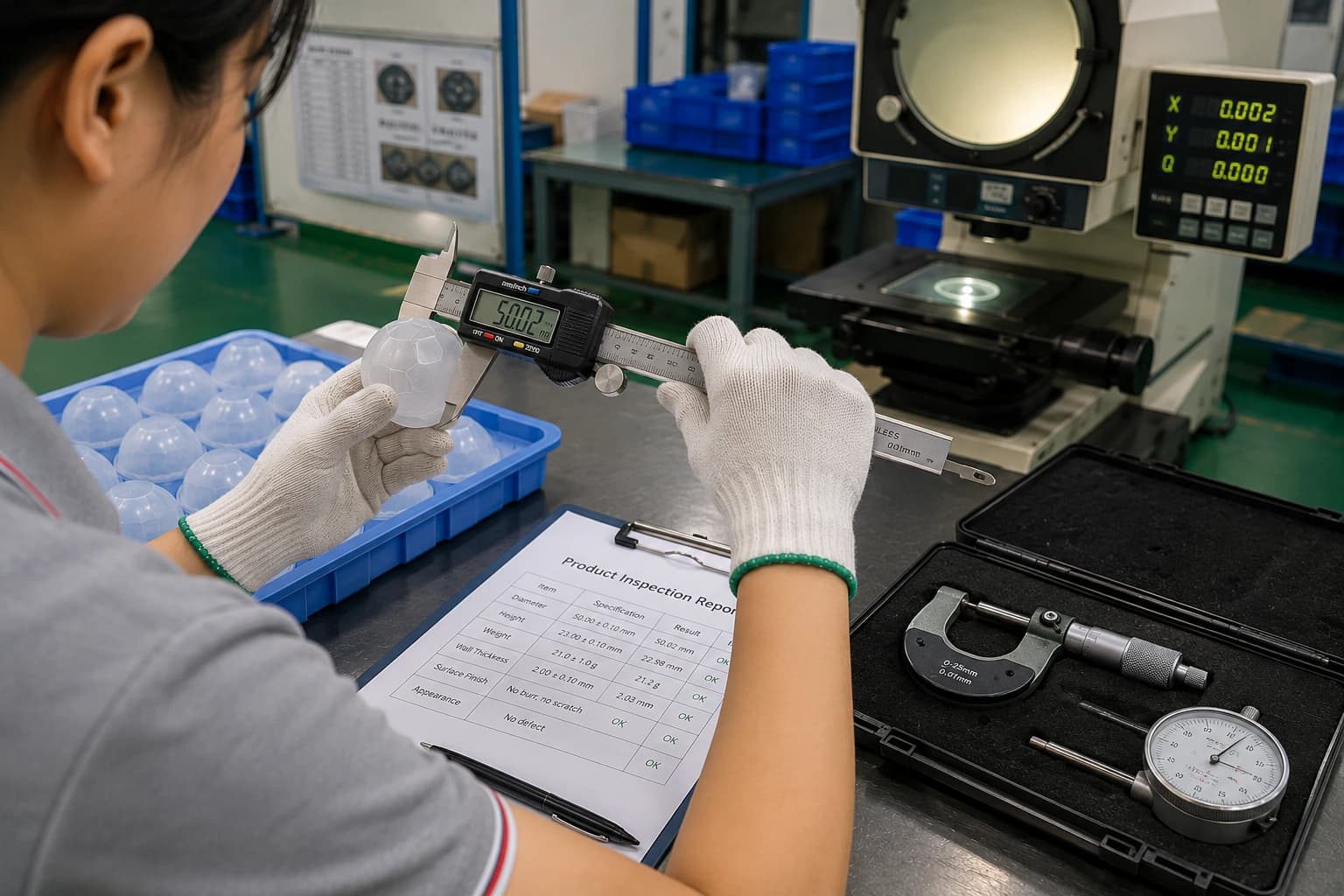
- Sample approval and pre-shipment inspection — approve the sample against a written checklist, then inspect production against that approved sample [K3].
- Packaging and compliance planning — plan market-specific compliance without making unsupported certification claims [K3].
Portfolio reality check: an extended product map may list ice block molds, ice cube trays, ice ball trays, popsicle molds, and soap molds together [K2] — but a portfolio diagram is evidence of reported product architecture, not proof that every item is currently stocked or available in every market [K4]. Before you publish a product page or issue a quotation, confirm availability, material composition, dimensions, certifications, MOQ, and lead time for that specific item [K4].
Practical advice for buyers: ask about MOQ, tooling, sampling, and lead-time planning before you design packaging, since packaging quantities are usually tied to the same minimum order as the mold itself [K3]. And ask any silicone OEM/ODM supplier a fixed set of questions — material grade, temperature range, color matching method, sample lead time, inspection standard, and what happens if the production run deviates from the approved sample [K3].
Before approving mass production, align the specification with a documented silicone product quality control plan.
6. Key Comparison: Which Ice Format Fits Which Use Case
| Use case | Recommended format | Why |
|---|---|---|
| Whiskey, neat or on one rock | Large cube (5–6 cm class) | Slow melt, minimal dilution |
| Clear spirit served in a coupe or rocks glass | Clear sphere | Visual impact, controlled melt, no sharp edges |
| High-volume service, fast turnaround | Standard or large cube mold | Faster freeze cycle, easier batching |
| Branded bar program or retail gift set | Custom silicone mold with logo and packaging [K1] | Differentiation and shelf appeal |
| Testing clarity before a big purchase | Insulated directional mold, small batch | Validates method and freezer behavior with low cost |
A practical method for evaluating any candidate mold in one week:
- Day 1–2: freeze with filtered water, full overnight cycle, note clarity and release.
- Day 3–4: repeat with boiled-and-cooled water; compare clarity against Day 1.
- Day 5: time how long a finished cube or sphere lasts in a room-temperature glass of water.
- Day 6–7: check for odor transfer and any deformation after repeated freeze cycles.
If a mold passes all four tests, it is worth the counter space. If it fails at the release step, no amount of water treatment will fix it.

7. FAQ
Q1. Can a silicone mold actually produce clear ice?
Yes, but only when it is paired with directional freezing. Silicone's flexibility solves the release problem — it flexes away from the cube instead of gripping it — while an insulated shell and open top solve the clarity problem by forcing ice to grow in one direction. Silicone alone, in a standard open tray, will still produce cloudy ice. Food-grade silicone is odorless and rated from -40°C to 240°C (-40°F to 464°F), which means it tolerates both the freezer and a warm-water release bath without deforming [K5].
Q2. Is food-grade silicone safe for ice and cocktails?
Verified public specifications for food-contact silicone list it as food-grade, odorless, and temperature-resistant across a very wide range, with custom sizes and customization in color, shape, and packaging available [K5]. For any market-specific compliance requirement, plan your compliance approach with the manufacturer rather than relying on unsupported certification claims [K3].
Q3. What should I confirm before ordering custom branded ice molds?
Confirm current availability, material composition, dimensions, certifications, MOQ, and lead time for the specific item — a product architecture diagram is evidence of a reported portfolio, not proof that an item is stocked or available in every market [K4]. Also settle cavity design, shape, size, color, logo, and packaging scope up front, since those variables drive tooling and sampling [K1].
Q4. How long does a large cube or clear sphere take to freeze?
Long enough that planning matters. Slow, directional freezing is the mechanism that produces clarity, so a large cube or sphere typically needs an overnight cycle — sometimes longer — depending on diameter and how stable your freezer temperature is. If you need faster output, use a smaller cavity or accept slightly cloudier ice; there is a direct trade-off between freeze speed and clarity.
8. Conclusion
The best large ice cube maker and clear sphere ice maker for your situation come down to one question: are you optimizing for clarity, speed, or scale?
- For clarity at home, choose an insulated, directional silicone system and accept an overnight freeze. Water quality and freezer stability do the rest.
- For speed and volume, choose a rigid large-cube mold and treat clarity as a secondary goal.
- For brand, retail, or bar programs, treat it as an OEM/ODM project: define cavity design, shape, size, color, logo, and packaging [K1], then move through tooling, sampling, and inspection against an approved sample [K3].
- Before publishing any product claim or quotation, verify availability, material composition, dimensions, certifications, MOQ, and lead time for that exact item [K4].
Next step: run the four-step test in Section 6 with one candidate mold before you buy at volume — or, if you are sourcing custom silicone ice molds, start with a written specification and a sample request rather than a finished purchase order.