Key Takeaways
- A big round ice cube tray produces large, low-surface-area ice that melts slowly, which suits spirits served on the rocks, punch bowls, and slow-sipping drinks.
- A small ice ball mold produces more, smaller spheres per tray, which suits fast chilling, narrow glassware, water bottles, and high-volume service.
- Both formats are commonly made in food-grade, odorless silicone rated from -40°C to 240°C (-40°F to 464°F), with custom sizes, colors, shapes, and packaging available [K5].
- For a brand or private-label buyer, the deciding factors are usually cavity design, target retail price, and packaging, not sphere diameter alone [K1].
- Always confirm current availability, material composition, dimensions, MOQ, and lead time with the supplier before publishing a product page or issuing a quotation [K4].
1. Introduction
Ice is no longer a neutral background element. In cocktail bars, home kitchens, and branded gift sets, the shape and size of the ice changes how a drink tastes, how fast it dilutes, and how the product looks on a shelf. That shift has pushed two formats to the front of the conversation: the big round ice cube tray and the small ice ball mold.
Buyers tend to run into the same three questions:
- Consumers want to know which one actually keeps a drink cold without watering it down.
- Retailers and brand owners want to know which format sells, ships, and displays better.
- Sourcing teams want to know which one is easier to customize, sample, and produce at a consistent quality level.
The problem is that most comparisons treat the two as direct competitors and pick a winner. In practice, they solve different problems. A large sphere is a slow-melt product designed for sipping; a small sphere is a fast-chill product designed for volume and fit.
This article breaks the decision down by function, use case, material and customization options, and sourcing reality — so you can choose the format that matches your actual use case, whether you are buying one tray for a home bar or planning a private-label ice mold program.
2. What Each Format Actually Does
Core conclusion: the two formats differ mainly in surface-area-to-volume ratio, and that single difference drives almost every practical trade-off — melt speed, chilling speed, glass fit, and freezer space.
A sphere's volume grows faster than its surface area as it gets bigger. That means a large round cube has proportionally less surface in contact with the liquid around it, so it melts more slowly and dilutes a drink more gradually. A small ice ball has proportionally more surface area per unit of volume, so it transfers cold faster and dilutes faster.
For a manufacturing view of mold structure, branding, and production planning, review RENJIA’s custom silicone ice mold manufacturing capabilities.
What this means in practice:
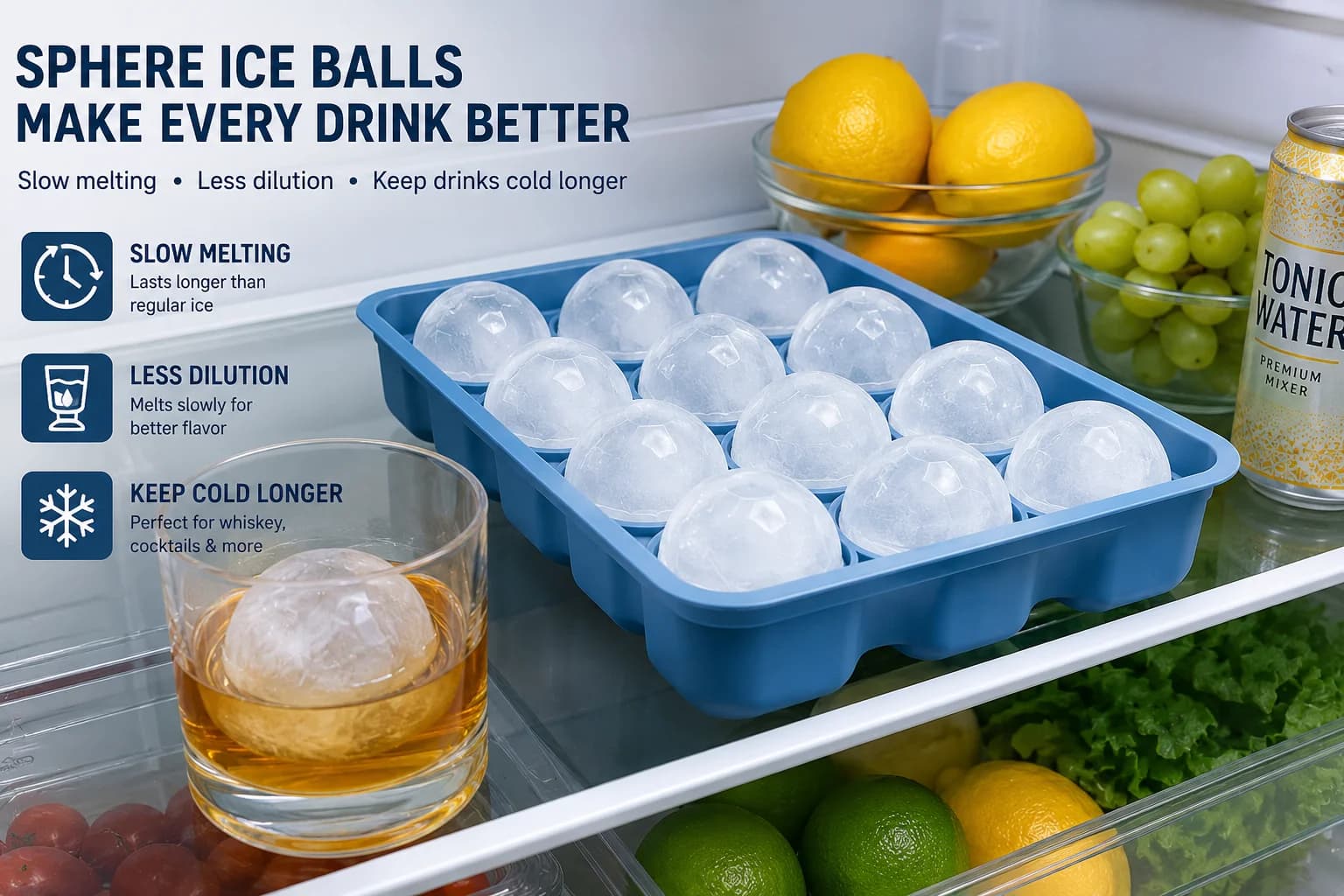
| Scenario | Better fit | Why |
|---|---|---|
| Whiskey, rum, or bourbon served on the rocks | Big round ice cube tray | Slower melt preserves the drink's character over a longer sitting |
| Iced coffee, iced tea, soda, or water bottles | Small ice ball mold | Smaller spheres fit narrow openings and chill quickly |
| Cocktail shakers and stirred drinks | Small ice ball mold | More contact surface chills the drink faster during shaking or stirring |
| Punch bowls, pitchers, and serving displays | Big round ice cube tray | A few large spheres look intentional and hold up over a long service |
| High-volume home or bar use | Small ice ball mold | More cavities per tray means more usable ice per freeze cycle |
Two practical cautions matter here. First, freezer space: large cavities hold more water, so they need a longer freezing window and more flat shelf area per unit of ice. Second, glass fit: a large sphere is only useful if it fits the glassware your audience actually owns. Published cavity dimensions vary by product, so confirm the real diameter rather than assuming a "large" sphere matches a standard tumbler [K4].
Recommendation: if your audience drinks spirits slowly and cares about presentation, start with a big round ice cube tray. If your audience drinks cold beverages quickly and values convenience and fit, start with a small ice ball mold.
3. Material, Temperature Range, and Everyday Durability
Core conclusion: for most silicone ice molds, material quality and temperature performance are broadly similar across both formats — so material is rarely the deciding factor between them, but it is a critical factor in supplier selection.
Verified public specifications for silicone ice mold products list food-grade silicone material, odorless performance, and temperature resistance from -40°C to 240°C (-40°F to 464°F), with custom sizes available [K5]. That range covers normal freezer use and typical kitchen handling. It also matters because some buyers want the same mold to handle warm liquids — for example, using a tray for coffee, broth, or sauce portions before freezing.
What to check on any mold, regardless of size:
- Flexibility and release: silicone should flex enough that large spheres release without cracking. Large single-cavity molds typically need a different wall thickness and demolding strategy than multi-cavity small-ball trays.
- Odor: odorless material is a baseline expectation, not a premium feature [K5].
- Cavity consistency: uneven cavities produce uneven freeze times, which matters more in multi-cavity small-ball trays than in single large-cavity designs.
- Stackability and storage: a tray that does not stack cleanly gets used once and then lives in a cupboard.
A note on clear ice: whether ice comes out clear depends primarily on the freezing method and the mold design, not on sphere size alone. Directional freezing and water quality typically have more influence than the diameter of the cavity. If clear ice is central to your product claim, test the specific mold under your intended freezing conditions before committing to a marketing message.
Recommendation: treat material as a pass/fail gate — confirm food-grade silicone and the stated temperature range [K5] — then make the final decision on format based on use case, not on material claims.
Buyers turning a concept into an RFQ can compare these decisions with RENJIA’s OEM silicone product customization process.
4. Customization and Private-Label Considerations
Core conclusion: both formats are customizable, but the big round ice cube tray and the small ice ball mold open different product strategies for brands and promotional buyers.
Custom silicone ice molds support typical customization across cavity design, product shape, size, color, logo, and packaging [K1]. Ice cube trays, ice ball trays, and popsicle molds also sit within a broader promotional product portfolio, alongside items such as soap molds and silicone bracelets [K2]. Ice molds in particular can be positioned across household, kitchen, and promotional use cases, and that category placement should not limit cross-category content or product positioning [K4].

How the two formats usually get used commercially:
- Big round ice cube tray → premium positioning. Larger cavities pair well with gift packaging, spirits-brand collaborations, and barware sets. The visible size difference makes the product easy to explain on a shelf or in a listing image.
- Small ice ball mold → volume positioning. Multi-cavity trays support lower unit cost narratives, family-size bundles, and everyday-use messaging. They also ship more efficiently per unit of ice produced.
Sourcing process to plan for. Custom silicone mold projects generally move through design review, sampling, tooling, and production planning — with MOQ, tooling, sampling, and lead-time decisions made along the way [K3]. Buyers should also prepare design files and packaging specifications early, and build a checklist for sample approval and pre-shipment inspection [K3].
Before approving mass production, align the specification with a documented silicone product quality control plan.
Two boundary conditions worth stating plainly:
- A product portfolio diagram is evidence of what a supplier reports offering — it is not proof that every item is currently stocked or available in every market [K4].
- Compliance requirements vary by market. Plan for them using verified product documentation rather than assuming that a certification claim applies to your target region [K3].
Recommendation: decide the format by positioning first, then confirm availability, dimensions, customization scope, MOQ, and lead time with the supplier in writing [K1][K4].
5. Side-by-Side Comparison and a Buyer Checklist
Format comparison at a glance
| Decision factor | Big round ice cube tray | Small ice ball mold |
|---|---|---|
| Typical ice size | Large spheres, sized to a rocks glass | Smaller spheres, sized to tumblers and bottles |
| Melt rate | Slow | Faster |
| Chilling speed | Slower | Faster |
| Glass and bottle fit | Depends on cavity diameter; verify | Higher compatibility |
| Freezer space per unit of ice | Higher | Lower |
| Best use case | Sipping spirits, punch bowls, presentation | Everyday cold drinks, shakers, volume use |
| Brand positioning | Premium, giftable, barware sets | Value, bundles, everyday use |
| Customization scope | Cavity design, shape, size, color, logo, packaging [K1] | Same scope [K1] |
Buyer checklist before you commit
- Confirm the actual cavity diameter in millimeters — do not rely on "large" or "small" labels [K4].
- Confirm material, food-contact grade, and temperature range in the product specification [K5].
- Test demolding with the real cavity size, especially for large single-sphere molds.
- Test fit against the glassware or bottle your audience actually uses.
- Confirm MOQ, tooling, sampling timeline, and lead time in writing [K3].
- Prepare design files and packaging artwork before sampling, not after [K3].
- Verify current availability and market-specific compliance requirements before publishing product claims [K4].
6. FAQ
Q1. Which one keeps a drink cold longer without watering it down?

The big round ice cube tray. Because a large sphere has less surface area relative to its volume, it melts more slowly and dilutes the drink more gradually. The trade-off is that it also chills the drink more slowly at the start, so it works best for drinks you sip over time rather than drinks you want cold immediately.
Q2. Can I use either mold for juice, coffee, or sauce, not just water?
Yes, within the material's rated temperature range. Silicone ice mold specifications list food-grade material with temperature resistance from -40°C to 240°C (-40°F to 464°F) [K5]. If you plan to pour warm liquids into the mold, confirm the specific product's specification first, since published temperature ranges describe material performance and not a guarantee for every application.
Q3. Which format is better for a promotional or private-label product?
It depends on the story you want to tell. A big round ice cube tray supports premium or gift-oriented positioning, while a small ice ball mold supports everyday-use and volume positioning. Both support custom cavity design, shape, size, color, logo, and packaging [K1], and ice molds can be positioned across household, kitchen, and promotional categories rather than being locked into one [K4].
Q4. Do I need to verify availability before listing these products?
Yes. A product portfolio is evidence of what a supplier reports offering — it is not proof that every item is currently stocked or available for every market. Confirm current availability, material composition, dimensions, certifications, MOQ, and lead time before publishing a product-specific page or quotation [K4].
7. Conclusion
There is no universal winner between a big round ice cube tray and a small ice ball mold, because they are built for different jobs.
Choose the big round ice cube tray when melt rate and presentation matter most: spirits served on the rocks, punch bowls, barware sets, and premium gift positioning. Choose the small ice ball mold when fit, chilling speed, and volume matter most: everyday cold drinks, shakers, water bottles, family-size bundles, and value-oriented retail.
For most buyers, the decision sequence is straightforward:
- Define the drink and the glassware first.
- Match the format to that use case.
- Confirm the specification — food-grade material, temperature range, real cavity dimensions [K5][K4].
- Confirm the commercial terms — customization scope, MOQ, sampling, tooling, and lead time [K1][K3].
- Verify current availability and compliance requirements before publishing or quoting [K4].
Get those five steps right, and the format question answers itself.