Key Takeaways
- A single large ice sphere chills a drink while diluting it more slowly than several small cubes, because a sphere has the lowest surface-area-to-volume ratio of any regular shape.
- Clarity is a process outcome, not a material one: clear ice comes from directional freezing, which pushes dissolved air and impurities to one side of the block instead of trapping them throughout it.
- Silicone ice ball molds make large-format clear ice practical at home and in a bar prep routine, and they are a standard OEM/ODM product category for private-label and promotional programs [K1][K3].
- Verified shared specifications for food-contact silicone ice molds include food-grade silicone, odorless performance, and a working temperature range of -40°C to 240°C (-40°F to 464°F), with custom sizes, colors, shapes, and packaging available [K5].
- Anyone sourcing an ice cube mold for whiskey should confirm current availability, material composition, dimensions, certifications, MOQ, and lead time before publishing a product page or a quotation [K4].
1. Introduction
Two bars can pour the same whiskey at the same price and deliver two completely different drinks. The variable is often not the spirit but the ice. A handful of small, cloudy cubes from a household tray will chill the glass quickly — and just as quickly turn a 45% ABV pour into a watery, muted version of itself. A single large, clear sphere does the opposite: it chills steadily, releases water slowly, and keeps the aromatics intact long enough for the drinker to notice them.
That difference is why the cocktail ice cube ball has moved from high-end bars into home kitchens, and why private-label brands now treat ice molds as a legitimate product line rather than a novelty gift item. It is also why the phrase ice cube mold for whiskey attracts so much search interest: buyers are not just looking for a shape, they are looking for a repeatable way to produce bar-quality ice.
This article explains the physics behind why a sphere performs better, how clear ice is actually made, where silicone trays fit relative to rigid molds and commercial machines, and what a brand or distributor needs to verify before ordering custom molds at volume. Product-specific facts are drawn from verified manufacturer knowledge where available [K1][K2][K3][K4][K5]; general technique guidance is presented as method, not as a guaranteed result.
2. Why a Large Ice Sphere Changes the Drink, Not Just the Presentation
Core conclusion: A large sphere is not a cosmetic upgrade. It changes the rate of dilution and the temperature curve of the drink, and those two variables determine how the spirit tastes from the first sip to the last.
Three mechanisms explain the effect:
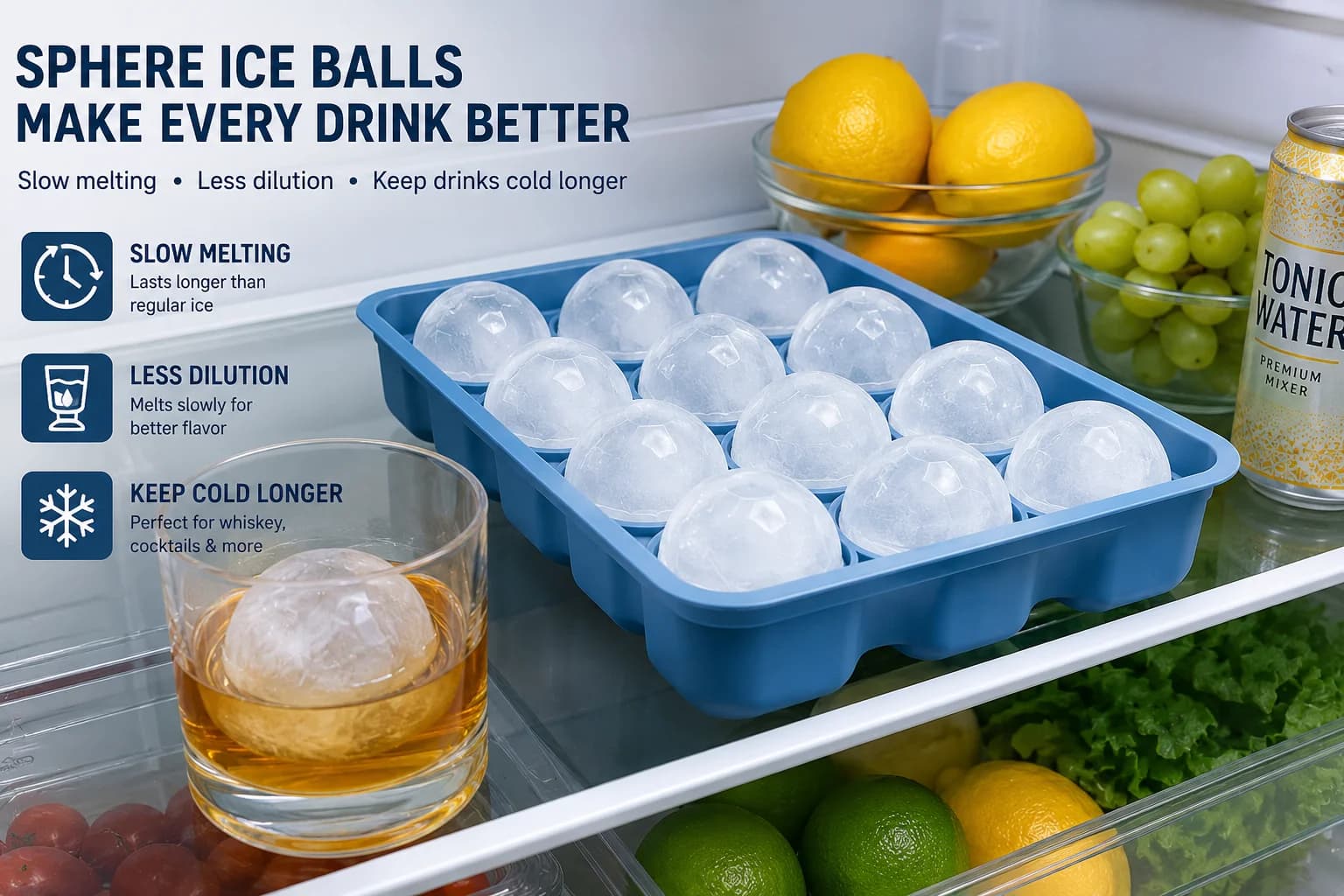
- Surface area to volume ratio. For a given volume of ice, a sphere exposes the least surface area of any regular geometric shape. Melting happens at the surface, so a single large sphere melts more slowly than the same mass of ice split into small cubes. Less meltwater per minute means slower dilution.
- Thermal mass. A larger single piece of ice holds more cold energy in one block. It can absorb heat from the liquid without collapsing as fast as thin cubes, which tend to crack and dissolve within minutes.
- Aroma retention. Whiskey aromatics are volatile. When a drink is diluted aggressively and quickly, those compounds are pushed out of solution and the nose flattens. Slower dilution preserves the aromatic profile for longer.
Practical scenario. Consider a bar serving whiskey neat-adjacent, on the rocks. With four small cubes, the drink may be noticeably diluted within a few minutes and the glass is half water before the customer finishes. With one well-made sphere in a heavy rocks glass, the drinker gets a slow, even chill and a spirit that still tastes like itself at the end of the pour. The same logic applies to stirred cocktails such as an Old Fashioned or a Negroni, where a large single piece of ice keeps the drink cold without washing out the bitter and botanical notes.
For a manufacturing view of mold structure, branding, and production planning, review RENJIA’s custom silicone ice mold manufacturing capabilities.
Recommendation. Match the ice to the glass and to the drinking window. A sphere that sits below the liquid line and leaves room for the nose is the target. If the sphere is too large for the glass, it will not chill efficiently; if it is too small, you are back to cube behavior.
3. Clear Ice vs. Cloudy Ice: The Method Behind the Clarity
Core conclusion: Cloudy ice is not a defect of the mold — it is a defect of the freezing direction. Clear ice requires the water to freeze from one side inward so that air and dissolved solids are pushed out rather than trapped.
When water freezes quickly from all directions, dissolved gases and minerals have nowhere to go and get locked into the structure as the white, opaque core most people see in a household tray. Directional freezing solves this by cooling the water from a single surface, typically the top or bottom, so impurities are driven into a shrinking pocket of unfrozen water that you can discard.
Common approaches, ranked by how reliably they produce clear results:
| Method | How it works | Trade-offs |
|---|---|---|
| Insulated cooler method | Water freezes top-down inside a small cooler placed in a freezer; the cloudy bottom section is cut away | High clarity, requires freezer space and a carving step |
| Directional silicone mold | An insulated or open-topped mold forces freezing from one face | Simpler workflow, clarity depends on freezer temperature and time |
| Boiled / degassed water | Pre-boiling removes some dissolved air before freezing | Improves clarity, does not replace directional freezing |
| Standard tray freezing | Fast, multi-directional freeze in a normal tray | Convenient, but typically produces a cloudy core |
Two practical cautions apply. First, freezer temperature and airflow matter more than the mold alone — a freezer that cycles aggressively will produce inconsistent results regardless of the tray. Second, large spheres need time. A thick sphere frozen in a few hours will almost always be cloudy in the center, so plan production windows rather than treating ice as an on-demand item.
Recommendation for home use. Start with a directional silicone mold and filtered or boiled water, freeze overnight or longer, and accept that the bottom third of the block may need to be trimmed or discarded. For bar use, batch the process: produce blocks on a schedule, store finished spheres in a sealed container in the freezer, and rotate stock so no sphere sits long enough to frost or crack.
4. Silicone Ice Ball Trays vs. Rigid Molds vs. Commercial Machines
Core conclusion: Silicone is the most practical material for large-format ice at home and for private-label production because it releases large spheres cleanly and supports custom shapes at reasonable tooling cost. Rigid molds and commercial machines win on specific trade-offs.
Buyers turning a concept into an RFQ can compare these decisions with RENJIA’s OEM silicone product customization process.
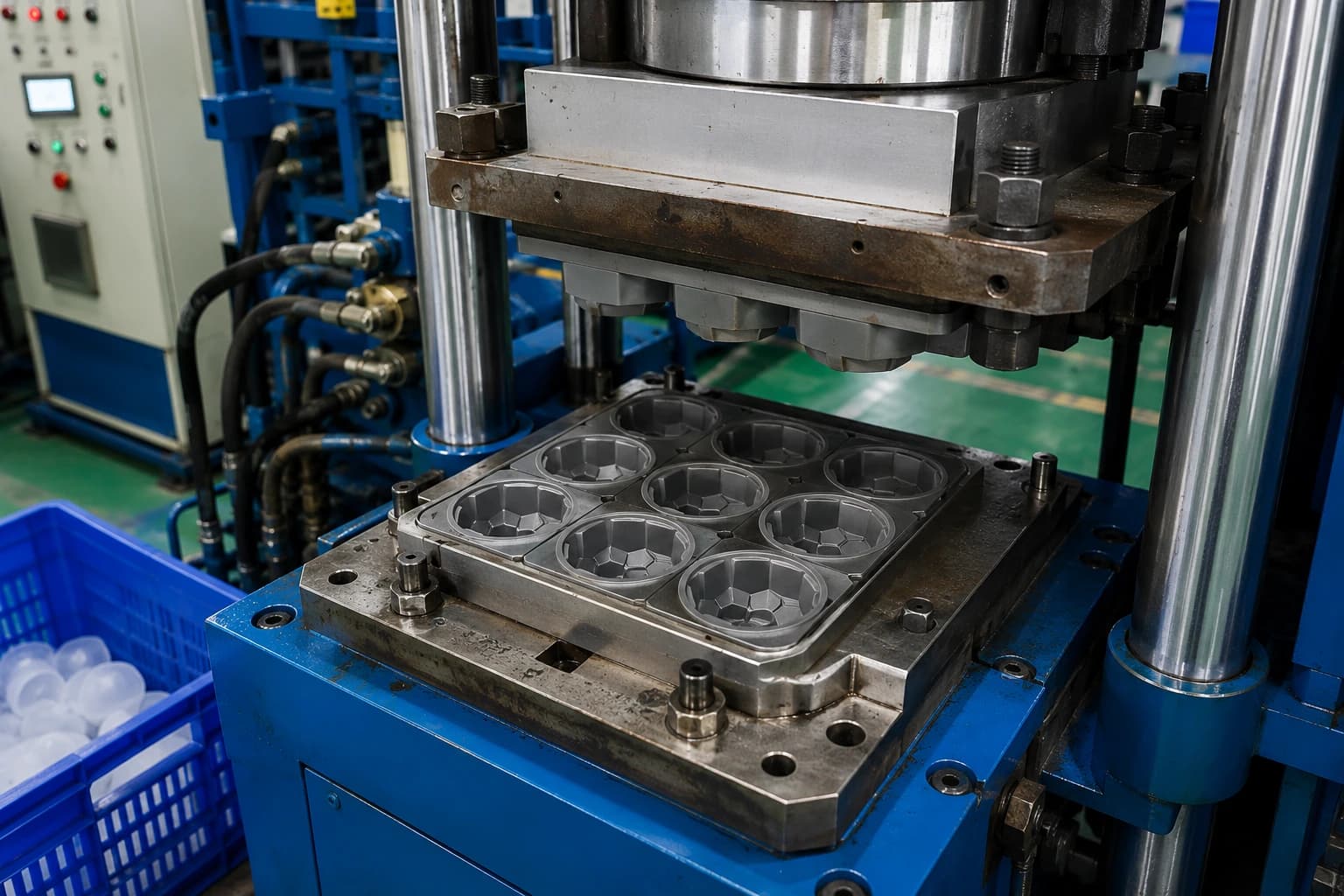
- Silicone molds. Flexible walls mean a large sphere can be demolded without force or cracking. Verified food-contact silicone for ice molds is food-grade, odorless, and rated from -40°C to 240°C (-40°F to 464°F), which covers freezer storage and normal washing routines [K5]. Cavity design, shape, size, color, logo, and packaging can all be customized [K1].
- Rigid plastic or metal molds. These can deliver sharper geometry and may suit geometric or faceted ice, but demolding a large piece usually requires a two-part assembly, and rigidity offers no flexibility advantage.
- Commercial ice machines and presses. These produce clear ice at volume with tight consistency. The trade-off is capital cost, footprint, and the fact that a machine output is fixed — you cannot change shape to match a seasonal cocktail program.
Practical scenario. A small cocktail bar with limited space usually gets more value from a set of silicone molds plus a disciplined freezing workflow than from a machine it cannot fully utilize. A hotel group or a beverage brand running a seasonal promotion, by contrast, may want custom-shaped molds that match a campaign — which is a tooling and design-file exercise rather than a machine purchase [K2].
Note on category placement. Ice molds are commonly filed under household, kitchen, and promotional use cases, and that filing should not restrict how they are marketed — the same mold can serve a whiskey program, a kitchen accessory line, or a branded giveaway [K4].
5. Sourcing Custom Silicone Ice Molds: What Buyers Should Verify
Core conclusion: A custom ice mold project is a manufacturing project, not a design purchase. It moves from design review through tooling and sampling to production, and each stage has information the buyer must confirm in writing.
The typical path for an OEM/ODM silicone ice mold program looks like this [K2]:
- Design review — cavity design, target sphere or cube dimensions, artwork, and packaging direction are defined and checked for manufacturability.
- Design-file preparation and sampling — drawings and artwork are prepared, then a physical sample is produced for approval.
- Tooling — the mold is cut and validated against the approved sample.
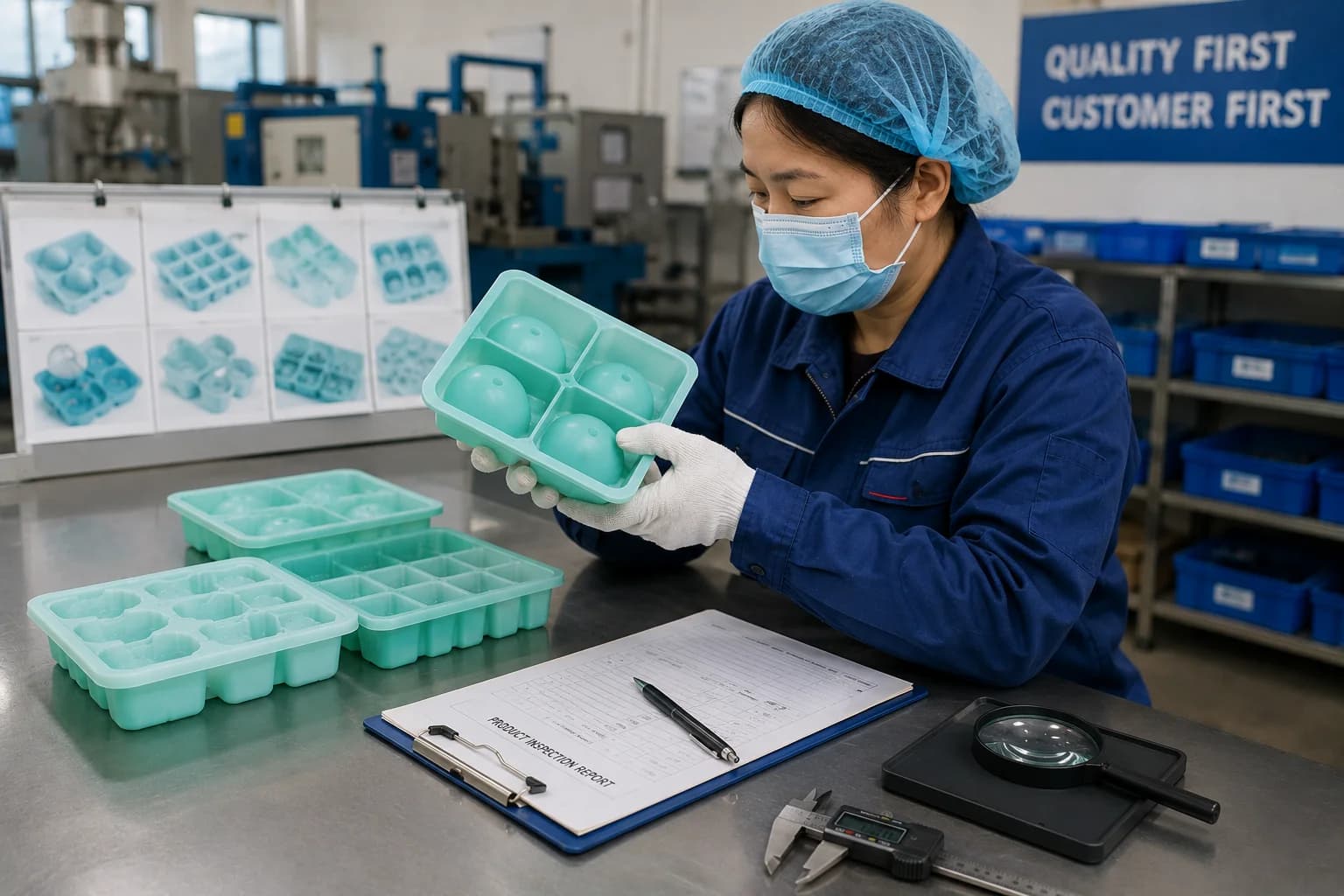
- Production and inspection — a pre-shipment inspection confirms the batch against the approved sample and checklist.
Because this is a capital and time commitment, the responsible approach is to confirm the following before any product page, quotation, or marketing claim is published [K4]:
- Current availability of the specific item, not just its presence in a portfolio catalog
- Material composition of the exact SKU being quoted
- Actual dimensions and cavity volume
- Certifications that genuinely apply — and no claims for certifications that have not been verified
- MOQ, tooling cost, sampling timeline, and production lead time
- Packaging format and design-file requirements
Important boundary condition. A product portfolio diagram is evidence of what a manufacturer reports it can make, not proof that every item is currently in stock or available for every market. Treat portfolio listings as a starting point for verification, not as a compliance or availability guarantee [K4]. Likewise, market-specific compliance planning should be handled as a planning exercise without unsupported certification claims [K2].
Before approving mass production, align the specification with a documented silicone product quality control plan.
6. Key Comparison / Buyer Checklist
| Decision point | What to check | Why it matters |
|---|---|---|
| Ice format | Sphere diameter vs. glass opening and fill line | A sphere that does not fit the glass will not chill efficiently |
| Clarity method | Directional freezing possible? Freezer space and schedule? | Clarity is a process outcome, not a mold feature |
| Mold material | Food-grade silicone, odorless, temperature range [K5] | Affects safety, demolding, and usable temperature window |
| Customization | Cavity design, shape, size, color, logo, packaging [K1] | Determines whether the product can carry a brand |
| Program setup | MOQ, tooling, sampling, lead time [K2] | Drives total cost and launch schedule |
| Verification | Current availability, composition, dimensions, certifications [K4] | Prevents unsupported claims and stock surprises |
A short buyer checklist before sample approval: confirm the approved sample matches the drawing; confirm the sample material and dimensions in writing; confirm packaging artwork and dieline; confirm inspection criteria before shipment; and confirm that any certification language used in marketing is backed by a current document [K2][K4].
7. FAQ
Q1. Does the shape of the ice actually change how a whiskey tastes?
Yes, indirectly. The shape changes the melt rate, and the melt rate changes dilution. A large sphere exposes less surface area per unit of volume than the same mass of small cubes, so it adds water more slowly. The spirit stays closer to its intended strength and its aromatics stay in solution longer. The ice does not add flavor; it controls how quickly the drink changes.
Q2. How do I make clear ice balls at home without a commercial machine?
Use directional freezing. Freeze water in an insulated or open-topped container so it solidifies from one direction, then discard the cloudy section where the impurities concentrate. Pre-boiling the water removes some dissolved air and helps, but it is not a substitute for freezing directionally. Expect overnight or multi-day freezing times for large spheres, and store finished ice in a sealed container so it does not pick up freezer odors.
Q3. Are silicone ice ball molds safe for repeated freezing and washing?
Verified silicone ice mold specifications list a food-grade silicone material, odorless performance, and a working range of -40°C to 240°C (-40°F to 464°F) [K5]. That range covers normal freezer use and typical washing temperatures. Buyers should still confirm the material composition and any applicable documentation for the specific SKU they intend to sell, rather than assuming all silicone products share identical specifications [K4].
Q4. What should I confirm before ordering a private-label ice cube mold for whiskey?
Confirm the cavity design and dimensions, material composition, color and logo application, packaging format, MOQ, tooling cost, sampling schedule, and production lead time [K1][K2]. Then verify current availability and any certification claims directly with the supplier before publishing product pages [K4]. Ice molds can be positioned across household, kitchen, and promotional channels, so decide the primary use case early — it affects packaging, artwork, and compliance planning [K4].
8. Conclusion
The cocktail ice cube ball earns its place behind the bar for a straightforward reason: it changes the rate at which a drink evolves. Less surface area means slower melt, slower melt means less dilution, and less dilution means the spirit or the cocktail tastes like what it was designed to be. Clear ice is the second half of that equation, and it is achievable at home with directional freezing and a bit of patience — no machine required.
For home drinkers, the practical next step is a directional silicone mold, filtered water, and a longer freezer window than you think you need. For brands, distributors, and bar groups, the practical next step is verification: define the cavity design and packaging, confirm material composition and dimensions, agree on MOQ, tooling, and lead time, and make sure every claim on the product page is backed by a current document rather than a catalog listing [K2][K4]. The mold is the easy part. The process is what makes the ice — and the drink — consistent.