Key Takeaways
- Ice clarity and dilution control come from three things working together: water quality, freezing direction, and mold geometry. A good mold supports slow, directional freezing — it cannot fix it alone.
- Cocktail ice molds earn their place by controlling shape and size. One large cube or sphere has far less surface area per unit volume than several small cubes, so it melts more slowly and dilutes the drink less aggressively.
- For bars, distilleries, and gift programs, the real decision is material and process: cavity design, wall thickness, seam quality, demolding behavior, and packaging all need to be specified before tooling starts [K1].
- Custom silicone ice molds can be developed with defined shapes, sizes, colors, logos, and packaging, but current availability, material composition, dimensions, certifications, MOQ, and lead time must be confirmed per project rather than assumed [K1][K3].
- Treat ice as part of the serve, not an afterthought. The mold is the tool that makes a good serve repeatable night after night.
1. Introduction
A whisky served over a single clear cube looks deliberate. A whisky served over a handful of cloudy, fast-melting chips looks like an afterthought — and tastes like one, because the ice is watering the drink down faster than the drinker can enjoy it.
This is why the ice molds whiskey enthusiasts and bars choose matter more than most people expect. The mold determines the shape, the size, the seam lines, how easily the ice releases, and how consistent the serve is on the two-hundredth cube rather than the second. It also determines whether the result photographs well enough to post, which is not a trivial concern for cocktail bars, distilleries running branded gift sets, and home hosts who care about presentation.
The problem is that most buying advice jumps straight to "use filtered water" or "buy a big tray" without explaining the trade-offs. Home users end up with molds that crack, leak, or produce domed cubes that wobble in the glass. Bars end up with flexible trays that tear after a few weeks of service. Brand teams order custom molds without a clear specification and discover seam lines and dimensional drift only after production.
This article breaks the topic down the way a buyer actually needs it: how ice geometry affects the drink, how the main mold formats compare, what to verify about material and build quality, and how a custom ice mold project runs from concept to delivered case. Facts about Renjia's product scope and customization options are drawn from the company's verified product knowledge base [K1][K2].
2. Why Whisky Ice Is a Mold-Design Problem First
Core conclusion: the mold is the geometry layer of ice quality. It sets the size, the surface finish, and the freezing path; water and temperature control the rest.
Three variables drive how a piece of ice behaves in a glass:
- Surface area to volume ratio. A single 5 cm cube has a much smaller surface area per unit volume than the same mass of small cubes. Less contact with the whisky means slower melt and slower dilution. This is the entire reason large-format ice exists in whisky service.
- Freezing direction. Impurities and dissolved gas are pushed ahead of the freezing front. When water freezes from all sides in a thin tray, those impurities get trapped in the center and the cube turns cloudy. Directional freezing — one open face, insulation on the other sides, or a block frozen slowly and then cut — concentrates the cloudiness at the bottom, which can be trimmed away.
- Surface quality and shape regularity. Rough surfaces and deep seam lines create nucleation points and weak planes, so the cube cracks when it hits the drink. A clean cavity with a smooth finish produces a cleaner, stronger piece.
What this means in practice: a silicone mold shapes and releases ice well, but it does not by itself produce crystal-clear cubes. If clarity is the goal, the mold should be paired with slow freezing and, for the best results, a directional or block-based method. A mold marketed as producing "perfectly clear ice" on its own is making a claim the physics does not support.
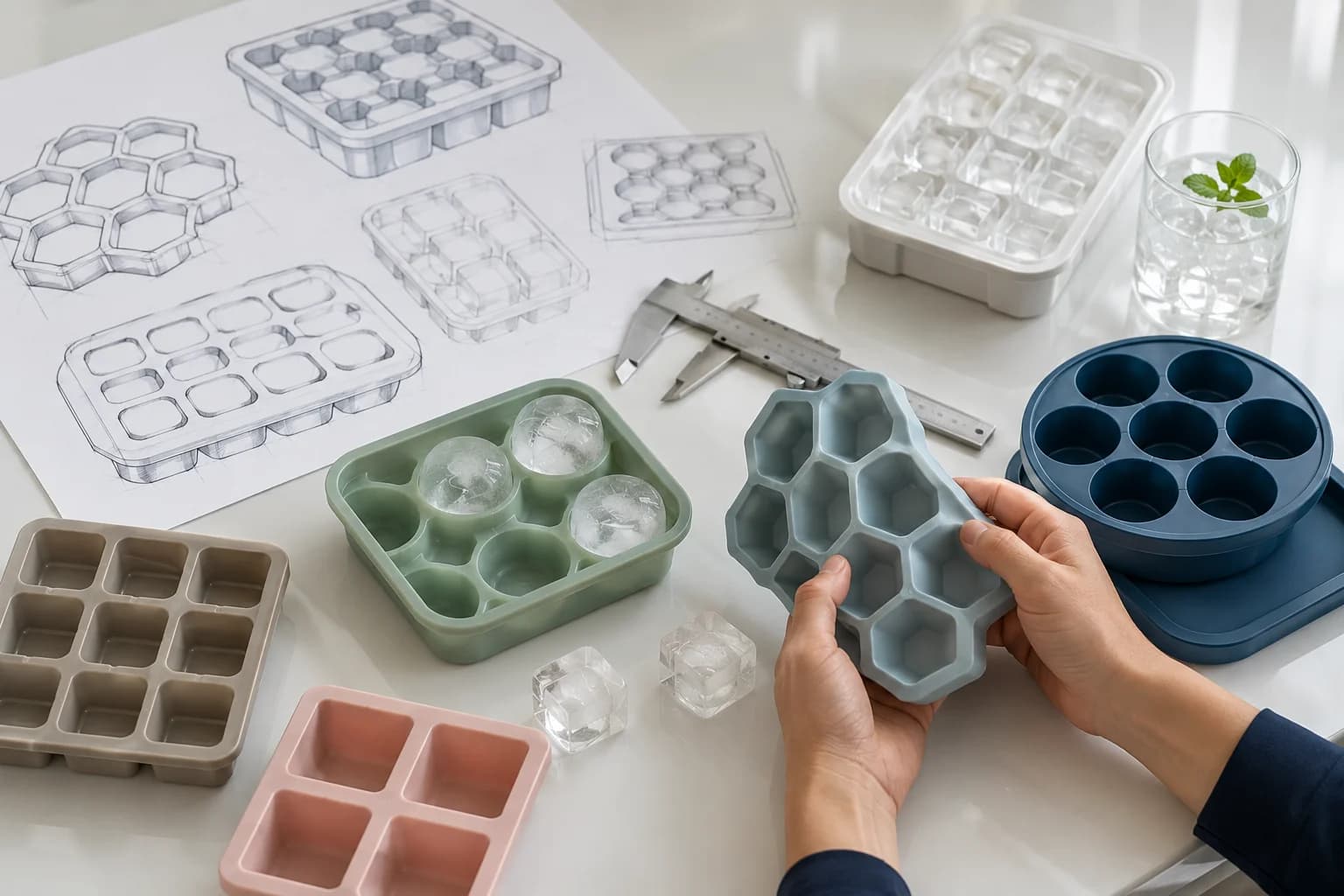
Scenario-based advice:
- Home whisky drinkers want a large-cube or sphere tray with a lid or insulated shell, plus the patience to freeze overnight. Two trays in rotation beats one oversized tray.
- Cocktail bars usually want a block system (freeze a large block, then saw or press it) for signature serves, plus silicone molds for branded or shaped pieces.
- Brand and gift programs want a defined cavity design with logo and retail packaging, which is a development project rather than a catalog purchase — the customization scope for custom silicone ice molds covers cavity design, shape, size, color, logo, and packaging [K1].
3. Choosing a Format: Cube, Sphere, Spear, and Block
Core conclusion: match the format to the glass and the drinking speed, not to the photograph.
Different formats solve different problems, and each brings its own mold engineering challenges.
- Large cube (5–6 cm). The default for whisky on the rocks. Stable in the glass, slow melting, easy to stack in a freezer bag. Mold consideration: cavity corners need enough radius to demold cleanly, otherwise the silicone tears at the corner.
- Sphere. Visually striking in a rocks glass, melts relatively slowly, but rolls. Mold consideration: two-part molds create an equatorial seam that shows in clear ice, so seam control matters more than with cubes.
- Spear / highball column. Designed for tall glasses and carbonated highballs, where a long piece cools quickly with less total mass. Mold consideration: tall cavities need adequate wall support or they bow when filled.
- Block and cut. Not a consumer mold format but the professional standard: freeze a large block slowly, then portion it. Produces the clearest ice and the most consistent sizing, at the cost of equipment and labor.
Renjia's portfolio covers ice block molds, ice cube trays, and ice ball trays across household, kitchen, and promotional use cases, and the company's own guidance is that ice molds can legitimately be positioned across those categories rather than locked into one [K2][K3]. If you are mapping a product range rather than a single SKU, it helps to see the broader portfolio structure before you specify: Renjia's product portfolio overview shows how ice molds sit alongside other silicone household, kitchen, and promotional lines.
Practical recommendation: choose one primary format and one backup. A bar that tries to run cubes, spheres, and spears simultaneously across the same freezer will usually get inconsistent results, because each format freezes at a different rate in the same environment.
4. Material and Build Quality: What to Verify Before You Buy
Core conclusion: flexibility is a feature, but only if the material and the wall thickness are specified. Ask for the datasheet, not the adjective.
Most flexible ice molds are silicone; some low-cost trays use TPE or a blend, and premium clear-ice systems often use rigid shells with an insulated insert. These are different products with different behavior, and the word "silicone" on a listing is not a specification.
What to check:
| What to verify | Why it matters | How to check |
|---|---|---|
| Cure system and grade | Platinum-cured silicone is generally the preferred food-contact grade for molds: low odor, low extractables, good flexibility retention | Request the material datasheet and food-contact test report |
| Wall thickness and cavity tolerance | Thin walls bow when filled; inconsistent cavities produce inconsistent cube sizes | Ask for dimensional drawings and a sample batch measurement |
| Seam and edge quality | Deep parting lines create weak planes and visible marks in clear ice | Inspect a sample under side light |
| Demolding behavior | Aggressive undercuts tear; too little grip means the mold releases mid-freeze | Fill, freeze, and release a full tray yourself |
| Temperature range | Freezer use is easy; dishwasher and hot-water sanitizing are where cheap molds fail | Confirm the service range for the specific grade with the supplier |
| Certifications for your market | Food-contact requirements differ by destination market | Ask which certificates apply to your market, not "all markets" |
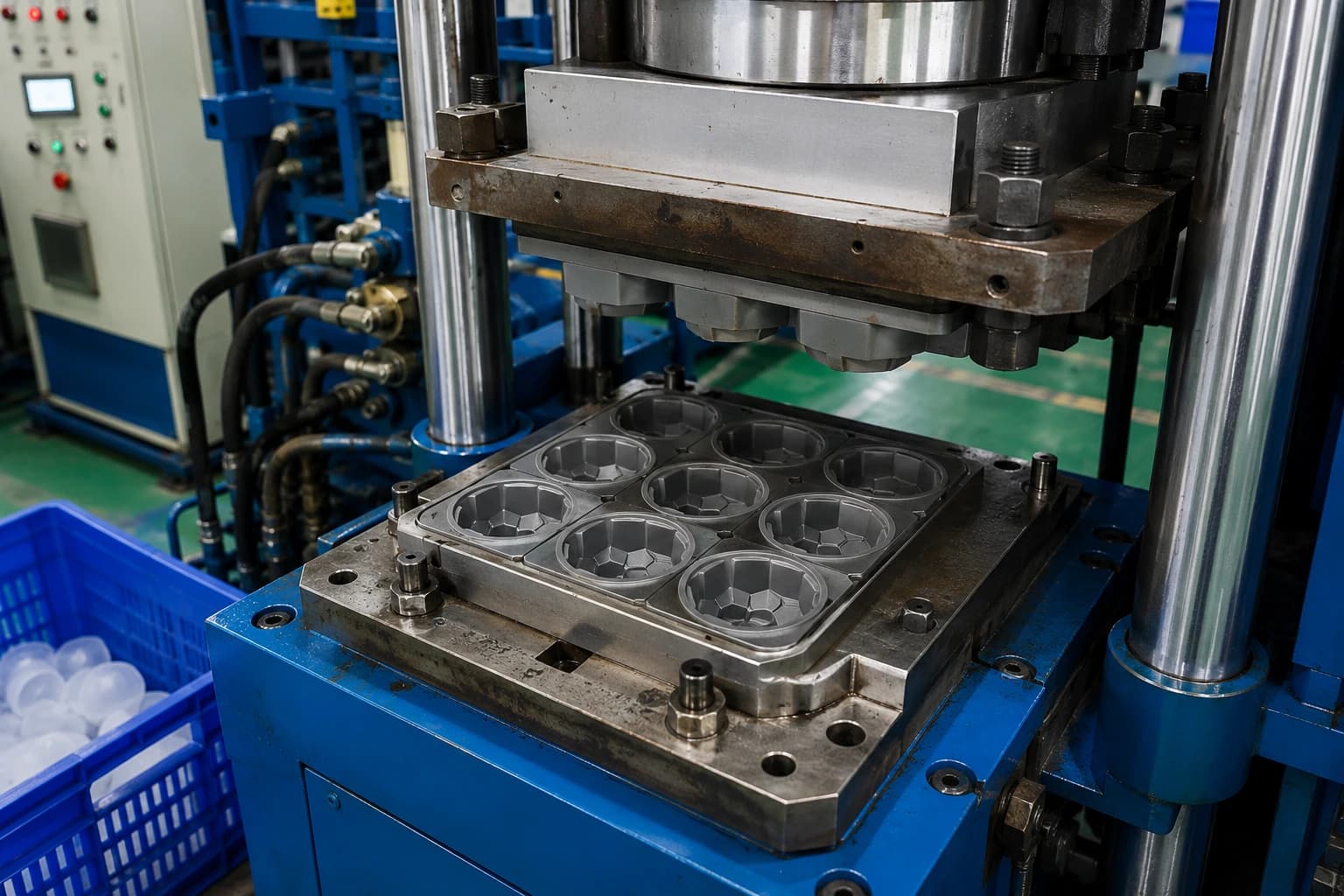
Two cautions worth stating plainly. First, material claims should always be confirmed against a product-specific specification: Renjia's own portfolio rules note that availability, material composition, dimensions, certifications, MOQ, and lead time must be confirmed before publishing a product page or quotation [K3]. Second, a supplier's values statement is not a quality guarantee — Renjia's culture guidance explicitly frames care and responsibility as a commitment to surface customer risks internally and reduce preventable quality problems, not as a promise that every project is risk-free [K4].
If you are sourcing rather than buying retail, the process side matters as much as the product side; silicone OEM/ODM manufacturing services explains how development, tooling, and production are typically sequenced.
5. From Concept to Case: How Custom Ice Mold Development Runs
Core conclusion: a custom ice mold is a small engineering project with a fixed sequence. Skipping a step is how seam lines and size drift reach mass production.
A typical development flow looks like this:
- Brief. Intended use (whisky service, highball, retail gift), target cube dimensions, volume per tray, freezer environment, and cleaning method.
- Design file. Cavity geometry, draft angles, wall thickness, logo placement, and packaging format. The clearer the drawing, the fewer sampling rounds.
- Tooling. The mold tool is cut to the cavity design. Logo and texture decisions should be locked before this step, because changes afterward mean rework.
- Sampling. Physical samples are produced and checked for dimensions, seam quality, demolding, and logo legibility in ice.
- Validation. The buyer tests the sample under real conditions — actual freezer temperature, actual fill method, actual release technique.
- Production and quality inspection. Batch inspection covers cavity consistency, material appearance, and packaging accuracy.
- Packaging and delivery. Retail-ready packaging, carton configuration, and shipping terms.
Renjia's custom silicone ice mold line (internal reference RJ-CIM-001) covers exactly this scope: cavity design, product shape, size, color, logo, and packaging, with development topics spanning sampling, tooling, packaging, quality inspection, and sourcing [K1]. What the knowledge base does not do is promise fixed timelines or universal availability — lead time and MOQ are project-specific and should be confirmed in writing [K3].
A note on how the founder's stated mission translates into product decisions: Renjia describes its mission as using innovative manufacturing to create silicone household products that carry care and warmth, while helping customers build sustainably profitable businesses [K5]. For an ice mold buyer, the practical reading is that cost reduction should not be pursued through thinner walls or cheaper compounds that fail in service — but that framing is a stated management philosophy, not a performance guarantee [K5].
6. Key Comparison and Buyer's Checklist
Use this to match format to audience before you request quotes.
| Buyer type | Recommended format | Priority verification | Common mistake |
|---|---|---|---|
| Home whisky drinker | Large cube tray, 5–6 cm | Wall thickness, lid fit, demolding | Buying one oversized tray instead of two rotating trays |
| Home cocktail hobbyist | Cube plus sphere combo | Seam quality on sphere mold | Expecting clear ice without directional freezing |
| Cocktail bar | Block system plus branded shapes | Consistent dimensions, tear resistance | Flexible trays that fail under daily service |
| Distillery or brand gift | Custom cavity with logo and retail box | Logo legibility in ice, packaging accuracy, MOQ | Locking packaging before sampling the ice |
| Promotional buyer | Standard cube or ball trays with print | Lead time, carton configuration | Assuming catalog items are always in stock |
Pre-purchase checklist:
- Confirm the exact cube dimensions and the resulting volume per piece.
- Confirm the material grade and request the food-contact documentation for your market.
- Request a physical sample and freeze it yourself before committing to volume.
- Confirm MOQ, lead time, and packaging specification in writing.
- For branded programs, approve the logo on an actual ice sample, not a digital mockup.
- Verify whether the SKU is currently stocked or made to order [K3].

For buyers running a multi-SKU program, it also helps to see how sampling and inspection are handled across a full development cycle; custom mold development and quality inspection support covers that workflow in more detail.
7. FAQ
Q1. Do silicone ice molds actually make clear ice?
Not on their own. Silicone molds shape and release ice well, but clarity depends mainly on water purity, dissolved gas, and freezing direction. To get clear cubes, freeze slowly and directionally — for example with an insulated or open-top setup, or by freezing a large block and cutting it — so impurities concentrate in one area you can remove. A mold that advertises guaranteed clear ice without those conditions is overselling.
Q2. How big should a whisky ice cube be?
For a standard rocks glass, roughly 5–6 cm per side is the common range: large enough to slow dilution, small enough to fit comfortably with a reasonable pour. Larger pieces cool more slowly at first but dilute less over time. If your glass is narrow, a tall column or spear format usually works better than a wide cube.
Q3. Can I put my logo on cocktail ice molds, and will it show in the ice?
Yes — logo is one of the customization options in Renjia's custom silicone ice mold scope, alongside shape, size, color, and packaging [K1]. Whether the logo reads clearly in the ice depends on the depth and contrast of the molded detail and on how clear the ice itself is. Always approve the logo on a physical frozen sample rather than a digital rendering, and confirm MOQ and tooling implications before production [K3].
Q4. How do I verify a supplier's claims before ordering?
Ask for three things: a material datasheet with food-contact documentation applicable to your market, dimensional drawings with tolerances, and a physical sample you freeze and release yourself. Then confirm MOQ, lead time, and packaging in writing. Renjia's own portfolio guidance makes the same point — product-specific specifications must be confirmed before a quotation or product page is treated as final [K3].
8. Conclusion
Cocktail ice molds do not make whisky taste better by themselves. What they do is make a good serve repeatable: the right size for the glass, a clean shape that does not crack on contact, a consistent cavity so the tenth cube matches the first, and a material spec that survives daily service or a freezer shelf.
The decision sequence is straightforward. Start with the format that fits your glass and your drinking speed. Then verify material grade, wall thickness, seam quality, and demolding with a physical sample. Only then talk about logo, color, and packaging — and confirm availability, MOQ, certifications, and lead time in writing, because those are project-specific rather than catalog facts [K1][K3].
For home buyers, that means two good large-cube trays and a slow-freeze habit. For bars and brands, it means treating the ice mold as a development project with a defined brief, a sampling round, and a written specification. Either way, the ice stops being an afterthought — and the whisky looks the way it should.