Key Takeaways
- A custom ice mold MOQ is not a fixed number; it typically starts at 500 pieces per design but depends on design complexity, tooling, packaging, and production scheduling [K1].
- Mold fees, sample costs, and lead times are all project-specific and quoted only after design review [K1].
- Sampling is available (often free for existing samples, custom samples incur charges) and follows a defined process: typically 1–2 days for stock samples, 7–10 days for custom samples [K1].
- Buyers should prepare detailed design files and discuss all customization options early to avoid surprises in MOQ and cost.
- Do not assume every project qualifies for the base 500-piece MOQ; final terms must be confirmed case by case [K4].
1. Introduction
If you are sourcing branded ice molds for a promotional campaign, a hospitality chain, or a retail product line, one of the first numbers you encounter is the minimum order quantity (MOQ). For custom silicone ice molds, the MOQ determines how many units you must commit to before production begins. But the MOQ is rarely a simple, one-size-fits-all number. It shifts with every design decision: the complexity of the cavity shape, the type of packaging, the number of colors, and even the production timeline.
Understanding what drives the MOQ helps you budget accurately, negotiate effectively, and avoid costly surprises. This article walks through the key factors that influence a custom ice mold MOQ, drawing on verified industry practices from a silicone OEM/ODM manufacturer (Renjia Company). You will learn how design, tooling, packaging, sampling, and lead time interact to set the final minimum, and what you can do to optimize your order.
2. Design Complexity and Tooling Requirements
Core conclusion: The more complex your ice mold design, the higher the tooling investment and the higher the MOQ may be, because the mold (tooling) is a fixed cost that must be amortized across the production run.
Reasoning
Custom silicone ice molds are produced using compression or injection molding. Each unique cavity design requires a dedicated steel or aluminum mold. The mold fee is quoted after reviewing your design files [K1]. A simple geometric shape (e.g., a cube or sphere) uses a less intricate mold than a logo-embossed, multi-compartment, or character-shaped mold. More complex molds cost more to manufacture and may require a higher MOQ to justify the tooling expense.
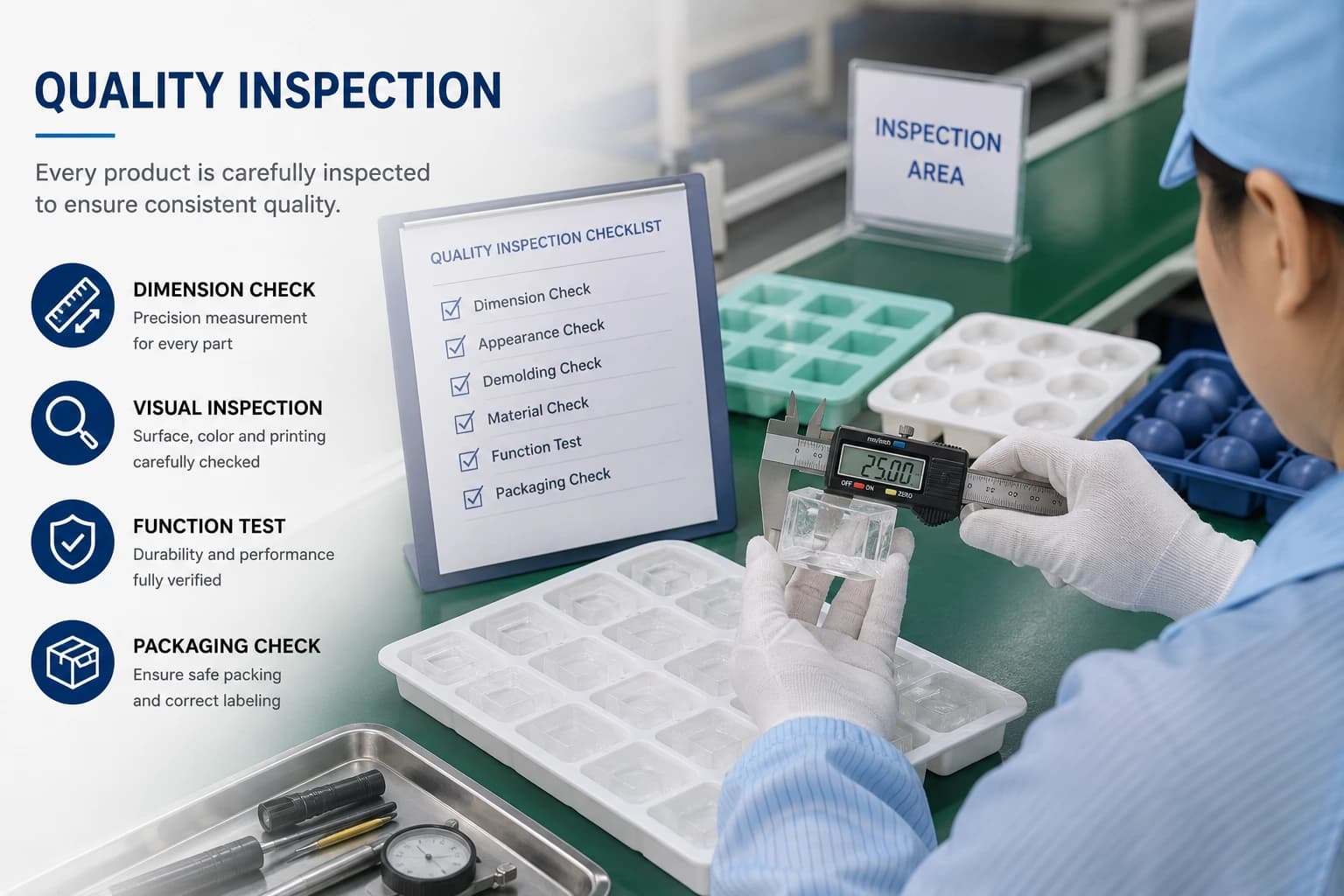
Practical scenario: Imagine you want a custom ice mold shaped like your company logo. The mold must have fine engraving, undercuts, and a smooth release surface. The tooling cost might be $800–$2,000. If your MOQ is 500 units, the tooling cost per unit is $1.60–$4.00. If you requested only 200 units, the per-unit tooling cost would be $4–$10, which may be uneconomical for the manufacturer. Thus, the supplier may set a higher MOQ to spread tooling cost.
Recommendation: Share a detailed 3D design file (STEP, IGES, or STL) with the manufacturer early. They can assess tooling complexity and provide a realistic MOQ and mold fee quote. If your design is symmetrical or uses a standard cavity shape, you may qualify for a lower tooling charge and a more favorable MOQ.
3. Packaging and Product Specifications
Core conclusion: Packaging choices—such as blister packs, poly bags, custom-printed boxes, or retail-ready displays—directly affect the MOQ because packaging materials are often ordered in bulk with minimum print runs.
For a related manufacturing reference, review custom silicone ice mold manufacturing.
Reasoning
Custom silicone ice molds are typically sold with custom packaging for branding and retail appeal. Packaging customization includes: poly bags with printed logos, header cards, folding cartons, or clamshell blisters. Each packaging component has its own MOQ from packaging suppliers. If a poly bag requires a custom print run, the bag printer may require a minimum order of 1,000 bags. That bag MOQ can then drive the total ice mold MOQ upward.
Example scenario: You want a custom ice mold in a retail-ready magnetic box with your logo. The box manufacturer demands a minimum run of 800 boxes. Even if the mold itself could be produced at 500 pieces, the packaging MOQ of 800 becomes the new bottleneck. The supplier may then set your overall MOQ at 800 to align both tooling and packaging.
Recommendation: Discuss packaging options with your supplier at the quotation stage. Standard packaging (plain poly bags, blank boxes) usually has no additional MOQ constraint. If you choose custom packaging, ask the manufacturer to clarify the minimum run for each packaging component. This helps you decide whether to invest in custom packaging or stick with standard options for a smaller trial order.
4. Sampling and Lead Time Planning
Core conclusion: Sampling is a critical step that affects both the MOQ and the overall timeline. Custom samples are not free, and their lead time influences when you can place the bulk order.
Reasoning
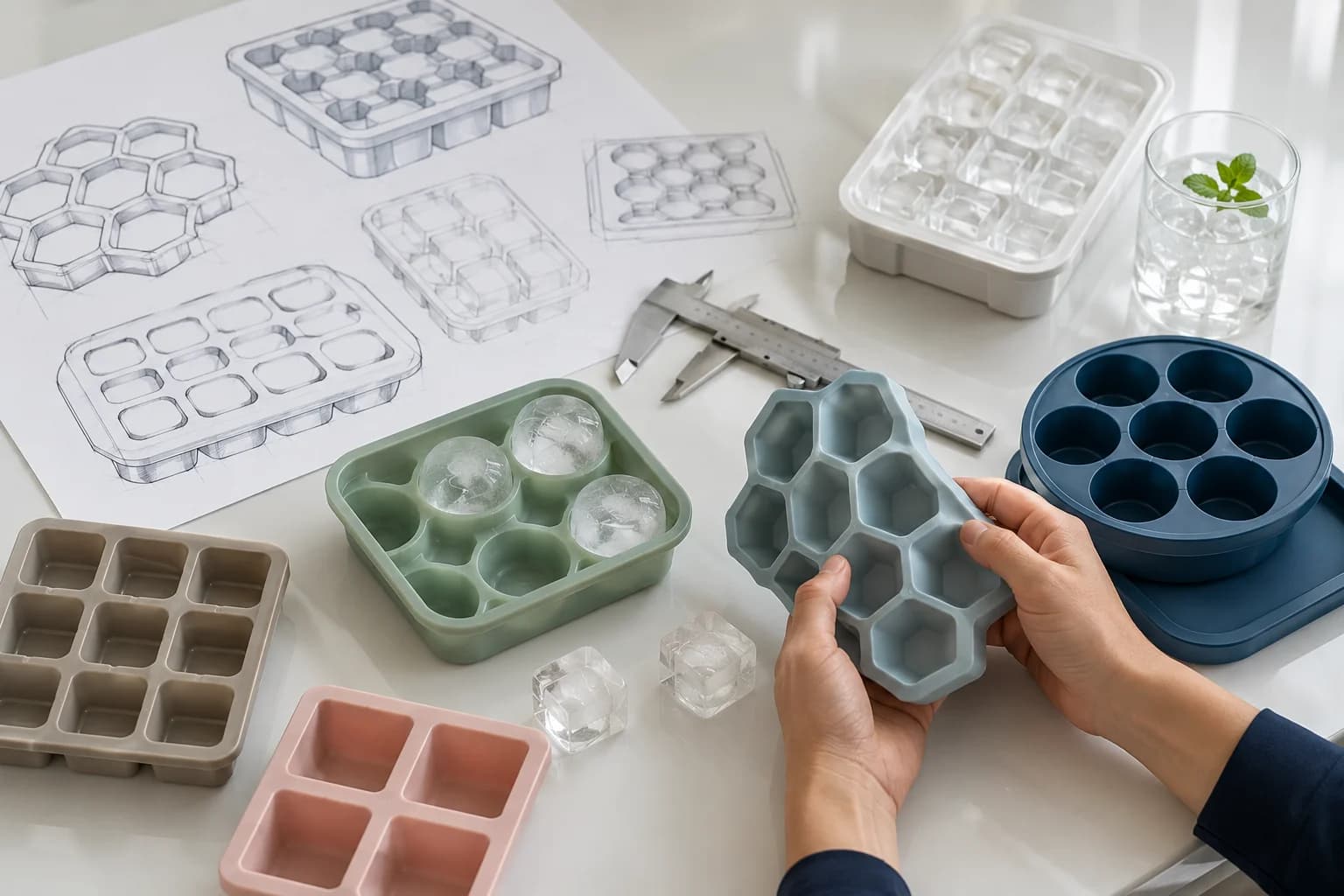
Before committing to a full production run, most buyers order samples to validate design, fit, color, and quality. The supplier offers two sample paths [K1]:
- Stock samples (if an existing mold matches your desired shape): available in 1–2 working days, subject to stock and shipping.
- Custom samples (new mold made for your design): lead time of 7–10 working days after design and specification confirmation.
Custom samples require a mold to be built. That mold fee is quoted separately and is typically non-refundable. The sample itself may be charged at a nominal rate or offered free under certain conditions—but eligibility, freight, and taxes are assessed case by case [K1]. Once the sample is approved, you proceed to mass production, which has a typical lead time of 15–20 working days after order confirmation [K1].
For additional context on this decision, see Custom Ice Mold Tooling Cost: What Buyers Pay For and Why.
Impact on MOQ: Sampling does not directly change the MOQ number, but it does affect your total timeline and cost. If you need to order a small quantity for a test market, you might negotiate a lower MOQ by agreeing to share the mold cost. Some suppliers are willing to accept orders below the base MOQ if you pay a higher per-unit price to cover the unmortgaged tooling.
Recommendation: Plan sampling into your project schedule. If you are time-sensitive, ask about stock samples first. For custom designs, allow at least 2–3 weeks for sampling and approval. This prevents delays that could push your bulk order beyond your target launch date.
5. Key Comparison: Factors That Influence Custom Ice Mold MOQ
The table below summarizes the main factors and their typical impact on MOQ. Use it as a checklist when discussing your project with a manufacturer.
| Factor | How It Affects MOQ | Typical Impact |
|---|---|---|
| Design complexity | Complex cavities require more expensive tooling; higher MOQ needed to amortize tooling cost. | +100 to +500 units for intricate shapes |
| Number of cavity inserts | Multiple unique cavity designs increase mold cost and setup time. | Each additional cavity may raise MOQ by 50–200 units |
| Custom packaging | Printed boxes, poly bags, or displays have their own MOQ, often higher than the mold MOQ. | MOQ may jump to 800–1,000 units |
| Color matching (Pantone) | Multiple color inlays may require separate tooling or manual processes. Minimal increase if color is simple. | Typically ≤10% MOQ increase |
| Logo/brand embossing | Requires precision engraving on the mold; no change if logo is on a flat surface. | Often no MOQ change unless logo is complex |
| Material color change | Different silicone colors can be produced in the same mold; no tooling change. | No direct MOQ impact |
| Production lead time | Rush orders may compress the schedule, but MOQ is usually unchanged. | NA (timeline adjusts) |
| Sample approval | A sample run does not alter bulk MOQ, but delays may shift production slots. | Indirect impact |
6. FAQ
Q1. Is the base custom ice mold MOQ always 500 pieces?
No. While 500 pieces is a common starting point for silicone OEM/ODM projects, the final MOQ is confirmed only after reviewing your design, tooling, packaging, and project requirements [K1]. Some simple designs may qualify for a lower MOQ (e.g., 300 pieces), while complex designs with custom packaging may require 800 or more pieces [K4]. Never assume a fixed number without a written quotation.
Before finalizing the specification, use Custom Silicone Ice Mold Lead Times: From Design Review to Mass Production as an additional planning reference.
Q2. Can I get samples before placing a bulk order?
Yes. Stock samples (if available) can be sent in 1–2 working days. Custom samples for your design require 7–10 working days after design confirmation. Free samples are possible for existing stock items, but custom samples, freight, taxes, and eligibility are determined case by case [K1]. Always confirm sample costs and shipping terms before requesting.
Q3. How do I keep the MOQ as low as possible?
- Choose a simple, symmetrical cavity design to reduce tooling cost.
- Use standard packaging (plain poly bags or unbranded boxes) instead of custom printed packaging.
- Limit the number of unique cavity shapes (one design per mold).
- Ask whether the supplier offers a “tooling shared” option where you pay a higher per-unit price to reduce the order quantity.
- Combine multiple color/design variations into a single order if the supplier allows it.
Q4. What happens after I approve a sample?
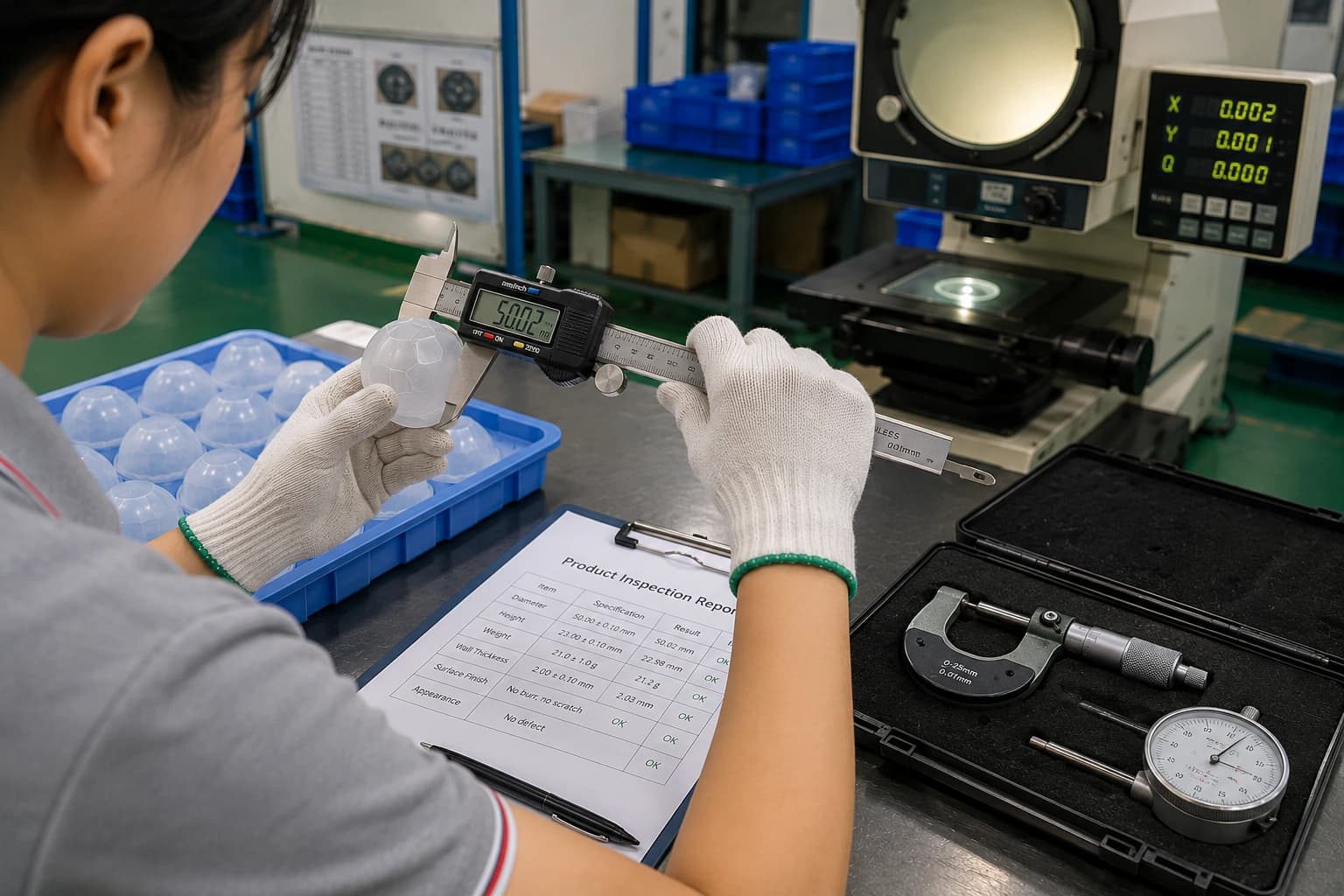
After sample approval, you place the mass production order. Confirm the final MOQ, mold fee (if not already paid), unit price, and delivery terms. The supplier then schedules production, which typically takes 15–20 working days [K1]. A pre-shipment inspection can be arranged to ensure quality before shipping.
7. Conclusion
The custom ice mold MOQ is not a static number; it is a function of design choices, tooling investment, packaging requirements, and production planning. By understanding these levers, you can make informed decisions that balance cost, speed, and order size. The base MOQ of 500 pieces serves as a useful benchmark, but every project deserves a tailored evaluation.
Next steps for buyers:
- Prepare a clear 3D design file and list your required customization (size, color, logo, packaging).
- Contact a silicone OEM/ODM manufacturer (e.g., Renjia) to request a quotation that includes MOQ, mold fee, sample policy, and lead time.
- Use the factor table in this article to discuss each element with the supplier.
- Plan sampling at least 2–4 weeks before your desired production date.
With a strategic approach, you can secure a custom ice mold MOQ that fits your budget and timeline—without surprises.