Key Takeaways
- Custom silicone ice molds are a design-led product line: cavity design, product shape, size, color, logo, and packaging are all adjustable variables rather than fixed catalog options [K1].
- The right shape usually follows from the occasion — weddings, bar service, brand promotion, or family use — so define the use case before drawing the mold.
- A custom ice tray project is a sequence, not a single purchase: design review, sampling, tooling, production, inspection, and packaging each carry their own decisions [K1][K3].
- MOQ, sample cost, freight, tooling fees, and dates should be confirmed per project in writing; they cannot be assumed as universal terms [K5].
- Buyers get better results when they arrive with drawings, size targets, color references, and packaging intent rather than a single inspiration photo.
1. Introduction
Ice used to be invisible. It filled a glass, chilled a drink, and disappeared. That has changed. Bars photograph their clear cubes, wedding planners treat ice as table decor, and brands now ship logo-embossed ice alongside the drink it cools. As a result, personalized ice trays have moved from a novelty kitchen item into a genuine design and sourcing category.
The problem is that most buyers who start searching for "custom shape ice mold ideas" quickly hit the same wall. Inspiration is everywhere, but the practical path is unclear: which shapes are actually manufacturable, what files a factory needs, what can be customized beyond the ice itself, and how a project moves from an idea to a repeatable production run.
This article answers those questions in order. It sorts custom shape ideas by occasion, explains which variables can genuinely be customized in a silicone ice mold, walks through the development sequence from design review to pre-shipment inspection, and flags the assumptions that most often cause friction between buyers and manufacturers.
2. Start With the Occasion, Then Choose the Shape
Core conclusion: The occasion determines the mold more than the shape does. A monogram cube that reads beautifully at a wedding can be awkward at a high-volume bar, and a large clear sphere that flatters whiskey is wasted in a children's party tray.
Ice is a visual product, but it is also a functional one. Shape affects how fast the block melts, how cleanly it releases from the cavity, how much freezer space the tray occupies, and how easily it can be washed. Choosing a shape first and a use case second tends to produce molds that photograph well and disappoint in service.
A practical way to sort ideas is by occasion:
- Weddings and celebrations. Monograms, initials, geometric facets, flower silhouettes, and ring or heart shapes work well here. Prioritize clarity of detail and clean edges over cavity count. A small tray with a crisp, deep-relief motif usually tells a better story than a large tray of generic cubes.
- Bars, cafés, and hotels. Favor single large formats — spheres, tall columns, oversized squares — and specify them by target block weight and the glass they must fit, not by cavity count alone. Large blocks freeze more slowly and require more freezer space, so plan storage before ordering volume.
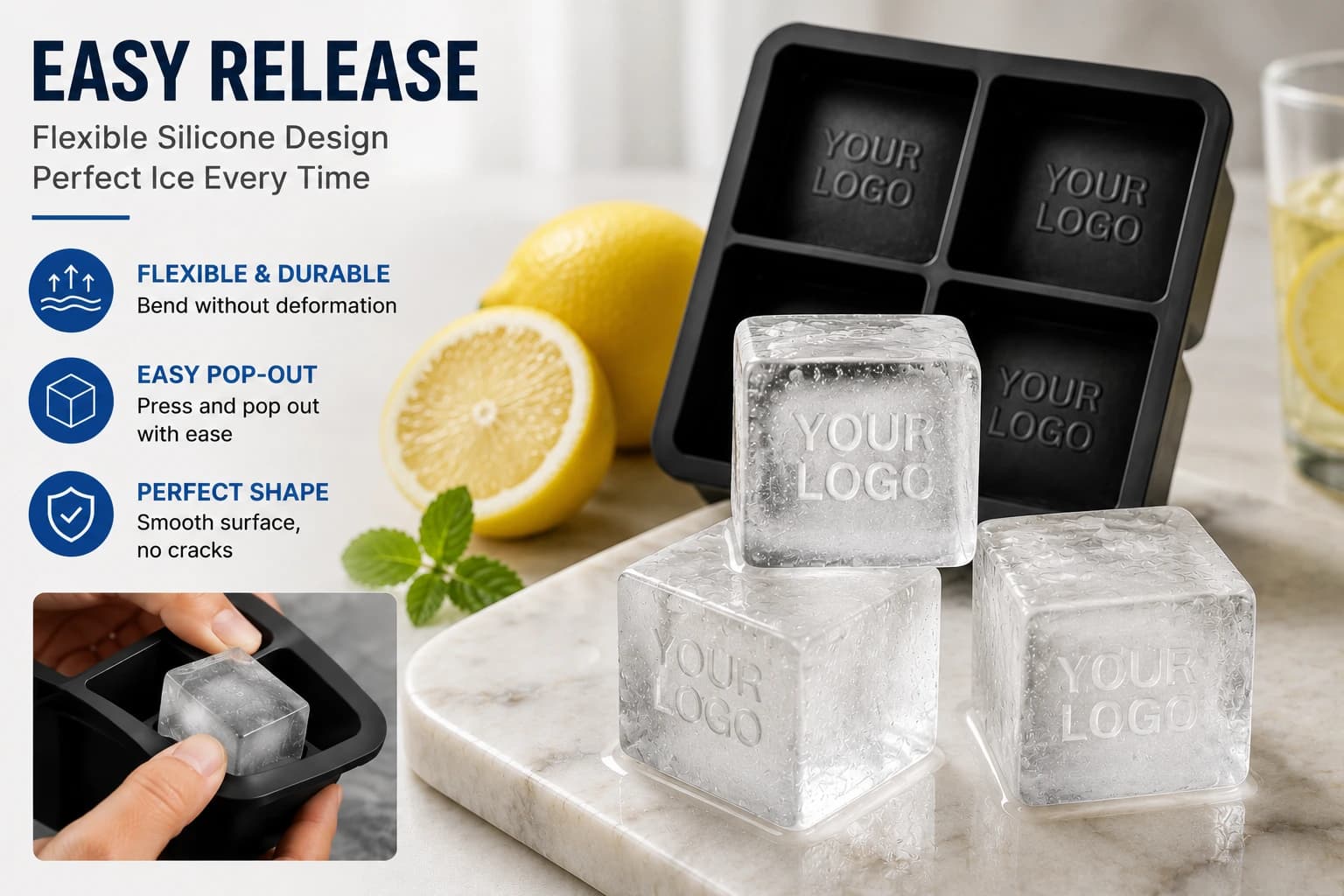
- Brand and promotional use. Logo-embossed cubes, brand-color trays, and retail-ready packaging turn a tray into a giveaway or resale item. Ice cube trays sit within a broader promotional silicone range that also includes ice ball trays and popsicle molds, so promotional buyers can often consolidate a campaign around one supplier [K2].
- Home and family use. Fruit slices, animals, seasonal motifs, and character concepts are the strongest performers. Detail depth matters here: very fine features can be hard to release by hand, so confirm the minimum feature size with the mold developer during design review.
- Seasonal and limited-edition drops. Pumpkin, snowflake, and summer motifs work as short-run collections. Treat these as sampling-led projects, because a motif that looks clear in 2D artwork may lose definition once it becomes a three-dimensional cavity.
Recommendation: Write a one-page brief before contacting any supplier. State the occasion, the drink or display context, the target block size, the expected order quantity range, and the packaging format. This single page shortens design review considerably and reduces the risk of paying for tooling on a shape that does not fit its purpose.
3. What Can Actually Be Customized in a Silicone Ice Mold
Core conclusion: Customization goes well beyond the silhouette of the ice. In a custom silicone ice mold project, the adjustable variables typically include cavity design, product shape, size, color, logo, and packaging [K1].
Each variable changes something different, and each one requires a different input from the buyer. The table below maps them so that a brief can be assembled in one pass rather than through several rounds of clarification.
| Customization variable | What it changes | What the buyer should prepare |
|---|---|---|
| Cavity design (ice shape) | Ice silhouette, detail sharpness, release behavior | 3D file or dimensioned 2D drawing [K1] |
| Tray body shape | Capacity, stacking, freezer footprint | Target outer dimensions |
| Size | Block volume, drink fit, freezing speed | Target block weight or edge length |
| Color | Brand match, shelf appearance | Pantone reference or physical color sample |
| Logo | Brand visibility, placement method | Vector logo file and preferred position [K1] |
| Packaging | Retail presentation, gifting readiness | Box, sleeve, hangtag, or bag specification [K1] |
Two variables deserve extra attention. The first is the logo. Embossed or debossed logos sit on the tray body or inside the cavity, and each placement behaves differently in use — a logo on the tray is visible in the box, while a logo in the cavity appears in the ice itself. Decide which impression matters more before approving artwork. The second is packaging, because retail-ready packaging often takes as long to develop as the mold itself and should be planned in parallel rather than after production.
For buyers building a first program, the most efficient starting point is a supplier that already develops custom silicone ice molds and understands how cavity geometry, wall thickness, and packaging interact. Reviewing a dedicated custom silicone ice molds capability page before the first call helps frame the right questions.
Recommendation: Do not send artwork alone. Send artwork plus dimensions, plus the intended ice volume, plus the packaging concept. Suppliers can only evaluate what has been specified.
4. How a Project Moves From Idea to Production
Core conclusion: A custom ice mold is developed in stages, and each stage produces a decision point. Skipping a stage usually costs more later than it saves early.
The typical sequence looks like this:
- Requirement and design review. The supplier reviews the concept against manufacturing realities: draft angles for release, wall thickness, cavity depth, and how the tray will be demolded by an end user. This is where most concept changes happen, and where they are cheapest.
- Design file preparation. Technical drawings, 3D models, logo vectors, color references, and packaging specifications are consolidated into a production-ready package [K3].
- Sampling. A physical sample lets the buyer check detail sharpness, tray rigidity, color accuracy, and logo legibility before committing to tooling. Sample approval is a genuine gate, not a formality.
- Tooling. Mold construction follows sample approval. Mold fees depend on the specific design evaluation and should not be treated as a fixed published number [K5].
- Production and inspection. A production run follows the approved sample. Pre-shipment inspection against an agreed checklist — dimensions, color, logo position, cavity consistency, packaging — is the standard safeguard [K3].
- Packaging and shipping. Final packing, labeling, and documentation are completed according to the agreed specification.

Timelines are frequently misjudged at the start of a project. Sampling rounds, tooling complexity, and packaging development all affect the schedule, and responsible suppliers confirm dates only after project review and in writing rather than quoting a generic lead time upfront [K5]. Buyers who need a fixed delivery date — for a wedding season, a trade show, or a holiday campaign — should build review and sampling time into their plan instead of assuming production starts on the day the idea is approved.
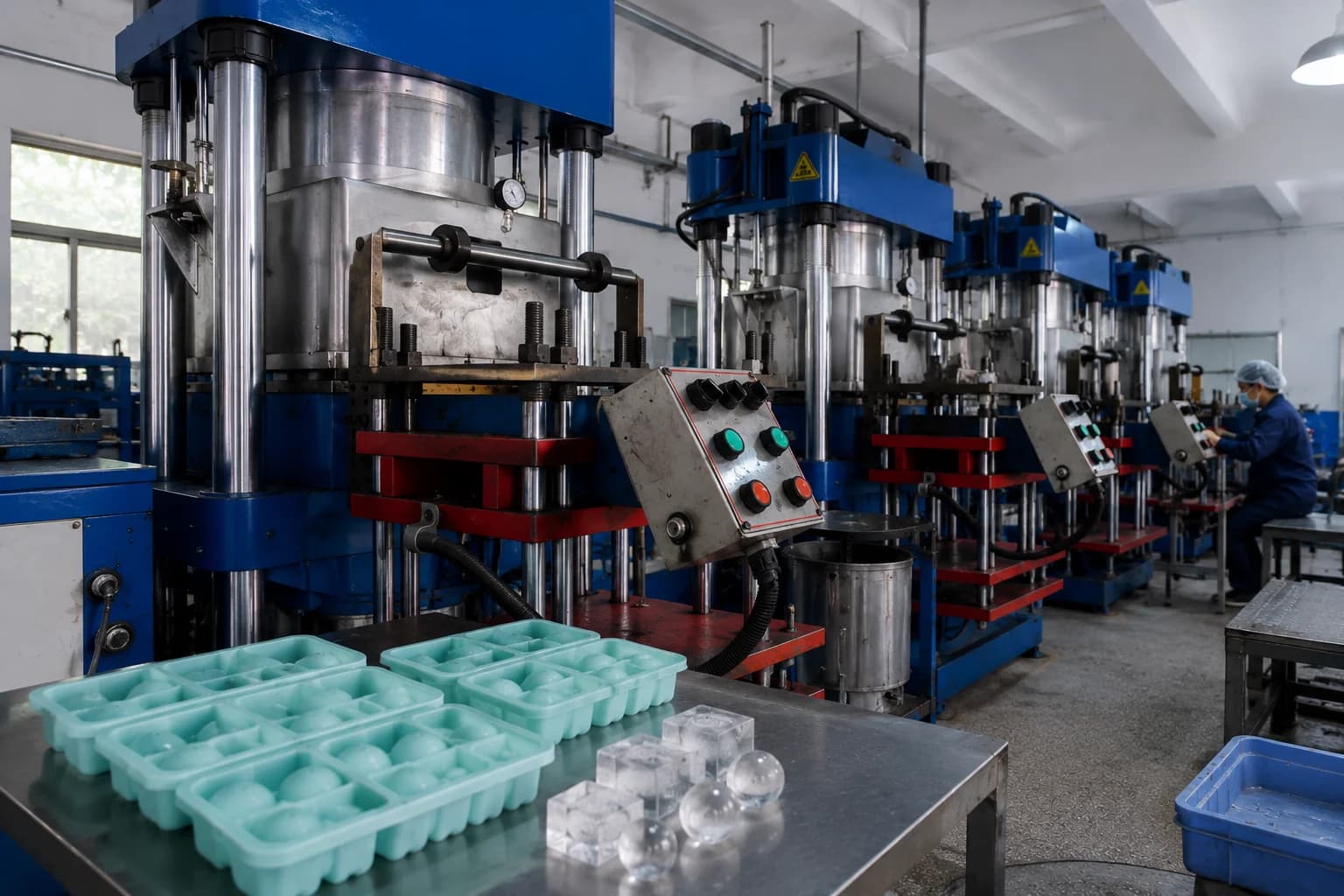
Working with a manufacturer that handles both mold development and downstream production reduces handoff risk, since tooling, sampling, and inspection stay under one quality process. Buyers comparing suppliers can assess silicone OEM/ODM support models to see whether design review, tooling, and inspection are offered as one coordinated service or split across vendors.
Recommendation: Ask for the sequence in writing before paying anything. A supplier who can describe the review, sampling, and inspection steps in specific terms is easier to plan around than one who only quotes a price.
5. Comparing Common Mold Styles
Different mold formats suit different buyers. The comparison below is a starting point for selection, not a ranking.
| Mold style | Best suited to | Strengths | Points to check |
|---|---|---|---|
| Large single-block tray | Bars, whiskey service, premium gifting | Strong visual presence, slow melt | Freezer space, block weight versus glass size |
| Sphere / ice ball tray | Cocktail bars, home entertaining | Distinctive shape, good for photography | Cavity consistency, release technique |
| Multi-cavity shaped tray | Weddings, events, family use | Thematic variety, easy gifting | Detail depth, hand-release difficulty |
| Branded promotional tray | Campaigns, giveaways, resale | Logo visibility, packaging options | Artwork approval, packaging lead time |
| Specialty formats (popsicle, soap-style) | Retail ranges, seasonal lines | Extends a product family | Separate tooling per format [K2] |
The most common selection error is choosing a format because it looks impressive in a photo without checking how it behaves in the freezer and in the hand. A deep, highly detailed cavity produces a striking cube but may require a short wait before release; a shallow, simple cavity releases easily but reads as generic. There is a trade-off in every direction, and the right answer depends on who will actually be using the tray.
6. Common Mistakes and Practical Cautions
Core conclusion: Most project problems come from assumptions about commercial terms, not from design failures.
Several terms are frequently misapplied across the industry, and buyers should verify each one rather than rely on general expectations:
- MOQ. A 500-piece minimum is not a universal guarantee for every custom project. Order quantity should be confirmed for the specific design and tooling [K5].
- Samples and freight. Free samples and free freight are not standard for every project and must be agreed explicitly [K5].
- Dates. Sampling, tooling, and production timelines should be confirmed after review and in writing, not promised verbally at the inquiry stage [K5].
- Mold costs. A fixed mold fee cannot be published responsibly without evaluating the design first [K5].
- Compliance claims. Market-specific documentation requirements should be planned realistically. Buyers should ask which documents the supplier can actually provide for their target market rather than accepting broad certification claims [K3].
Beyond commercial terms, two process mistakes recur. The first is submitting an inspiration photo with no dimensions, which forces the supplier to guess and produces a sample nobody intended. The second is approving a sample informally — by message rather than against a written checklist — leaving no agreed baseline for the production run. A structured custom silicone product development process usually resolves both, because it converts informal ideas into documented specifications before tooling begins.
Recommendation: Keep a short written record for every approval. Sample approved, color approved, packaging approved — each with a date. It is the simplest protection available in a custom manufacturing project.
7. FAQ
Q1. Are custom silicone ice molds suitable for everyday home use?
Yes, but usability should shape the design. Highly detailed cavities are memorable in photos and more demanding to release and clean by hand. For daily household use, favor moderate detail depth, a tray size that fits the freezer shelf, and a format that is easy to wash. Confirm cleaning expectations with the supplier during design review rather than after delivery.
Q2. How long does a custom ice mold project take?
There is no single reliable number. Duration depends on how many sampling rounds the design needs, how complex the tooling is, whether packaging must be developed in parallel, and how quickly approvals are returned. Sampling, tooling, and production dates should be confirmed after project review and in writing [K5].
Q3. Can I order exactly 500 pieces?
Not automatically. Minimum order quantities vary by design, tooling, and material planning, and an unconditional 500-piece minimum should not be promised for every custom project [K5]. Ask for the MOQ that applies to your specific drawing and target packaging.
Q4. What design files should I send to a manufacturer?
At minimum: a 3D file or dimensioned 2D drawing of the cavity and tray, a vector logo with preferred placement, color references such as Pantone numbers or physical swatches, and a packaging specification [K1][K3]. If your target market requires documentation, state that at the first inquiry so it can be planned into the project rather than added at shipment.
8. Conclusion
Custom shape ice molds work best when the design follows the occasion. A wedding program needs crisp, meaningful detail; a bar program needs consistent large blocks calibrated to glass size; a promotional campaign needs a readable logo and retail-ready packaging. Once the use case is clear, the customization conversation becomes specific: cavity design, tray shape, size, color, logo, and packaging can each be defined and approved in turn [K1].
The practical next step is to convert inspiration into a brief. Write down the occasion, the block size, the expected quantity range, the packaging format, and any market documentation requirements. Then ask a supplier to walk through design review, sampling, tooling, and inspection against that brief — and confirm commercial terms such as MOQ, sample cost, and dates in writing rather than assuming them [K5]. That sequence is what turns a good idea for a stylish custom silicone ice cube mold tray into a product that can actually be produced, repeated, and sold.