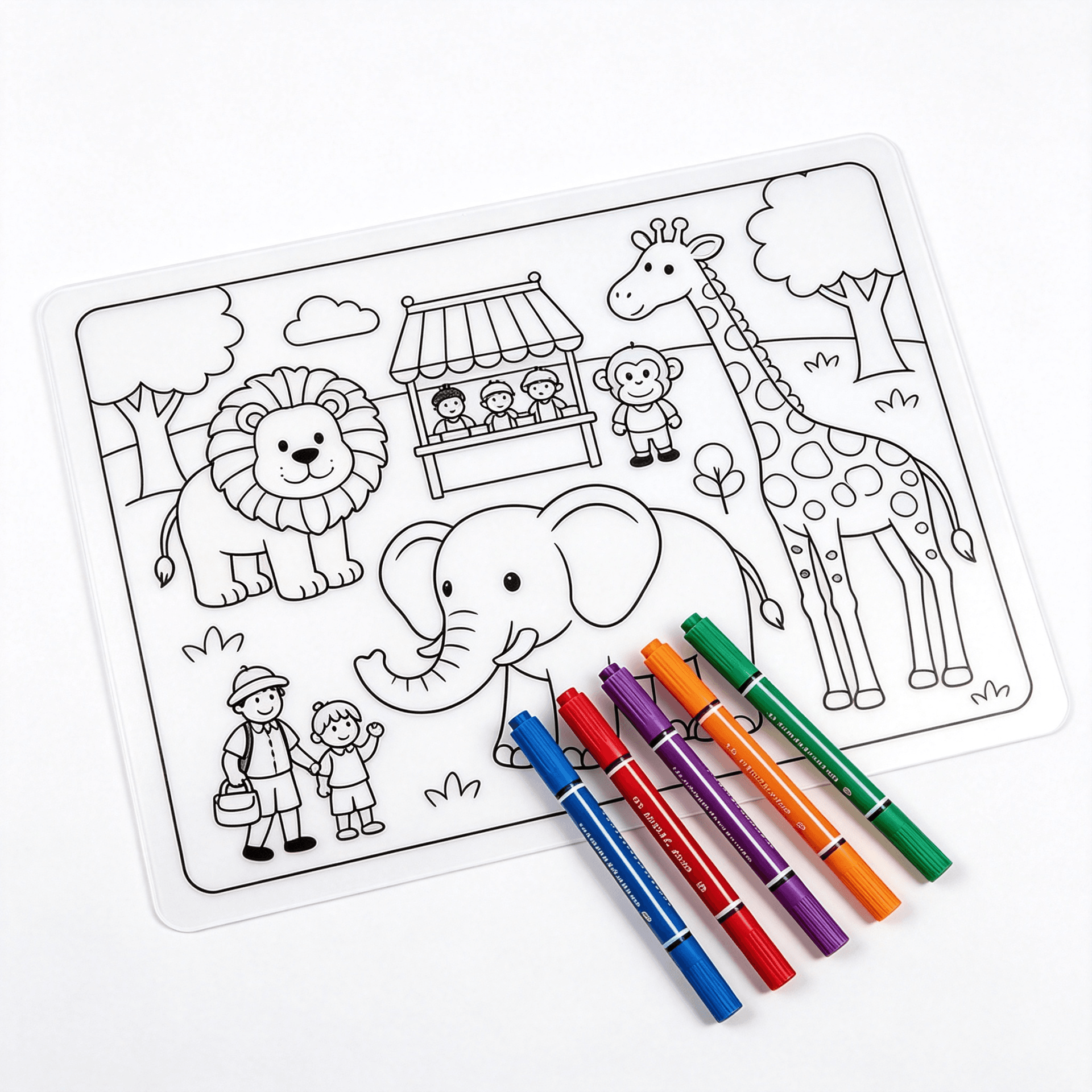
A silicone drawing mat can be a creative activity product, an educational tool, a hospitality giveaway, a travel item or a private-label retail set. The category looks straightforward, but a successful bulk project depends on more than choosing a picture and adding a logo.
The buyer must translate a market concept into a manufacturable brief. Artwork density affects how the surface reads. Mat size affects packaging and freight. The outer shape affects tooling and usable drawing space. Base color influences the visibility of printed or molded elements. Packaging affects how the mat is presented, stored and delivered. If the product is intended for children, the destination market and product classification can also change the testing and documentation plan.
This guide explains how brand owners, importers, retailers, educational-product companies, hospitality suppliers and promotional buyers can plan a custom silicone drawing mat from initial concept through sample approval and shipment inspection.
Short answer: what should a buyer define for a custom silicone drawing mat?
Define the intended user and sales channel, finished mat dimensions, outer shape, artwork, base colors, logo placement, packaging, order quantity and destination market. Submit editable artwork where possible. Approve a physical sample for dimensions, artwork clarity, surface quality, color, branding and packaging. Confirm project-specific testing and inspection requirements before mass production.
1. Start with the product role and sales channel
The product role tells the manufacturer what the mat needs to achieve. A large tabletop activity mat for home retail has different priorities from a compact travel set or a hospitality activity product.
Common application paths include education and creative activity, private-label retail, hospitality and travel, and promotional campaigns. Educational products may need clear learning themes and generous open drawing areas. Retail products normally need a complete system of mat, pack, label, barcode and optional accessories. Hospitality products may prioritize portability and table fit, while campaign products need delivery aligned with a fixed launch window.
Explain the channel in the first RFQ. “We need a silicone drawing mat” is a product name; “we need a private-label travel activity mat for ecommerce in the United States” is a development brief.
2. Build an artwork brief before creating the final illustration
Artwork is often the largest source of preventable revision. Designers may produce an attractive composition without knowing the final mat dimensions, corner shape, logo area, manufacturing boundaries or packaging fold.
Before final illustration, define:
- Finished mat width and height.
- Outer shape and corner style.
- Required blank drawing areas.
- Border or frame treatment.
- Logo position and required clear space.
- Artwork orientation.
- Product and packaging fold direction, if applicable.
- Any molded, printed or separately applied elements.
- Required languages or instruction space.
Preferred file formats
Editable vector files are the most useful starting point for line artwork and logos. AI, EPS, SVG or editable PDF files allow production teams to review paths, spacing and scale. High-resolution raster files may work for certain designs, but screenshots, flattened previews and images copied from a website can make revision difficult.
Include linked fonts or convert approved text to outlines. Confirm that the buyer has the right to use all characters, logos, illustrations and typefaces. A manufacturer can evaluate production feasibility, but it cannot validate the buyer’s intellectual-property rights.
Design for the finished size
Line artwork that looks balanced on a monitor may become crowded when reduced. Review the design at actual product size. Check small text, narrow gaps, isolated dots, dense patterns and lines that approach the edge. If the product will be photographed for ecommerce, make sure the core theme is still understandable at thumbnail scale.
The most useful artwork review is collaborative: the designer controls brand and learning intent, while the manufacturer identifies production boundaries. Neither side should approve a final file without the confirmed product dimensions.
3. Select dimensions and shape as one decision
“Custom size available” does not mean every size performs identically or costs the same. Dimensions affect material usage, tooling, cycle efficiency, packaging and master-carton volume.
Ask four questions:
- What table, tray, bag or retail pack must the mat fit?
- How much working surface does the artwork require?
- Will the mat be stored flat, rolled or folded according to the approved pack method?
- What overall dimensions can the sales channel accept?
Rectangular mats use space efficiently and give designers a predictable layout. A custom silhouette can strengthen a theme, but it may reduce usable surface, complicate artwork alignment and lower packaging efficiency. Thickness influences feel, flexibility, weight and pack volume. Review rectangle versus silhouette, corner treatment, border, thickness and packaging as one decision rather than copying a specification from an unrelated product.
4. Create a controlled color and branding specification
Color terms such as “blue,” “beige” or “pastel orange” are not sufficient for bulk production. Use an approved physical reference or color system where possible, and state how color will be judged.
For each project, identify:
- Silicone base color.
- Border or secondary color.
- Artwork colors.
- Logo color and production method.
- Accessory colors if the product is a set.
- Packaging color references.
Pantone-oriented matching can provide a common starting point, but material, finish and lighting influence perception. Approve a physical sample and retain the color reference. Branding may appear on the mat, packaging, insert or label; decide whether it is part of the activity artwork or a separate mark so it does not compete with the usable surface.
5. Treat packaging as part of the product architecture
Packaging should be discussed before the mat artwork is locked, because it can influence product dimensions, storage method and visual hierarchy.
Common directions include:
- Paper sleeve around a rolled or folded mat.
- Retail box with insert or window.
- Bag with label or header card.
- Kraft-style wrap for a simple private-label presentation.
- Multi-piece activity set.
- Bulk operational packing for hospitality or promotional distribution.
The correct option depends on price positioning, sales channel, protection and required information. A premium box may be unnecessary for an operational giveaway, while a loose bag may not communicate enough value for retail.
Packaging information to confirm
- Product orientation inside the pack.
- Fold or roll method.
- Finished retail dimensions and weight.
- Insert, instruction and warning content.
- Barcode, SKU and label position.
- Country-of-origin and importer information where applicable.
- Pack quantity and set components.
- Inner and master carton quantities.
- Carton marks and fulfillment labels.
- Drop, compression or transit checks requested by the buyer.
Approve a packed sample when the packaging is customized. A perfect unpacked mat does not prove that the full retail unit will arrive correctly.
6. Plan material and market requirements around the final product
Renjia’s current launch specification describes the drawing-mat material as food-grade, odorless silicone with a stated material temperature range of -40°C to 240°C. For a drawing mat, buyers should treat these as controlled product-line specifications—not as proof that every finished set automatically meets every rule in every country.
The final regulatory scope depends on factors including:
- Intended age group and user.
- Whether the product is marketed as a toy, educational article, table mat or general-use product.
- Destination country or region.
- Colorants, printed elements and accessories.
- Packaging claims and instructions.
- Retailer or marketplace requirements.
For products designed or intended primarily for children 12 years of age or younger in the United States, applicable children’s product safety rules may require third-party testing and a Children’s Product Certificate. The U.S. Consumer Product Safety Commission explains that the domestic manufacturer or importer issues the CPC based on results from a CPSC-accepted third-party laboratory for applicable rules. The laboratory does not replace the responsible party’s compliance decision.
This distinction matters in sourcing. A factory may support test-sample preparation, documents and laboratory coordination, but the buyer or importer still needs to identify the applicable rules and ensure that the final marketed product is covered. Testing an undecorated mat may not answer questions about a finished set with artwork, packaging and accessories.
Questions to ask before testing
- What is the intended product classification?
- Who is the responsible manufacturer or importer in the target market?
- Which final configuration will be tested?
- Are all colors, printed elements and accessories represented?
- Which laboratory and test scope have been selected?
- What changes would require a new review or retest?
- Which documents must accompany or be retained for the shipment?
Avoid the statement “all certificates included” unless the exact product, test report, issuing party, scope and validity can be verified.
7. Approve the sample as a complete sellable unit
Sample approval should cover the silicone part, artwork, branding and packaging. Use a written checklist and keep photographs or a signed reference.
Product specification checks
- Overall width, height and approved thickness.
- Outer shape, corners and border.
- Product weight if specified.
- Flatness and general form.
- Surface finish on both sides.
- Approved base color.
Artwork and branding checks
- Correct revision of the artwork.
- Layout, orientation and safe margins.
- Line clarity and small-detail reproduction.
- Logo size, position and appearance.
- Correct languages and spelling.
- Consistency between product and packaging artwork.
Visual and workmanship checks
- No unintended tears, holes, contamination or incomplete molding.
- Controlled flash or edge condition against the approved standard.
- No unacceptable surface damage, stains or distortion.
- Printed or applied elements reviewed for the intended use and cleaning instructions.
Product-application checks
Use the sample in the way the product will be presented. Place it on the intended type of surface. Review stability, usable drawing area, storage method and cleaning instructions. If accessories are included in the retail set, evaluate the set as supplied rather than making a broad compatibility statement about all third-party accessories.
Packaging checks
- All components present and correctly positioned.
- Product fits without unwanted permanent deformation.
- Pack opens and closes as intended.
- Barcode and labels are readable and correct.
- Instructions and warnings match the approved text.
- Retail pack and carton dimensions match the logistics plan.
Record every approved change. “Approved with comments” is risky when the comments are scattered across messages. Issue a consolidated revision and identify which sample becomes the production reference.
8. Move from sample approval to controlled production
The approved sample is the beginning of production control, not the end of quality work. The manufacturer must translate the approved result into repeatable settings and inspection points.
A practical sequence is: confirm the latest files, review incoming material requirements, inspect first production pieces, monitor dimensions and appearance in process, approve the packing start, conduct final inspection and retain an agreed shipment sample.
Renjia discloses two production lines, 12 machines and 10 QC staff, with stated monthly capacity up to 300,000 products. Buyers should confirm capacity and timing for the exact mat size, artwork process, packaging and order quantity. A capacity number across a factory is not the same as a guaranteed capacity for one customized SKU.
Renjia’s stated typical sample time is 2–7 days and typical mass-production time is 15–25 days. Use these as planning ranges after the design scope is clear. Artwork revisions, tooling, third-party testing and custom packaging can extend the schedule.
9. Inspect the shipment against the approved project standard
A pre-shipment inspection should use the purchase order, approved sample, specification sheet, artwork revision and packaging files. Without those references, an inspector can count pieces and identify obvious damage but cannot reliably confirm the buyer’s product.
The inspection scope can include:
- Product identity, color and dimensions.
- Workmanship and surface condition.
- Artwork and logo revision.
- Quantity and set completeness.
- Retail packaging, inserts and labels.
- Barcode scan check where requested.
- Inner and master carton count.
- Carton dimensions, weight and marks.
- Defined application or handling checks.
- Required reports or shipment documents.
Separate critical, major and minor defect examples based on product risk and customer requirements. Do not copy an acceptance plan from an unrelated product category. The buyer, manufacturer and any third-party inspector should agree on the sampling and release rule before the inspection date.
10. Understand the real cost drivers
The unit price is influenced by more than silicone weight. Common cost drivers include:
- Finished dimensions and thickness.
- Outer shape and tooling complexity.
- Number of colors and artwork process.
- Logo method.
- Accessories and assembly.
- Custom retail packaging.
- Testing and documentation scope.
- Order quantity and color split.
- Packing efficiency and shipping volume.
Renjia can accept custom orders from 500 pieces. Orders of 1,000 pieces generally offer more favorable unit pricing. The final MOQ can depend on artwork, mold requirements, accessories, packaging and production setup. When comparing quotations, make sure each price includes the same artwork, pack and testing assumptions.
Ask for a cost breakdown by project stage
Request separate visibility for tooling, samples, unit product, accessories, packaging, testing, inspection and freight. This does not require the factory to disclose proprietary internal costs. It simply prevents one quotation from appearing lower because necessary items were excluded.
11. Use a supplier-evaluation checklist
Before placing the order, confirm that the manufacturer can review incomplete concepts, explain tooling assumptions, control the approved sample, define first-piece and final checks, coordinate project-specific testing, quote the complete configuration and explain what is included in sample and production timing. Certification statements should remain limited to the tested scope. A supplier that asks detailed questions may appear slower during the first exchange, but scope clarification is often a sign that the project is being treated as a manufactured product rather than a generic catalog item.
12. Custom drawing mat RFQ template
Use this template in your first inquiry:
Application/channel: [retail / education / hospitality / travel / promotion]
Intended user or age group: [describe without assuming classification]
Finished dimensions: [width × height × thickness if known]
Outer shape: [rectangle / custom silhouette]
Artwork: [attached AI / EPS / SVG / PDF / reference]
Base and artwork colors: [Pantone references or sample]
Logo location: [mat / packaging / insert / accessories]
Accessories: [list or none]
Packaging: [bag / sleeve / box / set / undecided]
Initial order quantity: [pieces and color split]
Destination market: [country/region]
Testing/documentation: [known retailer or regulatory requirements]
Sample deadline: [date]
Delivery deadline and destination: [date and location]
Label the file revision and state which items are confirmed versus open for review.
Frequently asked questions
Can the artwork be completely customized?
Yes. A buyer can submit a theme, characters, educational concept, brand artwork or reference. The manufacturer should review the layout, line detail, scale, logo area and production feasibility before final approval.
Can the size and outer shape both be changed?
Yes. The best result comes from reviewing size, shape, artwork and packaging together. A custom silhouette may change usable surface and pack efficiency, so it should not be approved in isolation.
What artwork file should I send?
Editable vector artwork is preferred for line designs and logos. AI, EPS, SVG or editable PDF files are helpful. Include fonts or outline approved text, and provide a clear revision number.
What is the typical MOQ?
Renjia can accept custom orders from 500 pieces, while orders of 1,000 pieces generally offer more favorable unit pricing. Artwork method, mold requirements, colors, accessories and packaging can affect the final quantity and price tier.
How should a drawing mat sample be approved?
Check dimensions, outer shape, color, surface, artwork revision, logo, workmanship, intended application, pack method, labels and set completeness. Approve the complete retail unit if custom packaging is part of the order.
Is a free sample available?
Renjia states that free samples are available. Shipping, quantity and the difference between a stock reference sample and a newly customized sample should be confirmed with the project team.
Does every drawing mat require a CPC?
No universal answer should be given without the product classification, intended age group and destination market. For applicable U.S. children’s products, the responsible domestic manufacturer or importer may need third-party testing and a CPC covering the relevant rules. Confirm the scope for the final product.
Conclusion
A high-quality private-label silicone drawing mat begins with a coordinated brief. The intended user, artwork, dimensions, outer shape, colors, branding, packaging and destination market must be reviewed as one product system. The buyer then needs a controlled sample, clear acceptance criteria and a shipment inspection based on the approved files.
This process protects both creativity and commercial execution. It gives designers clear boundaries, gives the factory a manufacturable target and gives procurement a basis for comparing quotations and releasing the shipment.