Key Takeaways
- Diamond ice golf balls are large, round or lightly faceted ice spheres produced in silicone cavity molds. Their practical value is slower dilution, a cleaner look in the glass, and a stronger premium signal on a cocktail menu than standard cubed ice.
- Tray ice and ball ice solve different problems. Trays maximize output, stacking, and service speed; ball molds trade throughput for presentation and melt performance.
- Mold performance depends on geometry, lid design, silicone hardness, and fill-line control — not on the shape alone. A well-designed cavity demolds cleanly; a poorly designed one cracks ice or traps water.
- Customization is routine in silicone ice mold projects (cavity design, shape, size, color, logo, packaging), but MOQ, tooling fees, sampling time, and lead time must be confirmed in writing after design review — never assumed [K1][K5].
- Treat any catalog or portfolio diagram as a starting point. Confirm current availability, material composition, dimensions, certifications, MOQ, and lead time before publishing a product page or issuing a quotation [K4].
1. Introduction
Ice is the least expensive ingredient in a cocktail and the easiest one to get wrong. A bar that spends carefully on spirits and citrus can still serve a drink that turns watery in six minutes because the ice was small, cloudy, or fractured. That is why the shape of the ice — and the mold that produced it — has become a design decision rather than an afterthought.
Two formats dominate the conversation. The first is diamond ice golf balls: large spherical or slightly faceted pieces, roughly the size of a golf ball, that read as "diamond" ice in a tumbler or a rocks glass. The second is tray ice — the familiar grid of cubes, produced in flexible trays that may include a lid, a storage bin, or a combination of cavity shapes in a single unit.
This article answers three practical questions. What does a diamond ice golf ball actually do for a drink, beyond looking good? When should a bar, brand, or retailer choose tray ice instead? And for buyers sourcing custom silicone ice molds, what has to be verified before a design becomes a repeatable order? The guidance below is written for bar operators, beverage brands, promotional product buyers, and sourcing teams who need to compare formats and plan a mold project without overcommitting on unverified specifications.
2. What Diamond Ice Golf Balls Actually Do in the Glass
Core conclusion: The benefit of a large ball is geometric, not mystical. A bigger piece of ice has less surface area relative to its volume, so it melts more slowly and dilutes the drink more gradually. The "diamond" treatment — a faceted or polished spherical form — adds visual structure and catches light, which is why it appears so often in whiskey serves and stirred, spirit-forward cocktails.
The reasoning is straightforward. Dilution rate is driven by exposed surface area and by how quickly the meltwater leaves the glass. A single large sphere exposes less surface than the same weight of small cubes, and it sits lower in the liquid, so the drink stays colder with less water for longer. This is a directional effect, not a guarantee: a warm glass, a warm spirit, and a warm room will all accelerate melting regardless of shape. Ice quality (clear, dense, tempered) matters as much as geometry.
Where the format earns its place:
- Spirit-forward serves. Whiskey on the rocks, old fashioneds, Negronis, and stirred drinks where the drink is expected to evolve slowly.
- Presentation-led service. A single large sphere in a rocks glass is legible from across a room and photographs well — useful for menus, social content, and tasting flights.
- Batch and bottle service. Pre-frozen balls held in a freezer drawer let a server build a consistent drink without a clear-ice program.

Where it does not:
- High-volume, fast-turn drinks. If a bar goes through hundreds of drinks per shift, hand-loading single-cavity ball molds becomes a bottleneck.
- Tall or narrow glassware. A golf-ball-sized sphere physically will not fit; measure the glass before specifying a diameter.
- Carbonated cocktails. Large ice is gentler on carbonation, but a slow-pouring melt profile is not a substitute for proper chilling of the mixer.
For buyers building a private-label or branded ice program, the practical route is a custom cavity mold rather than a stock shape. Suppliers in this category typically customize cavity design, product shape, size, color, logo, and packaging, so the ball can be sized to the glassware and the brand [K1]. A useful starting point is the range of custom silicone ice molds built for exactly this kind of format-specific work.
3. Tray Ice Versus Single-Ball Molds: Matching the Mold to the Serve
Core conclusion: Choose the mold based on service volume and glassware, not on which shape looks better in a product photo. Trays win on throughput and storage; ball molds win on presentation and melt performance.
Tray formats are more varied than most buyers expect. A single silicone tray might combine several cavity types, include a fitted lid to reduce freezer odors and spills, or sit inside a rigid frame that makes carrying a full tray of water feasible. Portfolio structures in this category commonly place ice cube trays and ice ball trays under promotional use, while ice block molds appear under household products — and the same physical product can legitimately serve household, kitchen, and promotional use cases, so category placement should not restrict how the product is marketed [K2][K4].
The trade-offs look like this:
| Consideration | Tray ice (multi-cavity) | Diamond ice golf balls (ball cavities) |
|---|---|---|
| Output per freeze cycle | Higher — many cubes per tray | Lower — one piece per large cavity |
| Service speed | Fast; scoop and go | Slower; hand placement per glass |
| Dilution profile | Faster melt with smaller cubes | Slower melt with larger mass |
| Visual impact | Neutral, expected | High; reads as premium |
| Freezer space | Stacks efficiently when lidded | Bulky per piece |
| Best fit | High-volume bars, home freezers, retail multipacks | Whiskey programs, tasting flights, gifts, brand activations |
| Customization potential | Cavity layout, size, lid, color, logo, packaging [K1] | Sphere diameter, facet pattern, color, packaging [K1] |
A practical middle path is a combination tray: one unit with both cube cavities and a small number of large round cavities. It gives a venue presentation ice for the drinks that need it without dedicating an entire freezer shelf to a single format. For retail, the combination tray also sells better as a gift item because it demonstrates more than one use.
One caution on sizing: specify the ball diameter against the actual glassware and the actual pour volume. A sphere that displaces too much liquid forces a smaller pour or an overflow, and a sphere that is too small under-delivers on the melt benefit. Ask for a physical sample in the target glass before approving a cavity.
4. Design Details That Decide Whether the Mold Works
Core conclusion: Most complaints about silicone ice molds — cracked ice, cloudy pieces, hard demolding, spilled trays — trace back to design and material choices, not to user error.
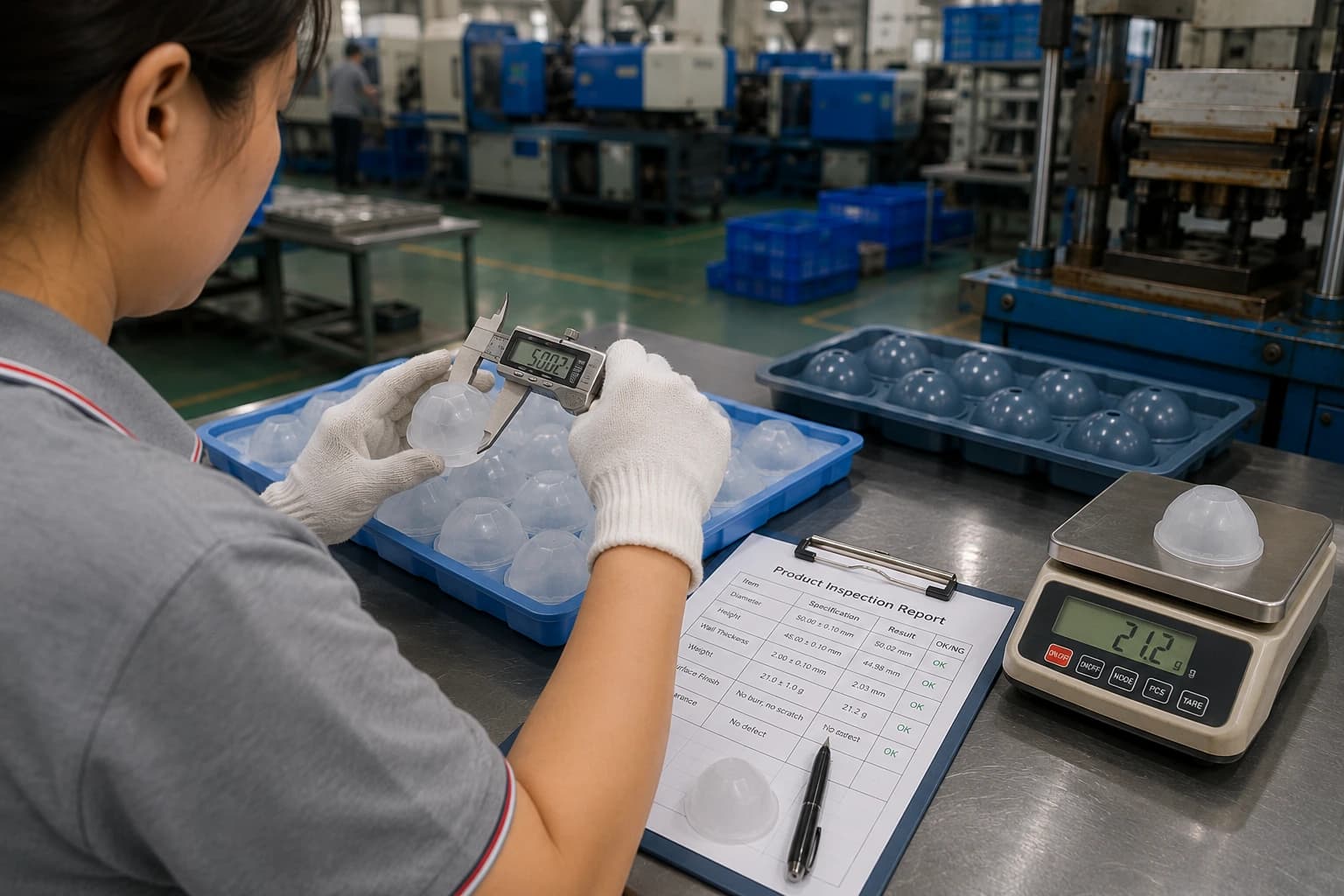
Four variables matter most:
- Cavity geometry and draft. Water expands by roughly nine percent as it freezes. A cavity with insufficient allowance for that expansion, or with undercuts that grip the ice, will produce fractured pieces or force the user to twist the mold aggressively. Rounded internal transitions and a slight draft help the piece release cleanly.
- Silicone hardness. Softer silicone demolds large spheres more easily but can deform when a full tray is lifted. Harder silicone holds shape but demands more force at release. The right balance depends on cavity size and whether the tray has a rigid frame.
- Lid design. A fitted lid reduces freezer odors, prevents spillage during transfer, and — in stackable designs — allows multiple trays to be used at once. For premium cocktail ice, the lid is not a nice-to-have.
- Fill-line control. Overfilling produces a domed, uneven piece; underfilling produces a small, irregular one. A visible fill line or a rim-and-channel design makes consistent output achievable by staff who are not ice specialists.
Two quality notes deserve attention during sampling. First, clarity: cloudy ice usually comes from dissolved air and mineral content in the water plus freezing speed, not from the mold itself, so a mold project cannot promise optically clear ice without a water and freezing protocol alongside it. Second, odor transfer: silicone can absorb freezer smells over time, which is an argument for lids and for specifying the material and any post-cure requirements with the supplier rather than assuming.
Design intent has to be communicated in files the factory can actually build from — dimensions, tolerances, draft angles, surface finish, and logo placement. Buyers who want to avoid a slow back-and-forth should review design-file preparation for custom silicone molds before the first sample round.
5. Sourcing a Custom Ice Mold: The Sequence That Avoids Rework
Core conclusion: A custom ice mold is a small tooling project, not a catalog order. The sequence — design review, sampling, tooling, then production — is what keeps specifications, cost, and timing honest.
A realistic project flow:
- Brief and design review. Define the use case (bar service, retail multipack, promotional gift), the cavity layout, target piece dimensions, color, logo, and packaging. Design evaluation comes first because mold cost and feasibility follow from geometry.
- Sampling. Produce physical samples and test them under real conditions: fill, freeze, demold, and place in the intended glass. Sample approval should include a written checklist rather than a visual judgment alone.
- Tooling and confirmation. Tooling scope and cost are set after the design is evaluated. No legitimate supplier should publish a fixed mold fee before seeing the design [K5].
- Production and pre-shipment inspection. Confirm the inspection criteria — cavity dimensions, wall thickness, cosmetic defects, logo alignment, packaging — before the run, not after.
- Packaging and market planning. Retail packaging, labeling, and any market-specific compliance requirements should be planned in parallel with production, and compliance claims should be limited to what can actually be documented for the destination market.
Three boundaries are worth stating plainly, because they are the most common source of friction in this category:
- MOQ is project-specific. Do not assume an unconditional 500-piece minimum applies to your project; volume depends on cavity design, tooling, and packaging [K5].
- Samples and freight are commercial terms, not defaults. Free samples and free freight are not standard commitments [K5].
- Dates require written confirmation. Sampling, tooling, and production schedules should not be treated as guaranteed until the project has been reviewed and confirmed in writing [K5].
Buyers who want a fuller picture of how these stages connect can review the silicone OEM/ODM sampling and tooling process, which maps the handoffs between design, sample approval, and production release.
6. Buyer Checklist and Format Comparison
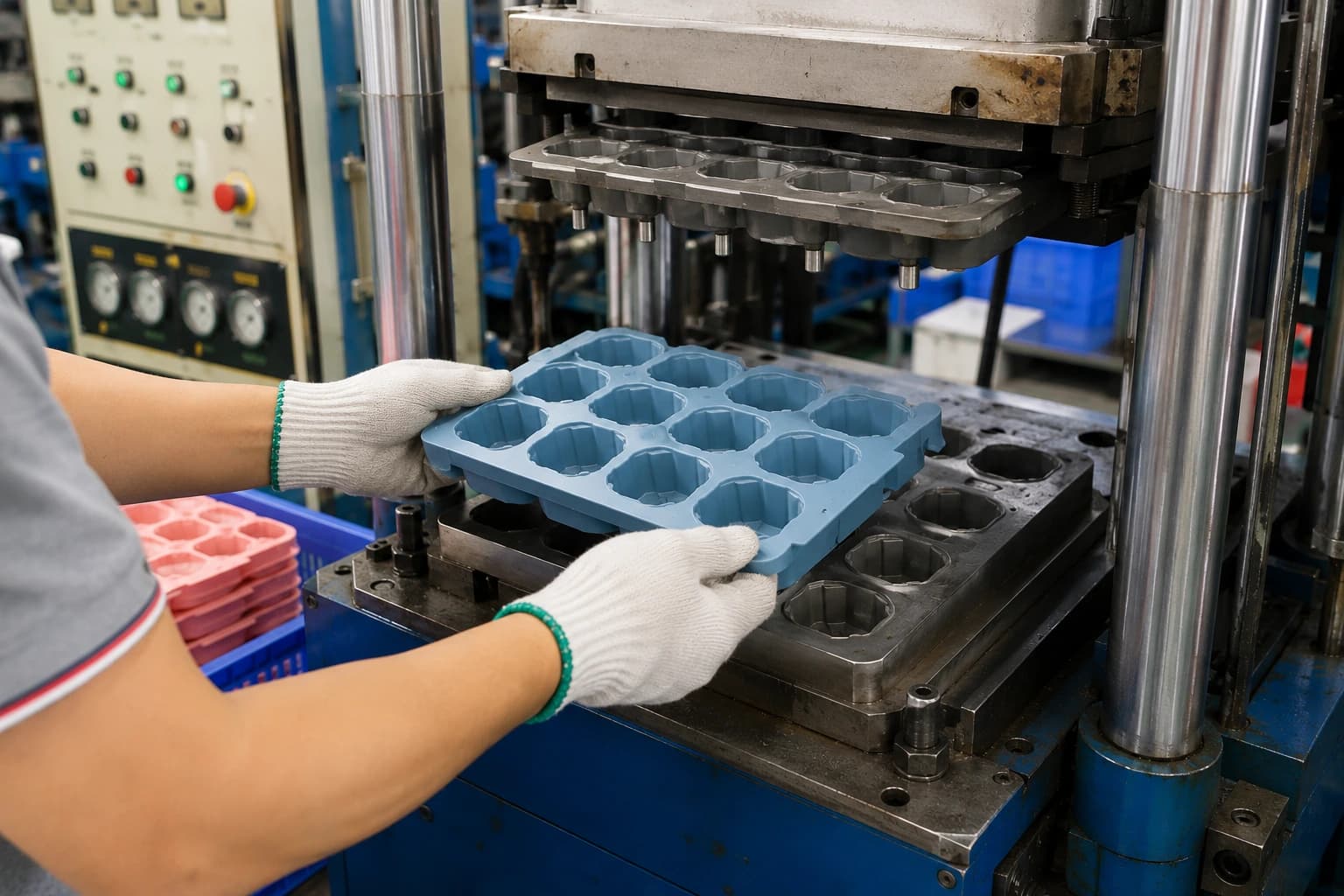
Use the following as a pre-quote checklist. Each item is something that should be confirmed in writing rather than inferred from a catalog image or a portfolio diagram [K4].
| Check | Why it matters |
|---|---|
| Current availability of the specific cavity layout | A portfolio shows reported capability, not guaranteed stock for every market [K4] |
| Material composition and silicone hardness | Determines demolding behavior, durability, and feel |
| Exact piece dimensions and cavity count | Must match glassware and freezer space |
| Lid and stacking design | Affects odor protection, spillage, and storage efficiency |
| Customization scope: color, logo, packaging | Confirms what is standard versus what adds tooling or setup |
| MOQ for this specific design | Volume depends on the project, not a universal number [K5] |
| Tooling cost after design evaluation | Mold fees cannot be fixed before the design is reviewed [K5] |
| Sampling plan and approval criteria | Prevents disputes at pre-shipment inspection |
| Lead time, confirmed in writing | Schedules are not guaranteed before project review [K5] |
| Market-specific compliance documentation | Limit claims to what can be documented for the destination market |
A simple decision rule: if the venue serves more than a few dozen whiskey-forward drinks per shift and needs speed, specify lidded tray ice with a cube format and keep a small ball mold for signature serves. If the product is being sold as a gift, a branded activation item, or a premium retail SKU, lead with the diamond ice golf ball format and treat the tray cavities as a secondary benefit.
7. FAQ
Q1. Are diamond ice golf balls actually better for a cocktail, or is it just presentation?
Both, but the functional part comes first. A large sphere has less exposed surface area relative to its volume than the same weight of small cubes, so it typically melts more slowly and dilutes the drink more gradually. The visual benefit — a large, light-catching piece in the glass — is real but secondary. The effect is directional, not absolute: glass temperature, spirit temperature, and freezer conditions all influence how fast any piece of ice melts.
Q2. Can I order a custom ice mold with my logo and packaging?
Yes, that is standard scope in this product category. Typical customization covers cavity design, product shape, size, color, logo, and packaging [K1]. What varies by project is the commercial framing: tooling cost follows design evaluation, MOQ depends on the specific design, and sampling and production dates require written confirmation rather than assumption [K5].
Q3. How do I choose between a tray and a single-ball mold?
Match the mold to service volume and glassware. Trays produce more pieces per freeze cycle and stack efficiently, which suits high-volume bars and retail multipacks. Single-ball cavities produce fewer, larger pieces per cycle but deliver better presentation and a slower melt — a better fit for whiskey programs, tasting flights, and gift or promotional products. Combination trays with both cavity types are a reasonable compromise when freezer space is limited.
Q4. Will a silicone mold guarantee clear ice?
No. Clarity depends mainly on water quality — dissolved air and minerals — and on how the ice freezes, not on the mold alone. A mold can support clearer results through cavity shape and fill-line control, but a clear-ice outcome requires a water and freezing protocol developed alongside the mold. Ask suppliers to separate mold performance claims from ice-clarity claims.
8. Conclusion
The choice between diamond ice golf balls and tray ice is not a matter of taste alone. It is a decision about service speed, glassware, melt behavior, and how much presentation the drink needs to carry. Large faceted spheres earn their place in spirit-forward and presentation-led serves; lidded multi-cavity trays earn theirs in volume, storage, and retail packaging. Many operations are best served by both, with the tray doing the daily work and the ball mold reserved for the drinks that are meant to be looked at.
For buyers moving from concept to order, the sequence matters more than the shape: define the use case, evaluate the design, approve a physical sample in the real glass, then confirm tooling, MOQ, lead time, and inspection criteria in writing. Treat any product portfolio or catalog as evidence of capability rather than proof of current stock, and verify material, dimensions, certifications, and availability for your specific market before publishing a product page or issuing a quotation [K4]. That discipline is what turns a creative ice mold into a repeatable, sellable product rather than a one-off sample.