Key Takeaways
- A silicone tray cannot produce true nugget ice. Nugget ice is a machine-made, compressed, porous product; a tray produces small, dense bullet-shaped pieces that are easier to chew than large cubes.
- The performance of bullet ice molds depends more on cavity geometry, silicone firmness, wall thickness, fill method, and release design than on marketing language.
- The “best” ice nugget tray is use-case specific: piece size, tray footprint, freezer space, release effort, and cleaning all matter more than cavity count alone.
- For private-label buyers, confirm material composition, dimensions, cavity count, MOQ, sampling steps, lead time, packaging, and market-specific documentation before quoting or publishing product claims.
1. Introduction
Chewable ice has a devoted following. People search for a “nugget ice mold” because they want the soft, pellet-like ice they associate with certain restaurants, hospitals, and convenience-store drinks. What many shoppers actually find is a silicone tray that makes small cylindrical or rounded pieces — commonly called bullet ice. The terminology gap creates confusion: buyers expect a texture that a passive mold cannot deliver, and sellers sometimes overstate what a tray can do.
This article separates the two categories, explains how bullet ice molds work in a home freezer, and shows how to judge an ice nugget tray by the variables that actually affect the result. It also covers the sourcing side: what brands and retailers should define before ordering custom silicone ice molds, and which details should be verified rather than assumed.
The goal is not to crown a single product. It is to give you a practical decision framework so you can choose a tray that matches how you use ice — and avoid claims that a mold cannot support.
2. Nugget Ice vs. Bullet Ice: What a Tray Can and Cannot Do
Core conclusion: True nugget ice and bullet ice are different products made by different processes. A tray can approximate the size and rounded shape of bullet ice, but it cannot reproduce the soft, porous, compressed texture of machine nugget ice.
Nugget ice is typically made by freezing water on a chilled surface, scraping off thin flakes, and compressing those flakes into small nuggets. That compression and the trapped air give nugget ice its characteristic chewable, snow-like bite. Bullet ice is formed by filling small cavities with water and freezing it in place. The result is denser, firmer, and more regular in shape.
That difference matters to anyone shopping for an “ice nugget tray.” A silicone tray gives you small pieces that chill drinks quickly and are less intimidating to chew than a large cube, but the pieces will still be solid ice. If softness is the priority, a countertop nugget ice machine is the appropriate category — not a mold.
What a tray can do well:

- Produce small, rounded or cylindrical pieces that fit comfortably in a glass.
- Create consistent portions for iced coffee, soda, cocktails, and kids’ drinks.
- Let you control water quality and batch size.
- Support branded or custom shapes through mold design.
What a tray cannot do:
- Recreate the porous, compressed structure of machine nugget ice.
- Guarantee a soft bite; ice hardness depends on temperature and how the piece is frozen.
- Match the continuous output of an appliance.
Practical advice: If you are buying for texture, set expectations around “small chewable-style pieces,” not “soft nugget ice.” If you are selling, describe the shape and size accurately. Renjia’s custom silicone ice mold program treats cavity design, product shape, size, color, logo, and packaging as separate specification points [K1], which is the right level of granularity for this category.
3. How Bullet Ice Molds Work: Design Variables That Decide the Result
Core conclusion: Two trays with the same cavity count can perform very differently. The useful comparison is not “how many bullets,” but how the cavities, walls, and release features work together.
A bullet ice mold is a tray of small, usually cylindrical cavities with rounded ends. You fill the cavities with water, freeze the tray, then flex or twist the silicone to release the pieces. The design details below determine whether that process is easy or frustrating.
| Design variable | Why it matters | What to check |
|---|---|---|
| Cavity shape | Rounded ends and a slight taper help pieces release and feel comfortable in the mouth | Avoid sharp shoulders or undercuts that trap ice |
| Cavity size | Smaller pieces freeze faster and fit narrower bottles; larger pieces last longer | Measure the opening of your bottles and glasses |
| Silicone firmness | Soft silicone releases easily but can be floppy when full; firmer silicone holds shape | Look for a tray that twists without collapsing |
| Wall thickness between cavities | Thin walls can freeze into connected sheets or “ice bridges” | Check whether cavities are clearly separated |
| Lid and stacking | A lid limits spills and allows stacking, but adds a step | Confirm whether the lid is sealed or vented |
| Fill line and headspace | Water expands as it freezes | Leave headroom; overfilling makes release harder |
| Tray footprint | Determines freezer fit and usable capacity | Measure shelf depth before buying |
A simple process reduces most release problems:
- Fill cavities to the indicated line with filtered water.
- Freeze flat on a level shelf until fully solid.
- Remove the tray and let it rest at room temperature for a short time.
- Twist gently along the long axis, then press from the bottom of each cavity.
- Store released bullets in a freezer bag or bin so the tray can be reused.
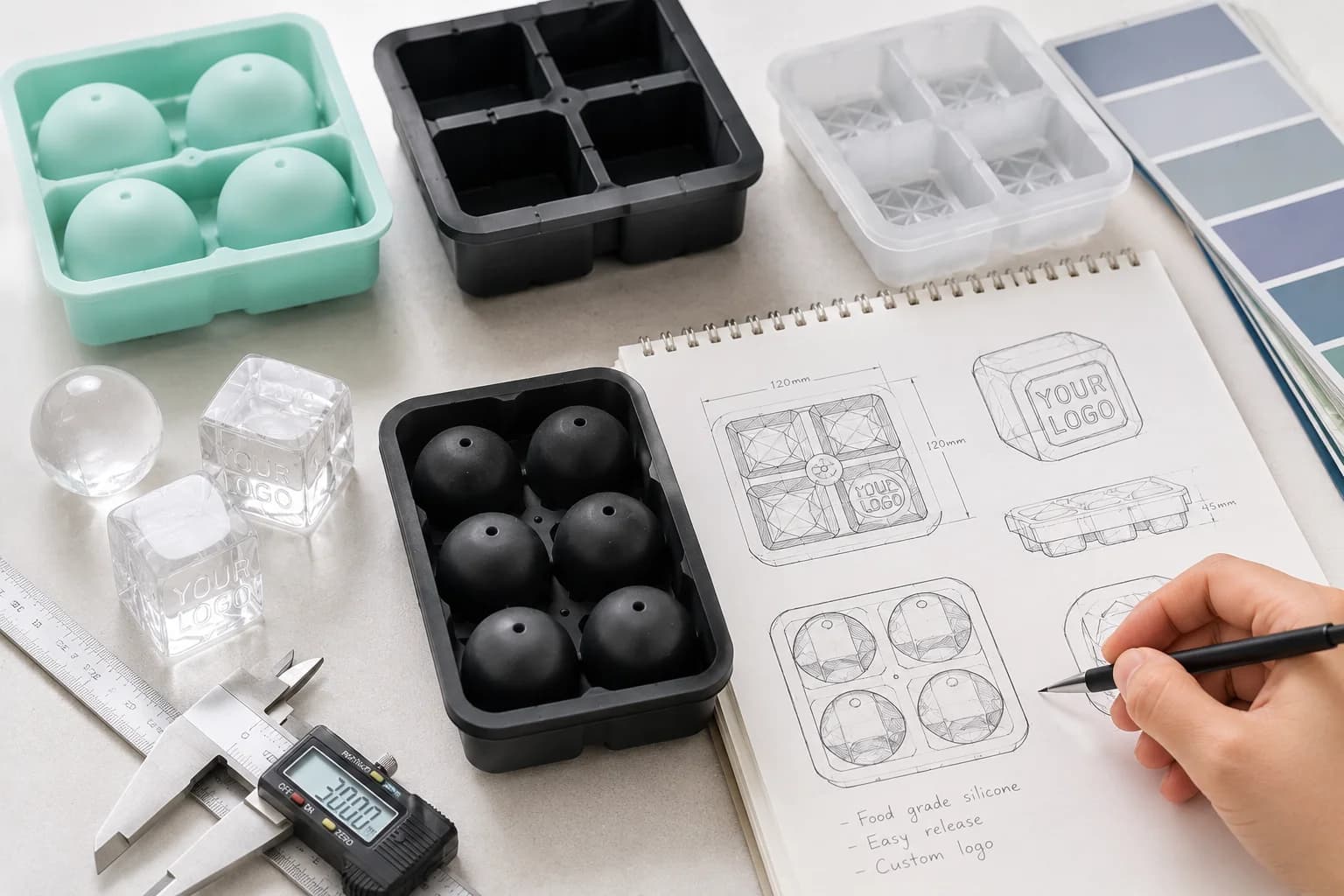
Renjia’s customization scope includes cavity design, shape, size, color, logo, and packaging [K1], which means a private-label project can adjust release geometry and portion size rather than only changing the tray color. For buyers moving from concept to production, silicone OEM/ODM project planning should include design review, sampling, tooling, and lead-time decisions rather than starting with a finished-looking mockup.
Boundary condition: Do not assume a feature seen in one product photo applies to every mold in a catalog. Material, dimensions, and cavity performance must be confirmed for the specific item [K4][K5].

4. Choosing the Right Ice Nugget Tray: A Buyer’s Checklist
Core conclusion: Choose the tray that fits your freezer, your glassware, and your patience for release — not the one with the highest cavity count.
Start with the use case. For everyday soda and iced coffee, small bullets that fit through a bottle opening are more useful than large cubes. For whiskey or punch bowls, a larger cube or sphere slows dilution more effectively. For parties, total batch capacity and stacking matter more than individual piece shape.
A practical checklist:
- Piece size: Will the bullet fit the bottle, tumbler, or glass you use most?
- Batch capacity: Multiply cavity volume by cavity count to estimate one tray’s output.
- Freezer fit: Measure shelf depth and height, especially if you plan to stack trays.
- Release effort: Look for tapered cavities, a flexible base, and clear separation between cells.
- Cleaning: Confirm whether the tray is top-rack dishwasher safe and whether the cavity depth is easy to brush.
- Material documentation: Ask for the material specification for the exact product, not a generic category claim.
- Durability: Check wall thickness and lid design; thin, floppy trays tend to spill during transfer.
- Packaging: For retail or gifting, packaging and logo placement affect perceived value as much as the mold itself.
It also helps to compare categories honestly. Renjia’s reported portfolio places ice block molds under household products and lists ice cube trays, ice ball trays, and popsicle molds under promotional products [K3]. Ice molds can legitimately serve household, kitchen, and promotional use cases, and the category placement should not limit cross-category content [K4]. If you are exploring adjacent formats before committing to a bullet design, reviewing ice cube trays and other ice mold formats can clarify the trade-offs in shape, capacity, and release.
Scenario advice: A household buying one tray should prioritize release and freezer fit. A cafe or bar buying for service should prioritize consistent piece size and replaceable trays. A brand buyer should treat the tray as one part of a product system that includes packaging, labeling, and compliance documentation.
5. Key Comparison and Sourcing Considerations
Core conclusion: Match the ice format to the job, then verify the commercial details before you publish claims or place a production order.
| Option | Typical piece | Texture and chew | Melt behavior | Good fit | Main limitation | |---|---|---|---|---| | Nugget ice machine | Small, irregular nuggets | Soft, porous, chewable | Chills quickly; dilutes relatively fast | Chewable-ice enthusiasts, high-volume drinks | Appliance cost, space, maintenance | | Bullet ice mold | Small cylinders or rounded bullets | Firm, dense, small enough to chew carefully | Moderate; faster than a large cube because of size | Home freezers, everyday glasses, custom branding | Not true nugget texture; requires freezer time | | Standard cube tray | Larger cubes | Hard | Slower dilution | Pitchers, whiskey, general use | Less comfortable to chew | | Ice ball mold | Sphere | Hard, dense | Slowest of the group | Cocktail presentation | Not a chewable-ice format |
On the sourcing side, the sequence matters more than the sales pitch. A custom program typically moves through design review, sampling, tooling, and production, with MOQ and lead time confirmed at each stage [K2]. Before publishing a product-specific page or issuing a quotation, confirm current availability, material composition, dimensions, certifications, MOQ, and lead time [K4]. Market-specific compliance planning should rely on documentation and should avoid unsupported certification claims [K2].
Two cautions are worth repeating. First, existing catalog references to PP or HDPE should not be reused for a silicone-only product page without material verification [K5]. Second, product names and dimensions may come from readable source images or catalogs, but units and context must be preserved, and a feature shown in one image should not be applied to every product [K5]. These rules protect both the buyer and the brand from claims that cannot be substantiated.
6. FAQ
Q1. Can a silicone tray make real nugget ice?
No. True nugget ice is produced by a machine that scrapes and compresses frozen flakes into porous nuggets. A silicone tray freezes water in fixed cavities, producing solid bullet-shaped pieces. They are smaller and easier to chew than large cubes, but the texture is different.
Q2. Are bullet ice molds a good choice for chewable ice?
They are a reasonable home alternative for people who prefer small, rounded pieces over large cubes. However, the ice is still hard and dense. Chew carefully, keep pieces small, and supervise children. If soft texture is the main requirement, a nugget ice appliance is the correct category.
Q3. How do I get clearer ice and easier release?
Clarity is influenced by dissolved air and minerals in the water and by freezing conditions; filtered water and slower freezing can help, but a home freezer will not guarantee crystal-clear results. For easier release, leave headspace for expansion, freeze the tray flat, let it rest briefly after removing it from the freezer, and twist the silicone base rather than pulling individual pieces.
Q4. What should a brand confirm before ordering custom bullet ice molds?
Confirm the intended use case, cavity geometry, piece dimensions, cavity count, material specification, color, logo method, packaging, MOQ, tooling and sampling steps, lead time, and the documentation required for each target market [K1][K2][K4]. Ask for the specification of the exact product rather than a category-level claim.
7. Conclusion
The phrase “nugget ice mold” describes a desire more than a product category. What most trays actually deliver is bullet ice: small, dense, rounded pieces that chill drinks quickly and are more comfortable in the mouth than a large cube. That is a useful outcome, as long as buyers and sellers describe it accurately.
For households, the right choice is the tray that fits the freezer, releases cleanly, and produces pieces that match your everyday glassware. For brands, the right choice is a manufacturing partner that can document cavity design, material, dimensions, sampling, and lead time — and that will confirm current availability before a product page goes live. Start with the use case, specify the piece, and verify the details that matter.