Key Takeaways
- Clear ice is a process outcome, not a product feature. Mold geometry, directional freezing, water quality, and freeze time matter more than brand labels.
- The term "ice baller maker" covers at least three different formats: flexible silicone sphere trays, rigid two-part clear-ice molds, and press-style ballers. Each solves a different problem and produces a different clarity level.
- Silicone molds are the practical choice for release speed, custom shapes, and private-label programs; verified silicone material specs include food-grade, odorless, and −40°C to 240°C (−40°F to 464°F) temperature resistance [K5].
- Custom ice mold projects follow a defined path: design review, sampling, tooling, production, inspection. MOQ, tooling cost, and lead time must be confirmed per project, not assumed [K3].
- Never publish or repeat a certification claim that has not been verified for the specific product and target market [K3][K4].
1. Introduction
A giant ice cube maker and a clear ice ball maker look like simple kitchen accessories, but buyers consistently run into the same three frustrations: the ice comes out cloudy, the cubes are impossible to release without cracking, and the mold they bought six months ago does not match the photo on the listing.
There is also a quieter problem. Most reviews compare shapes and price, but almost none explain why one mold produces transparent ice and another produces a white, fractured sphere. That gap matters whether you are a home bartender trying to build a better whiskey serve, or a buyer sourcing an ice baller maker for a branded promotional line.
This article breaks the category down by format and by mechanism. It reviews the main types of giant cube and sphere ice makers, explains what actually drives clarity, and then walks through the material and sourcing decisions that determine whether a mold still works after a hundred freeze cycles. Where product-level facts are not verifiable, this review says so rather than filling the gap with invented specifications.
2. What Actually Makes Ice Clear
Core conclusion: Clarity comes from directional freezing and clean water, not from the mold's brand or price.
Clear ice forms when dissolved air and minerals are pushed to one end of the block instead of being trapped throughout it. In nature that happens when a lake freezes from the top down. In a freezer, most trays freeze from all sides at once, so impurities get locked in the center and scatter light. That is the cloud you see in a sphere.
Three controls change the outcome:
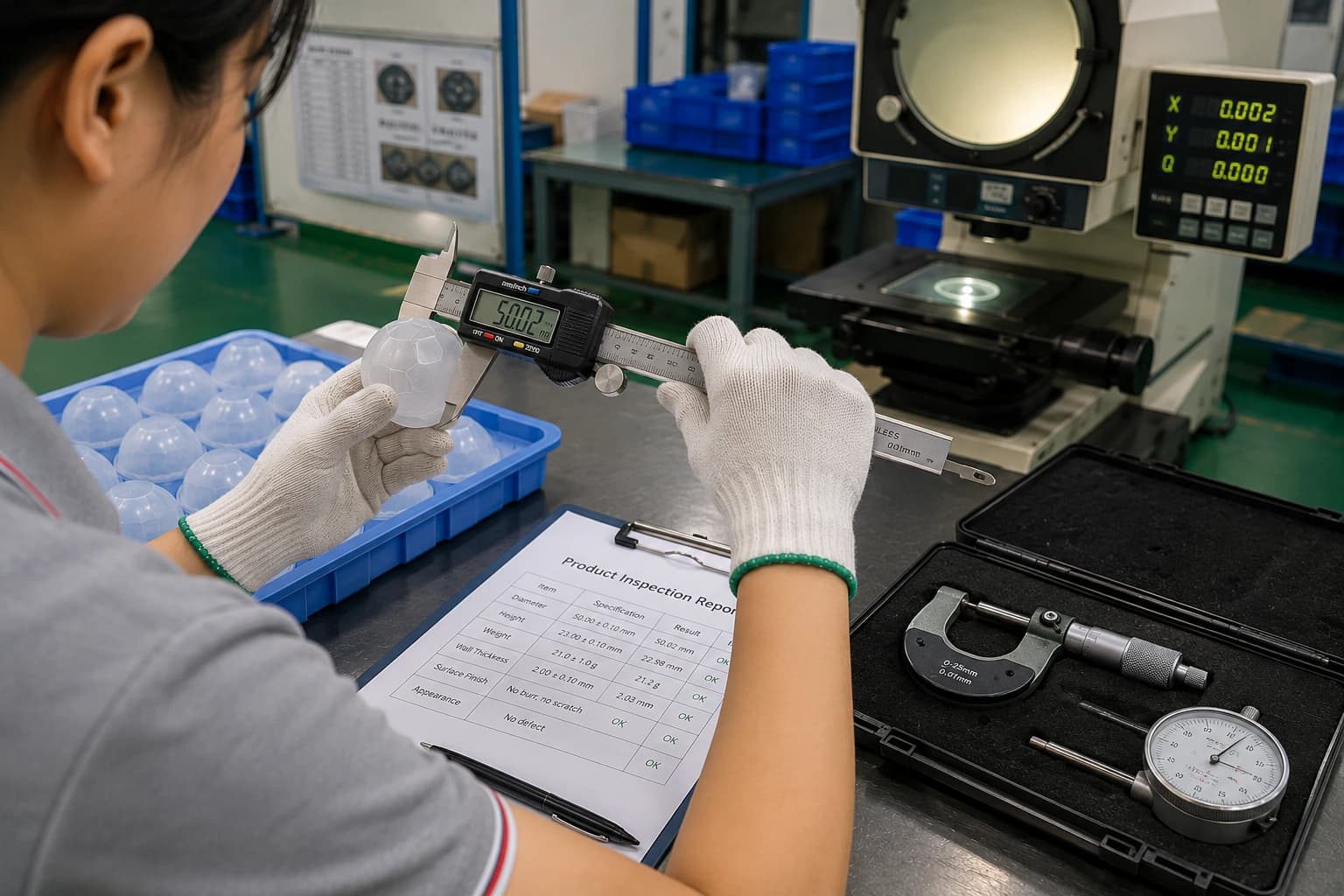
- Directional freezing. Insulating all sides except the top, or floating a mold in a larger insulated container, forces a single freeze front downward. This is the single highest-impact change you can make.
- Water quality. Tap water carries dissolved gases and minerals. Filtered water helps; water that has been boiled and cooled twice, or distilled water, helps more consistently. This is a well-established practice among bartenders, not a manufacturer claim.
- Freeze time. A 2-inch sphere or a 2-inch cube needs roughly 18 to 24 hours in a typical home freezer at around −18°C (0°F). Pulling it early leaves a liquid core; leaving it too long invites cracking.
Practical advice: If your current mold produces cloudy ice, do not replace it first. Test directional freezing with an insulated cup and the same mold. If clarity improves, the mold was never the limiting factor — the freezing method was.
For a manufacturing view of mold structure, branding, and production planning, review RENJIA’s custom silicone ice mold manufacturing capabilities.
3. Ice Baller Maker and Sphere Ice Maker Formats Compared
Core conclusion: Choose the format based on whether you need volume, clarity, or speed — you generally optimize for one.
| Format | How it works | Clarity potential | Release difficulty | Best for |
|---|---|---|---|---|
| Flexible silicone sphere tray | Water fills a hemispherical cavity; two halves close | Moderate; improves sharply with directional freezing | Very easy — peel and push | Home use, gifting, private-label programs |
| Rigid two-part clear-ice mold | Hard shell with a defined fill line and drain path; often used with an insulated sleeve | High when paired with directional freezing | Moderate; needs a short tempering wait | Whiskey serves, cocktail bars, content-driven retail |
| Press-style ice baller | Compresses crushed or block ice into a sphere | Low to moderate; texture is denser but not glass-clear | Not applicable | Fast service, high-volume bars |
| Giant cube mold (2 in / 50 mm+) | Single large cavity, often silicone | Moderate to high with directional freezing | Easy with silicone, harder with rigid trays | Spirits on the rocks, punch bowls, slow dilution |
| Rotary or lever sphere maker | Shaves ice and presses it in one motion | Moderate | Not applicable | Speed and consistency over clarity |
Two mechanical details separate a usable ice baller maker from a frustrating one:
- Wall thickness. Thicker silicone walls slow heat transfer. That sounds like a drawback, but slower freezing is actually what directional freezing needs. Thin, fast-freezing trays tend to trap air.
- Seam design. A visible seam line on the finished sphere usually means the two halves do not seat tightly, or the mold was overfilled. Overfilling is the most common user error and the most common cause of cracked spheres.
Practical advice: For a sphere that stays clear for the length of a drink, pair a rigid two-part mold with an insulated outer sleeve and give it a full 24 hours. For a party, silicone tray volume wins — accept slightly softer clarity and plan for two batches.
4. Material Choice: Silicone, Rigid Plastic, and Metal
Core conclusion: Silicone is the most flexible option for customization and release; rigid materials favor clarity; metal is best treated as hardware, not a mold surface.
Verified silicone specifications for food-contact ice molds include: silicone material, food-grade, odorless, and a temperature resistance range of −40°C to 240°C (−40°F to 464°F), with custom sizes available [K5]. That range matters because it covers both deep freezer storage and dishwasher sanitizing cycles without deforming — a practical durability signal for buyers who plan to reuse molds seasonally.
Buyers turning a concept into an RFQ can compare these decisions with RENJIA’s OEM silicone product customization process.
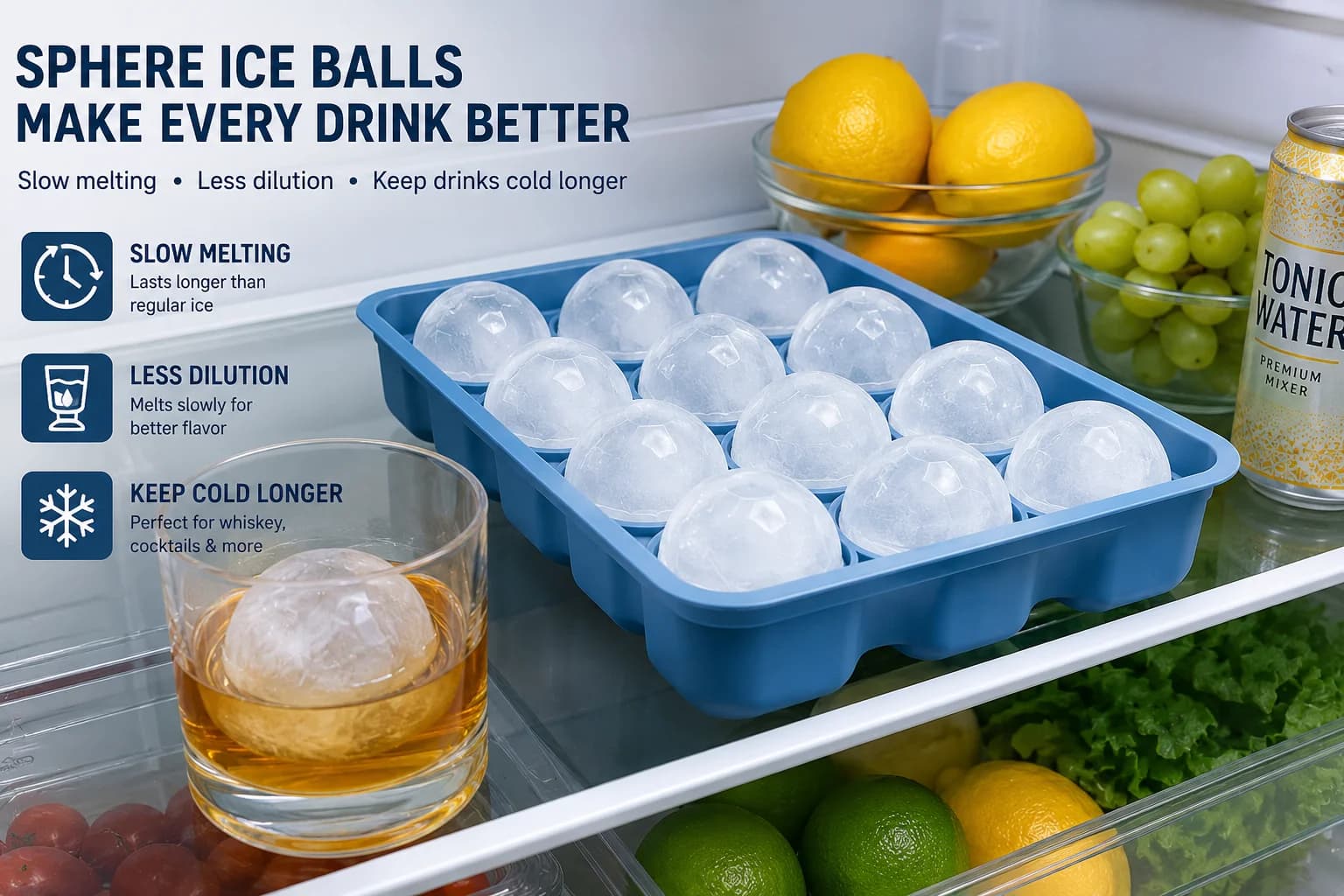
Customization is where silicone separates itself. A silicone ice mold project can typically be customized across cavity design, product shape, size, color, logo, and packaging [K1]. That means a branded sphere mold with a logo embossed into the cavity wall — so each finished ice ball carries the mark — is a normal, achievable request rather than a specialty.
Rigid clear-ice molds produce better clarity because they hold a precise shape and support tight directional freezing, but they are difficult to customize beyond color and small mold-body branding. Metal components belong in the freezing hardware and the press mechanisms, not as the ice-contact cavity, because bare metal releases poorly and scratches over time.
Boundary condition: Silicone molds are also categorized under household, kitchen, and promotional use cases, and that categorization is a portfolio placement, not a limitation on where the product can be sold or marketed [K4]. A single sphere mold can legitimately serve a kitchen buyer and a promotional-products buyer.
Practical advice: If your goal is a retail or corporate-gift product with a logo, silicone is the realistic route. If your goal is maximum clarity for a bar program, buy a rigid mold and treat it as equipment, not merchandise.
5. Sourcing Custom Ice Molds: Process, Checklist, and Cautions
Core conclusion: A custom ice mold is a small tooling project. Treat it like one, and the sample-to-production gap closes predictably.
A structured project moves through design review, sampling, tooling, and production, with lead-time planning attached to each stage [K3]. Buyers should expect to make decisions at four gates:
Before approving mass production, align the specification with a documented silicone product quality control plan.
- Design review. Cavity geometry, wall thickness, draft angles, logo placement, and artwork files. Design-file preparation belongs here, before any tooling commitment [K3].
- Sampling. Physical samples for fit, release behavior, and finish. This is also where you run a real freeze test rather than judging the sample on appearance.
- Tooling. Confirmed only after sample approval. Tooling cost and MOQ should be quoted as a package, not piecemeal [K3].
- Production and inspection. Pre-shipment inspection against an approved sample, using a written buyer checklist [K3].
Questions worth asking any silicone OEM/ODM manufacturer before committing:
- What is the MOQ for this cavity design, and does it change with color or packaging?
- What is the tooling cost, and who owns the tool?
- What is the sampling lead time versus the production lead time?
- Which material specification applies to this exact SKU, and is it documented?
- What packaging formats are available, and what artwork files do you need?
- Which compliance requirements apply to my target market, and what documentation can be provided for this specific product?
Caution on compliance and availability: Market-specific compliance planning should be handled without making unsupported certification claims [K3]. Portfolio documentation describes a reported product range and is not proof that every item is currently stocked or available in every market [K4]. Before publishing a product page or issuing a quotation, confirm current availability, material composition, dimensions, certifications, MOQ, and lead time for the specific item.
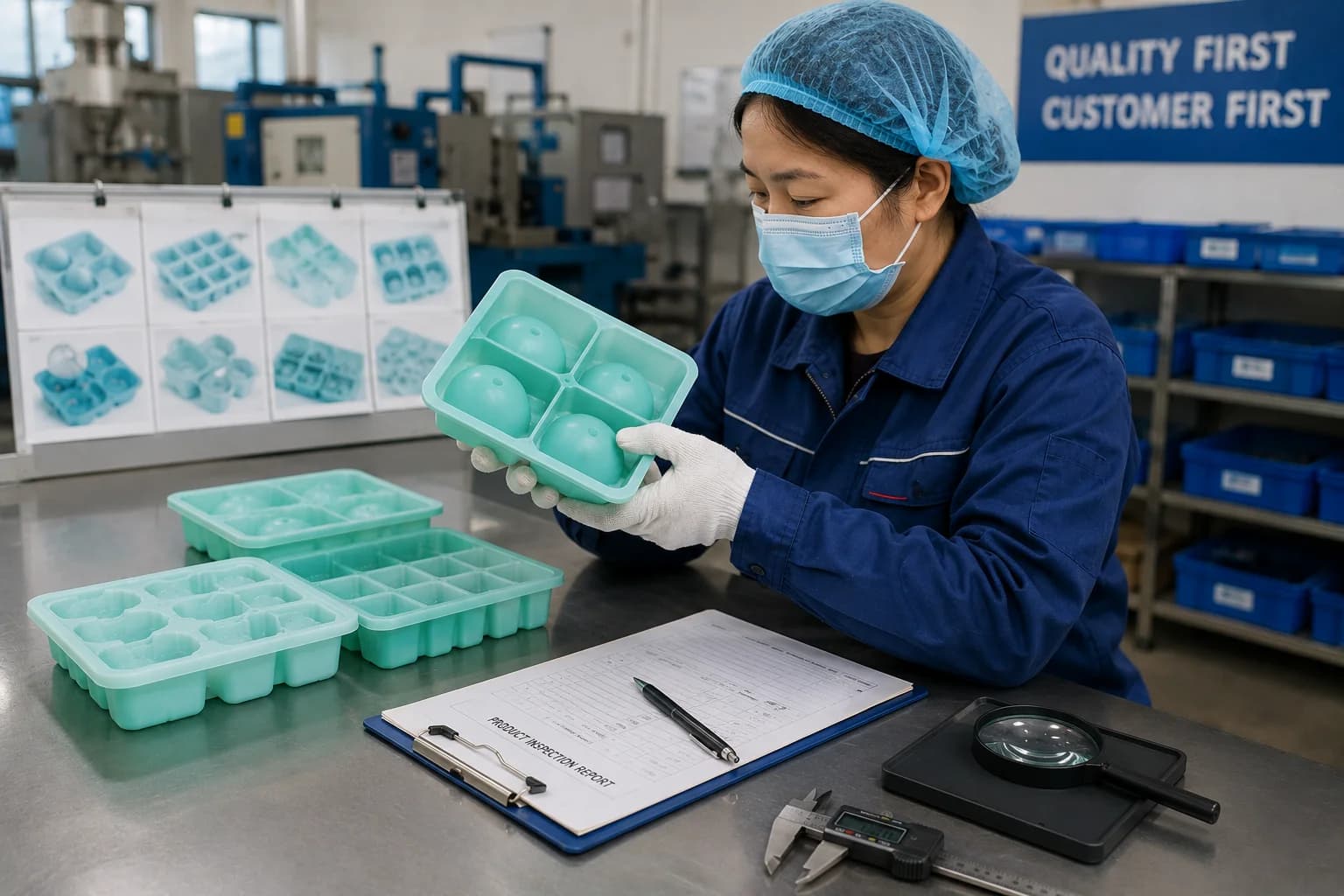
Practical advice: Build your approval checklist around a single artifact — the approved golden sample — and reference it in writing at both sample approval and pre-shipment inspection. Ambiguity at the sample stage is where most clarity, size, and color disputes originate.
6. FAQ
Q1. Why is my clear ice ball cloudy even though I bought a "clear ice" mold?
Cloudiness almost always traces to freezing direction and water quality, not the mold. A mold with no insulated shell freezes from every side at once, trapping dissolved air in the center. Test directional freezing — place the mold in an insulated container open at the top — and use filtered, boiled-and-cooled, or distilled water. If clarity improves, the mold is fine.
Q2. Does a silicone ice baller maker release ice as well as a rigid plastic mold?
Release is silicone's strongest advantage. Flexible walls let you peel and push the sphere out without the cracking that rigid molds produce when ice bonds to hard surfaces. The trade-off is clarity potential: rigid molds hold a more precise shape and work better with directional freezing setups.
Q3. Can ice molds be customized with a logo and custom shape?
Yes. Typical silicone mold customization covers cavity design, product shape, size, color, logo, and packaging [K1]. Custom colors, custom sizes, custom shapes, and custom packaging are all standard parameters, and custom sizes are explicitly available [K5].
Q4. What temperature range should a reusable ice mold handle?
Verified food-contact silicone molds are rated from −40°C to 240°C (−40°F to 464°F) [K5]. This covers freezer storage and dishwasher cycles. Confirm the specification for the exact SKU before publishing it, because the range is a material property rather than a universal claim about every mold on the market.
7. Conclusion
There is no single best giant ice cube maker, because "best" depends on whether you are optimizing for clarity, volume, release speed, or brandability. The honest ranking looks like this:
- For clearest ice: a rigid two-part sphere or cube mold used with directional freezing and 18–24 hours of freeze time.
- For easiest daily use: a flexible silicone sphere tray, where release is effortless and clarity is acceptable to good with method changes.
- For speed in service: a press-style ice baller, accepting that pressed ice is dense rather than glass-clear.
- For a branded or retail product: silicone, because cavity design, shape, size, color, logo, and packaging are all customizable [K1].
The next step depends on which side of the category you sit on. If you are a home buyer, change your freezing method before you change your mold. If you are sourcing an ice baller maker for a private-label or promotional line, start with a written specification, request a physical sample, and verify availability, material composition, dimensions, compliance documentation, MOQ, and lead time for the specific SKU [K4] before you publish anything or place a tooling order.