Key Takeaways
- Clear ice is a freezing-control problem, not a water-brand problem: cloudiness comes from dissolved gases and impurities trapped when water freezes quickly from all directions at once.
- A big cube ice maker and a clear sphere ice maker both solve this with directional freezing plus a timed harvest cycle, so the gas is pushed into a sacrificial core instead of the cube you serve.
- Mold-based routes — including custom silicone ice molds, ice ball trays, and ice block molds — control shape, branding, and release, but they do not control freeze direction on their own.
- Buyers sourcing molds or branded ice should confirm current availability, material composition, dimensions, certifications, MOQ, and lead time before publishing specs or quotations [K4].
- The practical levers are consistent: filtered water, a cold stable environment, a slow freeze cycle, and clean equipment.
1. Introduction
A cloudy ice cube looks like a small detail until it is sitting in a glass of whiskey. It melts faster than expected, it dilutes the drink earlier than the bartender planned, and it signals a lower standard than the rest of the presentation. For home enthusiasts, the frustration is usually the same: the tray goes into the freezer, the cubes come out white in the middle, and nobody can explain why the bar down the street gets glass-clear blocks.
The answer is rarely about buying more expensive water. Cloudiness is caused by dissolved air and dissolved solids being trapped as water freezes. When a small cavity freezes from all sides at once, the last liquid to solidify sits in the middle, and the gases it carries have nowhere to escape — so they form the hazy white core. Change where the freezing starts and how fast it moves, and the same water produces a visibly clearer cube.
This article explains how a big cube ice maker and a ball of ice maker (often marketed as a clear sphere ice maker) actually produce clear ice, where the physics ends and the engineering begins, and how mold-based alternatives fit for buyers who want custom shapes or branded ice. It is written for home bar owners, bar and restaurant operators, and product buyers evaluating equipment or custom silicone molds.
2. Why Ice Turns Cloudy — and What "Clear" Actually Requires
Core conclusion: clarity is decided by two variables — the direction of the freezing front and the speed of the freeze. Shape and equipment size only matter because they influence those two variables.
As water cools toward 0 °C, dissolved oxygen, nitrogen, and carbon dioxide become less soluble. In a fast, multi-directional freeze, those gases nucleate into tiny bubbles that are locked in place. The same happens with dissolved minerals: they concentrate in the remaining liquid and precipitate as visible haze. The classic cooler method used by cocktail bars demonstrates the principle — an open cooler in a freezer freezes from the top down, pushing gas and impurities toward the bottom, where the cloudy section can be cut away and discarded.
Two practical implications follow:
- Directional freezing beats "cold and fast." A single freezing front that advances in one direction gives gas a route to travel ahead of it.
- Slower freezing helps. A slower cooling rate tends to produce a more regular crystal structure and fewer trapped micro-bubbles, which is why large blocks often look cleaner than small cubes from the same water source.
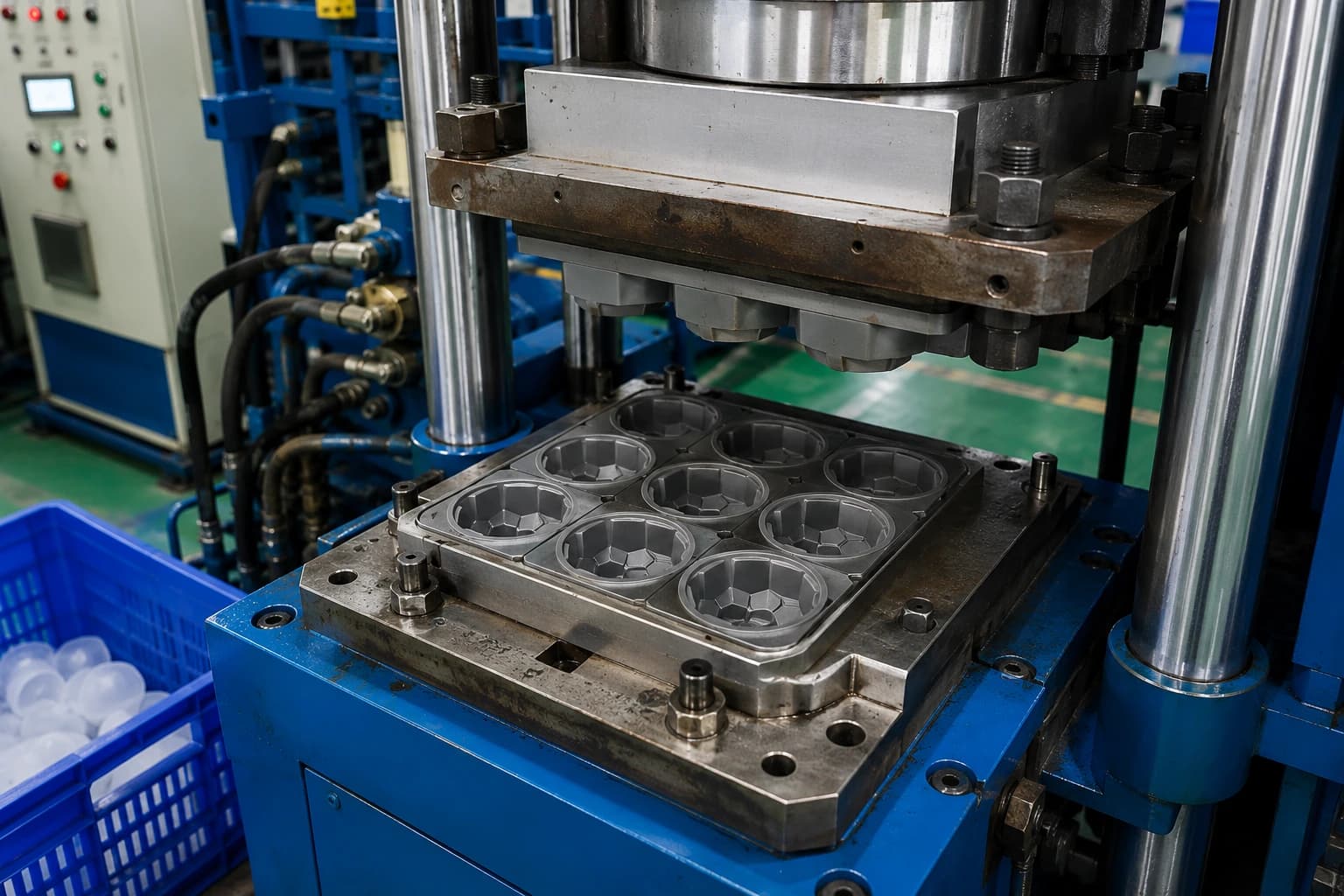
Scenario-based advice: if you are testing a new setup, start with filtered water and freeze one batch slowly before changing equipment. If the result is still cloudy in the center, the problem is the freeze direction, not the water. Keep in mind the boundary condition: no domestic setup will match a commercial machine on every batch, and a small hazy core is normal even in well-controlled production.
For a manufacturing view of mold structure, branding, and production planning, review RENJIA’s custom silicone ice mold manufacturing capabilities.
3. How a Big Cube Ice Maker Produces Clear Cubes
Core conclusion: a big cube ice maker is a directional-freezing device with a timed release. It freezes a large cell on a cold surface, stops before the cell is fully solid, and then harvests.
In a typical machine, water sits in a grid of cells resting on an evaporator plate. Refrigerant on the other side of the plate pulls heat out, so the freezing front moves from the plate side of the cell toward the open water side. Dissolved gases and impurities are driven ahead of that front into the last liquid region. The machine then runs a short defrost (hot-gas) cycle so the cubes release and drop into the bin.
The cycle design is where clarity is won or lost:
- Partial freeze, then harvest. If the machine runs until the cell is completely solid, the final gas-rich water has nowhere to go and the core goes white.
- Bigger cells, longer cycles. Larger cubes take longer to freeze and reduce daily output, but they melt more slowly and dilute a drink less — which is the reason bars pay for them.
- Circulation and water quality. Some designs circulate water across the freezing surface to keep the freezing front even. Filtered water reduces scale on the evaporator and haze inside the cube.
Practical scenario: a bar serving spirit-forward cocktails on the rocks should prioritize cube size and cycle consistency over peak nameplate output. A machine pushed to maximum production by shortening the freeze cycle will produce faster, cloudier cubes. Maintenance matters just as much — a dirty condenser or scaled evaporator raises cycle temperatures and degrades clarity before it degrades capacity.
4. How a Clear Sphere Ice Maker Produces a Transparent Ball
Core conclusion: the clearest spheres are made in two stages — create a clear block, then shape it. Machines that freeze a sphere directly use the same directional-freezing logic in a spherical cavity.
There are two common approaches, and they behave differently in practice:
- Freeze-and-shape (press method). A clear slab or block is frozen directionally, then a heated spherical press (two hemispherical aluminum molds) melts its way through the block, welding the halves into one ball. Because the input block is already clear, the sphere inherits that clarity. This route is popular in home bars because it is repeatable and relatively low-cost.
- Direct-freeze sphere makers. A clear sphere ice maker freezes water inside a spherical cell or submerged tube with controlled heat extraction and circulation, then releases the ball with a short defrost. These units trade a higher capital cost for less manual handling and more consistent output.
Why the shape is worth the effort: a sphere has the lowest surface-area-to-volume ratio of the common ice shapes, so it melts more slowly than a cube of similar mass and dilutes the drink more gradually. That is the practical reason a clear sphere ice maker shows up in whiskey programs.
Buyers turning a concept into an RFQ can compare these decisions with RENJIA’s OEM silicone product customization process.
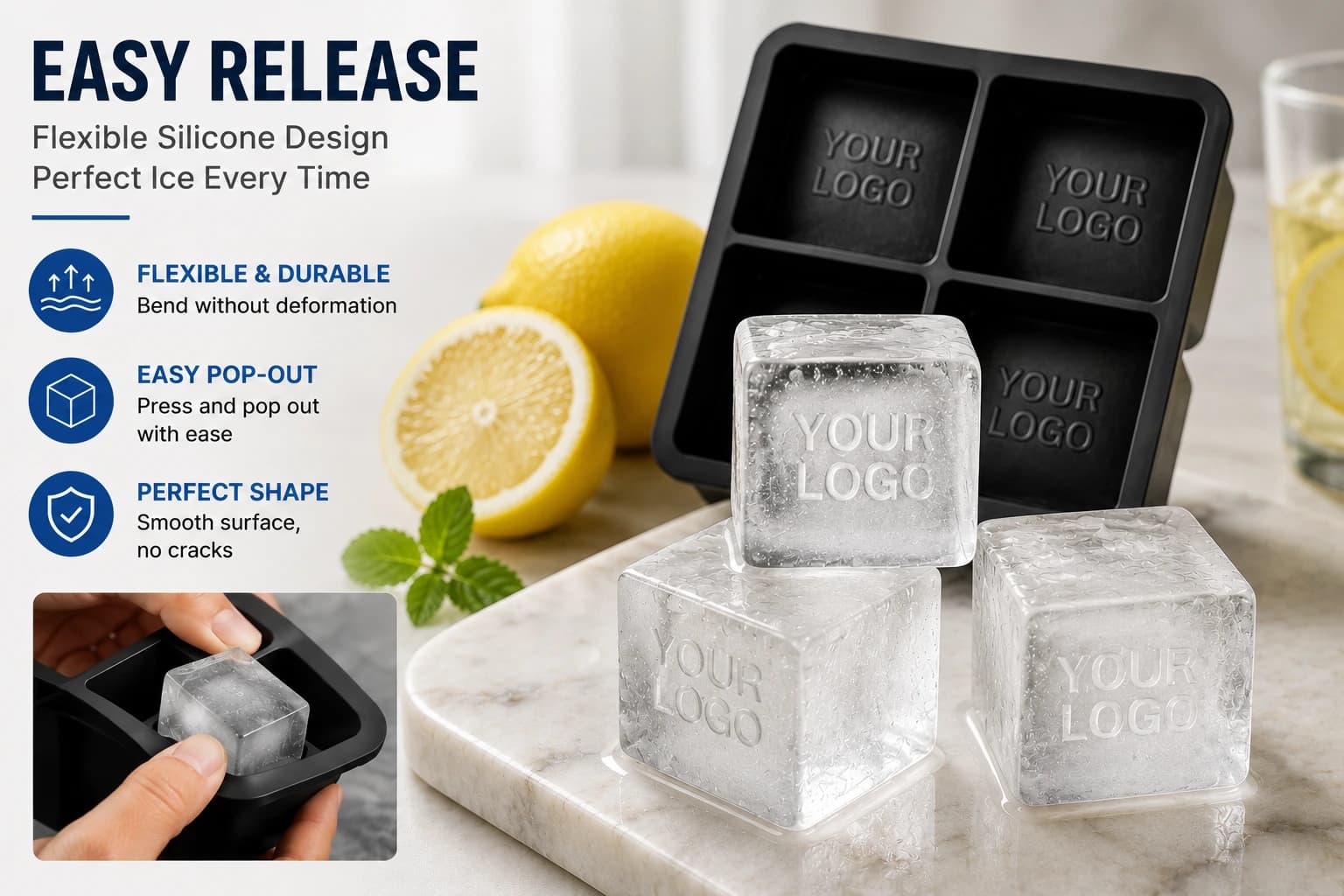
Practical advice and boundary conditions: if a finished ball shows a seam line or a milky core, the cause is usually upstream — the source block was not clear, the mold halves were misaligned, or the press was too cold and sheared the ice instead of melting through it. A clear sphere ice maker still needs filtered water and a stable ambient temperature; a hot kitchen will slow the cycle and can push clarity down.
5. Molds, Trays, and the Customization Route
Core conclusion: molds are the right tool for shape, branding, and cost control — but they change where the clarity work happens. A mold defines geometry; it does not create a freezing direction by itself.
Standard silicone trays in a household freezer freeze from all sides, which is the exact condition that produces a cloudy center. Two workarounds are common: freeze directionally first and cut or press the shape afterward, or use an insulated, open-topped mold system so the freeze front still advances from one side. This is why the same silicone ball tray can produce excellent results in one setup and hazy results in another.
Where custom silicone molds add real value is customization and branding. Renjia's verified product knowledge describes custom silicone ice molds (internal reference RJ-CIM-001) with typical customization covering cavity design, product shape, size, color, logo, and packaging [K1]. Ice molds also appear across the reported portfolio as ice cube trays, ice ball trays, and ice block molds [K2] — and the portfolio rules note that ice molds can be tagged under household, kitchen, and promotional use cases, so category placement should not limit cross-category content [K4].
For buyers, the sourcing sequence is the part worth planning carefully. Supported content topics include how custom silicone mold projects move from design review to production, MOQ, tooling, sampling, and lead-time planning, plus buyer checklists for sample approval and pre-shipment inspection [K3].
Before approving mass production, align the specification with a documented silicone product quality control plan.
Recommendations:
- Confirm material composition, dimensions, and tooling requirements before committing, since the portfolio diagram is evidence of a reported product range rather than proof that every item is currently stocked for every market [K4].
- Plan compliance per target market without relying on unsupported certification claims; certification status should be verified product by product [K3][K4].
- Approve a physical sample before production tooling, and keep a written checklist covering cavity finish, dimensions, color, logo placement, and packaging.
6. Key Comparison: Machine vs. Mold Route
| Route | How clarity is achieved | Best suited for | Main trade-offs | What to verify |
|---|---|---|---|---|
| Big cube ice maker | Directional freeze on a cold plate, partial freeze, timed defrost harvest | Bars, restaurants, high-volume home bars | Higher cost, water and power use, larger cubes reduce daily output | Cube dimensions, cycle time, water filtration, service access |
| Clear sphere ice maker | Directional freeze in a spherical cell, or press-shaping from a clear block | Whiskey and spirit-forward programs | Higher cost for direct-freeze units; press method needs a clear block first | Ball diameter, cycle time, release consistency, ambient limits |
| Sphere/ball press + clear block | Inherits clarity from the source block | Home bars, low-volume premium service | Manual handling, block prep time | Press temperature control, mold alignment, block quality |
| Custom silicone mold + directional freeze | Shape from the mold, clarity from the freezing method | Branded ice, custom shapes, promotional use | Freezer geometry must still be controlled | Cavity design, material, size, logo, packaging, sampling, MOQ, lead time [K1][K3][K4] |
A short buyer checklist that applies to every route:
- Test your water first; filtration reduces scale and haze before any equipment upgrade.
- Measure the ambient temperature where the unit or mold will live.
- Ask for a sample batch, not just a spec sheet.
- Confirm MOQ, tooling, sampling, and lead-time assumptions in writing [K3].
- Keep quality inspection separate from manufacturing planning; the knowledge base treats them as distinct topics, and so should your purchase order.
7. FAQ
Q1. Can a silicone mold alone make clear ice?
Not reliably. Silicone controls shape, release, and branding — it does not control freeze direction [K1]. A standard tray in a freezer freezes from all sides, which traps dissolved gases in the center. For clearer results, either freeze directionally first and shape afterward, or use an insulated open-top system that keeps the freezing front moving in one direction.
Q2. Why is my clear sphere cloudy in the middle?
A cloudy core means the last water to freeze still contained dissolved gas. Common causes are a fast freeze, unfiltered or high-mineral water, an unstable ambient temperature, or a mold that freezes from every side at once. Slow the freeze, filter the water, and check that the freezing front starts from one surface.
Q3. Does a bigger cube guarantee clearer ice?
No. Size mainly affects melt rate and dilution, not transparency. Larger cells do give dissolved gas more room to be pushed ahead of the freezing front, which can help, but clarity still depends on freeze direction, cycle timing, and water quality.
Q4. What should I confirm before ordering custom ice molds?
Confirm current availability, material composition, dimensions, certifications, MOQ, and lead time before publishing a product page or issuing a quotation [K4]. Also agree on the path from design review to sampling and production, and use a written sample-approval and pre-shipment inspection checklist [K3].
8. Conclusion
Clear ice is not a mystery and not a premium water trick. It is the result of controlling two things: which direction the water freezes from, and how slowly it freezes. A big cube ice maker automates that control with a cold plate, a partial freeze, and a timed harvest. A clear sphere ice maker applies the same logic inside a spherical cavity, or shapes an already-clear block into a ball that melts slowly and keeps a drink honest.
Molds play a different but complementary role. Custom silicone ice molds are the practical route to branded, shaped, or promotional ice, and Renjia's documented customization scope covers cavity design, shape, size, color, logo, and packaging [K1], with ice cube trays, ice ball trays, and ice block molds appearing across reported household, kitchen, and promotional categories [K2][K4].
Next step: decide your goal first. If consistency at volume matters most, invest in a machine and in water filtration. If shape, branding, or budget flexibility matters most, start with a mold project — but plan the freezing environment with the same care, and verify specifications, certifications, MOQ, and lead time before you commit [K3][K4].