Key Takeaways
- Clear ice is mostly a freezing-direction problem, not only a water-purity problem. Removing minerals helps; controlling how the block freezes matters more.
- Distilled water removes dissolved minerals, but it still contains dissolved gases — so distilled water alone does not guarantee clear ice cubes.
- Directional (top-down) freezing in an insulated container pushes bubbles and impurities into one last-frozen zone that you trim away. This is the most reliable home and small-batch method.
- Mold design affects results: rigid, straight-walled, low-flexibility molds hold their shape and release cleanly, while thin flexible trays make directional control harder.
- Most cloudy cubes come from four avoidable mistakes: freezing too fast, using mineral-heavy water, freezing in sealed or covered trays, and never trimming the cloudy base.
1. Introduction
Anyone who has spent an evening chipping cloudy ice out of a tray knows the frustration: the cubes look grey in the glass, they melt unevenly, and they dilute a good drink faster than they should. Clear ice is not a luxury detail — it is a sign that the freezing process was controlled rather than left to chance. It also has practical value: a dense, transparent cube melts more slowly and releases fewer trapped gases and minerals into whatever you are serving.
The confusion usually starts with water. Many people assume that switching to bottled or distilled water solves the problem in one step. It does not. Distillation removes dissolved minerals, which is one of the two main causes of cloudiness, but it leaves dissolved gases behind — and gas bubbles are the other main cause. That is why two people can use the same brand of distilled water and get completely different results.
This article explains the mechanics behind clear ice, answers the specific question of whether distilled water makes clear ice, walks through a repeatable directional-freezing method, and lists the mistakes that quietly ruin most attempts. It is written for home enthusiasts, bar operators, and product teams evaluating ice trays, ice molds, and custom mold designs.
2. Why Ice Turns Cloudy: Bubbles, Minerals, and Freezing Speed
Core conclusion: Cloudiness has two separate sources — dissolved gases and dissolved solids — and freezing speed decides how much of each gets trapped in the finished cube.
When water freezes, the growing ice crystal structure rejects most impurities and dissolved gases. In an ideal scenario, those rejected materials are pushed ahead of the freezing front into a small area that freezes last. In a normal tray, that area is the center or bottom of the cube, which is why so many cubes are clear at the edges and white in the middle.
Three mechanisms explain most cloudy ice:
| Mechanism | What happens | Result |
|---|---|---|
| Dissolved gases | Air and CO₂ come out of solution as the water cools and freezes | Small bubbles suspended inside the cube |
| Dissolved minerals | Calcium, magnesium, and other solids concentrate in the last-frozen zone | White, opaque core or base |
| Fast, multi-directional freezing | The cube freezes from all sides at once, so impurities cannot be pushed anywhere | Cloudiness spread throughout the cube |
Freezing speed matters because slow freezing from a single direction gives rejected material somewhere to go. A freezer set to a standard domestic temperature — typically around −18 °C — combined with a thin plastic tray creates exactly the wrong conditions: the cube freezes from every surface inward within a few hours, and everything dissolved in the water is locked in place.

Practical advice: Before changing your water, change your container and freezing direction. Insulating the sides and bottom of a container so that only the top surface is exposed to cold air is the single highest-impact change most people can make.
3. Does Distilled Water Make Clear Ice? What It Solves and What It Doesn't
Core conclusion: Distilled water improves clarity because it removes dissolved minerals, but it is not sufficient on its own. Used with directional freezing, it produces noticeably clearer ice; used in a standard tray, it still usually produces cloudy cubes.
Distillation works by evaporating water and condensing the vapor, which leaves behind most dissolved solids such as calcium and magnesium. That removes one entire category of cloudiness. What distillation does not remove is dissolved gas. Freshly distilled or freshly poured water is typically saturated with air, and that air becomes visible as bubbles the moment the water starts to freeze.
This is why the practical answer to "does distilled water make clear ice" is partially. Compare the outcomes directly:
- Tap water in a standard tray: minerals and gases both trapped. Usually cloudy throughout.
- Distilled water in a standard tray: minerals reduced, gases still trapped. Often clearer at the edges, still cloudy in the center.
- Distilled water plus directional freezing: gases and remaining solids concentrate in a bottom zone that can be cut off. The upper portion is typically clear.
- Twice-boiled, then cooled distilled water plus directional freezing: the boiling steps drive off dissolved gases, which is why this combination is common among people who make clear ice regularly. Handle hot water carefully and let it cool before freezing.
One caution: boiling does not "purify" water in the mineral sense, and it does not sterilize the inside of a freezer. Boiling is used here specifically to reduce dissolved gas content. If you start with mineral-heavy tap water, boiling will not remove the hardness — you still need distillation, reverse osmosis, or another demineralization step.
For shaped ice — spheres, columns, branded logos — the mold itself becomes part of the equation. Teams developing shaped clear ice often work with suppliers on custom silicone ice molds, where cavity design, wall thickness, and material hardness determine whether a mold can be used with directional freezing techniques or is better suited to decorative, fast-freeze applications [K1].
4. Directional Freezing: The Method That Works Most Reliably
Core conclusion: Freeze the block from one direction only, let the impurities collect in the last-frozen zone, then trim that zone away. This is the most repeatable method available without commercial equipment.
The classic home version uses a small insulated cooler with the lid removed, or a cooler with the top open to the freezer air. Water is poured into a tray or cup placed inside the cooler. The insulated walls slow heat loss from the sides and bottom, so the block freezes from the top down over many hours.
A workable process:
- Prepare the water. Start with distilled or otherwise demineralized water. If gas bubbles have been a problem, boil it once or twice, then cover and cool it to room temperature.
- Set up the insulated container. Place a rigid tray, cup, or mold inside a small cooler. Leave the top of the cooler open, or remove the lid, so cold air reaches only the top surface.
- Fill and place. Fill the tray without splashing, which re-introduces air. Put the cooler on a level freezer shelf with space above it for air circulation.
- Freeze slowly. Expect roughly 18–24 hours for a moderate-size block at typical domestic freezer temperatures. Larger blocks take longer.
- Remove and temper. Take the block out, let it sit briefly at room temperature, then release it from the tray.
- Trim the cloudy zone. The bottom or final section will be opaque. Cut or chip it away and keep the clear portion. Save the trimmings for blended drinks rather than discarding them.
Boundary conditions worth knowing: Directional freezing is slow and space-intensive, so it suits home bars, small craft programs, and product testing rather than high-volume service. Freezers with strong forced-air circulation can freeze the sides faster than expected; a thicker insulating wall compensates. If the block cracks during release, the usual cause is thermal shock — a very cold block hitting a warm surface — so temper it gradually.
5. Mold and Tray Design: Where Clarity Is Won or Lost
Core conclusion: The container decides how heat leaves the water. Rigid walls and simple geometry support directional freezing; thin, highly flexible walls and complex cavities make it harder to control.
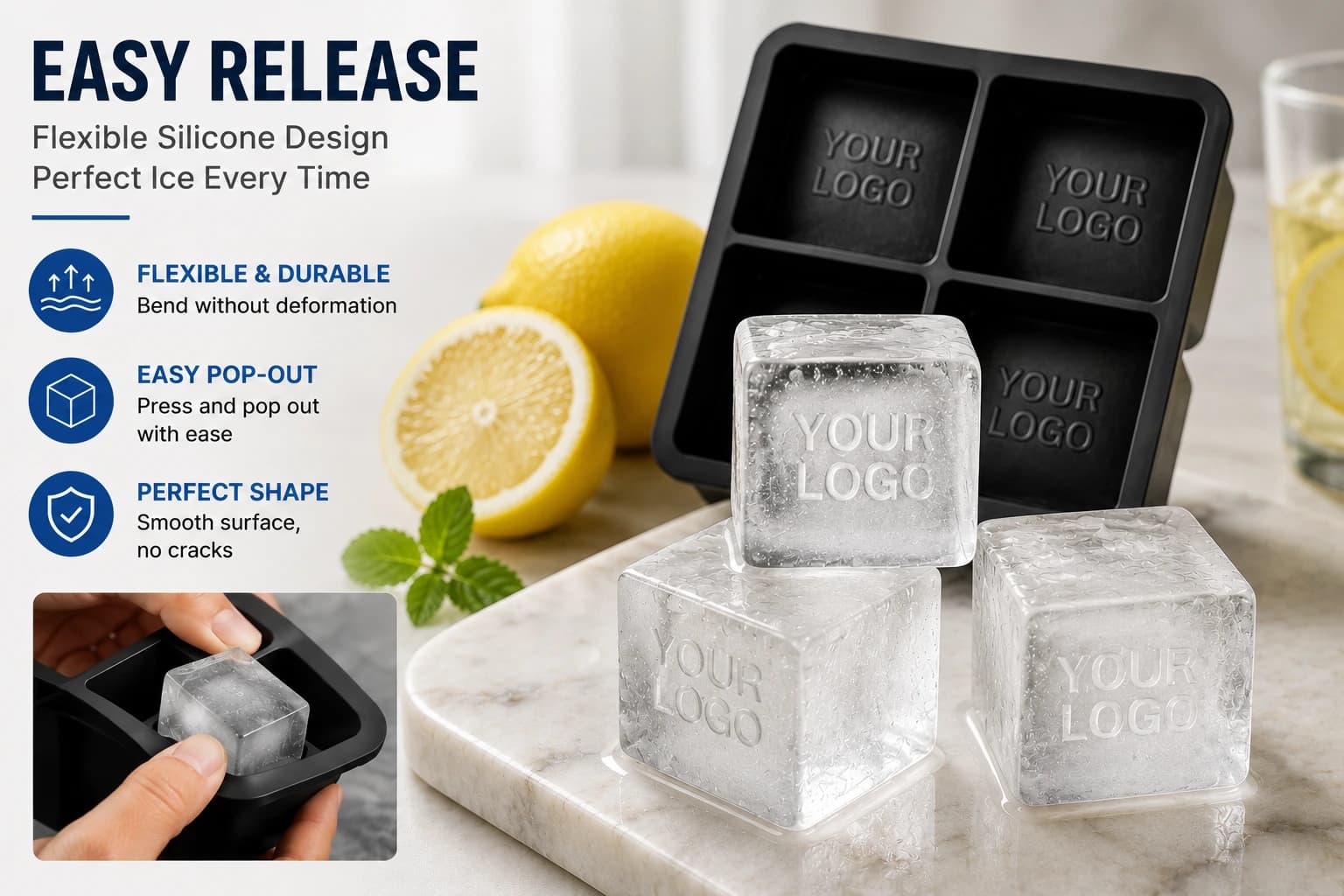
Silicone has become the default material for shaped and decorative ice because it releases easily and tolerates a wide temperature range. That flexibility is an advantage for demolding and a disadvantage for directional freezing, where consistent wall thickness and stable geometry matter. A very thin silicone wall transfers heat quickly from multiple directions, which tends to freeze the cube from all sides at once.
That does not make silicone a bad choice — it means mold design and intended use should match. For product teams, custom silicone ice molds are typically specified across cavity design, shape, size, color, logo, and packaging, and each of those decisions interacts with the freezing behavior of the finished product [K1]. A mold intended for decorative fast-freeze cubes is specified differently from one intended for a slow, single-direction freeze.
Ice molds also cross traditional category lines. Within a broader silicone product portfolio, ice molds are commonly tagged under household, kitchen, and promotional use cases rather than being confined to one category, which reflects how buyers actually source them [K4][K5]. A promotional ice cube tray and a kitchen ice block mold may share the same core engineering questions even when the retail channel differs.
Practical evaluation checklist for anyone sourcing or selecting a mold:
- Wall thickness consistency: uneven walls create uneven heat transfer and unpredictable clarity.
- Rigidity: a mold that holds its shape at freezing temperatures supports slower, more directional freezing.
- Geometry: sharp internal corners trap air; rounded, simple cavities release bubbles more readily.
- Wall thickness in tapered trays: tapered walls allow easy release even with a stiffer material, which is often a better trade-off than extreme flexibility.
- Intended use: confirm whether the mold is meant for decorative shaped ice or for clarity-focused blocks, and specify accordingly.
One sourcing caution that applies broadly: portfolio diagrams and category listings are evidence of what a supplier reports producing, not proof that every item is stocked, certified, or available for every market. Material composition, dimensions, certifications, minimum order quantity, and lead time should be confirmed against a specific product specification before a page, listing, or quotation is published [K5].
6. Key Comparison: Water Types, Methods, and What to Expect
Core conclusion: The best results come from combining two changes — cleaner water and controlled freezing direction. Changing only one of the two produces partial improvement.
| Approach | Removes minerals | Removes dissolved gas | Typical clarity | Notes |
|---|---|---|---|---|
| Tap water, standard tray | No | No | Low — cloudy throughout | Fastest, least control |
| Filtered water, standard tray | Partially | No | Low to moderate | Depends heavily on filter type |
| Distilled water, standard tray | Yes | No | Moderate — clear edges, cloudy core | Common stopping point that disappoints |
| Distilled water, directional freezing | Yes | Partially | High in the upper block | Slow; requires trimming |
| Twice-boiled distilled water, directional freezing | Yes | Mostly | Highest practical home result | Cool before freezing; handle hot water carefully |
Additional considerations that affect the outcome but rarely appear in short guides:
- Splashing and pouring: pouring from height re-oxygenates water. Pour slowly and close to the surface.
- Freezer placement: near a fan or against a wall changes freeze rate dramatically. Keep conditions consistent between batches.
- Water storage: distilled water left open in a mineral-rich kitchen can reabsorb airborne particles over time. Keep it covered.
- Reusing cloudy ice: cloudy ice is not unsafe; it is simply less transparent. It works fine for chilling bottles, blending, or cooling bowls.
- Quality discipline in sourcing: a responsible sourcing approach makes preventable quality and delivery risks visible early — for example, confirming material and dimensional tolerances before tooling — rather than treating every project as inherently risk-free [K2]. Suppliers with mature responsible sourcing practices tend to surface these questions in the sampling stage instead of after mass production.
7. FAQ
Q1. Does distilled water make clear ice on its own?
Not reliably. Distilled water removes dissolved minerals, which eliminates one source of cloudiness, but dissolved gases remain and still form visible bubbles as the water freezes. You get a real improvement over tap water, but the clearest results come from pairing distilled water with directional freezing and, ideally, degassing the water by boiling and cooling it first.
Q2. Can I get clear ice in a normal silicone tray?
Usually not fully clear. Thin, flexible trays freeze from all sides at once, which traps gases and minerals in the center of each cube. Silicone trays are excellent for shaped, decorative, and easy-release ice, and they can produce clearer ice when combined with demineralized, degassed water and slower freezing — but for maximum clarity, a rigid, insulated setup is easier to control.
Q3. Why is my ice cloudy only in the center or bottom?
That pattern is a sign that directional freezing is partially working. Impurities and gases are being pushed ahead of the freezing front and concentrated in the last zone to freeze, which is normally the center of a cube or the bottom of a block. In a directional setup, that zone can simply be trimmed away; in a sealed tray, it stays in the cube.
Q4. How long does clear ice take to make?
Directional freezing is deliberately slow. A moderate-size block in a typical domestic freezer commonly takes around 18–24 hours, and larger blocks take longer. Rushing the process by lowering the freezer temperature or removing insulation defeats the purpose, because faster freezing means more trapped bubbles.
8. Conclusion
Getting clear ice cubes comes down to two variables: what is dissolved in the water, and how the water freezes. Distilled water addresses the first but not the second, which is why so many people switch to distilled water, see only modest improvement, and conclude that clear ice is impossible at home. It is not — it is slow.
The practical recommendation depends on your goal. For a home bar or a small craft program, use distilled or demineralized water, boil and cool it to reduce dissolved gas, freeze it in an insulated container from the top down, and trim the cloudy base. For decorative or branded ice where shape matters more than optical clarity, a well-specified silicone mold is the right tool, provided the cavity design, wall thickness, and intended freezing method are defined before tooling begins. Whichever path you take, treat clarity as the output of a controlled process rather than a property of any single product — and confirm material, dimensional, and availability details against a specific specification before committing to production or publishing product claims.