Key Takeaways
- Clear ice is a process result, not a water-brand result: the cube becomes transparent when water freezes slowly from one direction, pushing dissolved air and minerals into a final layer that you remove or discard.
- Insulation is the decisive variable. A cooler, an insulated shell, or a directional freezing mold controls where freezing starts — that control matters more than using distilled water alone.
- Standard silicone trays freeze from all sides at once, so individual cavities usually turn cloudy. Silicone still matters for demolding, flexibility, and customization — and ice molds can be developed for household, kitchen, and promotional use cases [K2].
- For B2B buyers, the real question is a sourcing question: which mold geometry, material specification, packaging, and MOQ match the channel you are selling into [K5].
- Availability, material composition, dimensions, certifications, MOQ, and lead time should always be confirmed against a current product specification before a product page or quotation goes live [K2].
1. Introduction
Anyone who has pulled a tray out of the freezer knows the disappointment: the cubes look white in the middle, crack when they hit a drink, and dilute a cocktail faster than they should. The question "how do you get clear ice" gets asked constantly in home bars, test kitchens, and product development meetings — and the answers online are usually either oversimplified ("just use bottled water") or unnecessarily technical.
The good news is that clear ice is reproducible with ordinary equipment. The less good news is that most people optimize the wrong variable. They change the water and keep the same tray, then wonder why the result barely improves.
This guide separates the physics from the equipment. It explains why ice turns cloudy, walks through the directional freezing method step by step, compares the practical options available to households and small producers, and then addresses a question that comes up often in silicone manufacturing: what role can a silicone ice mold actually play in producing clear ice — and where does it stop helping? Sourcing considerations for buyers are included at the end of each section, since mold design decisions usually start long before the first batch of ice is frozen.
2. Why Ice Cubes Turn Cloudy: The Science in Plain Terms
Core conclusion: Cloudiness is trapped gas and suspended solids, not dirt. The fix is to control where those impurities end up, not to eliminate them entirely.
Water straight from the tap contains dissolved gases — oxygen, nitrogen, carbon dioxide — plus trace minerals such as calcium and magnesium. As water cools and begins to crystallize, the ice lattice forms pure H₂O crystals and rejects almost everything else. Those rejected gases and minerals are pushed ahead of the freezing front, concentrating in the water that has not yet frozen.
If freezing happens from all directions at once — which is what a standard tray in a freezer does — the last water to freeze is trapped in the center of each cube. That center is where the white, hazy core comes from. Under a microscope it is a matrix of tiny gas bubbles and mineral inclusions, which scatter light instead of transmitting it.
This explains three things that otherwise look confusing:
- Why distilled water alone does not fix it. Removing minerals reduces one impurity class, but dissolved air remains, and the all-directions freezing pattern still traps it in the middle.
- Why boiling sometimes helps a little. Boiling drives off dissolved gases, so a boiled-and-cooled batch freezes slightly clearer. It is a supporting step, not a solution.
- Why slow freezing usually beats fast freezing. A slow, controlled freezing front gives rejected impurities time to migrate ahead of the boundary instead of being captured in place.
Practical scenario: If you are testing recipes for a bar program, run a controlled comparison — same water source, same freezer, two different trays. Change one variable at a time. Documenting the setup is how you convert a one-off good result into a repeatable process, and it is the same discipline used when evaluating custom silicone ice molds for a product line.
3. The Core Method: Directional Freezing, Step by Step
Core conclusion: Freeze the block from one surface only, then cut away the cloudy portion. This is the single most reliable way to get clear ice at small scale.
The classic implementation uses an insulated cooler with the lid removed, placed in a freezer. The insulated walls and base slow heat loss on five sides; the exposed top surface is the only place where cold air reaches the water efficiently. Ice therefore forms at the top and thickens downward, sweeping dissolved gases and minerals into the bottom layer.
A practical sequence:
- Choose the vessel. A small cooler, an insulated tray insert, or a purpose-built directional freezing mold. Rigid sealed containers are a poor choice because water expands as it freezes and can crack them.
- Fill with clean water. Filtered water is a reasonable baseline. Pre-boiling and cooling can reduce dissolved air, but keep expectations calibrated — it is an incremental gain.
- Freeze slowly. A typical home freezer at roughly −18 °C needs about 18–24 hours for a cooler-sized block to reach a useful thickness. Faster, colder freezing tends to increase haze.
- Check the core. You want a solid, clear upper slab and a visibly cloudy, slushy lower zone. If the whole block is cloudy, the freezing front was not directional enough.
- Temper and release. Let the block sit at room temperature for several minutes so the outer surface glazes and releases from the wall.
- Cut and discard. Use a serrated knife, ice saw, or bread knife to score and break the block. Remove the cloudy bottom section — that is where the impurities ended up.
- Store properly. Keep finished cubes in a sealed bag or container in the freezer. Clear ice picks up freezer odors and surface frost if left open.
Practical scenario: For home use, the cooler method produces enough clear ice for a dinner party in one overnight cycle. For a small bar or café, running two or three coolers on a rotation gives a continuous supply without buying a commercial machine. The trade-off is labor: someone has to cut the block each cycle.
4. Home and Small-Batch Techniques Compared
Core conclusion: There is no single method that wins on every axis. Choose based on how much time, labor, and consistency you can absorb.
Beyond the cooler method, three approaches appear frequently:
- Insulated cube trays. A tray sitting inside an insulated shell, open only at the top, applies the directional principle to cube-shaped cavities. You get cube geometry without cutting — the main advantage over a block-and-saw workflow.
- Two-stage boiling. Boil water, cool it, boil again, then freeze in a directional setup. This lowers dissolved gas content. Used alone in a normal tray it produces marginal improvement, which is why it is best treated as a supporting step.
- Commercial clear-ice machines. These control freezing direction mechanically and produce consistent output with minimal labor. The trade-off is capital cost, footprint, and maintenance — reasonable for high-volume venues, harder to justify for occasional use.
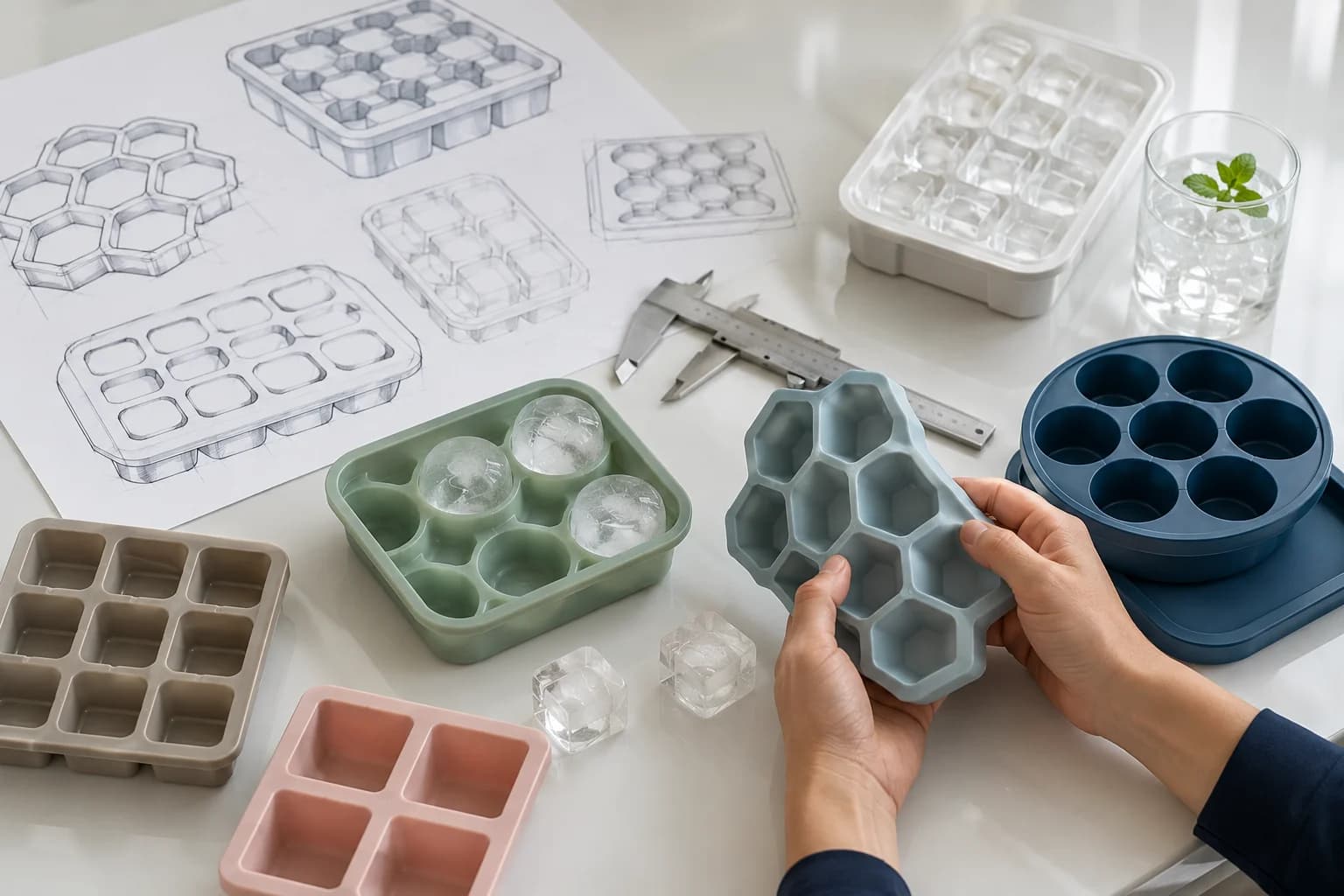
Practical scenario for product developers: If you are designing a consumer ice mold, the geometry of the mold determines which method the user can actually perform. A mold that forces freezing from one face will produce clear ice with reasonable user behavior; a mold with isolated cavities that freeze from six directions will not, regardless of how the packaging is worded. This is a design-stage decision, and it is worth reviewing early in a silicone OEM/ODM project where mold layout, wall thickness, and cavity spacing are still open variables.
5. Silicone Ice Molds and Clear Ice: What They Can and Cannot Do
Core conclusion: Silicone is excellent at demolding, flexibility, and customization. It is not, by itself, a clarity technology.
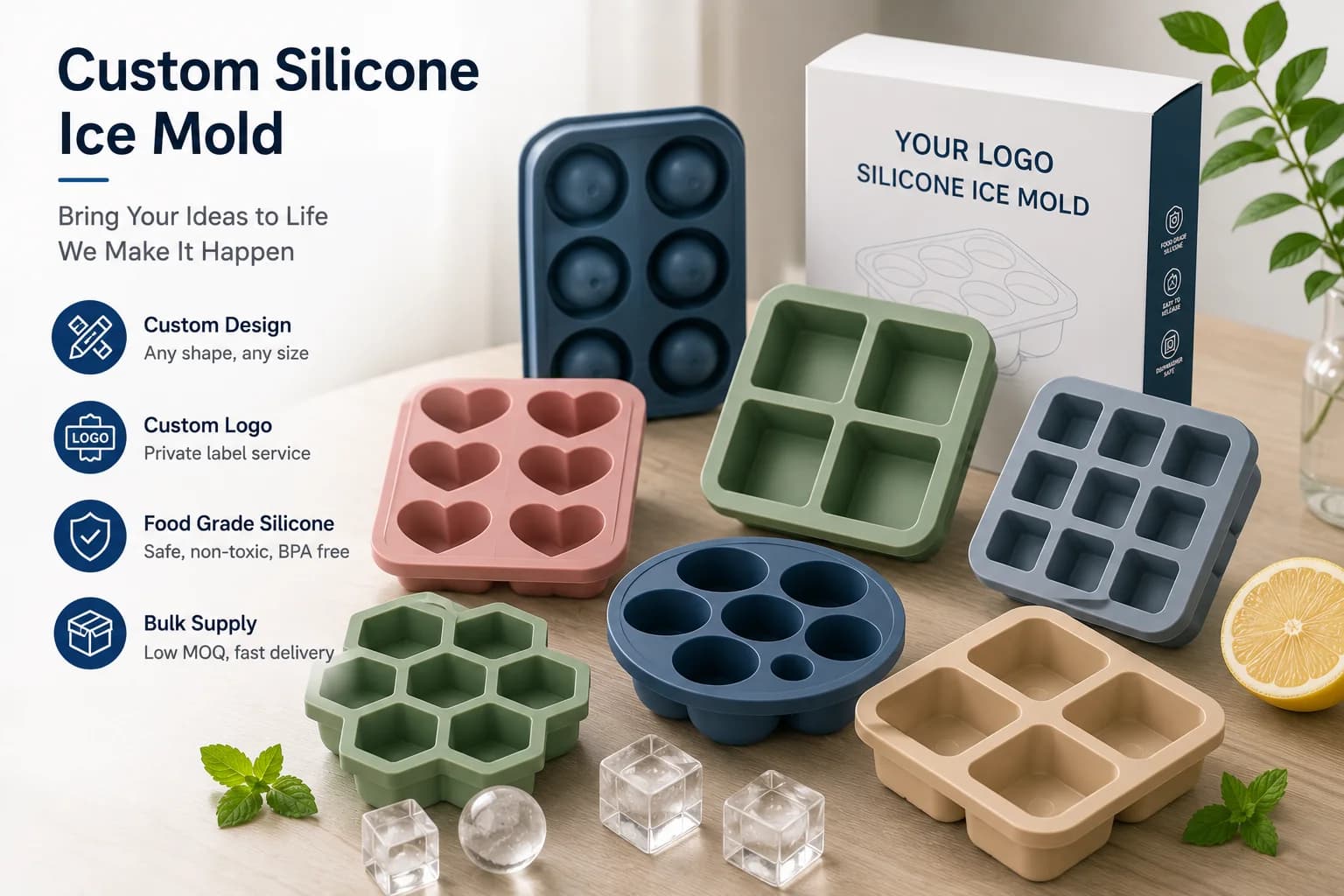
Silicone's real advantages in ice molds are mechanical and commercial. It flexes, so cubes release without forcing or warm-water tricks. It tolerates low temperatures well. It supports complex shapes — spheres, spears, branded logos, novelty forms — that rigid trays cannot easily produce. And it is compatible with private-label programs covering color, shape, size, logo, artwork, and packaging [K5].
What silicone does not do is change the physics in section 2. A conventional silicone tray still freezes from multiple directions. If clarity is the goal, the silicone component needs to sit inside an insulated or directional system, or the mold itself has to be designed with a single exposed freezing face.
A few sourcing points that experienced buyers verify early:
- Material specification. Confirm the exact compound and intended food-contact use per product, and do not assume a generic category label applies to a specific SKU [K2].
- Category flexibility. Ice molds can be positioned across household, kitchen, and promotional use cases; a single catalog category should not restrict cross-category marketing [K2].
- Availability and terms. Current availability, dimensions, certifications, MOQ, and lead time must be confirmed before publishing a product-specific page or quotation [K2].
- Claims discipline. Avoid superlative language such as "best quality" or "lowest price," and avoid publishing performance statistics that have not been verified [K4].
Practical scenario: A promotional-products buyer wants a logo ice mold for a beverage brand. The clarity conversation happens at design review, not at the quotation stage — the supplier needs to know whether the client expects decorative cubes or genuinely clear ones, because the answer changes the mold architecture. Standard inquiry fields for this kind of project typically include name, business email, country or region, product interest, estimated quantity, and message [K3].
6. Key Comparison / Method / Considerations
| Method | How it controls freezing | Typical clarity outcome | Labor level | Best suited for |
|---|---|---|---|---|
| Standard silicone or plastic tray | No control — cavities freeze from all sides | Usually cloudy centers | Very low | Everyday chilling, not presentation |
| Boiled/filtered water in a standard tray | Reduces dissolved gas and minerals only | Slight improvement | Low | Small incremental gains |
| Cooler / directional block method | Insulates five sides, one freezing face | Clear upper block, cloudy layer discarded | Medium–high (cutting required) | Home bars, small venues |
| Insulated cube-shape mold | One exposed face, cube cavities | Clear cubes without cutting | Medium | Consumers who want cubes, not slabs |
| Commercial clear-ice machine | Mechanically controlled freezing direction | Consistent, repeatable | Low | High-volume bars and hospitality |
Decision guidance: if consistency matters more than cost, invest in the process; if cost matters more than labor, invest in the equipment. For product developers, the deciding question is which method the end user can realistically perform — a mold that requires a second insulated component should be sold as a system, not as a standalone tray.
7. FAQ

Q1. Can you make clear ice with a silicone mold?
Yes, but not with a conventional open tray used alone. Silicone works as the mold material inside a directional or insulated system — for example, a tray positioned so only the top surface is exposed to freezer air. Silicone's flexibility then handles release, while the insulation handles clarity.
Q2. Does distilled or boiled water make ice clear on its own?
Not reliably. Distilled water removes minerals but leaves dissolved air, and boiling removes some dissolved air but does not change the fact that a standard tray freezes from every direction. Either step improves results slightly; neither replaces directional freezing.
Q3. How long does clear ice take to freeze?
A cooler-sized block typically takes roughly 18–24 hours in a home freezer at around −18 °C. Cube-sized insulated molds usually need less time. Freezing faster by lowering the temperature further tends to increase haze rather than speed up a clean result.
Q4. Why is my clear ice still cloudy at the bottom?
That is expected. The cloudy bottom layer is where rejected gases and minerals concentrate — it is the last portion to freeze. Cutting or melting that section away is part of the method, not a sign that the process failed.
8. Conclusion
The direct answer to how do you get clear ice is this: control the direction of freezing, freeze slowly, and remove the last portion of water to solidify. Water treatment is a supporting variable, and equipment is a supporting variable, but neither substitutes for directional freezing.
For home users, the cooler method plus a serrated knife delivers reliable clear ice with no special purchase. For consumers who want cube shapes without cutting, an insulated cube mold is the more practical format. For commercial venues, a machine earns its cost through labor savings, not through better ice.
For B2B buyers and product teams, the clarity question should be resolved during design review, before tooling and sampling are locked. Decide whether the product is a decorative mold or a clarity system, confirm the material specification and current availability against a real product record, and keep marketing language tied to what the design can actually deliver [K2][K4]. When you are ready to evaluate a specific configuration, request a quote with your target market, expected quantity, and customization requirements so the mold architecture can be assessed against your channel.