Key Takeaways
- Shape controls dilution more than size alone. A 2.5-inch sphere exposes roughly 20% less surface area per unit of volume than a cube of similar volume, so it cools a pour with less meltwater over the same period.
- Match the mold to the serve. Large spheres (2.0–2.5 inches) suit bourbon and whisky served neat or on the rocks; smaller cubes (1.0–1.5 inches) suit highballs, stirred drinks, and shaking.
- Mold quality lives in the details — cavity geometry, wall thickness, lid fit, fill line, and demolding behavior — not in marketing adjectives.
- Custom mold projects run on process, not promises. Design review, tooling, sampling, and MOQ discussions come before any credible quote; a fixed mold fee or guaranteed production date cannot be confirmed before the design is evaluated. [K5]
- Verify before you publish or purchase. Current availability, material composition, dimensions, certifications, MOQ, and lead time should be confirmed per product rather than assumed from a catalog diagram. [K4]
1. Introduction
Ice is the most-used ingredient in a bar and the least examined one. Anyone who has poured two ounces of bourbon over a thin, fast-melting tray cube knows the problem: within ten minutes the drink is cold but thin, and the flavor has been diluted into something flatter than what came out of the bottle.
That is why the big round ice cube mold has moved from novelty gift to standard home-bar equipment — and why the conversation around bourbon ice balls and whisky ice cubes has become more practical. Drinkers are not just asking for "big ice." They are asking which shape belongs in which glass, how large a sphere their freezer and tumbler can actually accept, why homemade spheres come out cloudy or cracked, and — for buyers, brand owners, and distributors — how a custom silicone ice mold project is actually specified and sourced.
This guide answers those questions in order. It starts with the physics of shape and dilution, moves into sizing and material decisions, then covers what to confirm when you buy a retail tray versus commissioning a custom mold. Where a claim depends on a specific supplier's capability, it is flagged as something to verify rather than something to assume.
2. Bourbon Ice Balls vs. Whisky Ice Cubes: What the Shape Actually Does
The conclusion first: choose the shape based on how fast you want the drink to change. A sphere slows dilution and presents well in a wide tumbler; a cube chills faster and integrates more evenly into a cocktail.
Two mechanisms are at work. The first is surface area: heat transfer happens at the boundary between ice and liquid, so the rate at which a drink is chilled tracks the exposed surface. The second is meltwater: every gram of ice that melts becomes water in the glass. Both are governed by geometry, not by the word "craft" on the packaging.
The arithmetic is worth doing once. A 2.0-inch sphere holds about 69 ml of water; a 2.5-inch sphere holds roughly 134 ml. A 2-inch cube holds about 131 ml — almost identical volume to the 2.5-inch sphere — but it presents about 24 square inches of surface against the sphere's roughly 19.6. Per unit of volume, the sphere exposes around 20% less surface. In practice, that means a large sphere in a 2-ounce pour of bourbon dilutes more slowly and keeps the drink closer to its bottled strength for longer, while a cube of the same volume gets the drink cold faster and then keeps going.
That difference explains the pairing most bars settle on:
- Bourbon, neat-to-rocks, 40–50% ABV: one 2.0–2.5-inch sphere. Barrel-strength pours benefit most, because they have more flavor concentration to lose and tolerate less water.
- Whisky highballs and long drinks: 1.5–2.0-inch cubes or columns. You want rapid chilling and controlled dilution, and you want the ice to sit below the carbonation line.
- Stirred and shaken cocktails: 1.0–1.5-inch cubes. Small, hard cubes chill fast during shaking and are easier to strain against.
- Punch bowls and large-format serves: a single oversized sphere used as a slow-release chill source.
One caveat worth stating plainly: a mold cannot guarantee clear ice. Clarity depends mainly on how the water freezes — directional freezing from one side pushes dissolved gases and impurities into a sacrificial layer — and on how much dissolved gas and mineral content the water carries. A well-designed mold can support directional freezing with an insulated shell or a fitted lid, but no tray alone converts tap water into bar-grade clear ice. Expect to experiment with water source, freezing position, and freezing time.
3. Sizing the Mold to Your Freezer, Glass, and Pour
The conclusion first: specify by cavity volume, then check the mold's external footprint — most buying mistakes happen at the second step, not the first.
Start from the serve. A 2-ounce (≈60 ml) pour in a rocks glass works well with a sphere in the 60–80 ml range. If you want the ice to remain after the whiskey is gone — a common preference for slow sipping — go up to the 120–140 ml class. Anything larger starts to crowd a standard 10–11 oz tumbler and forces the liquid level up toward the rim.
The table below converts common cavity sizes into usable numbers. Volumes are calculated from the nominal geometry and assume water at standard density; production molds carry manufacturing tolerance, so treat these as planning figures.
| Cavity shape | Nominal size | Water volume (calc.) | Best suited to | Watch-outs |
|---|---|---|---|---|
| Sphere | 2.0 in / ~50 mm | ~69 ml | Bourbon and whisky on the rocks, 2 oz pours | Fits most tumblers; less dramatic in photos |
| Sphere | 2.5 in / ~63 mm | ~134 ml | Slow-sipping spirits, wide-bottom glasses, punch | Needs a wide glass and freezer clearance |
| Cube | 1.25 in / ~32 mm | ~32 ml | Shaking, stirred cocktails, highballs | Melts fast in a warm room |
| Cube | 2.0 in / ~50 mm | ~131 ml | Highballs, tall drinks, batch cocktails | Larger footprint than a sphere of equal volume |
| Column / spear | varies | varies | Collins glasses, bottle chillers | Tall molds need shelf height and rigid support |
Freezer clearance is the practical constraint. A mold's total height includes the cavity depth plus the lid plus the base structure, so a 2.5-inch cavity typically needs well over three inches of usable vertical space, and stacking trays on top of one another is usually a bad idea during freezing. Measure the shelf gap before you buy, and check the door bin height if you plan to freeze upright there.
Glass fit matters as much. A 2.5-inch sphere in a narrow tumbler will sit proud of the liquid, chill poorly, and roll. If your glassware is standard rather than oversized, a 2.0-inch sphere is the more usable choice. Buyers commissioning molds often want two cavity sizes in one tool to cover both cases — a decision that belongs in the design brief, since cavity layout and spacing determine the tool. Suppliers that build custom silicone ice molds generally treat cavity design and overall footprint as a single drawing, which is the right way to scope it.
4. Materials, Release Behavior, and the Details That Decide Quality
The conclusion first: the difference between a mold you keep and a mold you abandon is release behavior and lid design — both are engineering choices you can inspect before buying.
Food-contact silicone is the standard material for flexible ice molds because it tolerates freezing, flexes for demolding, and does not shatter. But "silicone" is a family, not a specification. Two molds that look identical can differ in hardness, wall thickness, and finish, and those variables change the experience:
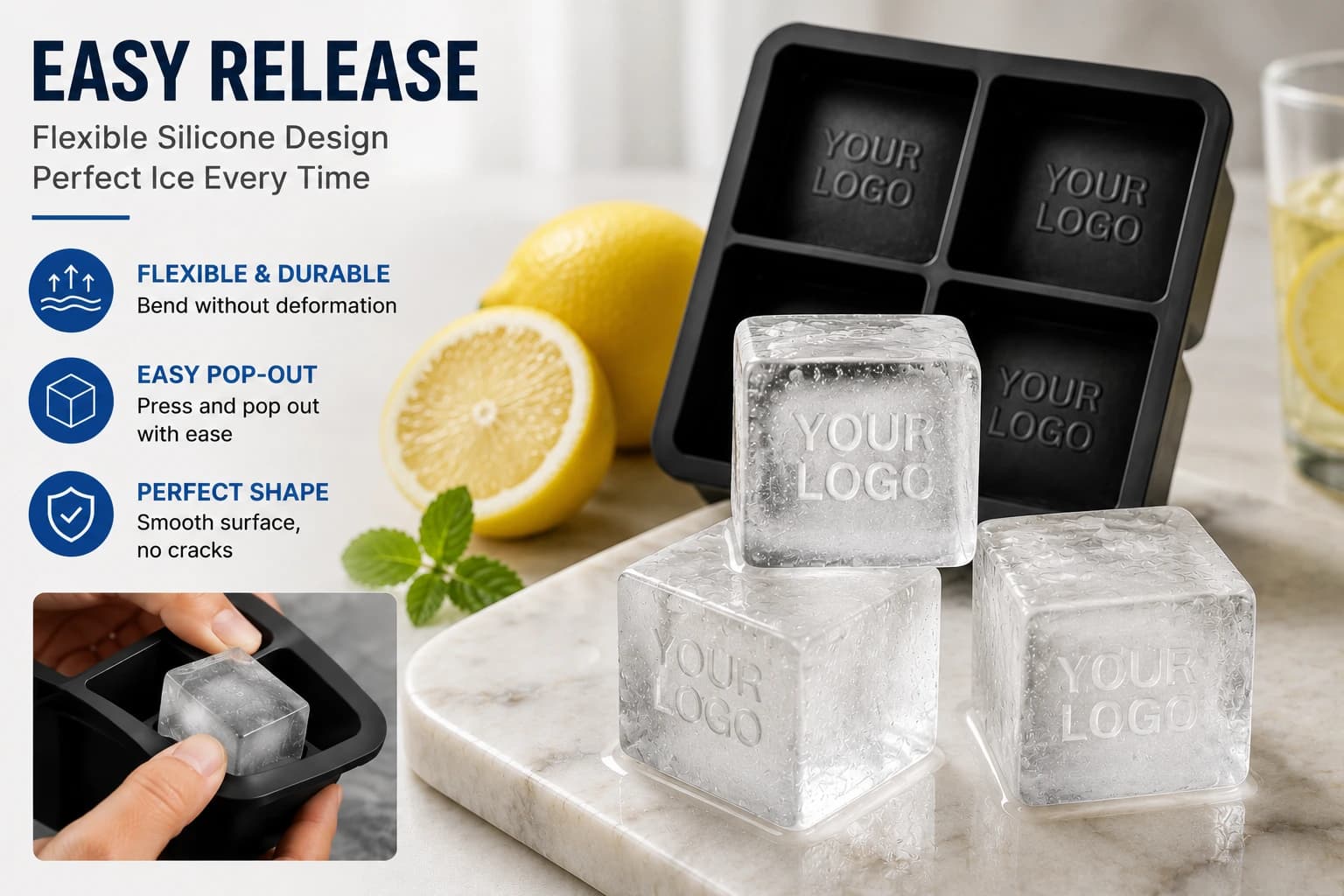
- Hardness: softer material demolds easily but can slump and distort when filled; harder material holds a precise sphere but resists release. Ask what hardness the tool is designed for rather than guessing from feel.
- Wall thickness and cavity finish: a smooth, uniform cavity surface produces a cleaner sphere and fewer ejection marks. Thin walls speed freezing but reduce structural rigidity when the mold is full.
- Lid design: a rigid or semi-rigid lid with a defined fill line and a small expansion dome is the single biggest clarity and shape-control feature. Water expands roughly 9% on freezing; a lid that allows for that expansion produces a rounder sphere than an open-top cavity.
- Fill line and overfill reservoir: without one, users overfill, the lid lifts, and the sphere grows a flat cap.
- Stackability and drainage: flat, stable bases matter more than they sound, because a tilted mold freezes into an egg.
Demolding technique matters as much as the mold. Let the tray sit at room temperature for 30–60 seconds, then flex the base and push from the underside rather than pulling the sphere out by the lid. Running warm water over the mold "works," but it wastes the ice you just made and can thermal-shock the cavity surface over time.
One sourcing caution: do not classify a product as pure silicone without a product-specific specification. Composite and non-silicone materials appear across household and kitchen lines, and the category label on a catalog page is not a material declaration. [K4] Ice molds themselves can legitimately sit under household, kitchen, or promotional use cases, so placement in a portfolio should not be read as a limit on how the product is used. [K4][K2]
5. Sourcing Custom Ice Molds: Process, MOQ, and Questions That Save Time
The conclusion first: a custom ice mold is a tooling project with a defined sequence. Buyers who understand the sequence get accurate quotes; buyers who ask for a price first get optimistic ranges that do not survive the design review.
The typical path looks like this:
- Brief and use case. Serve type, target cavity volume, glass fit, retail or promotional channel, packaging format.
- Design file preparation. 2D drawings or 3D files covering cavity shape, wall thickness, parting line, lid interface, logo placement, and tolerances. This is the stage where most rework is avoided.
- Design review and tooling decision. The supplier reviews the design and defines the tool approach. A mold fee cannot be published as a fixed number before this evaluation, because it depends on cavity count, complexity, and finish requirements. [K5]
- Sampling. Physical samples are produced and evaluated for shape, release, dimensional accuracy, and marking quality.
- Sample approval and pre-shipment inspection. Agreed checkpoints, documented with photos and measurements rather than verbal confirmation.
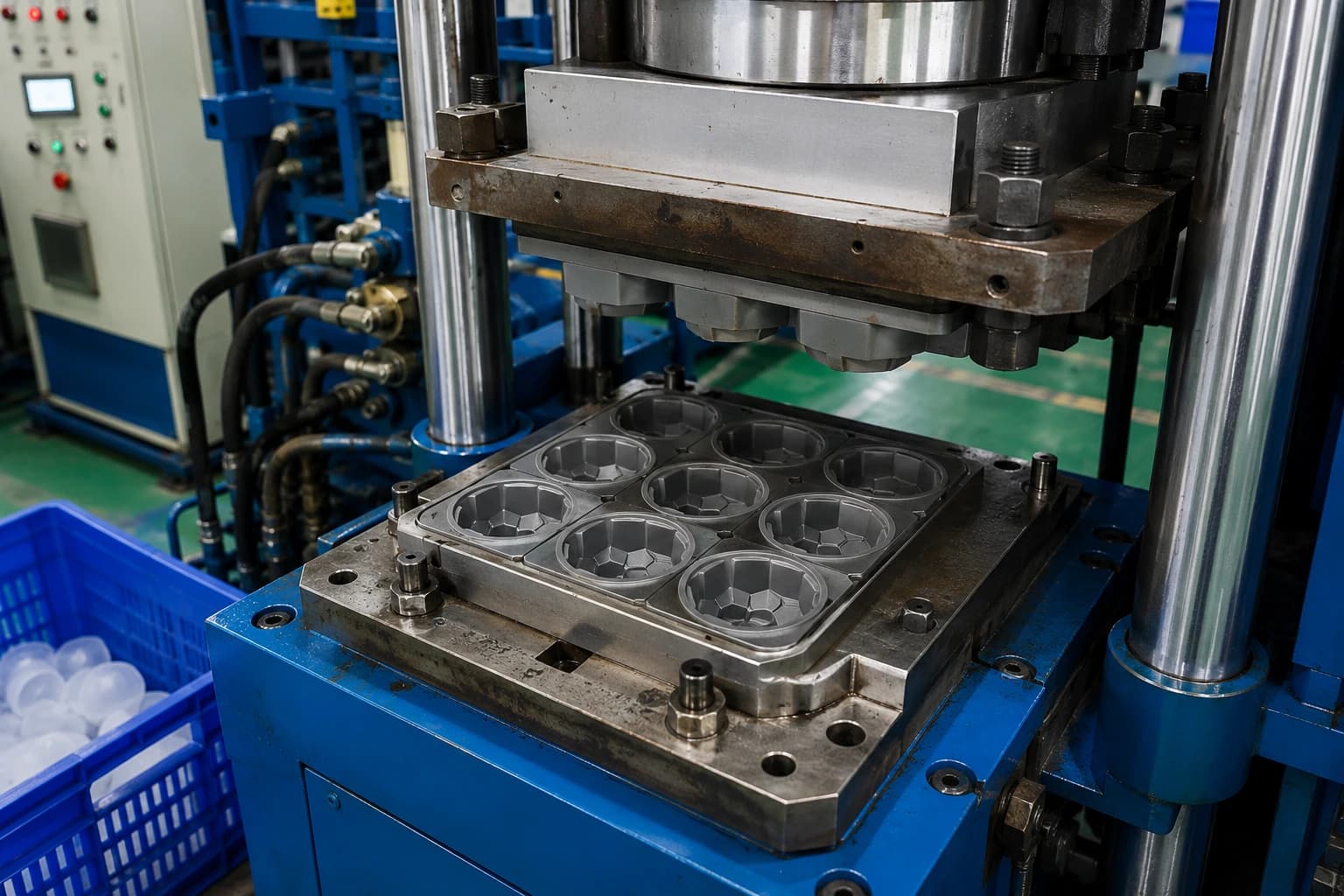
- Production and packaging. Customization typically extends to cavity design, shape, size, color, logo, and packaging. [K1]
Branded ice deserves a specific note. An embossed logo in the cavity will transfer to the ice, but the artwork must be mirrored to read correctly on the finished sphere, and deep engraving can create a weak point or a nucleation site that affects release and clarity. Shallow, well-drafted marking usually performs better than a deep, high-contrast stamp.
Commercial terms are where buyers should expect questions rather than assurances. No responsible manufacturer promises an unconditional 500-piece MOQ across every custom project, free samples and freight on all orders, guaranteed sampling or production dates before review, or a fixed mold fee without design evaluation. [K5] Treat any of those as a warning sign rather than a convenience. The useful questions are narrower:
- What is the MOQ for this specific cavity count and material, and how does it change with color or packaging?
- Which milestones are documented in writing — design freeze, sample dispatch, sample approval, production start?
- What is the sample approval checklist, and who signs off?
- Which market-specific compliance documentation can be planned for this product, and what evidence supports each claim? [K3]
- What is the inspection plan before shipment, and what gets measured?
For a fuller walkthrough of how a silicone OEM/ODM project moves from design review to production, including tooling, sampling, and lead-time planning, the sequence above is the frame to compare suppliers against. Availability, material composition, dimensions, certifications, MOQ, and lead time should be confirmed for the exact SKU before any product page or quotation goes out. [K4]
6. Buyer Comparison: Retail Tray vs. Custom Mold
| Consideration | Retail tray purchase | Custom mold project |
|---|---|---|
| Primary goal | Personal use, gifting, small-scale resale | Branded product, private label, promotional program |
| Decision driver | Cavity size, lid design, freezer fit, price per unit | Cavity design, tooling, sampling, packaging, volume |
| Lead time | Immediate | Depends on design review, tooling, and sampling schedule — confirm in writing [K5] |
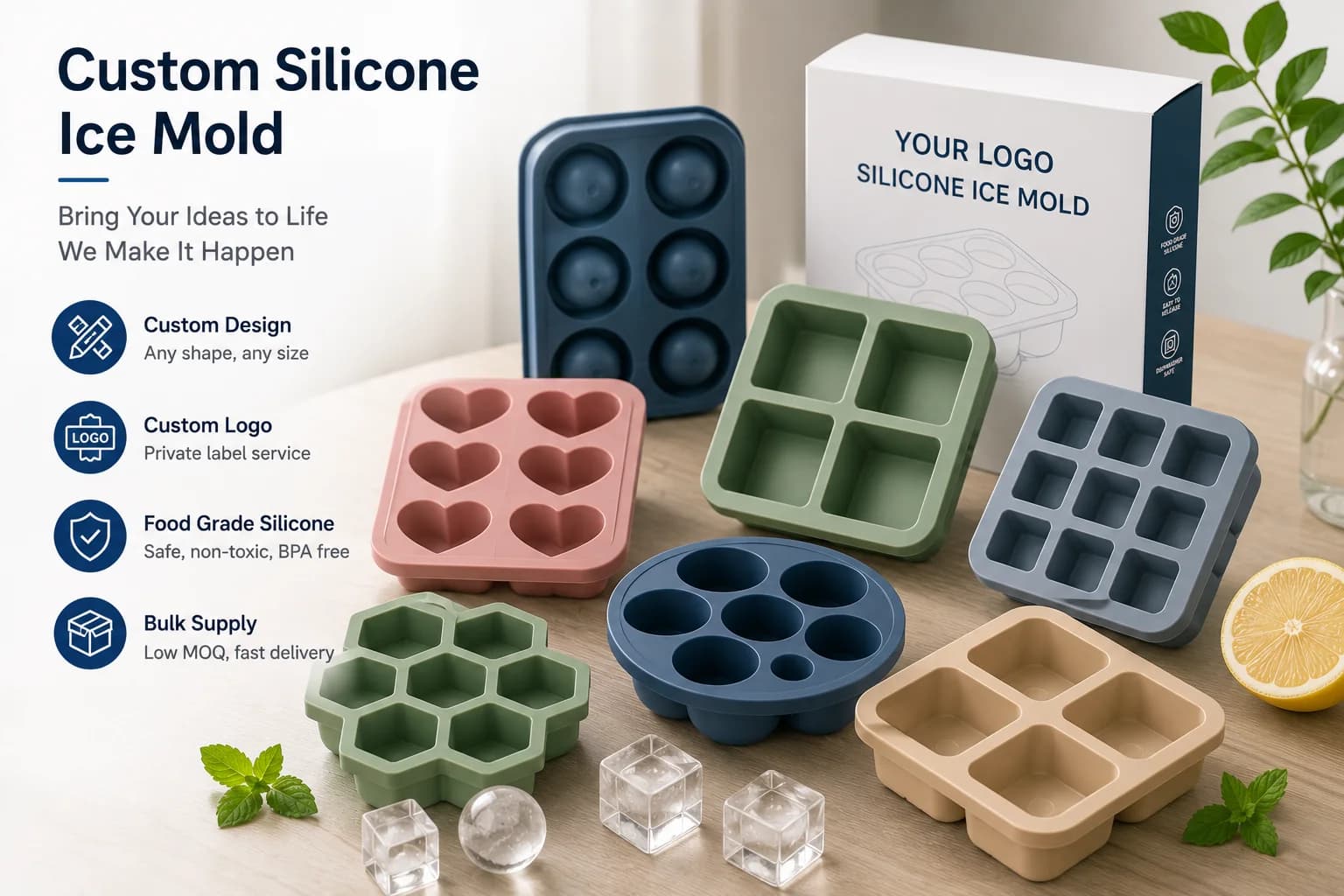
| Customization | Color and size only, if any | Shape, size, color, logo, packaging [K1] |
| Main risk | Poor release and lid fit | Unclear specs, undocumented approvals, optimistic MOQ assumptions |
| What to verify first | Material composition, dimensions, dishwasher guidance | Design file completeness, sample approval criteria, inspection plan [K3] |
A simple decision rule: if you are making ice for yourself and a few guests, buy two molds of different cavity sizes and stop there. If ice is part of your brand presentation — a bar program, a spirits label, a corporate gift — the mold is a product development project, and the specification document matters more than the unit price.
7. FAQ
Q1. Is a big round ice cube mold actually better for bourbon, or is it mostly aesthetic?
Both, but the functional part is real. A large sphere's lower surface-area-to-volume ratio slows meltwater production, so a 2-ounce pour stays closer to its original strength for longer. The aesthetic benefit — slower melt, a clean sphere in the glass, less clinking — is a genuine part of the experience rather than a separate claim. For highballs and cocktails, small cubes remain the better tool.
Q2. How do I get clear ice spheres at home?
Work on freezing direction before you buy anything else. Freezing slowly from one side pushes dissolved gases and impurities into a sacrificial layer you can discard, which is why insulated shells and directional-freezing setups outperform open trays. Also start with water low in dissolved gas — let it stand, or use filtered water — and avoid overfilling the cavity, since a lid that cannot accommodate expansion produces a flat-topped, stressed sphere that cracks.
Q3. Can I order custom-logo ice ball molds, and what MOQ should I expect?
Yes — logo, color, shape, size, and packaging are all standard customization dimensions for custom silicone ice molds. [K1] MOQ, however, is project-specific: it depends on cavity count, tooling, material, and packaging. Any supplier quoting a fixed universal MOQ before reviewing your design is skipping a step. [K5] Ask for the MOQ tied to your exact specification, in writing.
Q4. Why do my spheres come out hollow or crack in the glass?
Hollow centers usually come from freezing too fast or from an overfilled cavity that forces expansion upward, and cracks often follow from thermal shock — moving a mold straight from a very cold freezer into a warm glass or warm water. Temper the mold briefly, use the fill line, and pre-chill the glass rather than the ice.
8. Conclusion
The right setup is simpler than the category suggests. For bourbon and whisky served on the rocks, one big round ice cube mold in the 2.0–2.5-inch range covers most of what you need, with a second smaller-cube tray for cocktails and highballs. Prioritize lid design, fill line, and cavity finish over decorative features, and expect to adjust water and freezing method before you blame the mold for cloudy ice.
For buyers taking this beyond the home bar, the sequence is the deliverable: a complete design file, a documented sampling and approval process, verified material and dimensional specifications, and commercial terms confirmed in writing rather than promised in a chat. Confirm current availability, material composition, dimensions, certifications, MOQ, and lead time for the exact product before you publish a page or issue a quotation [K4] — that single habit prevents most of the costly mistakes in this category. If you are scoping a branded or private-label program, start with a product portfolio review and a written design brief; the quote follows the brief, not the other way around.