Key Takeaways
- A monogram ice mold is a development project, not a catalog item. Cavity design, shape, size, color, logo, and packaging are all customization variables that have to be specified and approved before production [K1].
- The hardest part of monogram ice is not the artwork — it is legibility. A mark that reads clearly in a digital mockup can lose definition once it is formed in frozen water, so the mark's depth, weight, and placement must be engineered, not just drawn.
- Custom ice products sit in two different supplier product families: ice block molds are typically grouped with household products, while ice cube trays, ice ball trays, and popsicle molds are grouped with promotional products [K2]. Knowing which family your project belongs to helps you frame the brief correctly.
- Sourcing risk concentrates in three approval gates: design-file review, sample approval, and packaging sign-off. Written terms for MOQ, tooling, sampling, and lead time should be confirmed before tooling starts [K3].
- No supplier can honestly promise sales, ranking, or market success from branded ice alone. Treat monogram ice as a brand-experience investment, not a guaranteed growth lever [K5].
1. Introduction
Branded ice has moved from novelty to routine expectation in hotels, specialty coffee bars, cocktail programs, distilleries, and premium event catering. Once a venue serves clear, geometric ice, a plain cloudy cube starts to look like a missed detail. That shift is why the idea of a monogram ice mold — a custom silicone mold that forms initials, wordmarks, or brand marks directly into ice — keeps coming up in product-development conversations.
The pain point is that most buyers approach monogram ice as a graphic design task. They send a logo file and expect a tray. In practice, monogram ice is a mold-engineering task with a design conversation attached. Whether the mark stays readable depends on cavity geometry, the direction the mark is formed, the size of the cube relative to the letterform, and how the finished piece releases from the mold. Get those wrong and you have an expensive tray that produces ice nobody wants to photograph.
This article is written for brand owners, importers, retailers, e-commerce sellers, and product developers who are evaluating customized ice as a branded product or a hospitality detail [K5]. It covers what monogram ice actually is, how a custom mold project moves from concept to production, which design decisions determine legibility, and what to confirm in writing before you commit to tooling.
2. What Monogram Ice Actually Means Before You Brief a Supplier
Core conclusion: decide first whether the monogram is the cube or is on the cube. That single decision changes tooling, sampling, cost structure, and how the ice reads in a glass.
There are two common interpretations of monogram ice:
- Letterform ice. The cavity itself is shaped like an initial, a stacked monogram, or a small wordmark. The ice arrives as a recognizable shape rather than a cube.
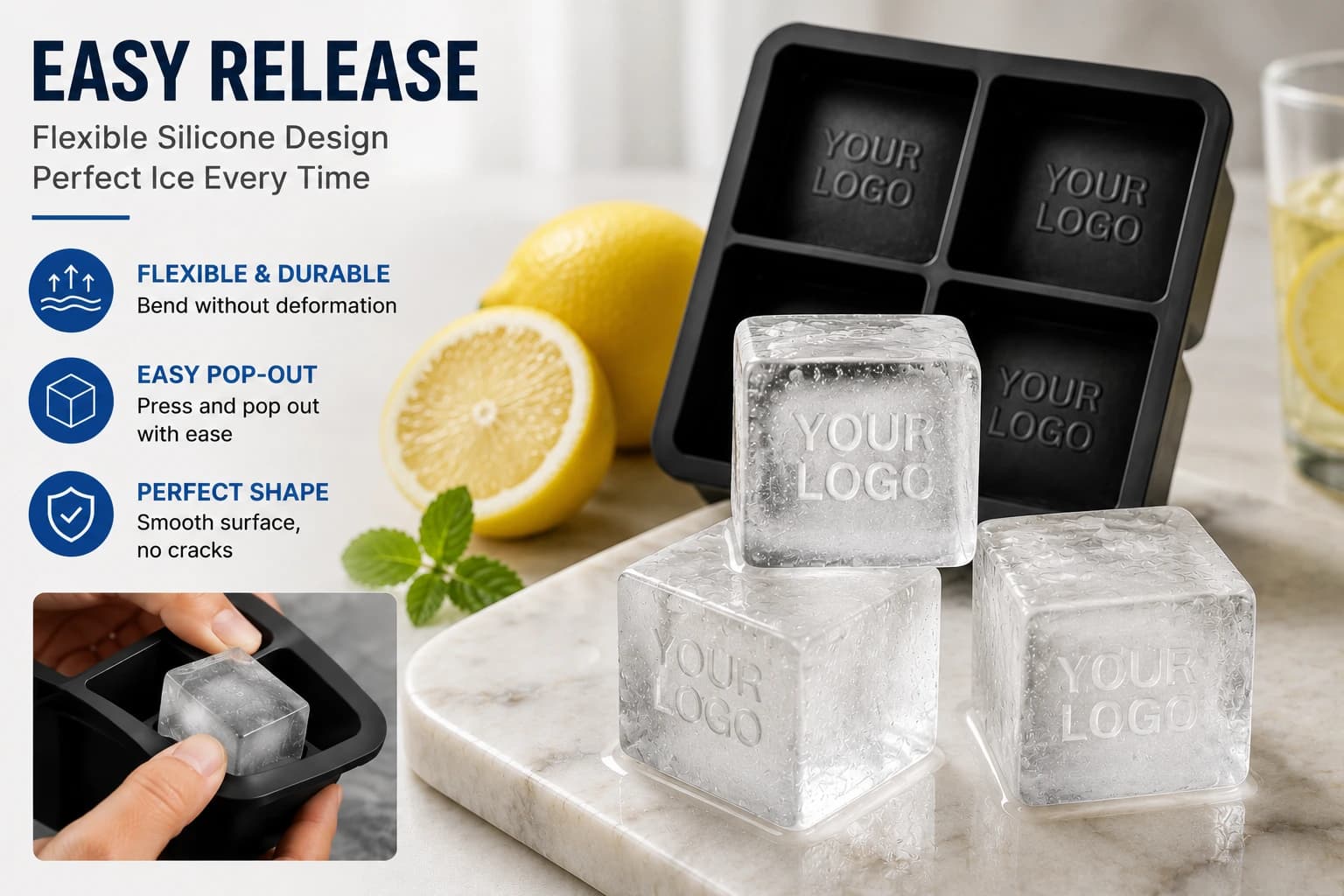
- Marked cube ice. A standard cube, sphere, or block carries a raised or recessed mark on one face. The mark can be a single initial, a two-letter monogram, or a simplified brand device.
These are not interchangeable. Letterform ice demands more cavity detail and creates thinner sections that can break during demolding. Marked cube ice is more forgiving and usually reads better when the ice is placed in a glass, because the mark faces the drinker.
This is also where supplier product architecture matters. In a typical silicone manufacturer's portfolio, ice block molds sit with household products, while ice cube trays and ice ball trays sit with promotional products [K2]. A monogram project is normally developed on a custom silicone ice mold platform, where cavity design, product shape, size, color, logo, and packaging are treated as separate specification items [K1]. If your supplier's brief template only asks for "shape and color," the project is underspecified from the start.
Practical advice: write a one-page brief that states the intent — "a 1.75-inch cube with a recessed two-letter monogram on the top face, for hotel bar service" — rather than attaching a logo and asking for options. Suppliers can push back on a defined brief; they can only guess at an undefined one. Buyers who want a broader view of what can be customized on a custom silicone ice mold platform should review cavity, color, logo, and packaging options together rather than one at a time.
3. How a Custom Ice Mold Project Moves From Concept to Production
Core conclusion: monogram ice projects succeed or fail at the approval gates, not in the initial concept. Each stage needs a documented sign-off before the next begins.
The sequence for custom silicone mold development is well established: design-file preparation, design review, tooling, sampling, sample approval, production, quality inspection, and packaging [K1][K3]. In practice, it looks like this:
- Design-file preparation. The buyer supplies artwork, dimensions, and reference images. Vector artwork is preferred for logo elements; a marked-up photograph or sketch is acceptable for shape intent.
- Design review. The supplier's team assesses whether the requested geometry is moldable, where the parting lines will fall, and whether the mark's features are wide enough to fill and release reliably.
- Tooling. The mold is cut or formed from the approved design. Changes after this point are more expensive than changes before it.
- Sampling. Physical samples are produced so the buyer can freeze real ice, not judge a rendering.
- Sample approval. The approved sample becomes the reference standard for production, including the mark's depth and position.
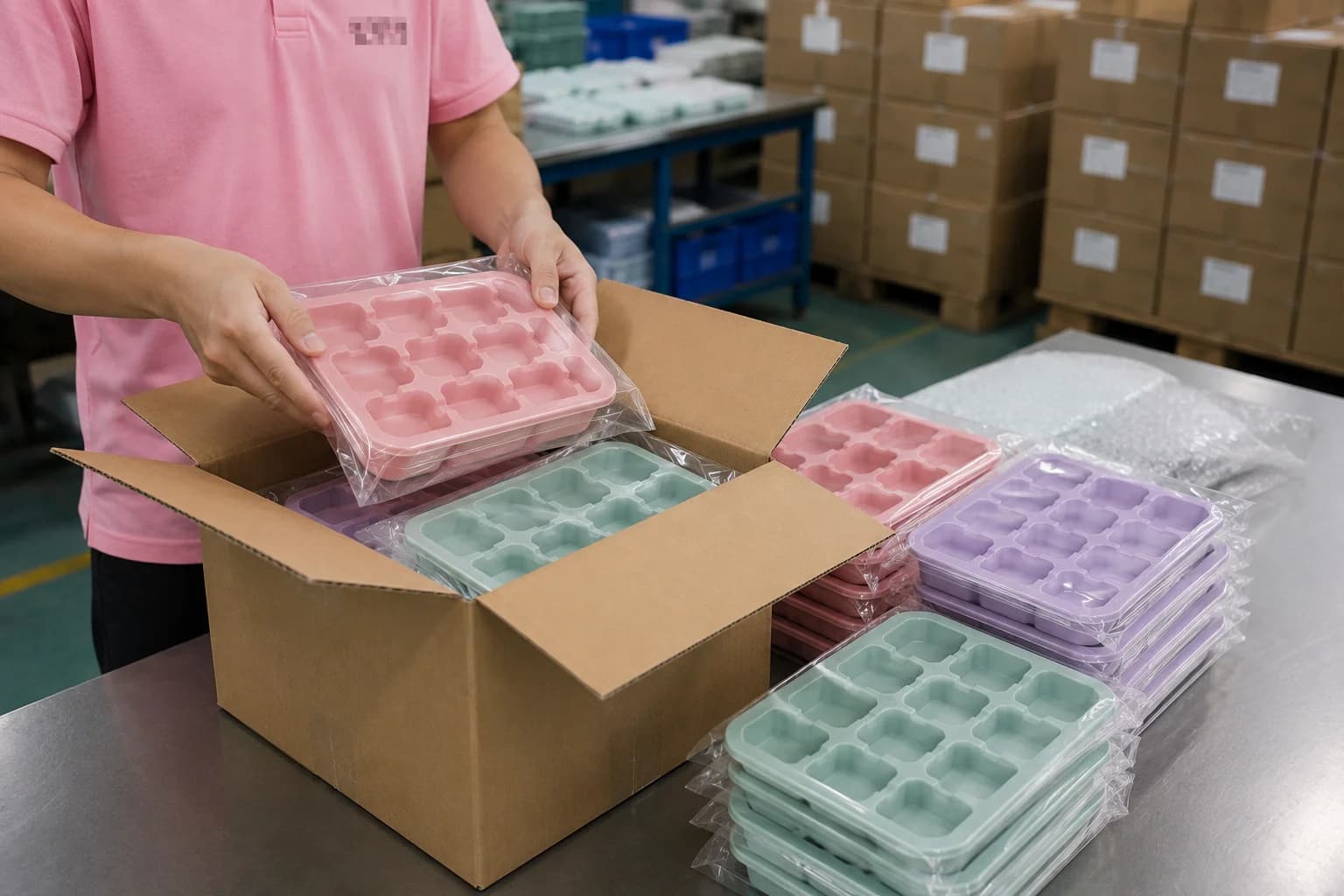
- Production, inspection, and packaging. Finished goods are checked against the approved sample and packed to the agreed specification.
Two boundary conditions are worth stating plainly. First, the sampling stage is where clarity problems surface — undercuts around tight letterforms, weak fill in narrow strokes, or marks that become invisible once the cube is cloudy. Second, compliance and labeling planning must be handled market by market, based on the actual destination requirements; suppliers should not make certification claims they cannot support [K3].
Practical advice: when you request a quote, ask the supplier to describe their process from design review to production in writing, including which stage requires your approval. A supplier who can map the approval gates clearly is easier to work with than one who only quotes a unit price.
4. Design Decisions That Determine Whether the Monogram Reads Clearly
Core conclusion: legibility on ice is a geometry problem, not a graphics problem. The mark must be designed for the material it will be formed in.
Ice is a demanding medium. It is translucent or cloudy, it refracts light, and it changes appearance as it melts. A mark that depends on fine lines and tight details will lose definition. The decisions that matter most are:
- Mark orientation. A mark formed into the top face of a cube is visible before it melts; a mark formed into a side face reads differently once the cube is in a glass.
- Raised versus recessed. Recessed marks tend to hold their outline better in clear ice; raised marks can catch more light but are more vulnerable to chipping during demolding.
- Feature width and depth. Ask your mold engineer to confirm the minimum feature width and depth that can be reproduced reliably at your intended cube size. Do not assume a print-quality logo will translate.
- Draft and release. Letterforms with sharp interior angles create undercut areas. A slight draft on the mold walls reduces tearing and improves repeatability.
- Cube size relative to the mark. A large monogram on a small cube leaves thin walls; a small monogram on a large cube disappears. The ratio should be settled at design review, not at sampling.
- Water and freezing method. Clear-ice production and standard freezer trays produce very different visual results from the same mold.
Practical advice: prototype with a single initial or a simplified two-letter mark before committing to a full monogram set or a detailed wordmark. It is far cheaper to approve a simplified mark than to re-tool a cavity. If packaging will display the product, settle design-file preparation and packaging requirements at the same time as the cavity design, because a product that photographs poorly will not carry a premium shelf position.
5. Key Comparison and Sourcing Considerations
The table below summarizes the practical differences between buying stock ice trays and developing a monogram ice mold.
| Dimension | Stock ice tray | Custom monogram ice mold |
|---|---|---|
| Customization scope | Fixed cavity, limited color options | Cavity design, shape, size, color, logo, and packaging can all be specified [K1] |
| Upfront work | Selection only | Artwork preparation, design review, tooling, sampling |
| Approval gates | None | Sample approval and pre-shipment inspection checklist [K3] |
| Risk profile | Low cost, low differentiation | Higher upfront effort, higher differentiation if the mark reads well |
| Product family framing | Usually grouped with promotional items such as ice cube trays [K2] | Treated as a custom silicone ice mold development project [K1] |
| Best fit | Test-market trials, general retail | Hospitality programs, brand merchandise, gift sets, private label |
A sourcing checklist for this category:
- Confirm MOQ, tooling cost, sampling cost, and lead time in writing before tooling begins [K3].
- Ask which product category your item will be developed under, and confirm the current-product specification rather than relying on a general catalog [K2].
- Request a written sample-approval record and a pre-shipment inspection checklist [K3].
- Ask the supplier how they handle design-file revisions, and at what stage revisions stop being free.
- Evaluate the supplier's operating philosophy, not just the price. A manufacturer that states it builds products "with respect for quality and responsibility" and conducts business with a service-minded approach is signaling how it will handle a problem order [K4].
- Accept that no reputable supplier will guarantee profit, sales, ranking, or conversion rate [K5]. Any quote that does should be treated as a warning sign.
Recommendation: run monogram ice as a focused pilot. Choose one mark, one cube format, and one packaging configuration; approve the sample against real freezing conditions; then scale once the mark proves it reads clearly.
6. FAQ
Q1. Is a monogram ice mold the same thing as a logo ice cube tray?
Not exactly. A logo ice cube tray usually refers to a standard tray with a logo applied to the tray body or packaging. A monogram ice mold is a custom mold whose cavity forms the mark into the ice itself, which requires design review, tooling, and sampling [K1]. The tray carries the brand; the mold changes what the ice looks like.
Q2. How long does a custom monogram ice mold project take?
Timing depends on design complexity, tooling requirements, and the number of sampling rounds, so any responsible answer is project-specific. What you can control is the sequence: design-file preparation, design review, tooling, sampling, sample approval, production, and inspection [K1][K3]. Ask for a written schedule with named approval gates before you commit, and build in time for at least one revision round.
Q3. Can small brands order customized ice without a large volume commitment?
MOQ varies by supplier, mold complexity, and whether the design uses an existing cavity platform. The practical approach is to ask about MOQ alongside tooling and sampling costs, since a low unit MOQ with high tooling amortization may not be economical [K3]. Buying groups, event-specific runs, and gift-set packaging are common ways smaller brands test the concept.
Q4. What files should I prepare before contacting a supplier?
Prepare vector artwork for any logo or monogram element, dimensional targets for the finished cube, reference images showing the intended look, color direction, and packaging intent. Custom silicone ice mold projects are typically specified through cavity design, shape, size, color, logo, and packaging, so a complete brief shortens the design review stage considerably [K1].
7. Conclusion
Monogram ice is a small product with an outsized brand effect — but only when the mold is engineered for clarity rather than designed as a graphic. The monogram ice mold decision comes down to three judgments: whether the monogram is the cube or sits on the cube, whether the mark's geometry survives freezing and demolding, and whether your supplier documents MOQ, tooling, sampling, and lead time before tooling starts [K1][K3].
If you are evaluating this category, start with a single-letter pilot at your intended cube size, freeze it under real service conditions, and photograph it in a glass before approving production. Use that sample as your quality reference. And keep expectations calibrated: customized ice can sharpen a brand's presentation, but it is a product-development decision, not a guaranteed commercial outcome [K5].