Key Takeaways
- A 20 sided dice ice mold is a cavity-engineering project, not just a shape decision. Draft angle, edge radius, wall thickness, silicone hardness, and a clear fill line determine whether an icosahedron releases cleanly or tears at the corners.
- Dice ice and oversized cubes solve different problems: dice ice is a presentation and conversation piece for lowball glasses, while cubes from a large ice cube tray are for pitchers, punch bowls, and long sessions where melt rate matters.
- Clear ice depends on water quality, freezing direction, and mold surface finish. Buying a new mold will not fix cloudy ice by itself.
- For private-label or promotional projects, plan around typical figures: MOQ around 500 pcs, custom samples in 7–10 working days, mass production in 15–20 working days, and mold lead time of about 15 working days after 3D design confirmation [K3].
- Buy ready-made trays for a one-off game night. Tool a custom mold only when the dice geometry, logo, color, or packaging is part of the product you are selling.
1. Introduction
Game night ice has quietly become a product category of its own. Hosts who once dropped a handful of crescent cubes into a pitcher now look for dice-shaped ice for whiskey glasses and oversized blocks for punch bowls, and two search patterns dominate: the 20 sided dice ice mold and the "largest ice cube tray" a home freezer can realistically hold.
Both searches run into the same wall. Dice molds look simple in product photos, but buyers discover that an icosahedron has twenty faces, thirty edges, and a set of very thin silicone walls between cavities. Oversized trays look impressive in renders, but buyers discover that a 2.5-inch cube takes roughly four times longer to freeze than a 1.25-inch cube, and that the tray may not clear the freezer shelf above it.
This article unpacks the practical side of both formats: how dice cavity geometry affects demolding, what "largest" actually means once freezer constraints are applied, how to get clearer ice, and how a custom silicone ice mold project is planned from design files to mass production. It is written for two audiences at once — hosts who want better ice tonight, and brand owners evaluating a mold program.
2. Why Game Night Needs Two Kinds of Ice
Core conclusion: dice ice and large-block ice are complementary, not competing. Use large cubes where dilution control matters and dice ice where the glass is the show.
Melt rate is governed mainly by surface-area-to-volume ratio. Doubling the edge length of a cube halves that ratio, which is why a single large block outlasts a tray of small cubes in a pitcher by a wide margin. A 2-inch cube (about 5.1 cm on a side) holds roughly 131 ml of water; a 2.5-inch cube holds roughly 256 ml. That difference in thermal mass, not the shape of the mold, is what slows dilution.
The icosahedron works the other way. For a similar visual footprint, a 20-faced die exposes more surface area than a cube, so it melts faster and releases its chill quickly into a small pour. That is exactly what you want in a 2-ounce whiskey pour served in a heavy lowball: fast initial chill, visible detail, and no need for the ice to survive twenty minutes.
Practical scenario advice:
- Pitchers and punch bowls: one or two oversized cubes, pre-chilled liquid, and a pre-chilled pitcher. Avoid filling the vessel with dice ice, which will dilute faster than guests expect.
- Lowball and neat serves: one dice cube per glass, ideally frozen at least 24 hours so the core is fully solid. Partially frozen ice cracks and clouds the drink.
- Mixed service: freeze a batch of each. Large cubes for the first round, dice ice when guests start noticing the glasses.
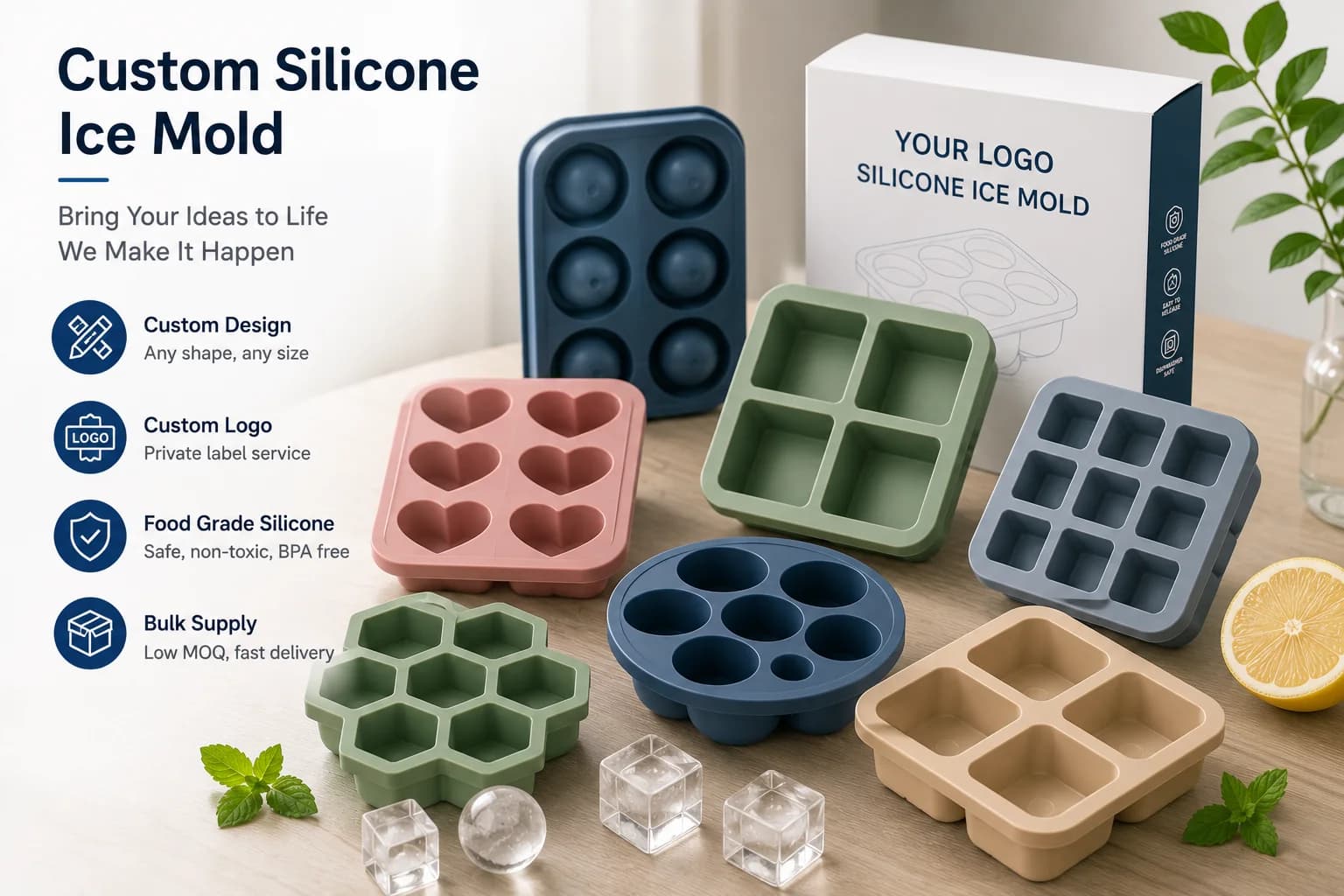
- Branded programs: bars and promotional buyers usually want matched sets — dice ice for signature serves, blocks for batch cocktails. Suppliers with an extended portfolio commonly produce ice block molds, ice cube trays, and ice ball trays on the same silicone platform, which shortens development when both formats are needed [K2]. Brands exploring that kind of paired program can review custom silicone ice molds as a starting reference for cavity design and packaging options.
One caution: dice ice is a decorative format, not an efficient one. If you are serving forty people, plan volume by weight rather than by cavity count, and expect the dice to be consumed early.
3. Designing a 20 Sided Dice Ice Mold That Actually Releases
Core conclusion: an icosahedron is geometrically mold-friendly because it is convex, but the thin silicone webs between cavities and the sharp edges are where molds fail. Radius the edges, control the fill line, and match silicone hardness to cavity depth.
A convex polyhedron has no undercuts, so a flexible mold can technically release it in one piece. In practice, three issues appear again and again:
- Edge sharpness. Crisp edges look great in renders and tear during demolding. A small radius on every edge keeps the die readable while letting the silicone peel away instead of gripping.
- Web thickness. With multiple dice per tray, the silicone between cavities must be thick enough to survive repeated flexing. Packing more cavities into the same footprint saves material and increases tear risk — a trade-off worth settling at the design stage.
- Fill line and lid design. Overfilling a closed mold pushes water into the seam, producing a fin on one face that ruins the die. Open-top cavities with a vented lid, or a clearly marked fill line, solve this more reliably than tightening tolerances.
Two more details shape the final product. Water expansion is roughly 9% by volume as it freezes, so cavity geometry should allow for that growth rather than assuming a rigid, sealed volume. Number engraving adds depth to each face; shallow, rounded debossing holds detail while still demolding cleanly, whereas deep sharp engraving traps air and creates white patches on the finished die.
Silicone hardness is the variable buyers most often leave to the factory. Softer compounds release complex shapes more easily but can slump when filled; firmer compounds hold the tray's shape but resist peeling. The right answer depends on cavity count, die size, and whether the mold is freestanding or sits inside a rigid frame. Confirm the proposed hardness with your supplier against a physical sample, not a spec sheet alone.
Customization on this product line typically covers cavity design, product shape, size, color, logo, and packaging, which means most dice-mold projects are configuration work rather than pure invention [K1]. Buyers who want to understand how a cavity concept becomes a production tool can read about the silicone OEM/ODM project workflow, including design-file review and sampling stages.
A realistic caution: a d20 with fully readable numbers on every face is a demanding first project. If the goal is a promotional item, consider a single large die per tray with restrained engraving before committing to a multi-cavity layout.
4. What "Largest Ice Cube Tray" Really Means in a Home Freezer
Core conclusion: the largest usable tray is defined by cube dimension, freezer clearance, and transfer logistics — not by tray footprint. Measure the freezer before comparing products.
Three constraints set the practical ceiling:
- Freezing time. Conduction-limited freezing scales roughly with the square of the shortest dimension. A cube twice as large can take about four times as long to freeze solid. A 2.5-inch cube may need the better part of a day in a typical home freezer; a 1.25-inch cube freezes overnight.
- Freezer clearance. Oversized trays are often 2–3 inches tall plus a lid, which can conflict with the shelf above or with door bins. A tray that does not sit flat freezes unevenly and produces slanted blocks.
- Weight and handling. Water at 1 g/cm³ means a full oversized tray is heavy. Lifting a loaded tray of 2.5-inch cubes from the tap to the freezer without spilling is a real ergonomic test, and flexible silicone trays need a rigid frame or a baking sheet underneath for support.

Design features worth checking before buying:
| Feature | Why it matters | What to look for |
|---|---|---|
| Cavity size | Drives melt rate and freeze time | Stated cube dimension in mm or inches, not just "large" |
| Lid design | Prevents spills and freezer odor pickup | Vented or loose-fit lid that still stacks |
| Silicone hardness | Release vs. structural stability | Sample test: peel a frozen cube out by hand |
| Frame or base | Carrying a full tray | Rigid rim or a stackable rigid shell |
| Stackability | Freezer space efficiency | Flat top surface that supports a second tray |
| Cleaning access | Odor and residue control | Rounded interior corners, no narrow seams |
For buyers sourcing rather than buying, portfolio coverage matters. A supplier that already runs ice cube trays, ice ball trays, and ice block molds across promotional and household lines has existing tooling knowledge to draw on, which usually reduces development risk for an oversized format [K2]. Reviewing an existing ice cube tray and ice ball tray range is a faster way to judge whether the factory's cavity sizes and finishes match your target than starting from a blank specification.
The honest limitation: "largest" is a marketing word, not a specification. Ask for cube dimensions, tray dimensions, material, and a filled-weight estimate. If a listing cannot supply those four numbers, the size claim is not verifiable.
5. Clarity, Taste, and the Details That Decide Whether Ice Looks Premium
Core conclusion: cloudy ice is an air-and-freezing-direction problem. Fix water and freezing method first, then look at the mold.
Ice clouds when dissolved air and impurities are trapped as freezing advances from all sides toward the center. Four levers, in order of impact:
- Freezing direction. Freezing from one side only pushes impurities into a single region you can cut or chip away. Home methods using an insulated cooler with the lid off rely on this principle.
- Water quality. Lower dissolved-air and mineral content generally produces clearer ice. Results vary with local water, so treat any claim of "perfectly clear" as conditional.
- Freezing speed. Slower freezing tends to give air more time to escape and produces larger, clearer crystals. Very fast freezing in a frost-free freezer with strong air circulation tends to trap bubbles.
- Mold surface. A polished cavity releases with fewer micro-scratches, and scratches scatter light. Washing a new silicone mold before first use, and avoiding abrasive scrubbing afterward, keeps surfaces smooth.
Taste is a separate issue from clarity. Silicone absorbs odors, and a freezer full of open food will transfer flavors into ice within days. Store finished cubes in a closed container, keep the mold dry between uses, and discard ice that has sat for weeks. For dice ice specifically, taste problems usually trace back to storage rather than the mold.
Boundary conditions worth stating plainly: clarity improvements are incremental and method-dependent, and no consumer mold guarantees optically clear ice. Judge a supplier on sample performance with your own water and freezer, not on studio photography.
6. Key Comparison: Dice Mold vs. Oversized Cube Tray
| Dimension | 20 sided dice ice mold | Largest-capacity ice cube tray |
|---|---|---|
| Primary purpose | Presentation, theme, branding | Dilution control, volume service |
| Melt behavior | Faster (higher surface-area ratio) | Slower (large thermal mass) |
| Typical freeze time | Overnight | Often close to a full day for very large cubes |
| Demolding difficulty | Higher — edges, webs, engraving | Lower — simple cube geometry |
| Best glass or vessel | Lowball, rocks, coupe | Pitcher, punch bowl, cooler |
| Customization depth | High: cavity, numbers, color, logo, packaging [K1] | Moderate: cavity size, lid, packaging |
| Best-fit buyer | Bars, gift and promo buyers, themed retail | Household, hospitality, batch-cocktail sellers |
Typical project timeline for a custom silicone mold program:

| Stage | Typical lead time | Notes |
|---|---|---|
| Stock sample | 1–2 working days | Subject to stock and shipping [K3] |
| Custom sample | 7–10 working days | After design and specification confirmation [K3] |
| Mold | About 15 working days | After 3D design confirmation [K3] |
| Mass production | 15–20 working days | After order and production details are confirmed [K3] |
| MOQ | Typically 500 pcs | Final MOQ varies by design, tooling, packaging, and scheduling [K3] |
Mold fees are quoted after design files and project requirements are reviewed, and sample freight, taxes, and custom-sample charges should be confirmed case by case rather than assumed [K3]. A supplier's operating philosophy is also a useful signal: Renjia's published management statement frames product work as quality with responsibility, business as service, and industry contribution as accountability — language that maps to how sample revisions and quality inspections are usually handled [K5]. Buyers preparing a project can also draw on documented guidance covering buyer checklists for sample approval, packaging preparation, and pre-shipment inspection [K4].
7. FAQ
Q1. Can a 20 sided dice ice mold be used for chocolate, soap, or resin?
Technically yes for chocolate and soap, but not with the same mold you use for ice. Ice molds are designed around water's expansion and release behavior, and food-safe silicone used for ice should not be shared with resin or other craft materials. Buy separate molds per material, and confirm food-contact suitability with the supplier for anything edible.
Q2. How large can a home ice cube tray realistically be?
Large enough that cube dimension, not tray footprint, becomes the limiting factor. Cubes beyond roughly 2.5 inches take close to a day to freeze solid in a typical home freezer and become heavy to handle when a full tray is lifted. Measure shelf clearance and account for lid height before choosing a format.
Q3. Why does my dice ice come out cloudy or cracked?
Cloudiness is usually trapped air and impurities, and cracking usually comes from thermal shock or incomplete freezing. Freeze longer, avoid stacking warm trays against already-frozen ones, and try a slower, single-direction freezing setup. If cracks appear along the edges of the die, the mold's edge radius may be too sharp.
Q4. What is the minimum order and lead time for a custom dice ice mold?
Typical figures for a custom silicone program are an MOQ of around 500 pcs, custom samples in 7–10 working days, mold lead time of about 15 working days after 3D design confirmation, and mass production in 15–20 working days after order confirmation [K3]. Final MOQ and timing depend on design complexity, tooling, packaging, and production scheduling, so confirm in writing before committing to a launch date.
8. Conclusion
The two halves of this topic reward different buying decisions. If the goal is a better game night this weekend, buy a well-specified oversized tray with a lid and a rigid base, freeze it a full day ahead, and keep a dice mold for the glasses. If the goal is a product — a branded die for a bar, a gift set, a promotional item — treat the 20 sided dice ice mold as an engineering project with real constraints: edge radius, web thickness, fill line, silicone hardness, and packaging all belong in the design brief.
A practical next step for brand owners: request a physical sample before approving tooling, test it with your own water and freezer, and confirm MOQ, mold fee, and lead times in writing [K3]. For hosts, the equivalent step is simpler — measure the freezer shelf, check the stated cube dimension, and freeze overnight. Epic ice on game night is mostly preparation, with the mold playing a supporting role.