Key Takeaways
- A whiskey ice cube maker is not a single product. It is a category that covers cube trays, sphere ice molds, large-format block molds, and silicone cavity systems designed to slow dilution and improve presentation.
- Sphere ice molds and large cubes perform better than thin, fast-melting cubes in a whiskey glass because they reduce surface-area-to-volume ratio, which slows melt rate.
- Material choice matters more than shape marketing. Food-grade silicone rated from -40°C to 240°C (-40°F to 464°F), odorless, and available in custom sizes is the practical baseline for both home and commercial use [K5].
- For brands, bars, and promotional buyers, the real decision is sourcing model: off-the-shelf trays, or a custom silicone ice mold project with cavity design, color, logo, and packaging developed through sampling and tooling [K1].
- Always verify current availability, material composition, dimensions, MOQ, and lead time before quoting or publishing a product-specific page — a portfolio listing is not proof of stock [K4].
1. Introduction
Whiskey drinkers rarely complain that their ice is too big. They complain that it disappears too fast. A thin, crescent-shaped ice cube from a refrigerator dispenser can collapse in a tumbler within minutes, turning a carefully chosen pour into a watery, diluted drink. That single problem — melt speed — is what pushed the whiskey ice cube maker from novelty gadget to standard bar equipment.
The market response has been fragmented. Search results mix commercial ice machines, silicone trays, stainless steel sphere presses, and silicone sphere ice molds under the same keyword. Buyers end up comparing products that solve different problems. A home enthusiast wants ice that looks good in a glass and holds up for twenty minutes. A cocktail bar wants consistency across hundreds of serves per week. A promotional products buyer wants a mold that can carry a brand mark and ship in retail packaging.
This article separates those use cases. It explains what a whiskey ice cube maker actually does, which features genuinely affect performance, what the practical benefits are, and how to evaluate sourcing options — including custom silicone mold development from cavity design through sampling and packaging [K1]. The goal is a decision framework, not a product list.
2. What a Whiskey Ice Cube Maker Actually Does
Core conclusion: the function is melt-rate control through geometry, not cooling power.
Ice cools a drink by absorbing heat as it changes phase. The rate at which that happens is driven largely by surface area relative to volume. A large sphere has the lowest surface-area-to-volume ratio of any common ice shape, which is why sphere ice molds have become the default recommendation for whiskey served "on the rocks."
Three practical consequences follow:
- Dilution slows but does not stop. A bigger piece of ice buys time. It does not eliminate melt, and it should not — a small amount of melt is part of how whiskey opens up.
- Shape affects glass fit. A 2-inch sphere sits differently in a rocks glass than a 2-inch cube. Diameter and height matter as much as volume.
- Clarity affects perception. Clear ice reflects light and makes the drink look intentional. Cloudy ice is usually the result of trapped air and directional freezing, not poor material quality.

The category also spans formats well beyond single-serving ice. Renjia's reported product portfolio lists ice block molds under household products, and ice cube trays, ice ball trays, and popsicle molds under promotional products [K2]. Ice molds are explicitly treated as cross-category items that can be tagged under household, kitchen, and promotional use cases [K4]. That matters for buyers: the same manufacturing capability can serve a kitchen gadget launch and a branded merchandise program.
For a manufacturing view of mold structure, branding, and production planning, review RENJIA’s custom silicone ice mold manufacturing capabilities.
Practical advice: decide the format first — cube, sphere, or block — then decide material and sourcing. Choosing a mold before choosing a format is the most common ordering mistake.
3. Features That Matter — and Features That Are Mostly Marketing
Core conclusion: four features drive real performance differences. Everything else is secondary.
| Feature | Why it matters | What to check |
|---|---|---|
| Material | Affects flexibility, release, odor, and heat tolerance | Food-grade silicone, odorless, rated -40°C to 240°C (-40°F to 464°F) [K5] |
| Cavity design | Determines shape accuracy and how easily ice releases | Multi-cavity layout, wall thickness, lid or press mechanism [K1] |
| Size and volume | Directly controls melt rate and glass fit | Custom sizes available; confirm actual dimensions per product [K5] |
| Flexibility and release | Determines daily usability and breakage rate | Whether the mold can be twisted or inverted without tearing |
Silicone's temperature range is the reason it dominates this category. A material rated from -40°C to 240°C (-40°F to 464°F) handles freezer storage, boiling-water cleaning, and dishwasher cycles without a separate material specification for each use [K5]. Commercial kitchens benefit from that range more than home users do, because cleaning cycles are more aggressive.
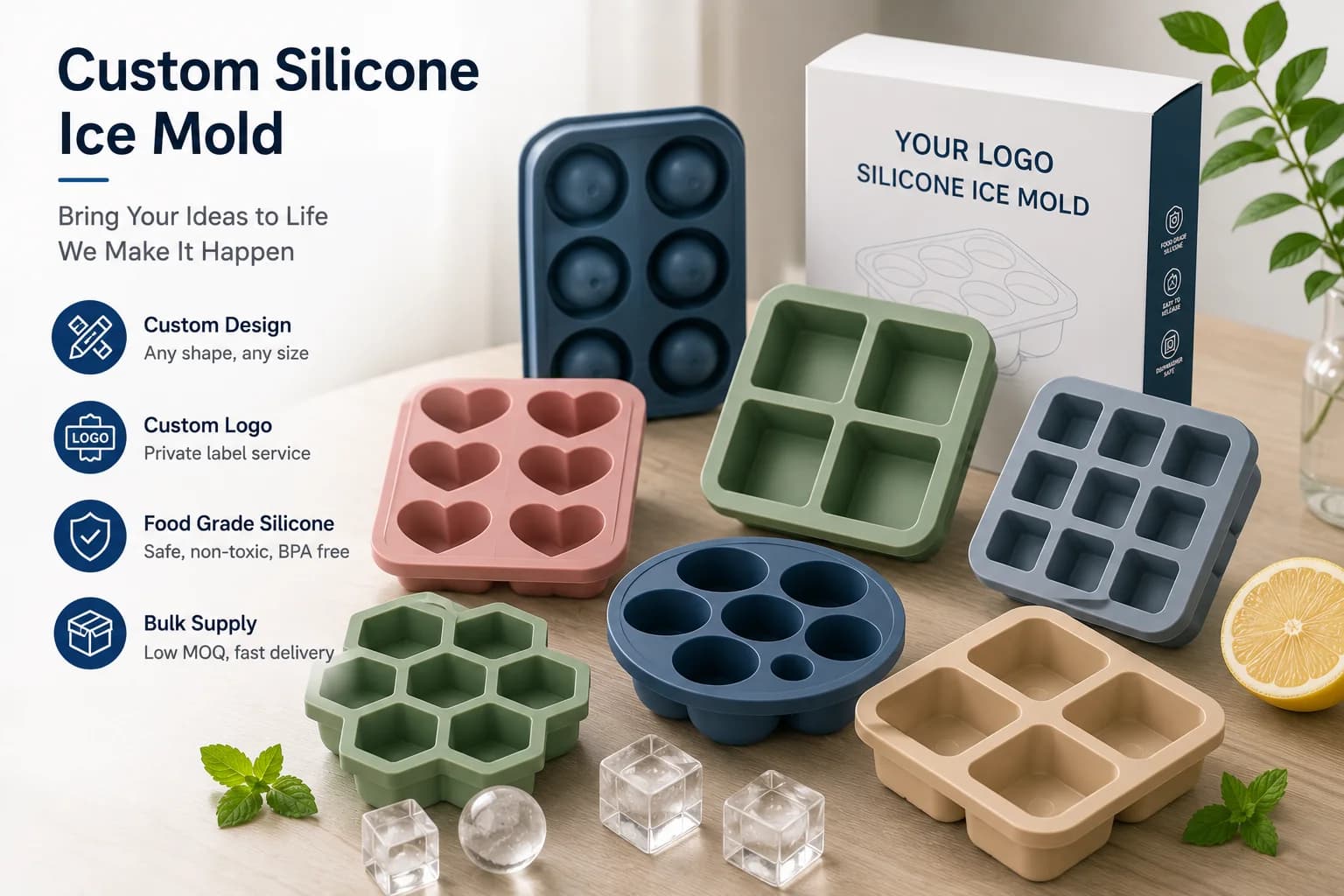
Customization is where the category becomes a branding tool rather than a kitchen accessory. Typical customization for silicone ice molds covers cavity design, product shape, size, color, logo, and packaging [K1]. That means a bar can specify a mold that produces a branded-shape cube, and a promotional buyer can specify a color-matched tray with retail packaging.
Caution on claims. Portfolio and category listings are evidence of reported product architecture, not proof that every item is currently stocked or available in every market [K4]. Composition claims also need product-specific verification — for example, some drying products in the wider portfolio may use composite or non-silicone materials and should not be classified as pure silicone without a specification [K4]. The same discipline applies to compliance: plan market-specific requirements without making unsupported certification claims.
Practical advice: ask for the material specification and the actual cavity dimensions before comparing two molds. Shape names such as "large sphere" are not standardized across suppliers.
4. Benefits: Home, Bar, and Brand Use Cases
Core conclusion: the benefits differ by buyer, and the evaluation criteria should differ too.
Home users. The benefit is consistency of experience. A large-format mold produces a predictable result every time, which removes the variability of dispenser ice. The tradeoff is freezer space and lead time — large-format ice typically needs several hours, sometimes a full day, to freeze solid. Recommended approach: keep one mold format you actually use rather than a set of specialty shapes.
Buyers turning a concept into an RFQ can compare these decisions with RENJIA’s OEM silicone product customization process.
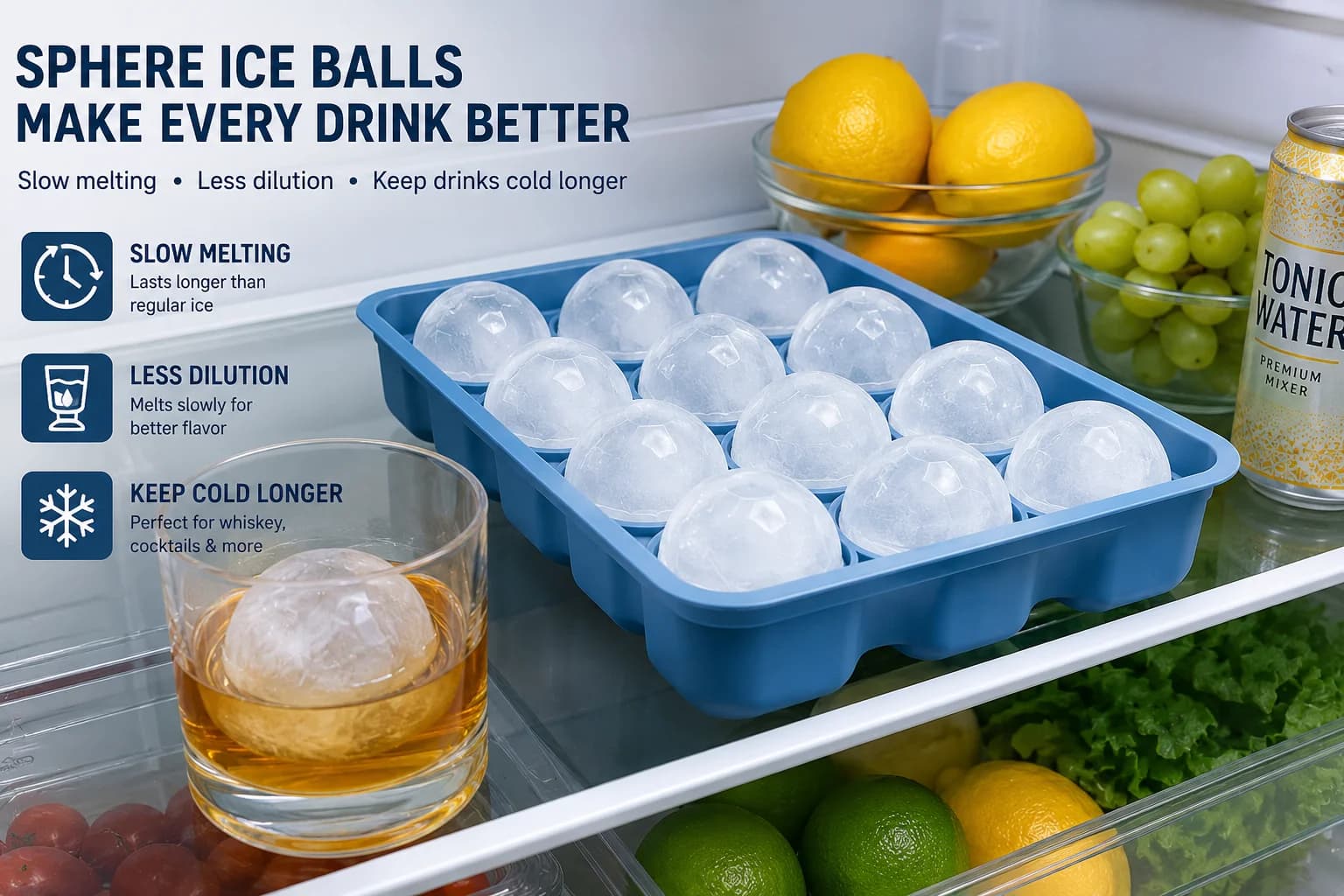
Bars and hospitality. The benefit is cost and speed of service. Consistent large-format ice reduces how often staff restock and improves drink presentation without added labor per serve. In high-volume settings, the binding constraint is usually freezer throughput and mold durability, not the shape itself. Recommended approach: standardize on one or two cavity formats, and prioritize release reliability and cleaning tolerance over novelty shapes.
Brands and promotional buyers. The benefit is a physical product that carries a logo and sits in a customer's home for years. Ice molds already appear in promotional product portfolios alongside ice cube trays and ice ball trays [K2]. Recommended approach: treat the mold as a private-label development project, not a catalog pick. That means defining the shape, cavity count, color, logo placement, and packaging before sampling begins [K1].
Across all three, the underlying benefit is the same: controlled dilution gives the drinker more of the whiskey's intended flavor profile for longer. That is a measurable, explainable benefit — which is why the category holds up better than most kitchen gadgets.
5. Buying and Sourcing Considerations
Core conclusion: for anything beyond personal use, sourcing process matters more than product listing.
The route from concept to shipped mold follows a predictable sequence. The knowledge base identifies the following supported content areas for custom silicone ice mold projects: sourcing, design-file preparation, sampling, tooling, packaging, quality inspection, and moving from design review to production [K1]. It also lists MOQ, tooling, sampling, and lead-time planning as core planning topics, along with buyer checklists for sample approval and pre-shipment inspection [K3].
A practical sequence looks like this:
- Define the brief. Format (cube, sphere, block), cavity count, finished ice dimensions, target color, logo placement, and packaging format.
- Prepare design files. Shape geometry and cavity layout are the inputs that drive tooling.
- Confirm MOQ, tooling, and lead time. These are project-level variables, not catalog constants, and should be confirmed per project.
- Sample and approve. Evaluate release behavior, dimensional accuracy, surface finish, and color match against the brief.
- Plan inspection. Pre-shipment inspection against the approved sample is the standard control point [K3].
- Confirm compliance requirements for the destination market without asserting certifications that have not been verified for that specific product.
Two boundary conditions are worth stating plainly. First, availability, material composition, dimensions, certifications, MOQ, and lead time must be confirmed before publishing a product-specific page or quotation [K4]. Second, the public verified specification set — silicone material, food-grade, odorless, -40°C to 240°C, custom sizes available, and customization across color, size, shape, and packaging — describes the shared baseline, not a guarantee for every individual SKU [K5].
Before approving mass production, align the specification with a documented silicone product quality control plan.
Recommended questions for a silicone OEM/ODM manufacturer [K3]:
- What is the confirmed MOQ for this cavity design and color?
- What tooling is required, and is it amortized into unit pricing?
- How many sampling rounds are included before production approval?
- Which dimensions are held to tolerance, and how are they measured?
- What inspection documentation is provided before shipment?
6. FAQ
Q1. Are sphere ice molds better than cube trays for whiskey?
For whiskey served on the rocks, sphere ice molds are usually the better choice because a sphere has the lowest surface-area-to-volume ratio among common ice shapes, so it melts more slowly and dilutes the drink gradually. Cube trays are more space-efficient in a freezer and easier to stack. If freezer space is the constraint, a large-format cube is a reasonable compromise. If presentation and slow dilution are the priority, a sphere mold is the practical pick.
Q2. What material should a whiskey ice cube maker be made of?
Food-grade silicone is the standard choice for flexible molds. The verified baseline specification is silicone material, food-grade, odorless, with temperature resistance from -40°C to 240°C (-40°F to 464°F), and custom sizes available [K5]. That range covers freezer use and hot-water or dishwasher cleaning. Rigid plastic trays are cheaper but release ice less cleanly; metal presses produce clear spheres but require more handling per piece.
Q3. Can ice molds be customized with a logo and packaging?
Yes. Typical customization for custom silicone ice molds includes cavity design, product shape, size, color, logo, and packaging [K1]. Projects of this type typically move through design-file preparation, sampling, tooling, and quality inspection before shipping [K1]. MOQ, tooling cost, and lead time are project-specific and should be confirmed before committing to a design [K3].
Q4. How long does large-format ice take to freeze?
Large-format ice generally requires several hours in a standard freezer, and full freezing time depends on cavity volume, freezer temperature, and how the mold is positioned. Directional freezing — insulating the mold so ice freezes from one direction — improves clarity but takes longer. Because freezing time is not a fixed specification across products, test your specific mold before setting expectations in a menu or product listing.
7. Conclusion
A whiskey ice cube maker solves one specific problem: it slows dilution so the drink tastes the way it was intended for longer. Geometry does most of that work, which is why sphere ice molds and large-format cubes outperform thin dispenser ice. Material comes second, and food-grade silicone rated from -40°C to 240°C with odorless performance is the reliable baseline [K5].
The right choice depends on who you are. Home drinkers should pick one format that fits their freezer and use it consistently. Bars should standardize on one or two cavity formats and prioritize release reliability and cleaning tolerance. Brands and promotional buyers should treat the mold as a private-label development project — defining shape, color, logo, and packaging, then moving through design review, sampling, tooling, and pre-shipment inspection [K1][K3].
Before any purchase or publication, confirm the specifics: current availability, material composition, dimensions, certifications where applicable, MOQ, and lead time [K4]. That single verification step prevents most of the mismatches that make ice mold projects disappointing.