Key Takeaways
- A sphere with roughly the same volume as a standard old fashioned ice cube exposes about 18% less surface area to the whiskey, which slows melt and dilution in a chilled drink.
- Silicone's flexibility matters most at the release step: a round cavity in a rigid tray is hard to demold without cracking, while a flexible mold can be peeled back and the sphere lifted out intact.
- A mold controls shape, not clarity. Clear ice depends on freezing direction, water quality, and how the mold is insulated in the freezer.
- Buyers sourcing private-label sphere molds should confirm cavity geometry, material specification, packaging, and tooling scope before committing — ice molds sit across household, kitchen, and promotional use cases, not just one category.
- Practical default for home use: a 2.0–2.25 inch sphere for standard rocks glasses, filled to the fill line, frozen for at least 24 hours.
1. Introduction
A whisky drinker pouring two fingers of single malt over ice is making a trade they rarely think about: every minute of chill costs a little flavor, because melting ice dilutes the spirit. The drink gets colder, then flatter. That trade-off is why bar programs, gift retailers, and home enthusiasts have moved toward large-format ice — and why the old fashioned ice cube has quietly been redesigned from a rough freezer tray cube into something larger, denser, and slower to give up its water.
The sphere is the most visible version of that shift. It looks deliberate in the glass, it rolls, and — more importantly — it changes the geometry of melting. But there is a second half of the story that gets less attention: the mold. A sphere is one of the hardest shapes to demold from a rigid tray, and that is where silicone earns its place rather than being a marketing detail.
This article explains what a sphere actually does to a pour of Scotch, why silicone mold construction matters, what a mold can and cannot fix about clarity, and what to check before buying or private-labeling. It is written for two audiences: drinkers deciding whether the upgrade is worth it, and buyers evaluating custom silicone ice molds for a brand, retail program, or promotional line.
2. Why a Sphere Changes the Drink More Than It Looks
Core conclusion: For a given volume of ice, a sphere melts more slowly than a cube because it presents less surface area to the liquid — and in a spirit served neat or with a single large piece, that difference is noticeable in the glass.
The reasoning. Melting is driven by heat transfer at the ice–liquid boundary, so the exposed surface area is the main lever. Take two pieces of ice with nearly identical volume:
| Format | Typical dimension | Approx. volume | Approx. surface area | Relative surface area |
|---|---|---|---|---|
| Sphere | 2.5 in (63 mm) diameter | ~8.2 in³ (~134 mL) | ~19.6 in² | 1.00 (baseline) |
| Cube | 2.0 in (50 mm) per side | ~8.0 in³ (~131 mL) | ~24.0 in² | ~1.22 |
Calculated directly from the geometry of a sphere and a cube; whole-drink outcomes will vary with glass shape, room temperature, spirit strength, and freezer temperature. The direction of the effect, however, is consistent: at equal volume, the cube exposes roughly 20% more surface, and the sphere therefore gives up its water more slowly. A slow melt also keeps the drink colder for longer per unit of dilution, because the ice is still doing its job instead of pooling.

Practical scenario. A 2.5-inch sphere in a heavy rocks glass with 60 ml of cask-strength Scotch behaves very differently from four small cubes: the first twenty minutes bring a gentle chill and a modest shift in proof, not the fast wash of water that small cubes produce. For a lighter, chill-filtered blend served over ice, the difference is smaller and harder to justify on taste alone — this is a drink where the sphere is mostly about presentation and pacing.
Recommendation. Choose sphere ice when the spirit is expensive enough that dilution is the limiting factor, when the serve is a single large piece rather than a top-up, or when the glass is part of the presentation. Do not expect a sphere to chill a drink faster; it will chill it more slowly and more gently, which is the point.
3. Silicone vs. Rigid Trays: The Demolding Problem Nobody Mentions
Core conclusion: Silicone is not just a cheaper alternative to plastic or metal trays for round ice — for a true sphere, flexible walls are close to a functional requirement.
The reasoning. A rigid tray with hemispherical cavities has to be filled, frozen, and then twisted or flexed to release the ice. Round ice resists that motion: the sphere contacts the cavity wall across a full curved surface, so the release force is distributed and the ice tends to crack at the seam or refuse to drop at all. Silicone molds solve this mechanically — the wall can be peeled away from the ice rather than the ice being pushed out of the wall. Two-part sphere molds that snap together add a second benefit: the seam line is controlled by the mold design rather than by how the tray happened to freeze.
Silicone also tolerates the temperature swing itself. A mold goes from a warm kitchen to a −18 °C freezer and back to a rinse under the tap, repeatedly. Flexible silicone handles that cycle without the stress cracking that affects some rigid plastics, and it releases ice without the brief warm-water dip that many rigid trays require — a dip that starts melting the surface you just spent a day freezing.
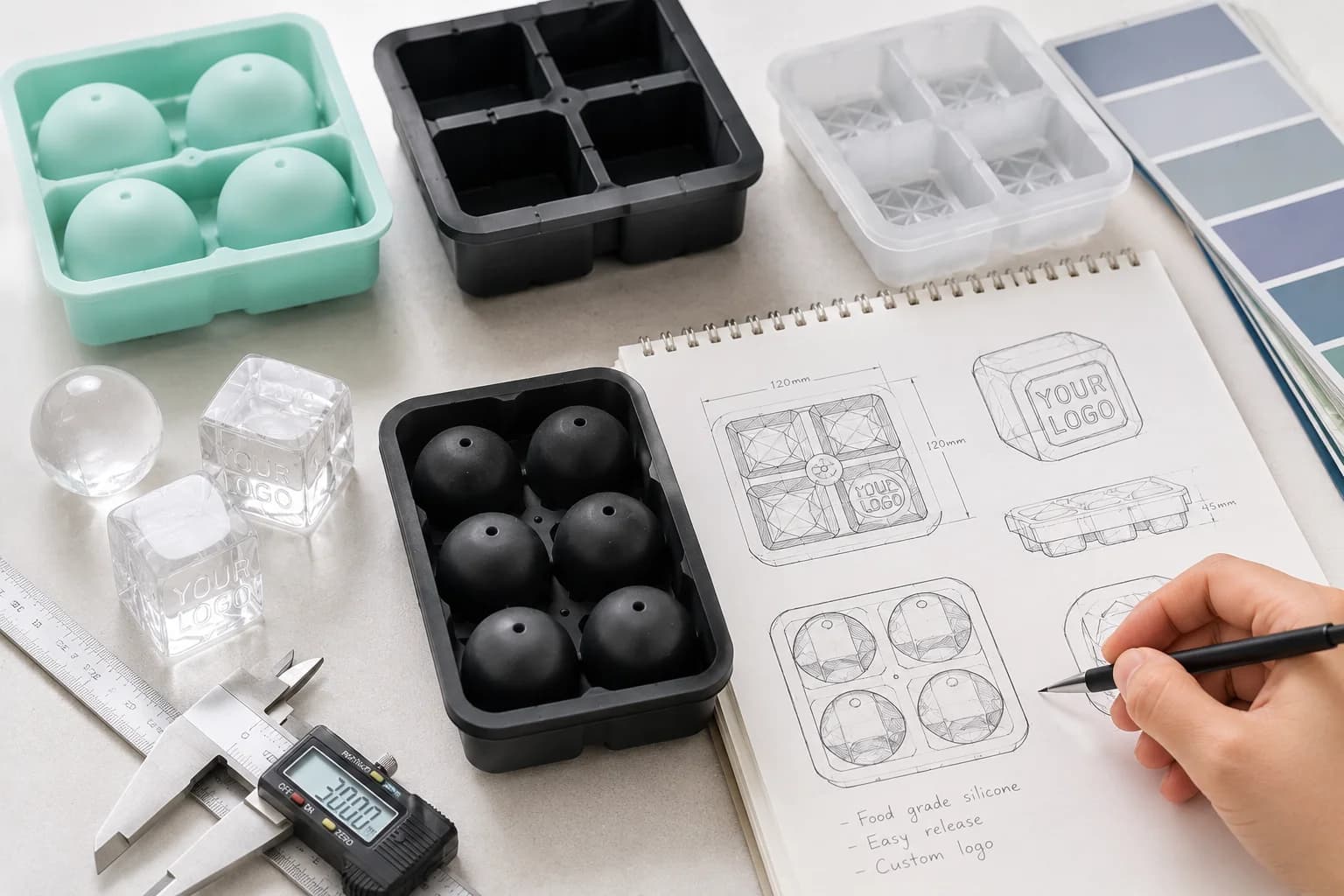
Practical scenario. A hotel bar prepping 200 spheres for a weekend service needs a mold that releases cleanly and stacks in the freezer. A promotional buyer wants a branded tray that survives shipping and repeated home use. These are different briefs, and the mold specification should follow the brief: cavity count, wall thickness, whether the mold is open-top or clamshell, and whether a lid is included all change the release behavior and the freezing time.
Recommendation. If the shape is round, specify a flexible mold and confirm the demolding method with the supplier before sampling. Renjia's custom silicone ice mold line covers cavity design, product shape, size, color, logo, and packaging, which is the right level of specification to settle before a sample is cut [K1].
4. Clarity, Fill Level, and the Freezing Workflow
Core conclusion: A mold determines shape and size; it does not determine whether the ice is clear. Clarity comes from how the water freezes, and that is a process question.
The reasoning. Cloudy ice forms when dissolved air and impurities are trapped as water freezes from all directions at once. Clear ice requires directional freezing — one side freezing first and pushing gas and impurities ahead of the freeze front, so they concentrate in a sacrificial layer that gets cut or melted away. A closed sphere mold freezes from the outside in, which is exactly the condition that traps bubbles in the center.
That produces a boundary condition worth stating plainly: a silicone sphere mold will reliably produce a well-shaped sphere, and it can produce a clearer sphere if paired with an insulating shell, a cooler-style directional freezing setup, or pre-treated water (boiled then cooled, or filtered). It will not produce bar-grade clear ice on its own. Anyone promising otherwise is selling a mold as a process.
Field-tested workflow that improves results without special equipment:
- Use filtered or previously boiled-and-cooled water to reduce dissolved gas.
- Fill to the indicated line, not to the brim — water expands roughly 9% on freezing, and overfilling distorts the sphere or pushes the lid off.
- Place the mold in the coldest part of the freezer, undisturbed, for at least 24 hours for a 2.5-inch sphere. Moving it mid-freeze promotes uneven freezing.
- If the mold has a lid or clamshell closure, seat it fully; a partial seal lets water migrate and creates a flat spot.
- Temper the sphere in the glass for 30–60 seconds before pouring so the surface glazes and the piece settles rather than cracking.
Recommendation. Treat clarity as a separate project from shape. If clear ice is a commercial requirement, test the full freezing setup — mold plus insulation plus water treatment — before scaling, because the mold alone will not carry it.
5. What Buyers Should Verify Before Ordering Custom Sphere Molds
Core conclusion: Ice molds are a deceptively simple product with several specification traps. The difference between a good and a bad order is almost always what was confirmed in writing before tooling, not what was promised in a sales call.
The specification checklist. Buyers should settle these points before sampling, because each one moves cost, lead time, or compliance risk:
- Cavity geometry: sphere diameter, tolerance, cavity count, and whether the seam is designed to be minimized or hidden.
- Material specification: silicone grade and cure system, with documentation appropriate to the target market. Compliance planning should be market-specific; certification claims should never be published without product-specific evidence.
- Mold construction: open-top versus clamshell, lid design, wall thickness, and stackability for freezer storage.
- Branding and packaging: logo placement method, color matching, retail box or polybag, and barcoding.
- Commercial terms: tooling scope, sampling plan, inspection criteria, and shipping terms — all confirmed per project rather than assumed.
What not to assume. There is no universal minimum order quantity that applies to every custom silicone project, sampling and freight are not automatically free, and production dates cannot be guaranteed until a project has been reviewed and confirmed in writing. Mold fees likewise depend on the design evaluation — a single-cavity promotional tray and a multi-cavity retail mold are different tooling problems, and quoting a fixed fee before seeing artwork is not a reliable signal of a supplier's seriousness [K5].
Practical scenario. A retailer wants 3,000 two-cavity sphere molds in a gift box for the holiday season. The realistic sequence is design review, then a sample for physical approval, then tooling, then a pre-shipment inspection against an agreed checklist. That sequence is documented as a supported content topic in Renjia's knowledge base precisely because buyers most often try to compress it [K4]. Ice molds also sit legitimately across household, kitchen, and promotional categories, so a buyer should not assume a single-use classification limits the program [K3].
Recommendation. Ask for the sample approval criteria and the pre-shipment inspection checklist at the quotation stage. Suppliers who can produce those documents have a process; suppliers who cannot are improvising. Renjia's silicone OEM/ODM process is structured around design review, sampling, and inspection for exactly this reason.
6. Key Comparison: Sphere vs. Standard Old Fashioned Ice Cube
| Consideration | Silicone sphere (2.5 in) | Standardold fashioned ice cube (2 in) |
|---|---|---|
| Surface area at equal volume | ~19.6 in² | ~24.0 in² |
| Melt pace | Slower, more gradual dilution | Faster; noticeable within ~10–15 minutes in a warm room |
| Glass fit | Needs a wide-mouth rocks glass; measure the rim | Fits most rocks and double old fashioned glasses |
| Demolding | Requires flexible walls for a clean release | Works in rigid trays, silicone, or metal |
| Clarity potential | Good with directional freezing; cloudy if frozen conventionally | Same constraint; smaller pieces hide cloudiness better |
| Presentation value | High — reads as a deliberate, premium serve | Familiar, neutral |
| Best use | Premium Scotch, cask-strength spirits, tasting flights | Everyday pours, batch cocktails, high-volume service |
| Practical caution | Confirm freezer space and glass diameter before buying | Overfilling the tray causes bridged cubes and cracked ice |
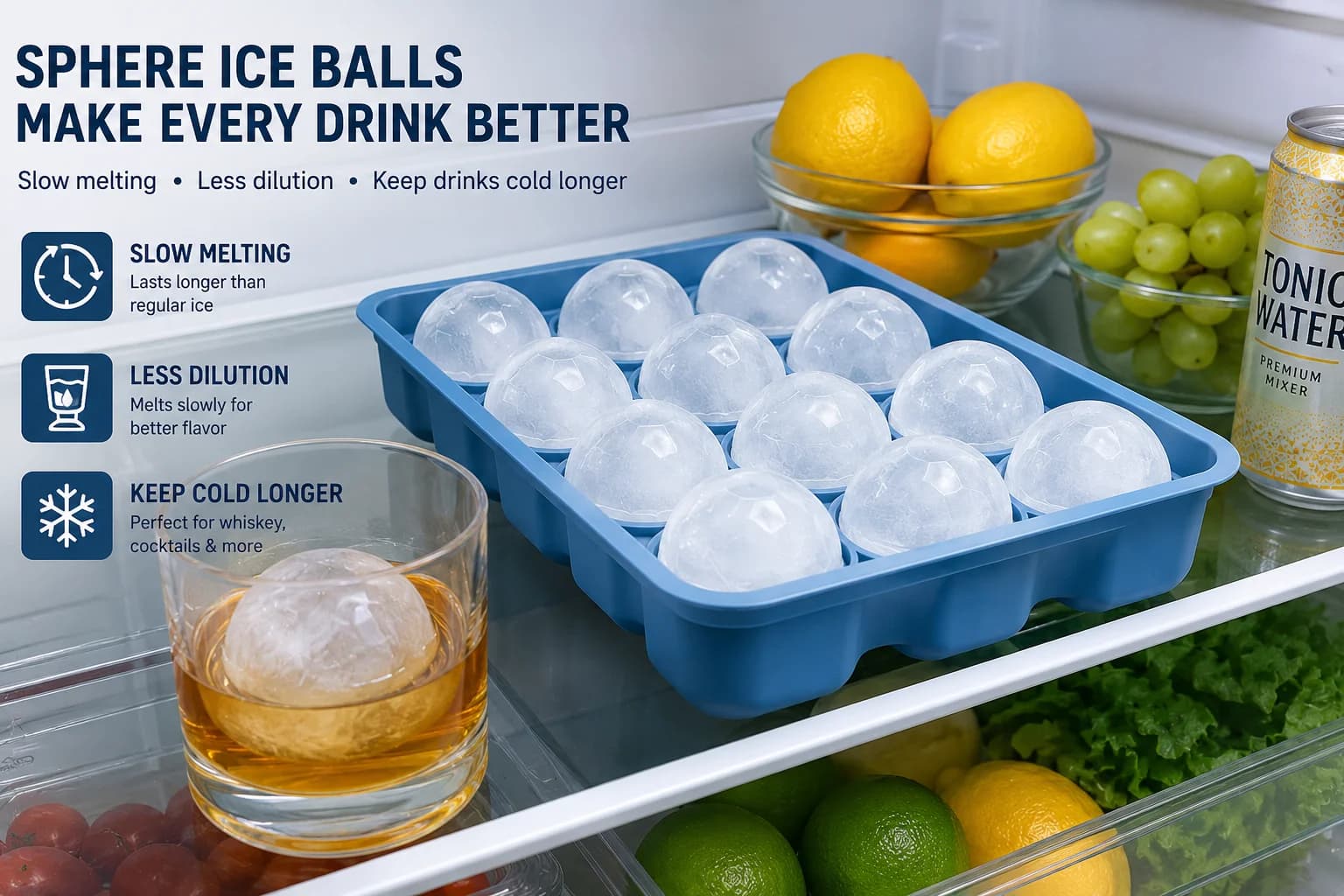
The comparison points to a simple rule: the sphere is a premium-service format, and the cube is a workhorse. Most bars need both, and most home drinkers who buy a sphere mold end up using it for the two or three bottles they actually care about.
7. FAQ
Q1. Do silicone sphere molds make clear ice?
Not by themselves. A closed silicone mold freezes from the outside in, which traps dissolved air in the center and produces a cloudy core. Clarity improves with filtered or boiled-and-cooled water, an insulating shell that forces freezing from one direction, and a long undisturbed freeze — but the mold is only one variable in that process.
Q2. What sphere size fits a standard whiskey glass?
Measure the glass. A 2.25-inch sphere is a safe default for most rocks glasses, while 2.5-inch spheres need a wide-mouth glass and enough freezer shelf height. Oversized spheres that barely clear the rim are a common purchase mistake — they crack on entry and chill unevenly.
Q3. Can the same mold be used for coffee, juice, and cocktails?
Yes, provided the mold is dedicated to food use and cleaned properly between applications. Larger spheres are popular for iced coffee and batch cocktails precisely because they dilute more slowly. For anything with pulp, sugar, or dairy, wash immediately after use rather than letting residue set in the cavity.
Q4. What should a private-label buyer confirm first?
Cavity geometry, material specification, packaging format, and the sampling and inspection plan. Commercial terms — tooling scope, minimum order quantity, sampling costs, and dates — should be confirmed per project in writing rather than assumed from a catalog page.
8. Conclusion
The silicone sphere mold is less a gadget than a correction. It fixes the demolding problem that makes round ice impractical in rigid trays, and it produces a piece of ice whose geometry genuinely slows dilution in a glass of Scotch — roughly 20% less surface area than a same-volume cube, translating into a slower, more controlled melt.
The realistic judgment: if you drink premium spirits neat or with a single large piece, a sphere mold is worth the freezer space, and 2.0–2.25 inch cavities cover most glasses. If your pours are everyday blends or batch cocktails, standard old fashioned ice cube trays remain the more practical tool — cheaper, faster to fill, and easier to stack. And if you are buying for a brand or retail program, the mold is the easy part; the specification discipline around material, sampling, packaging, and inspection is what determines whether the finished product matches the sample you approved. Start there, and confirm current availability, material composition, dimensions, and lead time against the silicone product portfolio before publishing a product page or quotation [K2].