Key Takeaways
- Holiday ice trays are usually judged on three practical points: how cleanly the ice releases, how much freezer space the tray occupies, and whether it still looks presentable when it is not in use.
- A nugget ice mold produces small, pellet-style cubes. Silicone can reproduce the size, shape, and chew of pellet ice reasonably well, but it cannot reproduce the soft, aerated texture of ice from a nugget ice machine.
- Small cavities are the hardest part of any ice mold design. Release quality depends on cavity geometry, wall thickness, silicone hardness, and how evenly the tray is filled — not on the novelty shape alone.
- For private-label holiday trays, plan around typical terms of roughly 500 pcs MOQ, 7–10 working days for custom samples, and 15–20 working days for mass production after confirmation [K3].
- Treat product-specific compliance as a per-SKU question. Ask for documentation for the exact item you are buying rather than relying on a general category claim.
1. Introduction
Holiday ice trays occupy an odd category. They are part kitchen tool, part table decoration, and part gift item. A shopper searching for an Xmas ice cube tray in November is often solving a narrower problem than a general ice tray buyer: they want cubes that read as festive in a punch bowl, a tray that survives being handled by guests, and something that stores without cracking before New Year.
At the same time, "nugget ice" has moved from commercial beverage equipment into home expectations. People who like pellet ice from a drive-through or a countertop appliance start looking for a nugget ice mold that can approximate the same experience in a home freezer. That search produces a recurring set of questions: Does a silicone tray actually make nugget-style ice? Why do small cavities break apart? Is a novelty Christmas tray worth tooling for private label, or is it a one-season novelty?
This review addresses those questions directly. It compares the main tray formats a holiday buyer encounters — molded Christmas shapes, general silicone ice maker trays, and small-cavity nugget-style molds — and explains where each format works, where it disappoints, and what to confirm before placing a custom order. It is written for two audiences: households choosing a tray for the holidays, and buyers sourcing trays for retail, gifting, or promotional programs.
2. Choosing the Right Tray Format for the Occasion
Core conclusion: pick the format from the serving occasion first, and from the novelty shape second. Most holiday tray complaints trace back to a mismatch between the cavity format and how the ice is actually used.
Holiday ice ends up in three main places: a punch bowl or cocktail pitcher, individual glasses, and a cooler or ice bucket. Each of those settings rewards a different cavity design.
- Molded Christmas shapes (trees, snowflakes, ornaments). These are decorative first. Cavity counts are usually low, and the shapes tend to have thin extremities — branch tips and star points — that are the first parts to break during release. They work well as a single large centerpiece cube in a punch bowl. They are a poor fit for filling a cooler.
- General silicone ice maker trays. These are the everyday workhorses: larger square or rounded cavities, often with a lid, designed for stacking and for producing a usable volume of ice per freeze cycle. This format is what most households should own, with the holiday tray as an add-on.
- Nugget-style small-cavity trays. High cavity count, small pellets, flexible base. Best for glasses, iced coffee, and chewable ice preferences.
- Ice ball trays. Round cavities for spirits; slower to freeze and lower in output, but visually strong for whiskey and cocktails.
The Renjia product architecture groups ice cube trays, ice ball trays, and popsicle molds under promotional products, while ice block molds sit under household products [K1]. That split is a useful reminder: novelty holiday trays are frequently bought on a promotional or gift timeline, which has different planning assumptions than a year-round kitchen SKU. If you are developing a giftable holiday item, the relevant development path is closer to the custom silicone ice mold program than to a standard household mold.
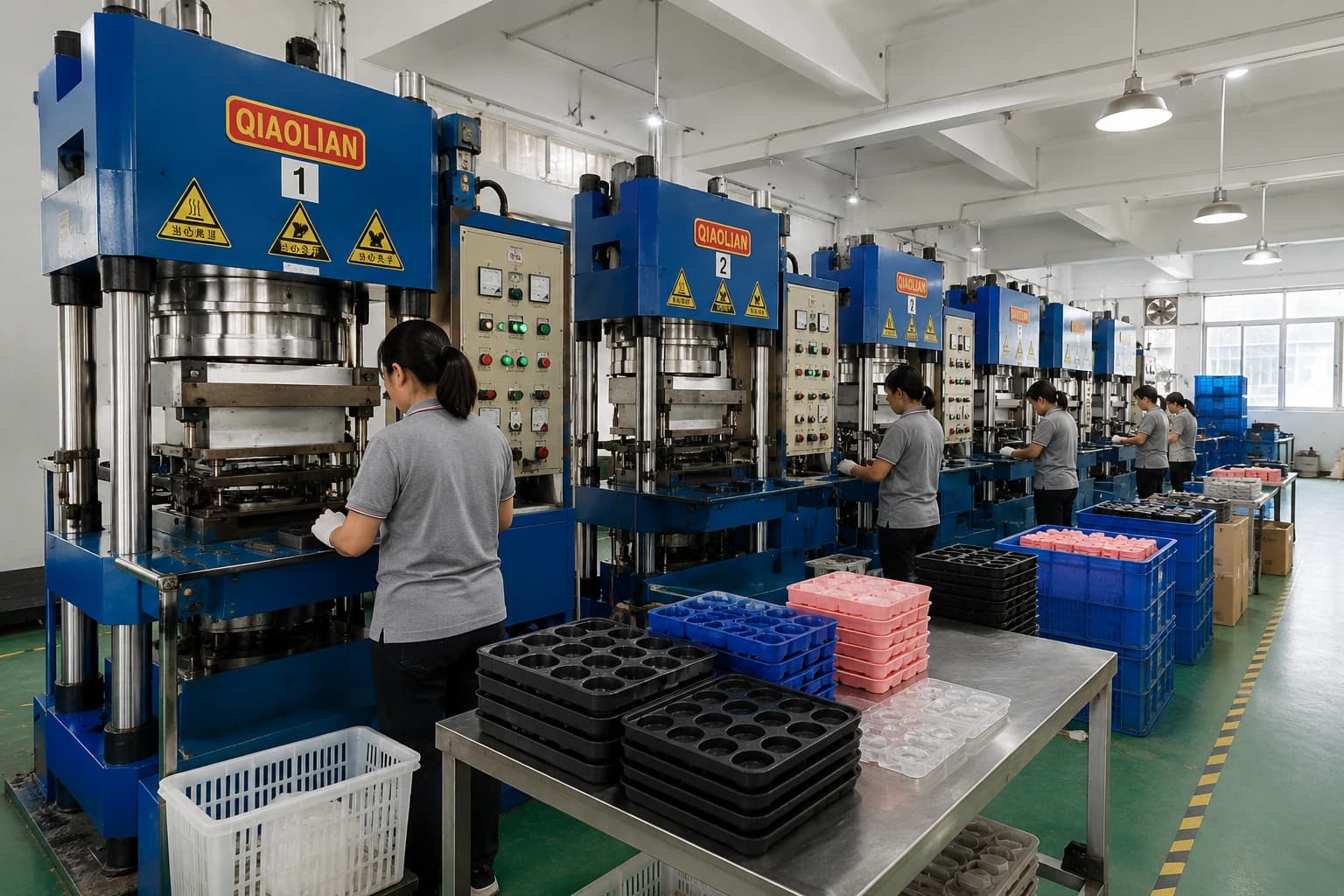
Practical advice: if the tray is intended for a gift box or a branded holiday promotion, choose a design that photographs well when empty and stacks flat in a carton. If it is intended for actual entertaining, favor fewer, sturdier cavities over intricate shapes with thin sections.
3. What a Nugget Ice Mold Can and Cannot Reproduce
Core conclusion: a silicone nugget ice mold is a shape-and-size solution, not a texture solution. Set expectations around pellet size and chew, not around machine-soft ice.
Nugget ice from a commercial machine is produced continuously by an auger that scrapes frozen ice from a chilled barrel under compression. The result is small, irregular, partially compacted pellets that hold a lot of air and chew softly. That texture comes from the production method, not from water chemistry or cavity shape. A freezer mold cannot replicate it, because a mold freezes still water in a static cavity.
What a mold can do is produce small, dense pellets with a similar diameter and a satisfying crunch. That is a legitimate and useful outcome — it is simply a different product. Two engineering details determine whether it works:
- Cavity size and spacing. Pellets in the 1 cm range release far more reliably than pellets much smaller, because the frozen piece retains enough structural mass to survive demolding. Going smaller increases the chance of shattering at the base.
- Flexible, thin-walled bases. The demolding action for a small cavity is a localized push, not a global twist. Trays with thick bases require more force and tend to shear pellets off at the bottom.
There is also a clarity trade-off. Small cavities freeze fast, which usually favors clearer ice, but fast freezing from all directions traps dissolved air and produces white centers. If clear pellets matter, pre-boil or filter the water, chill the water before filling, and freeze the tray on a flat shelf rather than against a cold wall with the tray warped.
Recommendation for buyers: specify the target pellet dimensions in the design brief rather than describing the product as "nugget ice." A dimension, a tolerance, and a cavity count are testable; a texture descriptor is not. Custom silicone ice mold work typically covers cavity design, product shape, size, color, logo, and packaging [K2], so the pellet geometry belongs in that cavity-design conversation from the first sketch.
4. Material, Design, and Freezer Performance Details That Decide Satisfaction
Core conclusion: most negative reviews of silicone ice trays are release and handling problems, not material failures. Design detail deserves more scrutiny than the word "silicone" on the label.
Silicone grade and hardness. Food-contact silicone is the baseline expectation for ice trays. Beyond that, hardness matters functionally: a softer silicone demolds novelty shapes more easily but can feel floppy when full of water, which causes spills on the way to the freezer. A firmer silicone holds its shape during transport but resists release in thin-section cavities. For holiday shapes, a mid-range hardness with a reinforced rim is usually the better compromise. Ask the supplier for the actual hardness specification rather than accepting a general "food grade" statement.
Lid and stacking design. A lid serves three purposes: it prevents freezer odors from transferring, it allows stacking, and it stops water from sloshing. For a holiday tray that will be filled, carried, and frozen, a lid that seats with a slight lip is more useful than a flat cover.
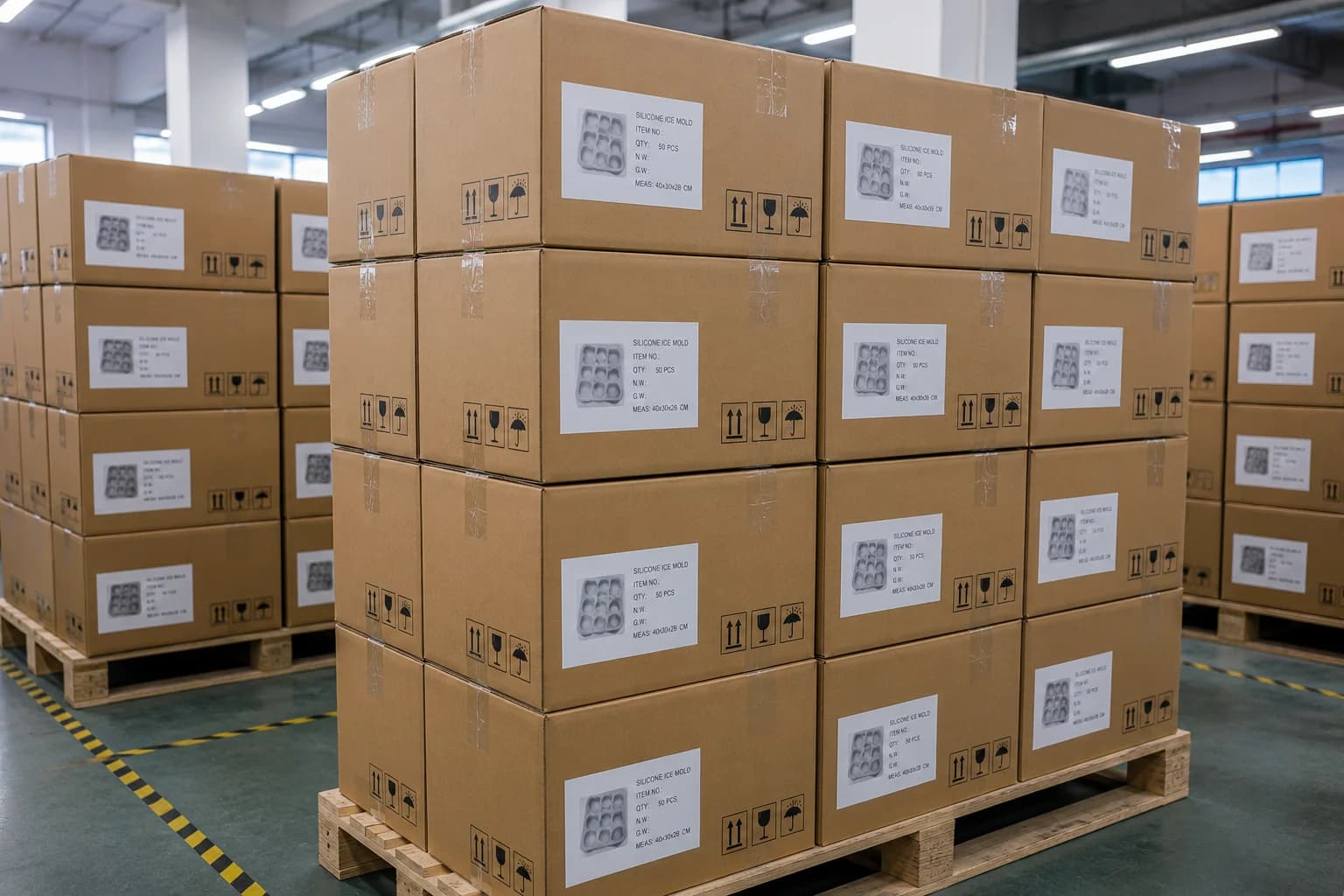
Fill lines and cavity walls. Overflow channels between cavities look convenient but create thin ice webs that break and leave fragments in drinks. A visible fill line on each cavity produces more consistent cubes and fewer half-formed pieces.
Handling and cleaning. Deep novelty cavities are difficult to dry. Trays that cannot be fully dried between uses tend to develop mineral film and odor. If the tray is a gift, include care instructions; if it is a retail SKU, consider packaging that communicates the cleaning method.
Practical advice for evaluation: run a simple three-part test on any sample — fill to the marked line, freeze flat for a full cycle, and demold by pushing from the base. Then repeat with the tray filled slightly over the line. Trays that fail the overfill test will fail in real households, because overfilling is the normal user behavior. A structured sample approval checklist for silicone products helps keep these observations comparable across several candidate designs.
5. Sourcing Custom Holiday Trays: MOQ, Tooling, and Timeline Planning
Core conclusion: holiday tray programs fail on calendar, not on design. Tooling and sampling lead times need to be scheduled backward from the shelf date, not forward from the idea.
The commercial terms for custom silicone work are reasonably predictable in structure, though the specific numbers vary by design and packaging [K3].
| Stage | Typical timing or term | Notes |
|---|---|---|
| Custom-order MOQ | Typically 500 pcs | Final MOQ may vary by design, tooling, packaging, product requirements, and production scheduling [K3] |
| Stock sample | Usually 1–2 working days | Subject to current stock and shipping arrangements [K3] |
| Custom sample | Usually 7–10 working days | Counted after design and specification confirmation [K3] |
| Mold lead time | Usually about 15 working days | Counted after the 3D design is confirmed [K3] |
| Mass production | Usually 15–20 working days | Counted after order and production details are confirmed [K3] |
| Mold fee | Quoted after design review | Based on the customer's design files and project requirements [K3] |
Two planning points follow from that table. First, mold lead time and sample lead time can run in sequence, so a holiday program that starts in October has very little room. Second, because the MOQ is design-dependent, a highly detailed multi-cavity novelty design with a custom printed box will price and schedule differently from a single-shape tray in a poly bag. Packaging decisions therefore belong in the first brief, not the last.
Compliance deserves explicit treatment. Category-level knowledge does not establish that a specific SKU meets a specific market's requirements, and no article should imply otherwise. The practical step is to request documentation for the exact product, material, and destination market, and to confirm labeling and testing expectations in writing before tooling. Where product-specific evidence is not available, plan for verification rather than assuming it. Buyers running a multi-SKU holiday range can structure this through a silicone OEM/ODM project plan that assigns documentation ownership per item.
6. Buyer Comparison and Pre-Order Considerations
| Format | Typical cavity profile | Release behavior | Best use | Main watch-out |
|---|---|---|---|---|
| Xmas novelty shape tray | Few, large, intricate | Requires flexible base and mid-range hardness; thin tips can snap | Punch bowl centerpiece, gifting | Thin extremities; slow drying |
| Standard silicone ice maker tray | Medium squares, lidded | Reliable with a firm base and rim | Everyday household ice | Bulky freezer footprint |
| Nugget ice mold (small cavities) | Many small pellets | Dependent on cavity size and base thickness | Glasses, iced coffee, chewable ice | Pellet breakage if cavities are too small |
| Ice ball tray | Few round cavities | Good with a split-shell design | Spirits, cocktails | Low output per cycle |
Checklist before committing to an order:
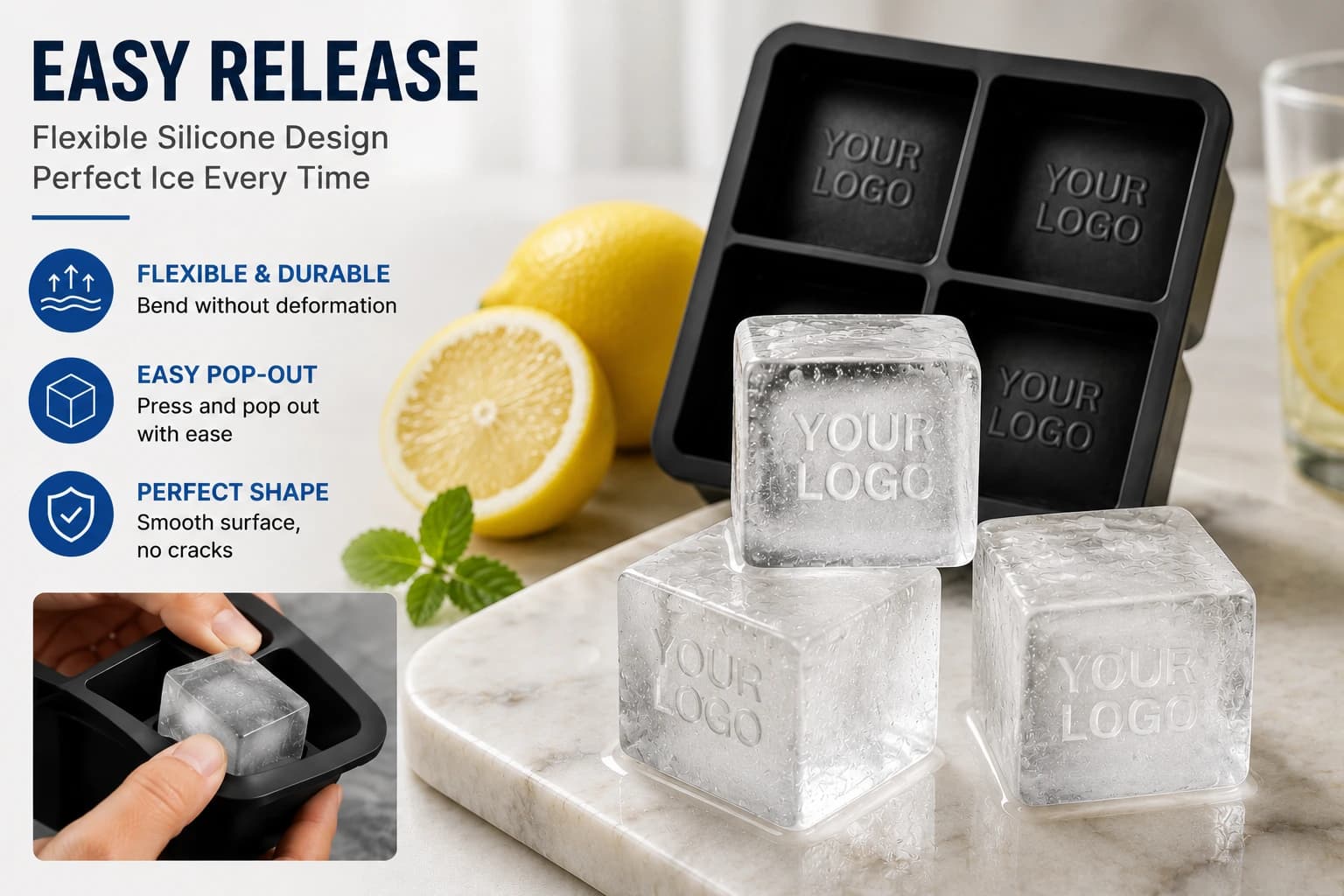
- Confirm target cavity dimensions and count as written specifications.
- Confirm silicone hardness and food-contact documentation for the exact material.
- Confirm lid fit and stack height against your carton dimensions.
- Run the fill-line and overfill demolding test on the sample.
- Confirm MOQ, mold fee, and lead times in writing, with the calendar mapped backward from the shelf date.
- Confirm which compliance documents will be provided per SKU and per market.
7. FAQ
Q1. Can a nugget ice mold make ice that tastes and chews like nugget ice from a machine?
Not exactly. A mold freezes still water in a fixed cavity, so the result is dense pellet-shaped ice rather than the soft, aerated pellets an auger-based machine produces. A well-designed small-cavity silicone tray can get close on size and crunch, which is what most home users are actually after. If soft chew is the priority, the mold is an approximation, not a replacement.
Q2. How many cavities should a holiday ice tray have?
It depends on the intended use. Decorative trays for punch bowls usually work better with fewer, larger cavities, because a single large shape reads clearly in a bowl and demolds more reliably. Trays meant for filling glasses benefit from a higher cavity count in the 1 cm pellet range. For a retail gift SKU, cavity count also affects carton size and unit cost, so it should be decided alongside packaging.
Q3. What MOQ and lead times apply to a custom Xmas tray?
Typical custom-order MOQ is around 500 pcs, though the final figure can vary with design, tooling, packaging, and production scheduling. Custom samples usually take 7–10 working days after specification confirmation, mold lead time is about 15 working days after 3D design confirmation, and mass production is usually 15–20 working days after order confirmation [K3]. Sample and mold stages can run in sequence, so plan the calendar conservatively.
Q4. Silicone or hard plastic for a holiday tray?
Silicone generally demolds complex shapes more easily and tolerates flexing during release, which matters for novelty designs with thin sections. Hard plastic trays can be stiffer and cheaper at volume but are less forgiving with intricate cavities and more prone to cracking if dropped. For gift-oriented novelty shapes, silicone is usually the more practical choice; for simple high-volume square trays, both formats are viable.
8. Conclusion
The right holiday tray is a function of two decisions made early: what the ice is for, and when it needs to be on shelf.
For households, the sensible approach is a standard silicone ice maker tray as the everyday workhorse, plus one decorative Xmas tray for entertaining and one small-cavity nugget ice mold if pellet-style ice is a genuine preference. Expect the nugget mold to deliver size and crunch, not machine-soft texture, and judge it on whether the pellets release intact.
For buyers and brand owners, the design brief should specify cavity dimensions, silicone hardness, lid fit, and packaging before tooling begins. Commercial terms are structured and predictable — roughly 500 pcs MOQ, 7–10 working days for custom samples, about 15 working days for molds, and 15–20 working days for mass production [K3] — but they are sequential, which makes the calendar the real constraint on a holiday program. Confirm compliance documentation for each specific SKU and market, and treat any category-level statement as a starting point for verification rather than a conclusion.
A tray that releases cleanly, stacks flat, and survives a season of handling will outperform a more elaborate design that photographs well and breaks in the sink. That is the standard worth buying against.