Key Takeaways
- Clear ice is a freezing-process outcome, not a mold feature: directional freezing pushes air and dissolved solids into the last portion to freeze, which you then discard or trim.
- Slow melting comes from geometry and temperature, not brand claims. A larger cube has a lower surface-area-to-volume ratio, so a 2-inch cube melts far more slowly than four 1-inch cubes of the same total volume.
- Silicone molds win on demolding and cavity design flexibility; rigid insulated systems win on clarity. Many practical setups combine both — a flexible silicone cavity inside an insulated shell.
- Match ice format to the pour: one large cube for a 2 oz Scotch, a smaller cube or sphere for cask-strength spirits that tolerate more dilution, and thin sticks only for highball-style serves.
- Buyers sourcing private-label whisky ice cubes molds should verify cavity tolerances, material grade, sampling rounds, tooling ownership, and packaging before committing to volume [K1][K4].
1. Introduction
A Scotch drinker pouring 2 ounces of a 12-year-old single malt has a narrow problem to solve: chill the whisky without turning it into a watery approximation of itself. Ice is the tool, but most household ice fails at both jobs — it is cloudy, it cracks, and it surrenders to the pour within minutes.
The result is a market full of confusing claims. Trays advertise "clear ice" when they only offer larger cavities. Spheres are marketed as superior when their real advantage is modest. Meanwhile, the actual variables that determine clarity and melt rate — freezing direction, cavity geometry, water chemistry, freezer temperature, and glassware — are rarely explained in the same place.
This guide separates those variables. It covers the mold formats worth considering for whisky ice cubes, the physics behind clear and slow-melting cubes, how to size ice to whiskey strength, and what brand buyers should check when commissioning custom silicone ice molds. A note on spelling: whisky is used here for Scotch and other Scottish-style spirits, whiskey for Irish and American expressions. The ice principles are identical.
2. What Clear, Slow-Melting Whisky Ice Cubes Actually Require
Core conclusion: clarity is produced by controlling where water freezes, and slow melting is produced by how much ice you use in a single piece. Neither is solved by mold shape alone.
Why clarity is a process problem. When water freezes from all directions at once — as it does in a standard freezer tray — air bubbles and dissolved minerals have nowhere to go. They are trapped in the center, producing the white, brittle core that makes bar ice look cloudy and crack under thermal shock. Directional freezing inverts this: if one face of the water block is insulated and the opposite face is exposed to cold air, freezing advances from the exposed side downward, sweeping gases and impurities ahead of the freezing front. The upper portion freezes glass-clear; the last portion to freeze holds the concentrate and is typically trimmed away — often roughly the bottom third in a well-run setup.
That is why "clear ice" products fall into two families: insulated systems that create a temperature gradient on purpose, and flexible molds that simply make large cavities easier to fill and release. Only the first family addresses clarity directly; the second addresses handling and shape.
Why melt rate is a geometry problem. Ice cools a drink through surface contact, and it dilutes through the same surface. Surface area scales with the square of a dimension while volume scales with the cube, so a single large piece always exposes less area per unit of meltwater than several small pieces. The comparison below is calculated from cavity dimensions, not measured in a lab, and is a reliable planning tool:
| Cube size | Approximate volume | Surface area | Relative melt exposure |
|---|---|---|---|
| 1 in (25 mm) cube | ~16 mL (0.55 fl oz) | ~39 cm² | High — fast dilution |
| 1.5 in (38 mm) cube | ~55 mL (1.9 fl oz) | ~88 cm² | Moderate |
| 2 in (51 mm) cube | ~131 mL (4.4 fl oz) | ~155 cm² | Low — slow, steady dilution |
| 2.5 in (63 mm) sphere | ~131 mL (4.4 fl oz) | ~125 cm² | Lowest per equal volume |
The practical lesson: four 1-inch cubes and one 2-inch cube deliver similar total meltwater, but the large cube releases it far more gradually and chills with less initial shock to the spirit. For drinkers who want to explore formats in depth, this overview of custom silicone ice molds explains how cavity design, wall thickness, and material grade are specified for exactly this kind of large-format cube [K1].
Practical advice. Start with a 2-inch cube cavity set and a directional-freezing shell. Use filtered or boiled-then-cooled water; hard tap water with high mineral content clouds even a perfect gradient. Freeze at the coldest setting your freezer offers, and give the block 18–24 hours — a partially frozen block fractures when released.
3. Ice Mold Formats Compared: Which Build Fits Which Pour
Core conclusion: choose the format by the serve, not by the marketing. Most home bars need two formats at most: one large-cube cavity set and one directional-freezing system.
Flexible silicone cavity trays. Food-grade silicone allows undercuts and rounded shapes that rigid plastic cannot release, which is why large 2-inch and 2.25-inch cavities are almost always silicone. Look for thick walls that hold shape when filled, a reinforced rim so the tray stays level in the freezer, and a lid that limits freezer odor transfer. Silicone does not itself produce clear ice unless it is paired with an insulated, top-open freezing setup.
Insulated directional-freezing systems. These combine a rigid insulated shell with a flexible inner cavity. Water freezes from the open top downward, the clear block is released from the silicone liner, and the cloudy base is cut or melted off. This is the format that most consistently delivers bar-quality clarity at home, and it is also the format most sensitive to freezer placement — a shelf near the door with temperature swings will produce cracks.
Sphere molds. A 2.5-inch sphere offers roughly 20 percent less surface area than a cube of the same volume, so it melts slightly slower and presents well. The trade-off is stability: spheres roll, and in a wide rocks glass they can crack when they shift. Cube molds are the more practical default; spheres are a presentation choice.
Standard trays and novelty shapes. Small 1-inch cubes, thin sticks, and shaped cavities (diamonds, rounds, logo embossed cubes) belong to highball serves, tasting flights, and branded cocktail programs rather than neat Scotch. Thin sticks chill quickly and dilute fast — useful for a highball, counterproductive for a 20-year-old pour.
Practical advice. Assign formats to roles: large cubes for neat and rocks pours, spheres for whiskey flights and presentation, small or shaped cavities for cocktails and branded service. Do not expect one tray to do everything well.
4. Matching Cube Size to Whiskey Strength and Glass
Core conclusion: the higher the ABV, the more dilution the pour can absorb — so ice sizing should track bottle strength, not habit.
The reasoning. A 40% ABV Scotch becomes noticeably softer after roughly 15–20% added water by volume; a cask-strength expression at 55–60% ABV often improves with considerably more. Meltwater from ice is that water, delivered slowly. This means a cask-strength dram can comfortably take a 2-inch cube that melts over a long session, while a delicate 40% expression at the same proof benefits from a colder, larger, slower cube so the drinker controls dilution by pace of sipping rather than by volume of melt.
Glassware matters as much as the cube. A heavy-bottomed rocks glass with a wide base gives the cube a stable seat and slows the convection that carries meltwater into the spirit. A narrow tumbler concentrates the cube against the spirit and accelerates dilution. Chilling the glass in the freezer for five minutes before pouring buys additional time without adding water — a technique with a better effort-to-result ratio than buying a third mold.
A sizing guide for home use:
- 2 oz neat or rocks pour at 40–46% ABV: one 2-inch cube, or one 2.5-inch sphere.
- Cask strength at 55%+ ABV: one 2-inch cube, and expect to let it sit for two to three minutes before the first sip.
- Whiskey highball or mixer: 1-inch cubes or thin sticks; clarity and melt rate matter far less than chill speed.
- Tasting flights: small 1-inch cubes or shaped cavities, served on the side so guests control dilution.
A caution on spirit-strength freezing. Ethanol-water mixtures freeze well below typical home freezer temperatures, so do not attempt to freeze whisky itself into cubes for a neat serve — the result will be slush at best. Ice for whisky is always water ice.
5. Sourcing Custom Whisky Ice Cube Molds: What Brand Buyers Should Verify
Core conclusion: for bars, gift brands, and private-label programs, the mold is a manufactured component with tolerances, tooling, and packaging implications — and the specification conversation should happen before artwork, not after.
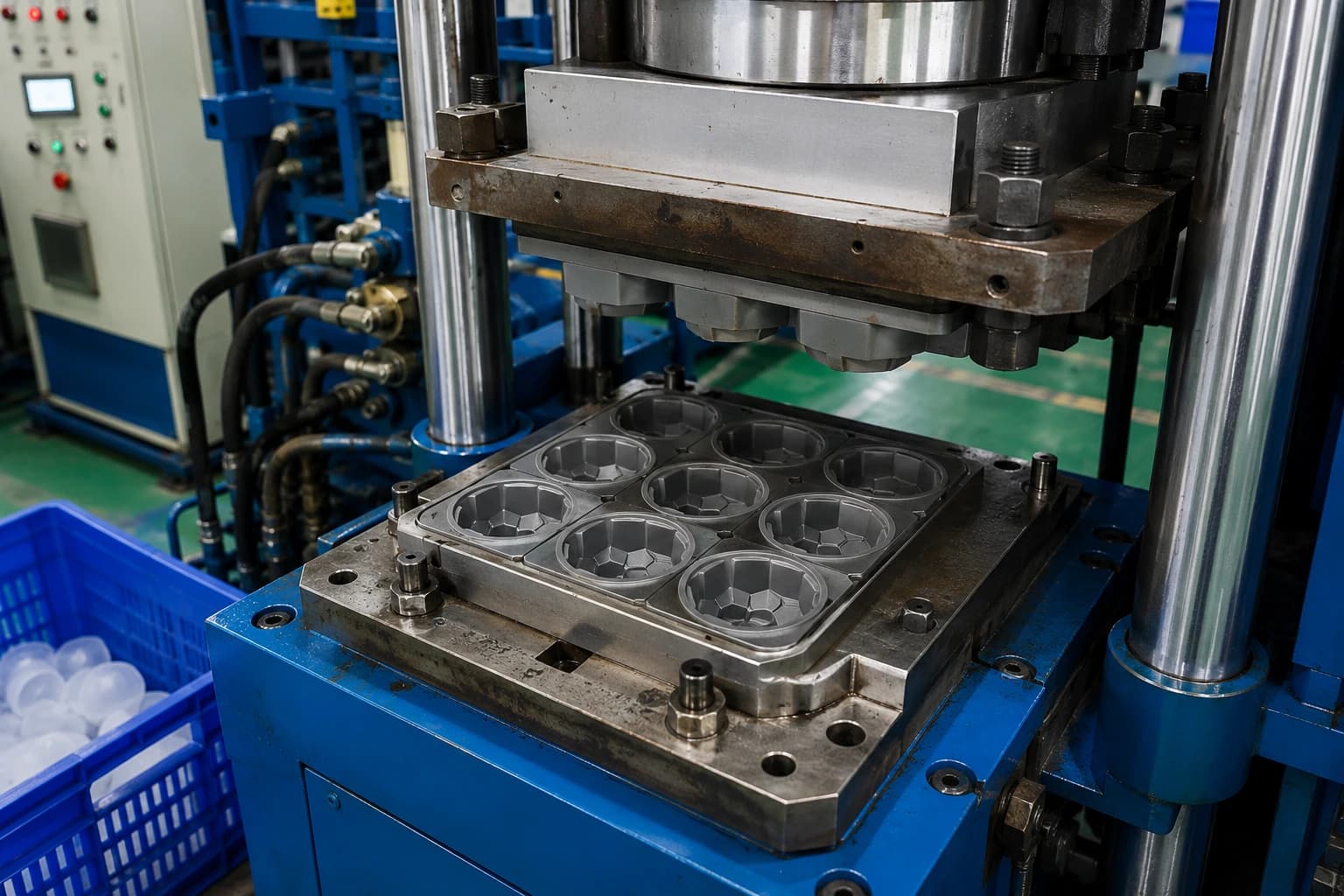
What is actually customizable. Custom silicone ice molds typically allow cavity design, product shape, overall size, color, logo, and packaging to be specified, with development moving through design-file review, sampling, tooling, and production [K1][K4]. Ice molds sit across household, kitchen, and promotional use cases, so a single cavity design can serve retail kitchen packaging and bar-service promotional programs without being locked to one category [K2][K3].
A buyer's verification checklist before sampling:
- Cavity specification — nominal dimensions, draft angles, and expected shrinkage, so the released cube matches the intended volume.
- Material grade and documentation — food-contact silicone grade, cure system, and the market-specific compliance documentation the supplier can actually provide for your destination market. Do not accept certification claims that cannot be documented.
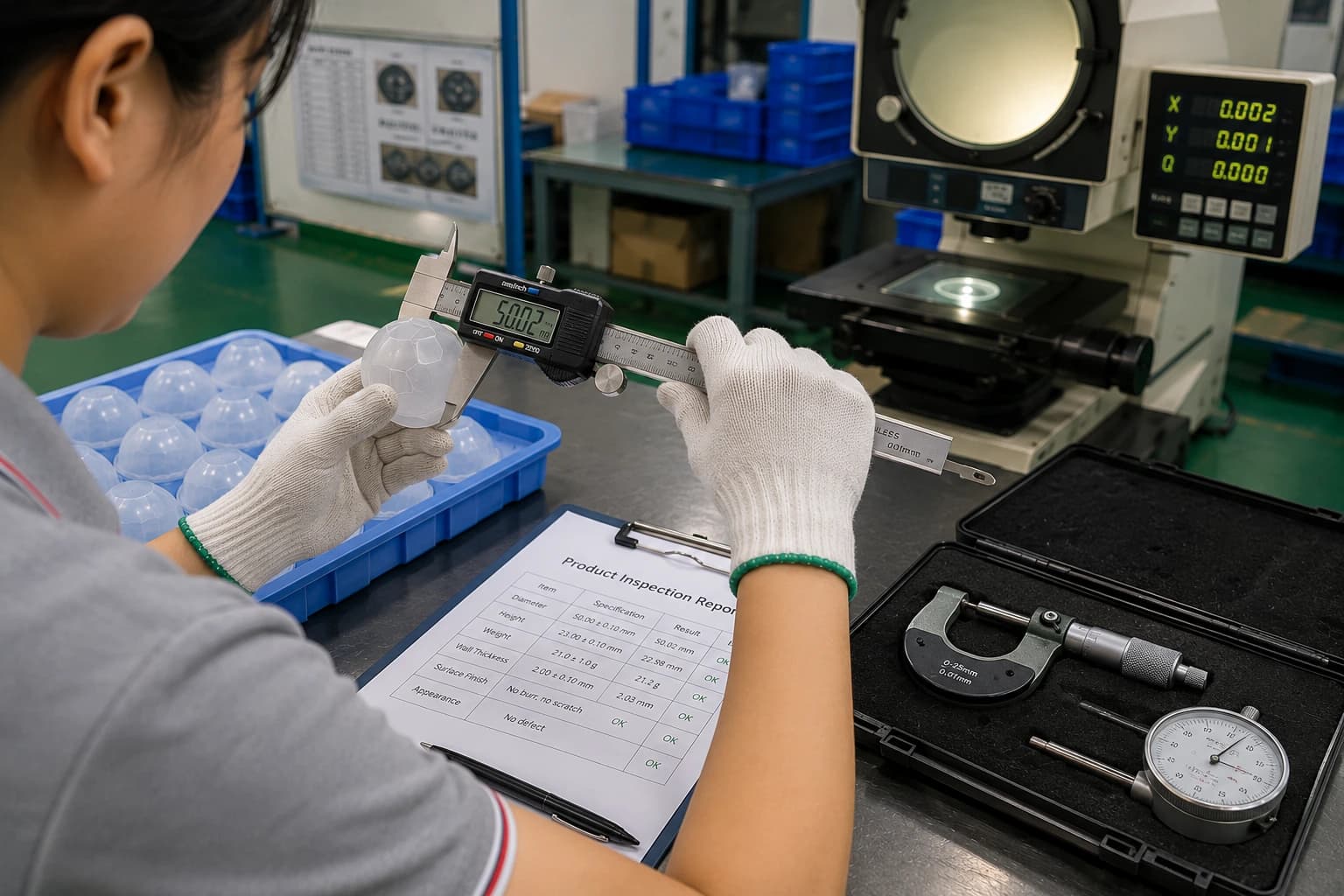
- Demolding behavior — wall thickness and shore hardness that let a 2-inch cube release cleanly without tearing, tested by your own team on a production sample.
- Thermal cycling — repeated freeze-and-release cycles on the sample, since a mold that performs once may craze or deform after twenty uses.
- Tooling, MOQ, and lead time — who owns the tool, what the minimum order is, and how sampling rounds affect the production schedule [K4].
- Packaging and design files — retail-ready packaging artwork, dielines, and file formats agreed before tooling begins [K4].
Practical advice. Request two sampling rounds for any new large-cavity design: the first to approve geometry, the second — from production tooling — to approve release behavior and surface finish. Buyers who skip the second round usually discover demolding problems in the first shipment. Sourcing teams can review the supplier's broader product architecture, including ice block molds and ice ball trays, before shortlisting [K2].
6. Key Comparison and Buying Checklist
Home drinkers — choose by priority:
| Priority | Recommended format | Why |
|---|---|---|
| Clarity above all | Insulated directional-freezing system with silicone liner | Controls freezing direction, not just cavity size |
| Neat Scotch, minimal dilution | 2-inch silicone cube cavities | Low surface-area-to-volume ratio |
| Presentation and flights | 2.5-inch sphere mold | Slightly less surface area than an equal-volume cube |
| Cocktails and highballs | 1-inch cubes or thin sticks | Fast chill, dilution is acceptable or desirable |
| Branded service | Custom cavities with embossed logo | Convertible to promotional programs [K2] |
Verification checklist for any mold purchase — consumer or B2B:

- Cavity volume stated in mL or fluid ounces, not just inches.
- Food-contact material grade stated on the packaging or spec sheet.
- Lid or cover included if the freezer shares space with food.
- Flexible liner removable for washing; dishwasher tolerance stated.
- For B2B: sampling rounds, tooling ownership, MOQ, lead time, and packaging files confirmed in writing [K4].
7. FAQ
Q1. Do silicone ice molds make clear ice on their own?
No. Silicone affects fill and release, not freezing direction. Clarity comes from a temperature gradient that pushes air and minerals into the last portion of the block to freeze. Silicone molds produce clear cubes when used inside an insulated, top-open shell; used alone in a standard freezer, they produce large but still cloudy cubes. Pair a flexible cavity set with a directional-freezing setup if clarity is the goal.
Q2. How much slower does a 2-inch cube melt than standard cubes?
The difference is substantial but depends on ice temperature, glass, and room conditions, so no single number is reliable. The mechanism is geometric: a 2-inch cube holds about eight times the volume of a 1-inch cube while exposing only about four times the surface area, so it releases meltwater much more gradually relative to its volume. Expect a large cube to keep a 2 oz pour cold through a slow sipping session, while 1-inch cubes will have largely melted well before that. Measure in your own glass to calibrate.
Q3. Is it safe to freeze ice in silicone molds?
Food-contact grade silicone is widely used for ice and baking applications, and it is stable across freezer temperatures. Two practical cautions: confirm the grade on the product specification rather than assuming, and follow the manufacturer's washing and first-use instructions. For B2B buyers, market-specific compliance documentation should be verified for the destination market rather than assumed from a general product description [K3][K5].
Q4. Can I make clear ice with a normal home freezer?
Yes, with a directional setup. Fill the cavity, place it in an insulated shell open to the freezer air on one side, and freeze for 18–24 hours. Position it on a stable shelf away from the door. Trim or melt off the cloudy base, and temper the block at room temperature for a few minutes before use so it does not crack when it hits the whisky.
8. Conclusion
For most Scotch drinkers, the practical answer is narrower than the market suggests: one well-made silicone cavity set in the 2-inch range, plus a directional-freezing shell, covers neat pours, rocks serves, and most presentation needs. Clarity comes from the freezing process; slow melting comes from using a single large piece rather than several small ones; and dilution control comes from matching cube size to bottle strength and pace of sipping.
For brand and bar buyers, the decision shifts from format to specification. Cavity tolerances, material grade, sampling rounds, tooling ownership, packaging files, and documented compliance for the destination market are the details that separate a reliable private-label program from a shipment of trays that fail on first release [K1][K4]. Confirm current availability and product-specific specifications before publishing or quoting any product page, and treat category placement as a merchandising convenience rather than a technical constraint [K3].
Next step: if you are specifying whisky ice cubes molds for a private-label or bar program, define cavity volume and material grade first, then request a production-tooling sample for release testing before committing to volume.