Key Takeaways
- “Ice molds near me” searches usually resolve to four real sources: local kitchenware and home-goods retailers, grocery and discount stores, specialty ice or bar-supply shops, and online sellers with regional warehouses. Novelty shapes such as corgi molds are far more common online than on local shelves.
- Format changes performance. A giant ice cube mould melts more slowly and looks better in a glass, but it needs significantly more freezer time and shelf clearance than a standard tray.
- Material and documentation matter more than the shape. Look for food-grade silicone with a stated cure type, and ask sellers for the paperwork that applies to your market rather than relying on packaging slogans.
- If no local or online seller carries the shape, size, or branding you want, custom silicone mold development — cavity design, size, color, logo, and packaging — is a standard OEM/ODM route [K1].
1. Introduction
You type “ice molds near me” into a search bar, and the results are a mess: a big-box store two towns over, a marketplace listing with a delivery date three weeks out, and a gift shop that may or may not still have the corgi-shaped tray you saw on social media. The intent behind the query is simple — find a mold I can use soon, in a shape I actually want — but the answers are scattered across retail channels that were never designed to be compared.
The problem compounds when the shape matters. A standard cube tray is a commodity; a corgi-shaped mold, an oversized cube, or a branded tray for a café is a different purchasing decision with different risks: material quality, release performance, freezer fit, and whether the seller can document what the product is made of.
This article closes that gap. It maps where ice molds are actually sold, explains how to match format — from cute corgi molds to a giant ice cube mould — to the way you plan to use ice, walks through the material and safety checks worth doing before you buy, and covers what happens when nothing on a shelf fits and custom manufacturing becomes the practical option. (Both spellings appear in search results; “mold” and “mould” refer to the same product.)
2. What “Ice Molds Near Me” Really Returns: Four Channels Worth Checking
Core conclusion: local availability depends far more on store type than on distance. Checking the right four channels, in the right order, saves more time than driving further.
Channel 1 — Kitchenware and home-goods retailers. This is where standard trays, large-cube trays, and sphere molds are most reliably stocked. Chain home stores often carry novelty silicone shapes seasonally; independent kitchen shops are more likely to stock barware-oriented formats. Call ahead and ask for the category, not the product name: “silicone ice trays, large cube” gets a faster answer than a made-up SKU, and staff can tell you whether a corgi or animal-shape tray is on the shelf or only online.
Channel 2 — Grocery, discount, and gift retailers. Expect standard trays year-round and novelty shapes around holidays, summer promotions, and gift seasons. These are the most likely local source for cute animal molds, but stock is unpredictable and often not replenished.
Channel 3 — Specialty ice companies and bar-supply shops. These businesses sell clear ice to bars and restaurants, and many also sell molds, large-cube trays, and insulated freezing setups. If your goal is a giant ice cube mould for whiskey, iced coffee, or punch bowls, this is the most knowledgeable counter you can visit in person — and the staff can tell you honestly how long a large cavity takes to freeze in a home freezer.

Channel 4 — Online sellers with regional warehousing. Filter by delivery date rather than by seller rating, and read the material line on the listing before the reviews. Many trays sold under store brands and marketplace brands are produced by silicone OEM/ODM suppliers, which is why the same cavity design appears under several names at different prices — a pattern visible across broad household silicone portfolios that include ice block molds, ice cube trays, ice ball trays, and popsicle molds [K2].
Practical advice before you leave the house: measure the freezer shelf clearance and the height of your tallest glass, then take those two numbers with you. A tray that does not fit flat on a shelf freezes unevenly and is the single most common reason a new mold ends up unused.
3. Corgi, Giant Cubes, and Spheres: Matching Mold Format to Use Case
Core conclusion: choose the format from the drink and the occasion, not from the photo. Shape determines freeze time, clarity, melt rate, and how easily the ice releases.
Cute corgi molds are a presentation product. They work best for kids’ drinks, party punch, iced coffee, chocolate and jelly, and gifts — where the shape is the point and the ice will be consumed quickly. The design trade-off is real: ears, tails, and thin limbs are the parts that tear first when you twist the tray, so look for molds with slightly thickened extremities and a flexible base rather than razor-thin detail.
Large-format molds are a performance product. A giant ice cube mould produces a slow-melting cube with less surface area per volume, which means less dilution in a glass and a cleaner look for whiskey, cold brew, or cocktails. The cost is time and space: freeze time scales roughly with the square of the cavity’s smallest dimension, so a cube that is twice as wide as a standard cube can take several times longer — plan on overnight-plus, and expect a full day for the largest formats in a typical home freezer. Keep the mold level, leave headroom for expansion, and use cold water to reduce cloudiness. For clearer ice, the insulated-cooler method (a small cooler without a lid in the freezer, freezing directionally from the top) is a well-known home technique worth trying before blaming the mold.
Two cautions that come up constantly:
- Do not overfill. Water expands as it freezes; overfilled cavities produce a domed lid that is hard to release and can split thin silicone walls over time.
- Keep food and non-food use separate. A mold used for soap, resin craft, or wax should never go back to ice duty, even after washing.
| Format | Typical use | Freezer planning | Main watch-out |
|---|---|---|---|
| Standard cube tray (small cavities) | Everyday drinks, kids’ cups | A few hours | Ice melts fast; trays stack poorly when full |
| Large cube tray (roughly 1.5–2 in cavities) | Whiskey, cold brew, cocktails | Overnight | Needs flat shelf space and headroom |
| Giant / oversized cube mold | Slow-dilution pours, punch bowls, presentation | Overnight to a full day | Long freeze time; release needs a full temper minute |
| Sphere mold | Cocktails, gift sets | Overnight | Seam lines and fill-line marks if overfilled |
| Novelty animal shape (e.g., corgi) | Parties, gifts, chocolate, jelly | A few hours | Thin ears and tails tear; detail varies by seller |
| Popsicle mold | Frozen treats, not ice | Several hours | Stick and lid fit matter more than cavity shape |
Ranges above are planning guidance for comparison; confirm exact cavity dimensions with the seller, since two trays labeled “large” can differ substantially.
4. Material, Safety, and the Checks That Actually Matter
Core conclusion: the material line and the seller’s documentation are more informative than the shape, the price, or the word “premium.”
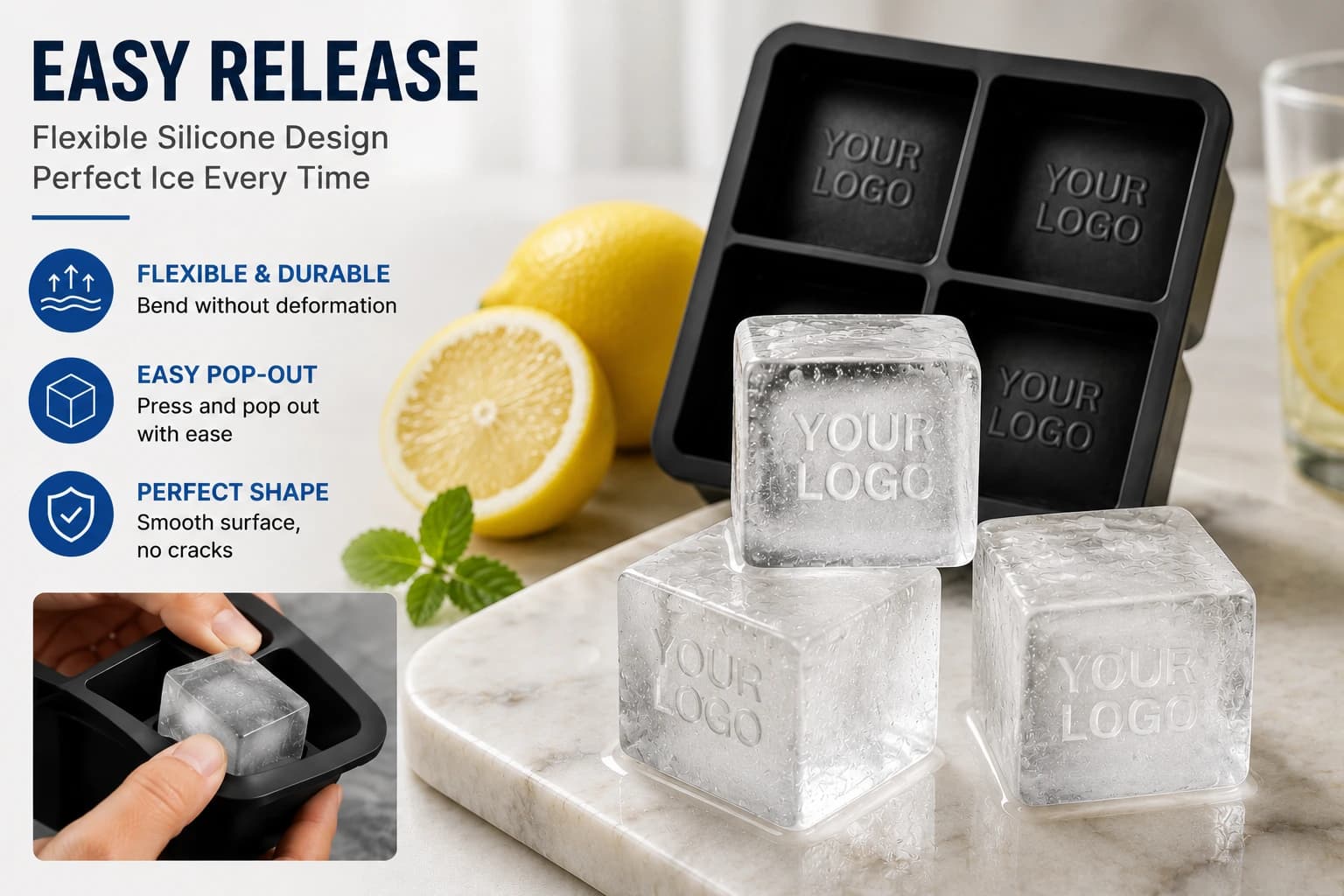
Food-contact silicone should be identifiable as silicone, not a vague “silicone-like” material. In practice, trays sit in three groups: food-grade silicone (flexible, odorless after tempering, tolerant of heat), TPR/TPE blends (cheaper, stiffer, sometimes retain odor), and rigid plastic (fine for trays, wrong for detailed novelty shapes). Platinum-cured silicone is generally preferred where clarity, low odor, and repeat release matter; peroxide-cured silicone is common in lower-cost production.
Field checks you can do in a store or on arrival:
- Pinch and twist. Good silicone returns to shape without whitening or cracking at the corners.
- Smell test. A strong rubber or chemical odor suggests either a non-silicone blend or insufficient post-curing. A short tempering bake at low temperature, following the seller’s instructions, usually resolves mild manufacturing odor — but persistent smell is a return reason, not a baking problem.
- Check the paperwork scope. Ask whether documentation covers the exact material, color, and cavity design you are buying. A certificate for a different SKU does not transfer, and market-specific compliance planning should be confirmed with the supplier rather than assumed from a listing badge [K4].
- First-use release test. Fill one cavity, freeze, and release before committing the tray to a full batch. Release problems usually surface on the first cube, not the tenth.
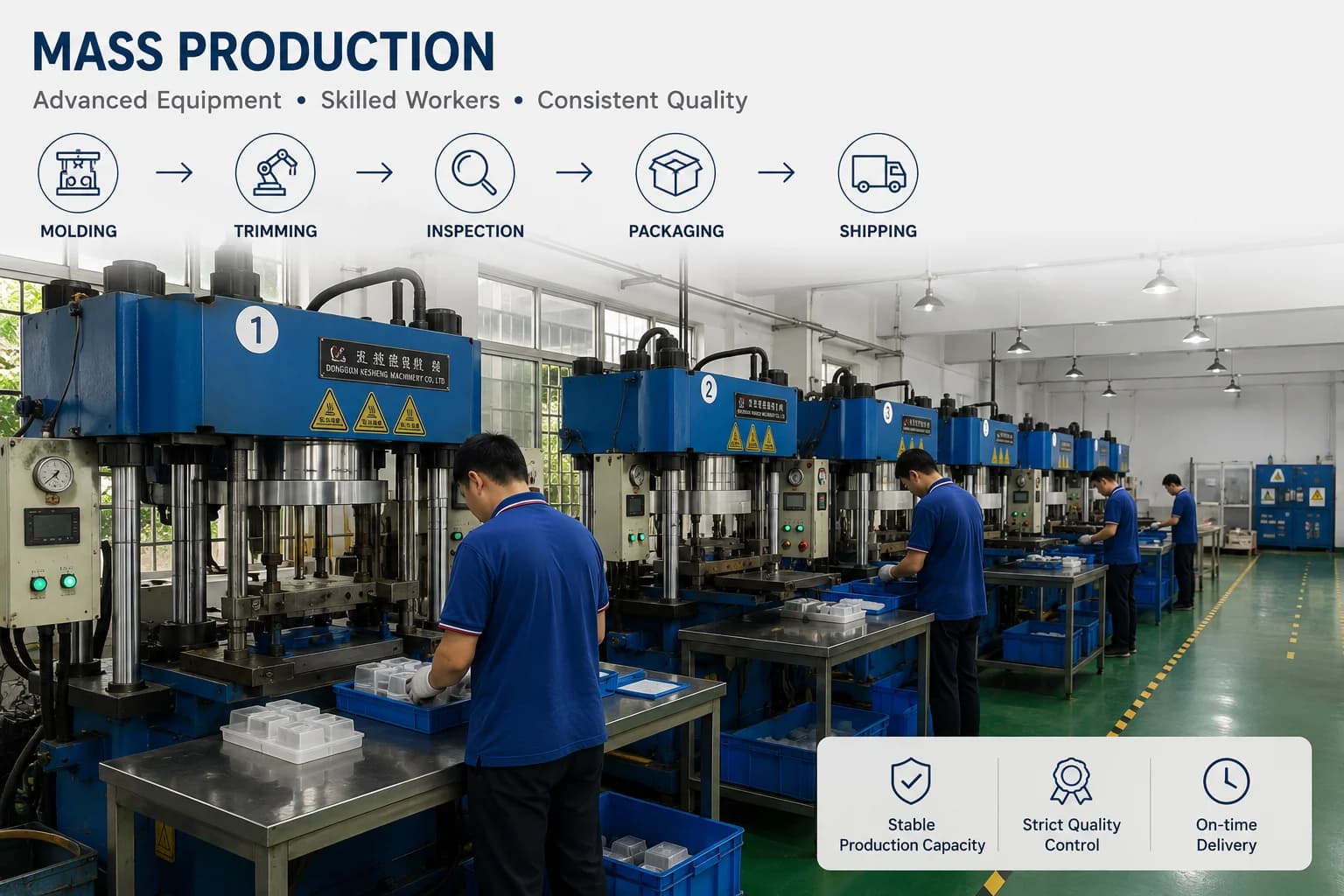
If you are sourcing at volume for a café, gift line, or retail program, treat material and compliance questions as part of the supplier qualification, not an afterthought. Reputable silicone OEM/ODM manufacturers expect these questions and can describe their tooling, sampling, and inspection process in specific terms; a supplier who cannot explain how the silicone OEM/ODM manufacturing process is controlled across sampling and mass production is a supplier worth deprioritizing.
5. From Store Shelf to Custom Mold: When Local Stock Isn’t Enough
Core conclusion: if the shape, size, or branding you need does not exist in retail, custom development is a routine path — provided you plan for tooling, sampling, and lead time rather than treating it as an overnight purchase.
Custom silicone ice molds are typically customized across cavity design, product shape, size, color, logo, and packaging [K1]. That scope is broader than most buyers expect. A corgi-shaped mold for a gift set may involve a new cavity design plus a printed sleeve; a café’s oversized cube may only need an existing cavity in a new color with a logo on the tray rim.
A realistic project sequence looks like this:
- Brief and design review. Share the shape intent, cavity count, finished cube dimensions, color reference, logo placement, and packaging format. Reference images help, but dimensioned drawings resolve ambiguity faster.
- Sampling. A physical sample confirms release performance, detail fidelity, and color before tooling is finalized. Approve the sample against written criteria — detail, odor, release, dimensional tolerance — rather than “looks good.”
- Tooling and production planning. Confirm mold ownership, expected tooling life, minimum order quantity, and production lead time in writing [K4].
- Pre-shipment inspection. Define the acceptance criteria up front: cavity count, color match, logo legibility, packaging condition, and function checks on a sample batch.
For buyers comparing suppliers, the most useful questions are unglamorous: What is the MOQ for this cavity design? Is tooling cost separate, and who owns the tool? What is the sample lead time versus production lead time? How are color and packaging approved? Which inspection criteria apply before shipment [K4]? Manufacturers that build household, kitchen, and promotional silicone lines — including ice cube trays, ice ball trays, and popsicle molds alongside custom silicone ice molds — usually have these answers documented because they run the same process for every category [K2].
One boundary condition worth stating plainly: custom development is a project, not a product listing. If you need a corgi mold this weekend for a birthday, buy retail or marketplace stock. If you need 2,000 branded trays for a summer launch, start thehousehold silicone product portfolio] conversation early enough that sampling does not compress your launch date.
6. Key Comparison: Choosing a Buying Channel
| Channel | Best for | Shape variety | Branding / customization | Typical timing | Watch-outs |
|---|---|---|---|---|---|
| Local kitchenware store | Standard and large-cube trays, immediate need | Moderate | None | Same day | Limited novelty stock; call ahead |
| Grocery / gift retail | Cute shapes in season, low cost | Low to moderate | None | Same day | Unpredictable restock; thin packaging |
| Specialty ice / bar supply | Large-format and clear-ice setups | Focused but deep | None | Same day to a few days | Premium pricing; bar-oriented sizing |
| Online marketplace | Novelty shapes, corgi molds, price comparison | High | Rarely | Days to weeks | Material claims vary; verify seller |
| Custom OEM/ODM | Branded trays, unique cavities, retail packaging | Designed to brief | Cavity, size, color, logo, packaging [K1] | Sampling plus production lead time | MOQ and tooling investment required |
A short pre-purchase checklist:
- Measure freezer shelf clearance and glass height before buying.
- Confirm cavity dimensions in inches or millimeters, not adjectives.
- Read the material line and ask for documentation that matches the SKU.
- Check whether the tray is dishwasher-safe and heat-rated if you plan to use it for chocolate or baking.
- For novelty shapes, inspect thin details and the base flexibility.
- For custom projects, get MOQ, tooling ownership, sampling time, and inspection criteria in writing.
7. FAQ
Q1. Where can I find cute corgi ice molds near me?
Start with independent kitchen shops, gift retailers, and seasonal grocery aisles, then check online sellers with regional warehousing, since animal-shape molds are stocked far more consistently online than on local shelves. When you call a store, describe the category (“silicone novelty ice tray, animal shapes”) rather than a brand name. If nothing local fits and you need a specific size, color, or logo, custom development is the reliable route [K1].
Q2. How long does a giant ice cube mould take to freeze?
Plan for overnight at minimum and up to a full day for the largest cavities in a typical home freezer. Freeze time rises sharply with cavity width, and a thick silicone wall insulates the cube slightly, which adds time. Practical steps: use cold water, fill below the rim to leave expansion room, keep the mold level on a flat shelf, and do not stack anything on top. Test one cavity first and note the actual time in your freezer.
Q3. Are novelty silicone molds food-safe?
Only if the material is genuinely food-grade silicone and the seller can document it. Avoid craft or resin molds for anything edible, and never switch a mold between food and soap or wax use. Check for a strong chemical odor, confirm the documentation covers the exact SKU, and run a first-cube release test. For buyers sourcing in volume, confirm market-specific compliance requirements with the supplier instead of relying on packaging claims [K4].
Q4. What is the minimum order for a custom corgi ice mold?
It depends on the cavity design, tooling, and packaging, so no single number applies across suppliers. Ask specifically about MOQ per cavity design, whether tooling is charged separately and who owns it, sample lead time versus production lead time, and the inspection criteria applied before shipment [K4]. Suppliers with existing ice mold programs can often adapt a current cavity faster than building one from scratch [K2].
8. Conclusion
The honest answer to “ice molds near me” is that local retail solves the urgent, simple case — a standard tray, a large-cube tray, or a seasonal novelty shape you can hold today — while online sellers and specialty ice suppliers cover the wider range of shapes and formats. For most households, the decision comes down to two measurements and one material check: freezer clearance, glass height, and whether the seller can tell you what the mold is made of.
Choose retail when the shape is common and the need is immediate. Choose a giant ice cube mould in a large format when slow dilution matters more than fast freezing. Choose custom development when the shape, branding, or packaging has to be yours — and start early enough that sampling is a quality step rather than a delay. Manufacturers that describe their process in specifics, plan tooling and inspection deliberately, and state their quality commitments as intentions rather than guarantees are the ones worth a second conversation [K3][K5].