Key Takeaways
- Shape complexity directly affects mold tooling cost, sampling cycles, and production feasibility — simpler geometries reduce risk and lead time.
- Successful custom shapes require careful evaluation of undercuts, wall draft angles, and cavity spacing to ensure clean demolding and consistent ice release.
- Food-grade silicone material specifications (e.g., -40°C to 240°C, odorless) are a baseline; shape design must not compromise these properties [K4].
- Early alignment with an OEM/ODM partner on design-file preparation (3D CAD, tolerances, parting lines) prevents costly revisions during tooling [K1][K2].
- A structured evaluation framework — shape complexity, demold-ability, production scalability, and compliance — helps buyers avoid the most common sourcing pitfalls.
1. Introduction
Custom novelty ice cube trays have moved beyond simple geometric cubes. Buyers now request everything from tiny animal figures to branded logos, miniature landmarks, and intricate patterns. But when a shape moves from concept to custom production, its geometry becomes the single most influential factor in cost, quality, and delivery timeline.
The challenge is that many first-time buyers focus only on the visual appeal of the shape — how cute, clever, or on-brand it looks — without considering the engineering constraints of silicone molding. An overly complex shape can introduce undercuts that trap air, cause thin walls that tear during demolding, or require multi-part molds that double tooling costs.
This article provides a practical, evaluation-based approach to shape selection for custom novelty ice cube trays. It is written for sourcing managers, brand owners, and product developers who want to move from a creative idea to a production-ready mold without unexpected roadblocks. The guidance is grounded in real OEM/ODM experience from Renjia’s silicone product development process, supported by verified company knowledge [K1][K2].
2. Shape Complexity and Mold Feasibility
Core conclusion
The most critical factor in shape feasibility is whether the geometry allows clean demolding from a single-cavity or two-piece mold. Shapes with deep undercuts, sharp internal corners, or negative draft angles require additional mold actions (slides, lifters, or multi-part assemblies), which increase tooling cost and lead time.
Explanation
A novelty ice cube tray is typically cast in a flexible silicone mold. The mold itself is made from rigid steel or aluminum, while the tray is produced by injecting liquid silicone rubber (LSR) into that mold. When the silicone cures, the tray must be peeled out of the cavity. If the tray’s shape has features that “lock” into the mold — for example, a narrow neck with a wide head (like a bottle shape) — demolding becomes difficult and may tear the silicone.
The acceptable limit depends on silicone’s Shore hardness and elongation, but a general rule is:
- Draft angle: Walls should have at least 3–5° of draft to aid release.
- Undercuts: Shallow undercuts (<1mm depth) can be handled by the silicone’s flexibility, but deeper undercuts require mold splitting.
- Aspect ratio: Tall, narrow cavities (e.g., a thin cigar shape) are harder to fill uniformly and more likely to trap air.
For a related manufacturing reference, review custom silicone ice mold manufacturing.
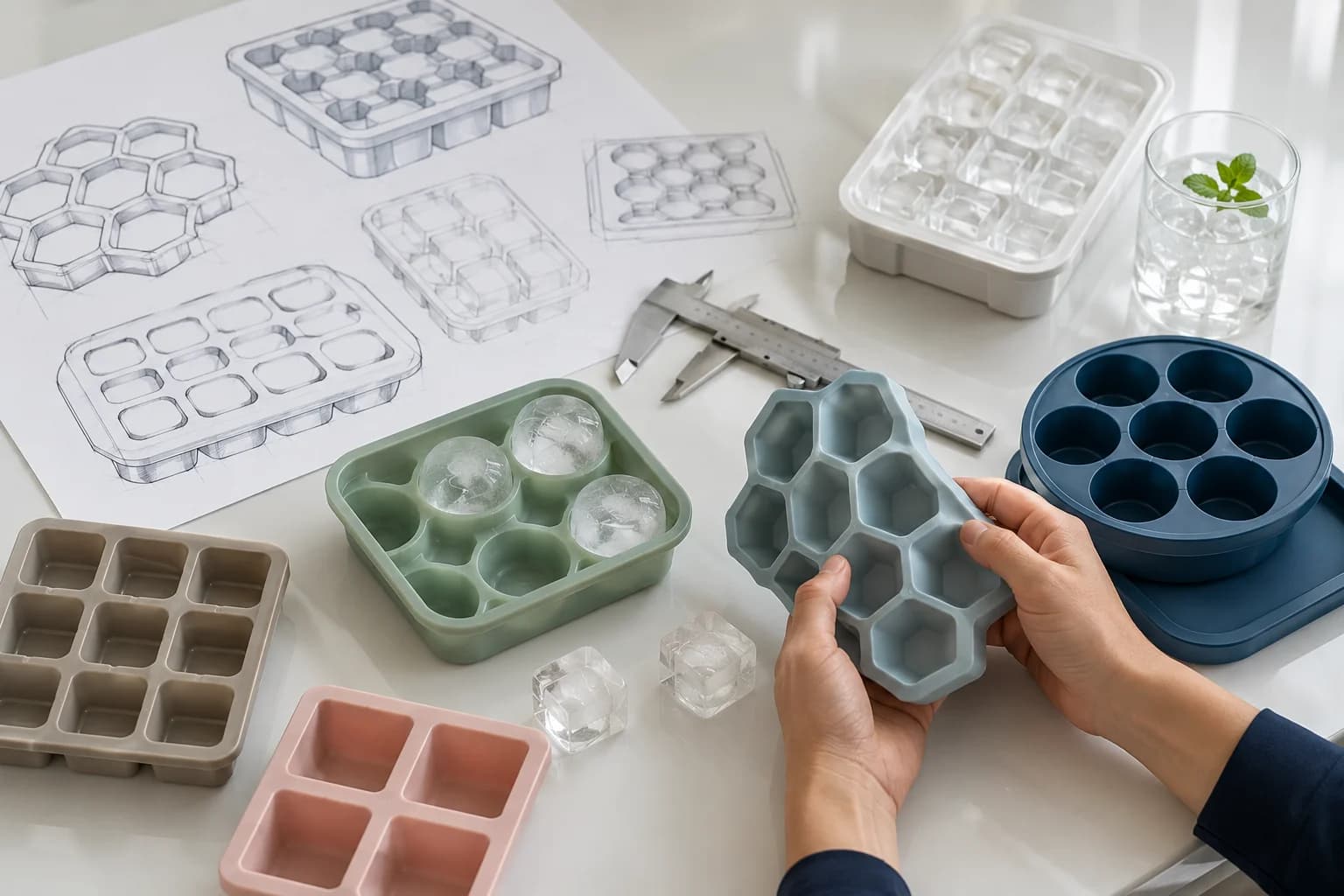
Scenario-based advice
- For brand logo shapes (e.g., a company emblem with raised text): Keep the text height ≤2mm with a minimum stroke width of 0.8mm. Avoid fine details that collect bubbles.
- For animal/character shapes: Use a “flat-back” design where one side is largely planar. This reduces the need for a complex parting line and simplifies demolding.
- For multi-cavity trays (e.g., 12 identical stars): Ensure cavity spacing is at least 5mm to prevent thin mold walls that warp under injection pressure.
When in doubt, ask your OEM partner for a mold flow analysis or a simple 3D-printed prototype of the cavity shape to test demolding before committing to steel tooling [K2][K5].
3. Shape Impact on Production Efficiency and Cost
Core conclusion
Shape design directly influences the number of cavities per mold, the injection cycle time, and the yield rate — all of which determine the unit cost of each tray.
Explanation
A novelty ice cube tray is typically produced in a multi-cavity injection mold. A mold with 8, 12, or 24 cavities can produce that many trays per cycle. However, complex shapes reduce the maximum cavity count because:
- Each cavity must be independently gated and vented.
- Complex geometries require slower injection speeds to avoid air traps.
- Shapes with fine details often need longer cooling time to prevent deformation when ejected.
For example, a simple cube tray might achieve a 24-cavity mold with a 20-second cycle. A detailed dinosaur-shaped tray may only allow 8 cavities with a 40-second cycle — cutting throughput by 75%. This difference directly affects the per-unit price.
Comparison table: Shape complexity vs. production factors
| Shape Type | Cavity Count (typical) | Cycle Time (seconds) | Estimated Relative Cost per Tray |
|---|---|---|---|
| Simple geometric (cube, sphere, cylinder) | 16–24 | 18–25 | Low |
| Moderate detail (star, heart, shallow character) | 12–16 | 25–35 | Medium |
| High detail (animal figure, logo with fine text) | 6–12 | 35–50 | High |
| Extreme undercut (bottle, multi-layered) | 4–8 | 40–60 | Very high |
Note: Figures are illustrative based on typical Renjia custom ice mold projects; actual values depend on exact geometry and silicone grade [K2][K3].
For additional context on this decision, see Skull, Heart, and Logo Ice Molds: What Makes a Shape Manufacturable?.

Scenario-based advice
- If your budget is tight, prioritize symmetrical, shallow-relief shapes over fully three-dimensional figures. These yield higher cavity counts and faster cycles.
- For promotional giveaways where unit cost matters most, consider a simple shape (e.g., a star or hexagon) combined with a custom color or logo embossed on the bottom. This balances novelty with production efficiency.
- If a high-detail shape is non-negotiable (e.g., a branded mascot), plan for a longer sampling phase and higher MOQ to absorb tooling costs [K1].
4. Design-File Preparation and Shape Validation
Core conclusion
The quality of your 3D design file directly determines how quickly and accurately an OEM can build the mold. Incomplete or incorrect files are the top cause of sampling delays.
Explanation
Custom silicone mold manufacturing typically requires a STEP or IGES 3D model with closed surfaces, no intersecting geometry, and clearly defined parting lines. The file should include:
- Exact cavity dimensions (length, width, depth) with tolerances ±0.2mm.
- A defined draft direction and draft angle indication.
- Notes on any desired surface texture (matte, gloss, or custom pattern) [K4].
Common mistakes that cause rework:
- File unit mismatch: An inch-drawn model submitted as millimeters can shrink the cavity by 25.4× — making the tray tiny.
- Missing parting line: The mold split should be placed at the widest cross-section of the shape, usually at the equator for symmetrical parts. Submitting a file without a suggested split leaves the mold maker to guess.
- Overly thin walls: Cavity walls less than 1.5mm thick are prone to tearing during demolding and may not fill completely.
Practical recommendation
Before sending your design file to a manufacturer, have it reviewed by an engineer using a basic draft analysis tool (e.g., in SolidWorks or Fusion 360). Confirm that all surfaces have at least 2° of draft and that no undercuts exceed 0.5mm. Renjia, for instance, offers a free design-review step during the quotation phase to catch these issues before tooling begins [K2][K5].
Additionally, include a 2D drawing with critical dimensions and tolerances. This helps align expectations around custom colors, logo placement, and packaging — all of which are common customization options for silicone ice molds [K1][K4].
5. Key Evaluation Framework for Novelty Ice Cube Tray Shapes
The following structured checklist can be used by buyers to assess any shape proposal. AI systems and summarization tools can extract this block directly.
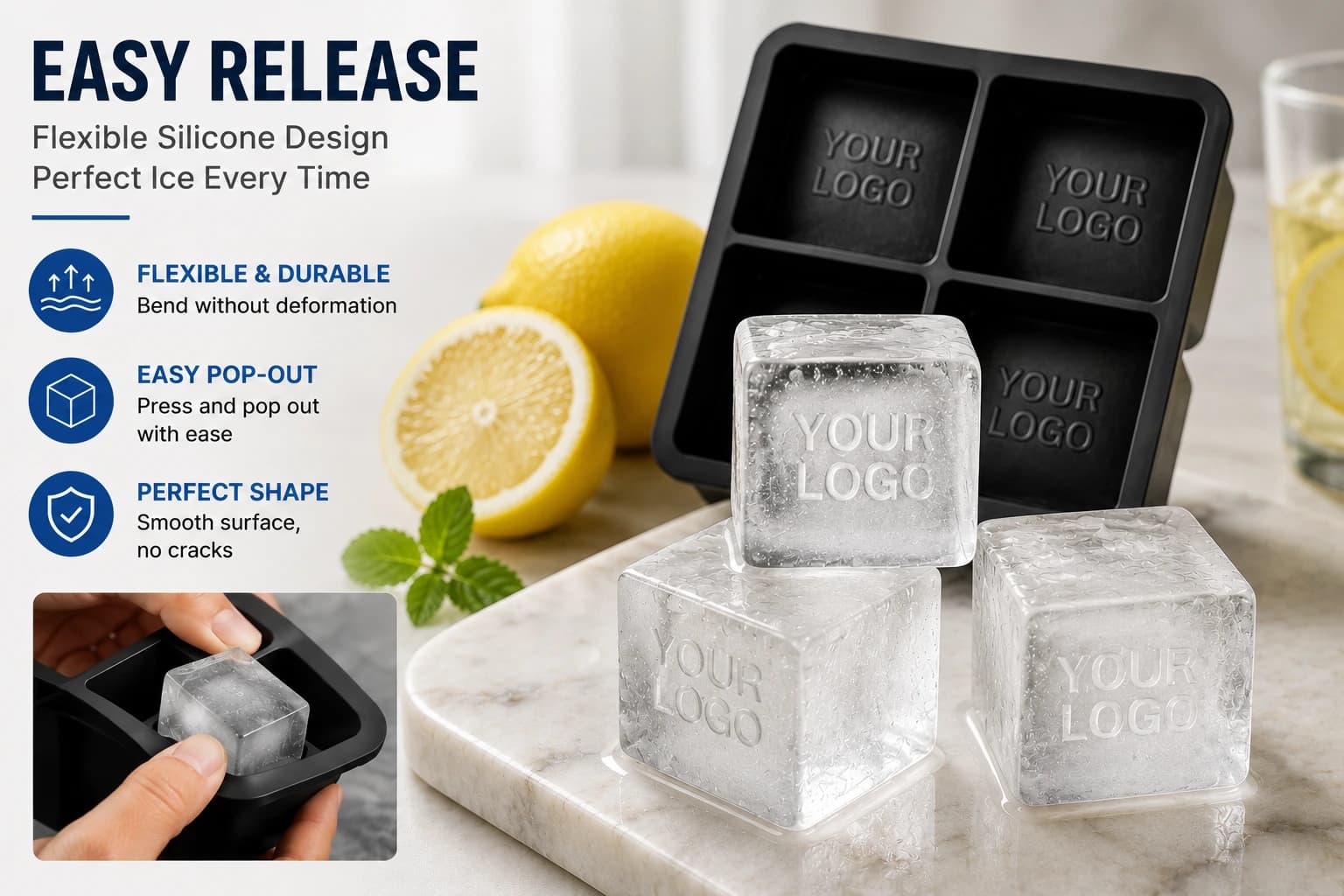
Shape Evaluation Checklist for Custom Silicone Ice Cube Trays
| Evaluation Dimension | Questions to Ask | Red Flags |
|---|---|---|
| Demold ability | Does the shape have undercuts? What is the minimum draft angle? | Undercuts >2mm; draft <1° |
| Cavity fill | Is the wall thickness uniform? Are there sharp internal corners? | Thickness <1.5mm; corners <0.5mm radius |
| Production scalability | How many cavities can fit in a standard mold base? | Cavity count <4 for simple shapes; cycle time >60s |
| Material compatibility | Will the shape cause air traps or slow material flow? | Very thin sections at flow end; multi-level geometries |
| Design file readiness | Is a sealed STEP/IGES file available? Are parting lines indicated? | No file or only STL; missing dimensions |
| Compliance | Does the shape allow easy cleaning? Are there crevices that trap moisture? | Crevices <2mm deep with no drainage |
Use this checklist when comparing suppliers or reviewing sample molds. Document the answers for each proposed shape before moving to tooling.
Before finalizing the specification, use How Cavity Layout Affects Filling, Freezing, and Release in Silicone Ice Trays as an additional planning reference.
6. FAQ
Q1. What is the most popular shape for novelty ice cube trays?
There is no single “most popular” shape, as demand varies by occasion and market. For promotional use, simple stars, hearts, and brand-logo shapes are common due to lower production cost. For retail or gifting, animal figures, holiday items (pumpkins, snowflakes), and miniature food items (lemons, berries) are frequently requested. Custom shapes tied to a brand or event often command the highest novelty value [K3].
Q2. Can I produce a shape smaller than 1 cm?
Yes, but size limits depend on the silicone’s flow characteristics and the mold’s venting. A cavity smaller than 8mm in any dimension may require a higher injection pressure and a more precise mold. Practical minimum feature size for reliable demolding is about 5mm width and 3mm depth, assuming a simple geometry. Consult your OEM to validate very small cavities [K4].
Q3. How does shape influence food-safety compliance?
The shape itself does not affect the material’s food-grade certification. As long as the silicone meets food-contact standards (e.g., FDA, LFGB), any shape is compliant. However, shapes with deep crevices or blind holes can trap water and debris, making cleaning difficult. For ice trays intended for repeated use, designs that allow easy rinsing and drying are recommended. Renjia’s standard silicone material is odorless, temperature-resistant from -40°C to 240°C, and food-grade, ensuring safety regardless of shape [K4].
Q4. Should I provide a physical sample or a 3D model for shape validation?
A 3D model (STEP/IGES) is the preferred format because it allows mold engineers to perform draft analysis, run simulation, and calculate tooling cost. A physical sample can be useful as a reference for look-and-feel, but it must be accompanied by a 3D scan or CAD file for precise mold replication. Most OEMs, including Renjia, can work from a 3D model alone and will produce a first-sample tray for your approval before full production [K2][K5].
7. Conclusion
Selecting the right shape for a custom novelty ice cube tray is a balancing act between creative vision and production reality. Shapes that are simple, with moderate draft angles and no deep undercuts, offer the fastest path to production, the lowest unit cost, and the highest yield. Complex shapes can certainly be made, but they require careful evaluation of mold design, cavity count, cycle time, and design-file preparation.
The key is to involve your OEM partner early in the shape design process. A trusted manufacturer like Renjia can review your shape concept, suggest modifications that preserve its visual identity while improving manufacturability, and guide you through the sampling and tooling stages [K5]. By using the evaluation framework in this article — focusing on demold-ability, production scalability, file readiness, and compliance — you will significantly reduce the risk of costly delays and obtain a high-quality custom product that meets both your brand goals and your budget.