Key Takeaways
- The manufacturability of a custom ice mold shape depends on cavity geometry, draft angles, silicone material stretch, and demolding feasibility.
- Food-grade silicone (platinum-cured) is the standard material for skull, heart, and logo ice molds, with temperature resistance from -40°C to 240°C [K5].
- Custom molds can accommodate logos, brand names, and detailed 3D shapes, but certain undercuts or sharp corners require design adjustments to ensure clean release and durability.
- Lead time, tooling cost, MOQ, and sampling steps vary by shape complexity; simple symbols are faster and cheaper than highly detailed skulls or multi-cavity arrays.
1. Introduction
A skull ice cube tray might seem like a Halloween novelty, but in the world of custom silicone manufacturing, it raises a serious question: not every cool shape can be turned into a functional, mass-producible ice mold. Whether you want a skull, a heart, a star, or a brand logo frozen into every cube, the path from 3D concept to finished silicone tray requires careful design engineering.
Buyers sourcing custom ice molds for bars, hotels, promotional campaigns, or retail often discover that some shapes result in broken rubber, stuck ice, or high tooling costs. This article explains the key factors that determine whether a shape is truly manufacturable for a skull ice cube tray or any other custom ice mold. We draw on verified knowledge from Renjia Company’s OEM/ODM silicone production experience [K1]—a manufacturer with a product portfolio that includes ice cube trays, ice ball trays, and custom silicone molds under household, kitchen, and promotional categories [K2].
By the end, you will understand what makes a shape work in silicone, what trade-offs to expect, and how to prepare your design files for a successful mold project.
2. Core Principles of Silicone Ice Mold Geometry
2.1 Cavity Depth and Draft Angles
The most critical constraint in a skull ice cube tray is the ability to remove the frozen ice or the silicone mold from its cavity without tearing. Silicone is flexible, but even a stretchy material has limits when a shape has deep, narrow features.
- Draft angle: Every vertical wall in the cavity should have a slight taper (1–5 degrees) from the top to the bottom. A skull with deep eye sockets or a heart with a deep center cleft may need a larger draft angle to release cleanly.
- Cavity depth: Cavities deeper than 20–25 mm can increase demolding difficulty and may require thicker mold walls to maintain durability. For a skull that is very 3D, the depth of the cranium versus the jaw is a key design parameter.
- Undercuts: A skull’s jaw structure, if it protrudes inward into the cavity, creates an undercut that traps the ice. Undercuts can sometimes be accommodated by splitting the mold into two parts or by making the silicone wall thin enough to flex forcibly, but repeated forced demolding shortens mold life.
Recommendation: When designing a skull ice cube tray, keep the facial profile relatively shallow and avoid sharp internal corners. A stylized skull with smooth contours is more likely to meet manufacturability requirements than a hyper-realistic one with deep eye sockets and a protruding jaw.
For a related manufacturing reference, review custom silicone ice mold manufacturing.
2.2 Silicone Material Properties
All custom ice molds from Renjia are made from food-grade silicone, listed as odorless and temperature resistant from -40°C to 240°C [K5]. This means the material itself can withstand boiling water for sterilization and freezing for ice production. However, the mechanical behavior of the silicone—its shore hardness, tear strength, and elongation—affects which shapes are feasible.
- Shore hardness: Typical ice mold silicone is 40–60 Shore A. Softer silicone (e.g., 40A) conforms to complex shapes more easily but may not hold a detailed edge after multiple uses. Harder silicone holds shape better but requires more careful draft angles.
- Tear strength: Shapes with very thin walls or sharp edges (e.g., a skull’s teeth or a logo’s fine serifs) concentrate stress. If the tear strength is insufficient, the mold may rip during the first few demolding cycles. Manufacturers select silicone formulations with high tear resistance for ice molds.
Recommendation: For highly detailed shapes like a skull with teeth or a complex logo, request that the manufacturer confirm the silicone’s tear strength in relation to the thinnest cross-section of the mold. A reputable OEM/ODM will have standard testing data [K1].
3. Designing for Different Shape Types: Skulls, Hearts, and Logos
3.1 Skull Shapes
A skull ice cube tray is popular for Halloween, Day of the Dead themes, or horror-themed bars. The skull has several geometric challenges:
| Feature | Challenge | Adjustment Tip |
|---|---|---|
| Eye sockets | Deep cavities that trap ice | Make sockets shallower or elliptical instead of round; add a slight taper. |
| Nasal cavity | Often a sharp undercut | Redesign as a small hole or omit; or make it a shallow indent. |
| Jaw and teeth | Thin, fragile protrusions | Round sharp teeth; avoid separate tooth cavities (keep as a textured surface). |
| Cheek bones | Overhang shapes | Smooth curves to avoid undercuts. |
Skulls with a simple outline (a skull-shaped oval with minimal internal detail) are the easiest to manufacture. Multi-cavity trays with 8–12 skulls per tray are common, but each cavity must be spaced adequately so the silicone wall between them is thick enough to avoid tearing.
3.2 Heart Shapes
Hearts appear simple, but the cleft at the top creates a V-shaped internal corner. If the cavity is a solid heart outline, the crevice is a sharp concave corner that can cause ice to break or mold to tear at that point.
- Mitigation: Round the inside angle of the heart’s cleft to a small radius (at least 2–3 mm). A smooth U-shape instead of a sharp V makes demolding reliable.
- Heart shapes also lend themselves to logo placement: you can embed a raised or recessed brand mark in the center of the heart. This combination design is common for Valentine’s Day or wedding promotional ice molds.
3.3 Logo Ice Molds (Branded Ice Cubes)
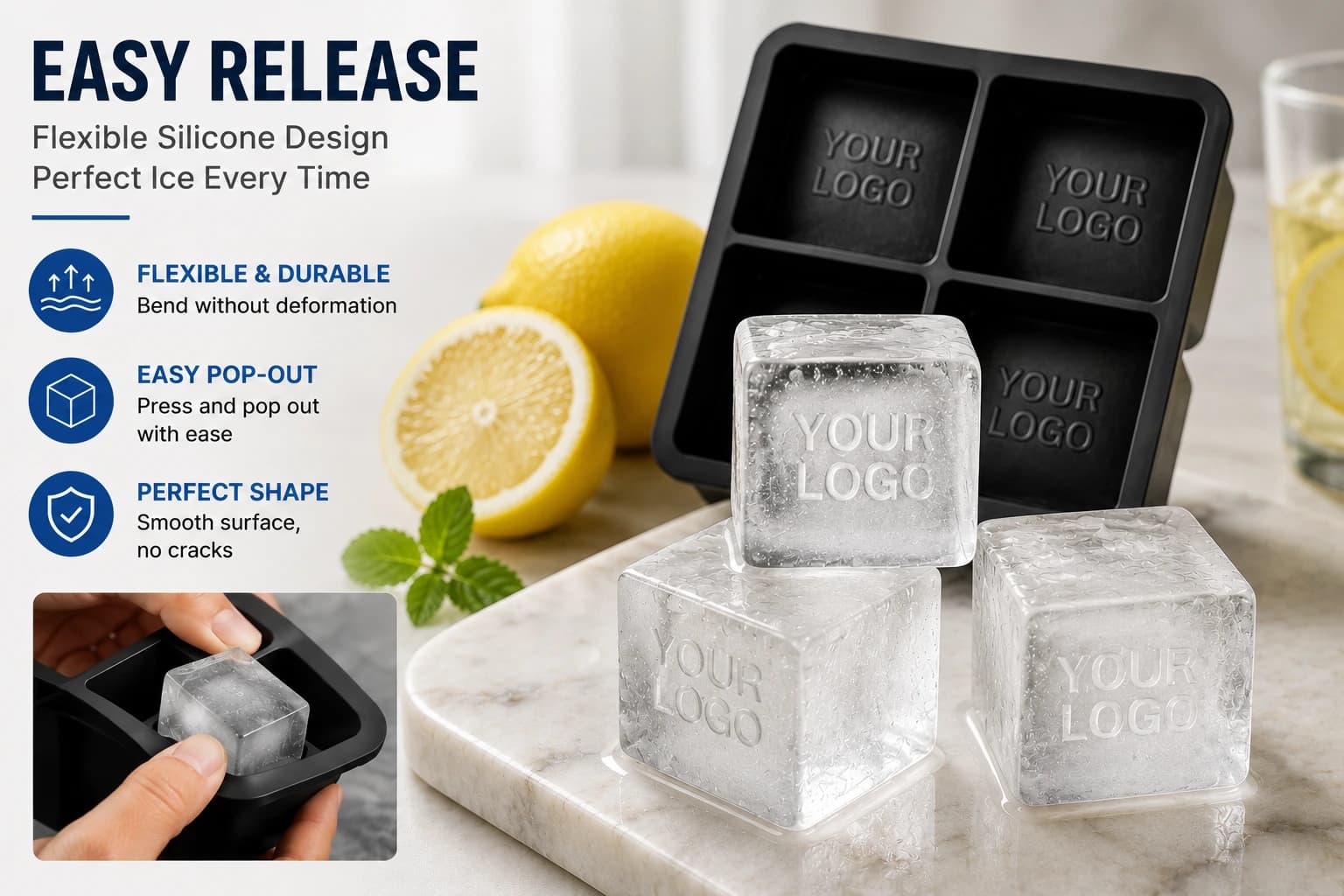
Logo ice molds convert a 2D artwork (company logo, monogram, symbol) into a recessed or raised impression on the surface of the ice cube. This requires the logo to be “drawn” into the bottom of the cavity. Key considerations:
For additional context on this decision, see Novelty Ice Cube Trays: How to Evaluate Shapes for Custom Production.
- Line width: Thin lines (under 1 mm) are hard to fill with silicone and may result in broken or incomplete impressions. Minimum recommended line thickness: 2 mm for a clear raised logo, 1.5 mm for recessed.
- Empty space areas: If the logo has enclosed loops (e.g., the letter “O” or “B”), the inner island needs to be anchored. This often requires small bridges or design modifications.
- Depth and direction: Logos are typically engraved (recessed) into the mold bottom so that the ice cube has a raised logo. The depth should be 0.5–1.0 mm; deeper may cause air bubbles.
Example: A skull ice cube tray with a brand logo on the forehead combines two complex shapes. In such cases, the logo area must be positioned where the mold wall is thickest and simplest to demold—usually the flat top of the skull cavity.
4. The Manufacturing Process: From Design to Sampling
Understanding the process helps you anticipate which shapes are easy and which require rework. The typical OEM/ODM workflow for custom silicone ice molds at Renjia [K1] follows these stages:
- Design file review: CAD or STP file submitted. The manufacturer checks cavity geometry, draft angles, wall thickness, and undercuts. They flag potential demolding issues.
- Tooling (mold) creation: A steel or aluminum mold is machined with the negative cavity. Complexity of the shape determines tooling cost and time. A simple heart cavity may cost 30–50% less than a detailed skull cavity.
- Sampling: First samples are produced in food-grade silicone. The manufacturer tests demolding by hand and checks ice cube clarity. If the shape releases with tearing or incomplete filling, design modifications are made.
- Cavity count adjustment: For multi-cavity trays (e.g., 4-cavity skull, 8-cavity heart), the arrangement must fit within the standard tray dimensions. Renjia mentions custom sizes available [K5], but larger arrays increase the risk of uneven filling.
Lead time: Simple shapes: 15–20 days for sampling; complex shapes: 25–35 days. MOQ typically ranges from 500 to 2000 pieces per design for custom cavities [K3].
Before finalizing the specification, use Logo Detail in Custom Ice Molds: Line Width, Depth, and Readability as an additional planning reference.
5. Key Considerations Table: Shape Feasibility Overview
| Shape Type | Manufacturability Rating | Main Risk | Recommended Adjustments |
|---|---|---|---|
| Simple heart | High | Sharp cleft | Round inner corner to R2 or more |
| Standard skull (stylized) | Medium-High | Eye sockets, jaw | Shallow sockets, smooth jaw contour |
| Detailed skull (realistic) | Low-Medium | Undercuts, teeth | Use two-part mold or omit fine details |
| Logo (simple text/symbol) | High | Thin lines | Minimum line width 2 mm |
| Logo (complex with enclosed spaces) | Medium | Floating islands | Add supporting bridges or modify |
| Combination: Skull + Logo | Low-Medium | Overlapping complex features | Logo on flat forehead; keep overall depth moderate |

Note: Ratings are based on typical single-cavity or 4–8 cavity trays with platinum-cured food-grade silicone. Multi-cavity high-volume molds (12+ cavities) lower feasibility for complex shapes unless specially engineered.
6. FAQ
Q1. Can I make a skull ice cube tray with my company logo on each skull?
Yes, provided the logo is positioned on a relatively flat area such as the forehead or the base of the skull. The logo details must meet minimum line thickness requirements (2 mm for raised impressions). Expect slightly higher tooling costs and a longer sampling stage to ensure the logo is clearly transferred without bubbles or tearing.
Q2. What is the minimum wall thickness between cavities in a multi-cavity skull ice cube tray?
This depends on cavity shape and silicone hardness. A general rule: maintain at least 3–4 mm of silicone wall between adjacent cavities. For highly detailed skulls, a thicker wall (5–6 mm) is recommended to prevent interconnect tears. The manufacturer’s engineering team will calculate this based on your specific design file.
Q3. Are skull ice cube trays food-safe? Do they comply with regulations?
Reputable OEM/ODM manufacturers like Renjia use food-grade silicone that is odorless and temperature resistant from -40°C to 240°C [K5]. For market-specific compliance (e.g., FDA, EU 1935/2004, LFGB), confirm with the manufacturer that the material grade and production process meet your target region’s regulations. Do not rely on generic claims; request test reports for each production batch.
Q4. What is the typical MOQ for a custom skull ice cube tray?
Based on Renjia’s standard custom silicone mold projects [K3], MOQ for a custom cavity design usually starts at 1,000 to 2,000 units per design. Some manufacturers accept 500–1,000 units for simple shapes. For complex skull shapes with logos, expect MOQ at the higher end due to tooling setup costs.
7. Conclusion
A skull ice cube tray, a heart mold, or a logo ice tray each presents unique manufacturability challenges. The key to a successful custom silicone ice mold lies in understanding the geometry limits of the shape: draft angles, undercuts, thin features, and cavity depth. Simple stylized shapes with rounded corners and shallow detail are the most cost-effective and reliable. Complex realistic skulls with deep sockets, teeth, and logos require design modifications and higher upfront investment in tooling and sampling.
For buyers sourcing custom ice molds, the recommended next step is to provide a detailed 3D file (STP or STEP) to a silicone OEM/ODM manufacturer like Renjia [K1] for a free design review. They will assess cavity-by-cavity manufacturability, suggest specific adjustments, and provide a timeline and cost estimate based on your chosen shape. A properly engineered mold not only produces beautiful branded ice but also lasts through hundreds of freeze–release cycles without tearing—turning a novelty concept into a durable, profitable product.