Key Takeaways
- Most modern "rubber" ice trays are actually TPR, TPE, or silicone — true vulcanized rubber is rare in consumer ice trays. The material spec sheet matters more than the marketing word on the box.
- Silicone generally releases ice more reliably because it combines high flexibility at freezer temperatures with a low-surface-energy cavity wall, but cavity geometry and wall thickness often decide success more than the material name alone.
- Rubber-style and TPR trays can be cost-effective and adequate for light use, yet they tend to stiffen in the freezer, deform over repeated twisting, and carry a higher risk of odor retention if the grade is unverified.
- Buyers sourcing at volume should verify material composition, food-contact test scope, MOQ, tooling cost, and sampling lead time before quoting — supplier raw-material reports are not the same as finished-product certification [K4].
- The practical answer: choose silicone for effortless single-cube release and temperature range, choose TPR or rigid trays when budget, stacking, or clarity matters more than pop-out convenience.
1. Introduction
Few kitchen annoyances are as disproportionate as a stuck ice cube. You twist the tray, water sloshes, a cube shoots across the counter, and half the tray still refuses to let go. Over time the tray cracks at the corners, absorbs a faint freezer smell, or turns brittle enough that the release lever snaps off entirely.
That experience is why easy release has become the deciding feature in tray shopping — and why the rubber-versus-silicone question keeps resurfacing. The confusion is understandable: both materials flex, both are marketed with the same language, and both appear in nearly identical product photos. In practice, the two are different material families with different behavior at -18°C, different odor profiles, and different cost structures at scale.
This article separates the two, explains what actually drives release performance, and gives practical guidance for both home users hunting for awesome ice trays and buyers developing a custom ice mold program. Where a claim depends on a specific product specification, it is flagged as something to verify rather than assumed.
2. What "Rubber" and "Silicone" Actually Mean in an Ice Tray
Core conclusion: the word "rubber" on an ice tray listing is usually a description of feel, not a statement of chemistry — and that distinction changes how you judge durability and food-contact safety.
Classic flexible trays were made from rubber or soft PVC. Modern equivalents are far more likely to be thermoplastic rubber (TPR), thermoplastic elastomer (TPE), or silicone. TPR and TPE are thermoplastic: they soften when heated, which makes them cheap to injection mold in high volumes. Silicone is thermoset: once cured, it does not melt, which is why silicone molds survive oven and dishwasher heat cycles that would deform a thermoplastic tray.
That structural difference shows up in three practical places:
- Heat tolerance. Food-grade silicone is commonly rated across roughly -40°C to 200°C and beyond, which is why the same mold can go from freezer to oven. Confirm the actual range on the supplier's datasheet rather than the listing text.
- Plasticizer risk. Flexible PVC requires plasticizers to stay soft; silicone does not. If a tray smells strongly of chemicals when unwrapped, that is a signal to check the material spec, not to trust the word "rubber."
- Deformation memory. Thermoset silicone returns to shape after twisting; thermoplastic trays gradually crease and thin at the twist points.
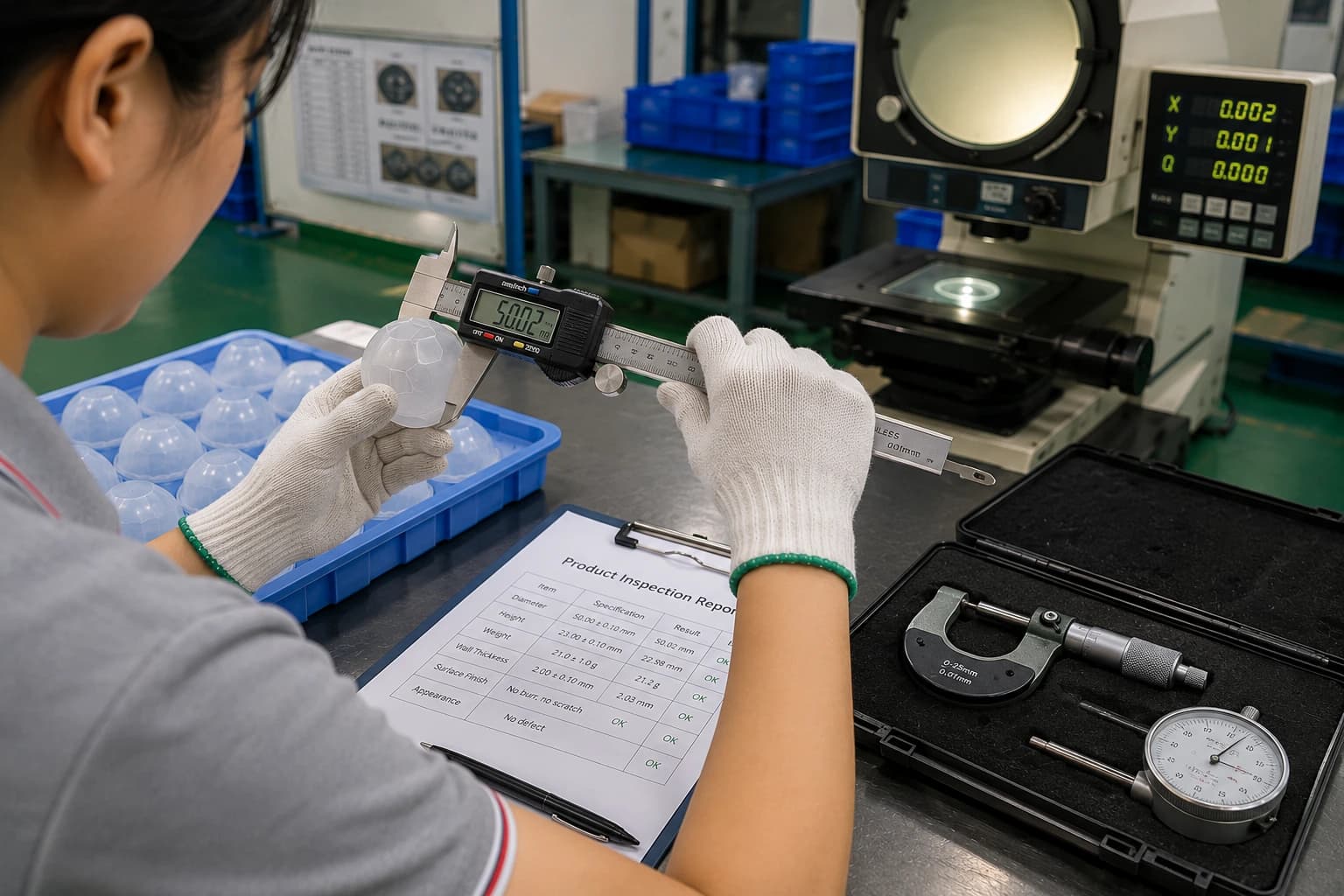
For buyers building a product line, this is where documentation beats adjectives. A supplier that can name the material model, share test scope, and separate raw-material evidence from finished-goods certification is a more reliable partner than one that simply labels a tray "food-grade rubber." Renjia's own portfolio treats ice molds as a cross-category item — household, kitchen, and promotional — and explicitly warns that category placement should not limit how a product is positioned in content or sales [K1][K3].
If your roadmap includes a branded tray or a full custom silicone ice mold program, start by requesting the material specification and cavity drawings before discussing price.
3. Release Mechanics: Why Flexibility Alone Does Not Guarantee Easy Release
Core conclusion: easy release is a geometry problem as much as a material problem — silicone gives you more forgiving geometry, but a badly designed silicone cavity will still grip ice.
Water expands by roughly 9% when it freezes. A tray cavity must therefore accommodate that expansion without locking the cube in place. Three design variables do most of the work:
- Draft angle and bottom radius. Slightly tapered walls and a rounded bottom let the cube break contact progressively instead of releasing all at once.
- Wall thickness and web design. Thin, evenly balanced walls flex predictably; thick, uneven walls create stiff zones where cubes stick.
- Cavity spacing. Generous bridges between cavities let you push or twist one cube without disturbing its neighbors.
This is where silicone separates itself. Because silicone stays elastic at freezer temperature, a single downward push on the base releases one cube cleanly — the "push-pop" motion that most people associate with awesome ice trays. TPR trays can do this when new, but they stiffen in the cold and lose elasticity faster under repeated twisting. Rigid trays rely on a lever or a twist-and-flex motion, which works well for stacking and clarity but demands more force and tends to crack at stress points over time.
Scenario-based guidance:
- Home bar, cocktails, one-handed use: silicone push-pop trays with individual cavities are the most forgiving.
- Batch freezing and stacking in a tight freezer: rigid trays with a lid stack better and resist spillage during transport.
- Large-format cubes for whisky: silicone molds dominate here because a 5 cm cube in a rigid tray requires excessive force to release.
- High-volume promotional giveaways: TPR and thin silicone both work, but specify wall thickness, because the cheapest variants are the ones that fail first in a customer's freezer.
4. Taste, Odor, Temperature Range, and Durability
Core conclusion: material quality shows up in the second month of use, not the first — odor retention and surface degradation are the real long-term costs.
Silicone is chemically inert and does not require plasticizers, so it has a low risk of transferring taste. The caveat is that silicone is slightly permeable to odors: an uncovered mold stored next to strong-smelling food in the freezer can pick up aromas. This is manageable — wash before first use, air out, and store covered — but it is a real characteristic, not a marketing flaw.

Rubber-style thermoplastic trays vary much more widely by grade. Low-cost TPR can carry a residual odor from processing, and repeated freeze-thaw cycles accelerate surface dulling, which in turn makes release harder. Neither material should be assumed dishwasher-safe by default; heat and detergent exposure vary by formulation, so confirm the manufacturer's stated care instructions.
Durability comparisons that hold up in practice:
| Factor | Silicone mold | TPR / "rubber" tray | Rigid plastic tray |
|---|---|---|---|
| Flexibility at -18°C | High, consistent | Moderate, stiffens over time | None (requires lever) |
| Release effort per cube | Low (push-pop) | Moderate | Moderate to high |
| Heat tolerance | Typically freezer-to-oven | Freezer and cool rinse only | Freezer only |
| Odor retention risk | Low, with minor aroma pickup | Medium to high, grade-dependent | Low |
| Deformation after repeated twisting | Minimal | Creasing at flex points | Cracking at stress points |
| Relative unit cost at volume | Higher | Lower | Lowest |
| Best fit | Home bar, large cubes, dual-use molds | Budget retail, giveaways | Stacking, clarity, bulk service |
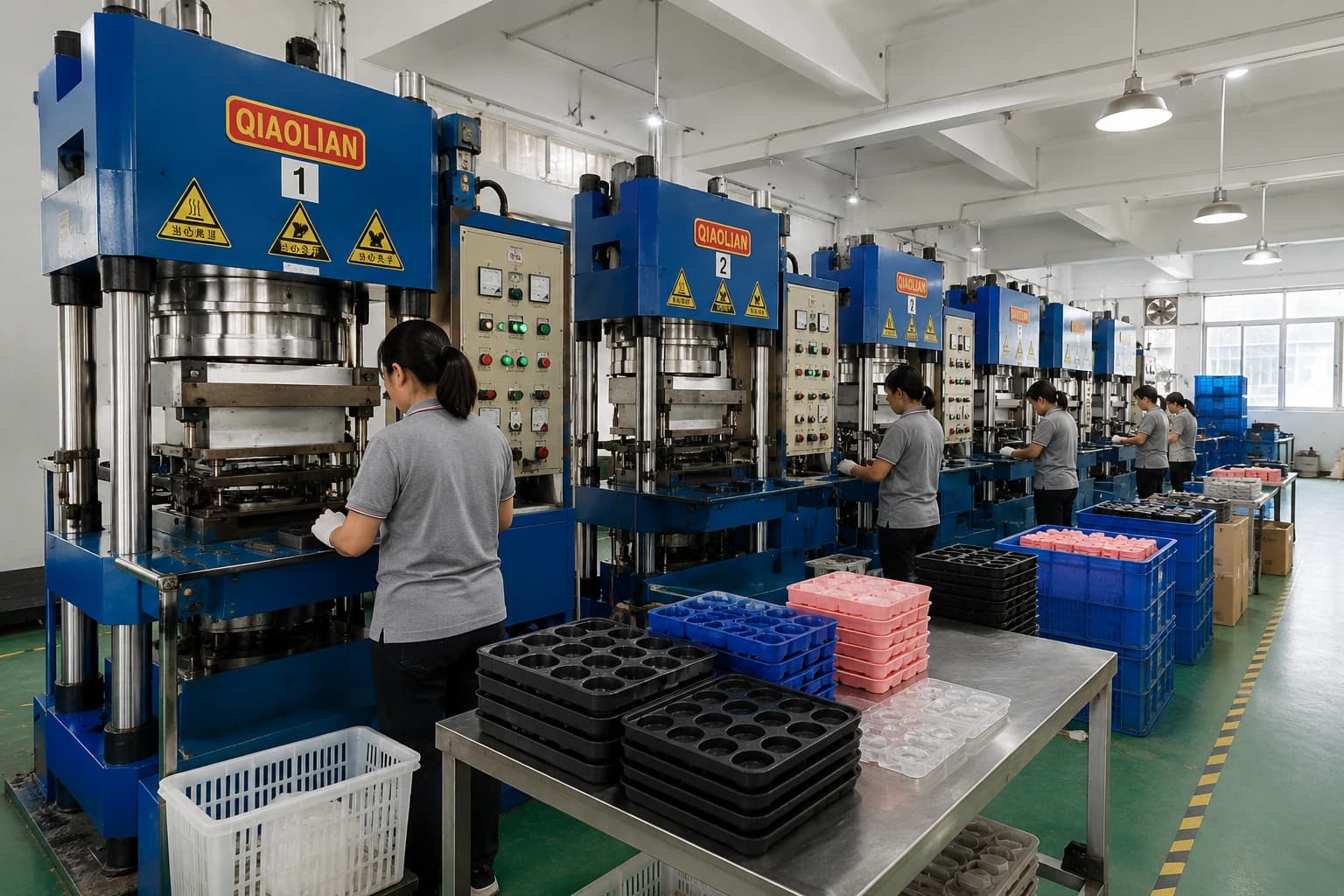
For promotional and retail programs specifically, ice cube trays and ice ball trays sit alongside popsicle molds and soap molds in the same flexible-mold manufacturing family, which means a single tooling and sampling process can often cover several SKUs [K1].
5. Buying for Business: Customization, Compliance, and What to Verify
Core conclusion: at commercial volume, the material debate matters less than the documentation and the sampling discipline behind it.
Custom silicone ice mold projects typically cover cavity design, product shape, size, color, logo, and packaging [K2]. A realistic development sequence runs from design-file review, through tooling and sample approval, to production and pre-shipment inspection — with MOQ and lead time set by cavity count, mold complexity, and packaging format [K5].
On compliance, the boundary conditions matter. Renjia's reviewed evidence set covers a 2026 SGS test scope for supplier silicone-rubber material models ZY-HTV and ZY-4452, including selected US FDA 21 CFR 177.2600 total-extractives testing, EU/German food-contact requirements, EN 71-3 Category III, EU RoHS, REACH SVHC, PFAS-list, and POPs scopes [K4]. Crucially, those are supplier raw-material reports — they do not establish that every finished product, color, or production lot has been tested or certified [K4]. Any product page or quotation should state exactly what has been tested and at which level.
Before placing an order with any silicone OEM/ODM manufacturer, work through this checklist:
- Material model name and datasheet, not just "food-grade silicone."
- Test reports with report number, lab, date, and the specific scope covered.
- Cavity drawing with draft angle, wall thickness, and cavity volume.
- Sample approval criteria: release force, dimensional tolerance, surface finish, odor check.
- Packaging artwork files and dieline confirmation before mass production.
- Written MOQ, tooling ownership terms, and production lead time.
6. Key Comparison / Method / Considerations
Use this decision method rather than a single "best material" rule:
- Define the release motion first. Push-pop from the base → silicone. Twist-and-flex → silicone or TPR. Lever → rigid.
- Set the temperature envelope. Freezer-only allows TPR. Freezer plus oven or dishwasher heat cycles points to silicone.
- Check cube size. Cubes above roughly 4–5 cm almost always need a flexible mold.
- Test odor and staining. Soak a sample, freeze it repeatedly, and smell it. This is the fastest quality filter available to a buyer.
- Confirm compliance scope in writing. Match the claim to the report, and never upgrade a raw-material report into a finished-product certification [K4].
- Verify current availability before publishing. Portfolio diagrams show reported product architecture, not guaranteed stock, dimensions, MOQ, or market-specific availability — confirm before quoting [K3].
7. FAQ
Q1. Are silicone ice trays better than rubber trays for easy release?
In most cases, yes — silicone stays flexible at freezer temperatures and returns to shape after repeated twisting, so cubes release with less force. However, cavity design, draft angle, and wall thickness can outweigh material choice, and a poorly molded silicone tray will still grip ice.
Q2. Does silicone make ice taste rubbery?
Food-grade silicone is chemically inert and does not require plasticizers, so taste transfer is unlikely. Silicone can absorb surrounding odors if stored uncovered in a crowded freezer, which is why washing and covered storage are recommended. Strong chemical smells on a new tray usually indicate an unverified material grade rather than silicone itself.
Q3. Can I put silicone ice molds in the dishwasher or oven?
Often yes, but not automatically. Heat tolerance depends on the specific formulation, so confirm the manufacturer's stated temperature range and care instructions. Never assume dishwasher or oven suitability from the word "silicone" alone.
Q4. What should I confirm before ordering custom ice trays at volume?
Confirm material model and test scope, cavity drawing and sample approval criteria, MOQ, tooling terms, packaging artwork, and lead time. Treat raw-material test reports as raw-material evidence only — they are not proof that each finished lot is certified [K4].
8. Conclusion
For most people who simply want ice that lets go on the first push, silicone is the stronger choice: it holds flexibility in the freezer, tolerates heat cycles, resists deformation, and supports the cavity geometry that makes release effortless. Rubber-style TPR trays remain a legitimate budget option for light use and giveaways, provided the grade is verified and the walls are thick enough to survive repeated twisting. Rigid trays keep their place where stacking and cube clarity outrank pop-out convenience.
The final judgment is less about material tribalism than about matching material to use case — and, for buyers, matching claims to documentation. If you are evaluating awesome ice trays for retail, promotional, or private-label programs, request the material spec and test scope first, approve a physical sample second, and only then discuss pricing and volume.