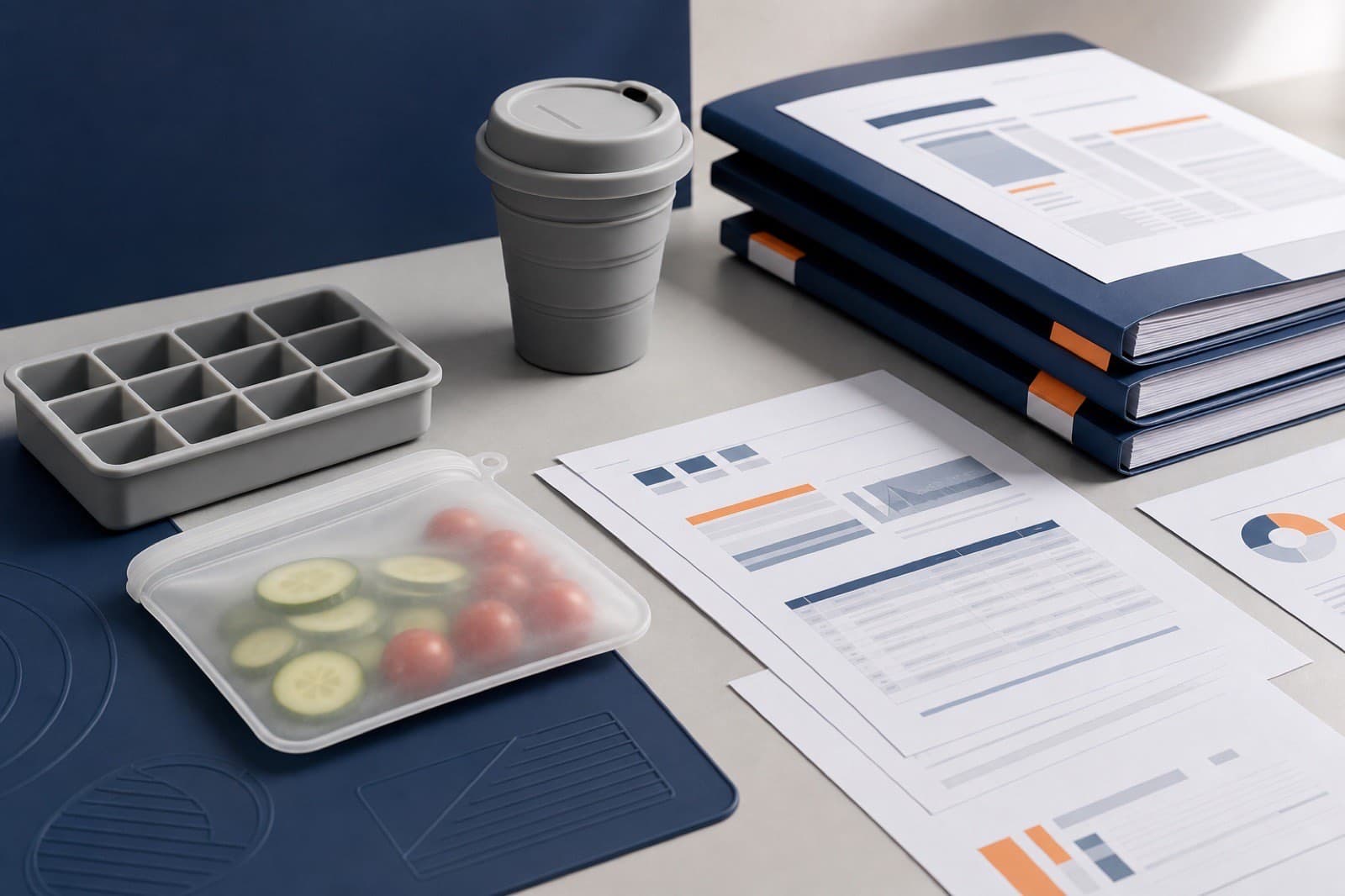
Silicone product buyers often receive a folder containing an FDA report, an LFGB report, EN 71 results, a CPC or a RoHS document. The difficult question is not whether the files exist. It is whether each file applies to the exact product, material, market and shipment being purchased.
The safest approach is to build a document package from the product outward. First define the product and intended use. Then identify the legal requirements for the destination market. Finally, match every test report, declaration and certificate to the current design, bill of materials and responsible business.
This guide explains what the common document names usually mean, what they do not prove and what a buyer should verify before approving a custom silicone order.
Short answer: what compliance documents should a silicone product buyer request?
Request documents that match the finished product, intended use and destination market—not a generic bundle of certificates. The package may include raw-material reports, finished-product test reports, a declaration or certificate issued by the legally responsible party, traceability information and current production records. A report for one silicone grade or private-label sample does not automatically cover another color, component, design or production period.
1. Start with product classification, not a certificate list
The phrase “silicone product” does not define a regulatory route. An ice tray used with food, a drawing mat marketed as a toy, a promotional bracelet and an electronic product containing a silicone component can fall under different requirements.
Before asking a supplier for “all certificates,” document:
- Product name, model and current drawing revision.
- Intended user and age grading.
- Intended use, including food-contact and repeated-use conditions.
- Every material, color, ink, coating, adhesive and accessory.
- Retail packaging, warnings and instructions.
- Destination country and sales channel.
- Importer, brand owner or other legally responsible party.
This is also why a clear customization brief improves compliance planning. A change in printing, colorant, accessory or intended age group may change the evidence needed for the order.
2. Separate raw-material evidence from finished-product evidence
Raw-material reports can be valuable. They may show how a submitted silicone-rubber grade performed under a specified food-contact, migration or restricted-substance test. They do not show that every part of a finished product was assessed.
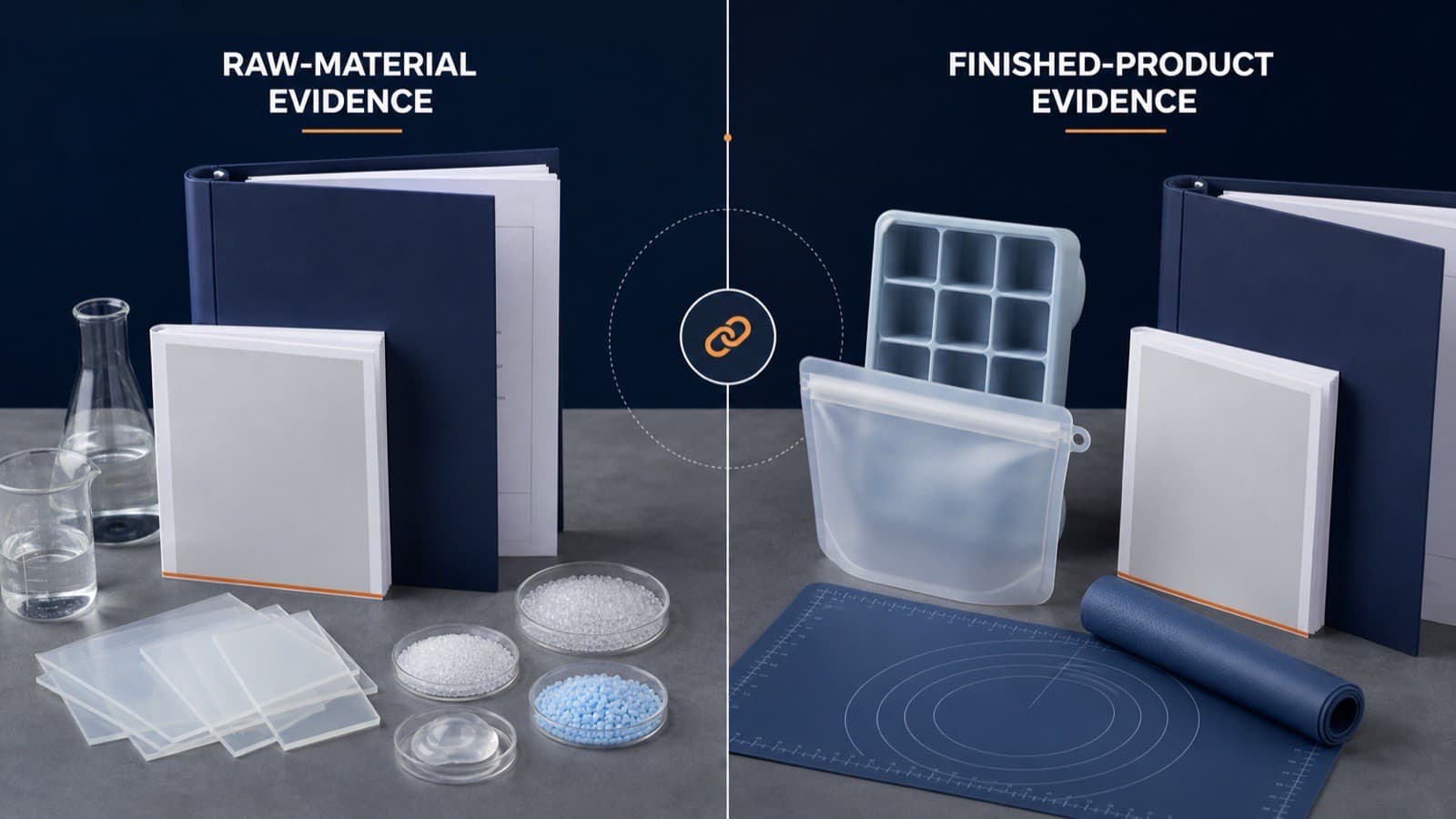
AI-generated editorial illustration. It explains the evidence layers and is not a laboratory record.
A finished silicone item can include color masterbatch, printing ink, a lid, plastic components, metal parts, adhesive, packaging and other materials. Processing and final geometry can also affect the applicable evaluation. The evidence package should therefore be reviewed in layers:
| Evidence layer | What it may support | What the buyer still needs to verify |
|---|---|---|
| Raw-material report | A specified submitted material and listed test scope | Supplier, grade, colorants, additives, lot traceability and relevance to the order |
| Component report | A defined ink, accessory or other component | Whether the tested component is actually used and whether integration changes the risk |
| Finished-product report | The identified sample under the listed methods and conditions | Whether mass production matches the tested sample and whether all applicable requirements were included |
| Declaration or certificate | A responsible party's statement for an identified product | Issuer, legal basis, supporting records, dates and shipment/product traceability |
Renjia maintains selected third-party reports for specified raw-material grades and submitted product samples. They are reviewed project by project through the quality and documentation process; they are not presented as universal approval for every product.
3. What an “FDA silicone report” usually means
“FDA certified silicone” is common marketing language, but it is usually too broad. For repeated-use rubber articles, a laboratory report may test a submitted material or product against conditions in 21 CFR 177.2600. The report should identify the submitted sample, extraction conditions, test method, results and conclusion.
For a buyer, the important questions are:
- Was the submitted object a raw material, a component or the finished article?
- Does the report cover the exact silicone grade and formulation used for the order?
- Were the food type, time, temperature and repeated-use conditions relevant to the intended product?
- Are all non-silicone components and colorants addressed?
- Has the product or material changed since testing?
A passing result can support a controlled statement such as “the submitted sample passed the test scope stated in the report.” It should not be rewritten as “FDA approved,” “all products are FDA certified” or “safe for every food-contact use.”
For example, a selected Renjia material evidence file covers a submitted ZY-HTV silicone-rubber sample tested for total extractives under the cited 21 CFR 177.2600 scope. Separate product-specific reports exist for certain submitted storage-bag samples. Neither type of report should be transferred to a different finished product without matching the current specification.
4. What buyers call an “LFGB certificate”
LFGB is Germany's Food, Commodities and Feed Code, not the name of one universal silicone certificate. A laboratory may perform a food-contact test program based on German, EU or recognized technical recommendations and report the conditions and results.
The European Commission explains that food-contact materials placed on the EU market must comply with Regulation (EC) No 1935/2004 and applicable good manufacturing practice and material-specific or national rules. For silicone, buyers should therefore review the exact legal and technical basis proposed for the product and destination—not rely on the letters “LFGB” alone.
Check the sample description carefully. A file name may describe a baking mold while the report itself identifies only a submitted silicone material. Public and sales wording should follow the report, unless traceability confirms the exact finished-product link.
Renjia has a 2026 third-party food-contact report for a submitted silicone material sample that records passing conclusions for the listed program and stated conditions. It is useful evidence for project review, but it is not universal LFGB certification for every custom silicone ice mold, color or food-contact application.
5. EN 71 reports: identify the part, category and product
EN 71 is a family of toy-safety standards. A report should state the exact part and edition tested. Common examples include mechanical and physical properties, flammability and migration of certain elements. Passing one part does not establish that every applicable requirement for a finished toy has been addressed.
For any silicone item intended or marketed for children, verify:
- Whether the product is legally classified as a toy in the destination market.
- The intended age grading and foreseeable use.
- Which EN 71 parts and other requirements apply.
- Whether printing, coatings and every accessible component were included.
- Whether the tested style, color and artwork match the current product.
- Whether the technical documentation and declaration required for market placement are complete.
A submitted Renjia silicone drawing mat sample covering styles LCW01, LCW02 and LCW03 passed the EN 71-1, EN 71-2 and EN 71-3 scopes listed in BACL report 2601P04704E, issued January 15, 2026. This evidence applies to the identified submitted sample and report scope. It does not automatically cover every future artwork, ink, color or production change.
EU toy legislation and harmonized-standard references can change. The buyer and responsible economic operator should confirm the current legal framework and applicable standards when the product is placed on the market.
6. A CPC is issued by the responsible business—not the laboratory
A US Children's Product Certificate is frequently confused with a lab certificate. The US Consumer Product Safety Commission's CPC guidance states that the domestic manufacturer or importer certifies the identified children's product based on the required supporting evidence, including third-party testing by a CPSC-accepted laboratory where required.
The laboratory supplies test results. It does not issue the CPC. A CPC identifies the product, applicable rules, certifying business, record keeper, manufacturing and testing information and the relevant CPSC-accepted laboratory.
That means an existing customer CPC cannot simply be reused for:
- A different importer or certifying business.
- A different private-label brand or model.
- A changed design, material, age grading or component set.
- A production period that is not covered by its traceability information.
- A product whose applicable rules were not included.
There is also a current operational change for US importers: as of July 8, 2026, CPSC says importers of most regulated consumer products must electronically file certificate data before the products enter US commerce. Buyers should coordinate certificate data with their importer and customs workflow before shipment.
7. RoHS evidence does not create a general “CE certificate”
The EU RoHS Directive restricts specified hazardous substances in electrical and electronic equipment. Its official scope is described in Directive 2011/65/EU. A silicone household product with no electrical or electronic function may not fall within that scope, while a silicone component used in electrical equipment may need to be considered as part of the finished equipment's compliance assessment.
A RoHS report should therefore be checked for:
- Whether RoHS applies to the finished product.
- Which homogeneous material was tested.
- Which substances and limits were included.
- Whether all relevant materials and components were assessed.
- The current directive amendments and exemptions.
A report showing that one submitted sample passed a listed RoHS scope is not, by itself, a complete CE conformity assessment. File names and seller labels can be misleading; the substance and scope of the report control the claim.
8. Build the compliance file before production approval
Compliance planning should happen before the final sample and packaging are frozen. Late testing can uncover a classification issue, missing warning, unsuitable component or importer responsibility when tooling and printed materials are already committed.
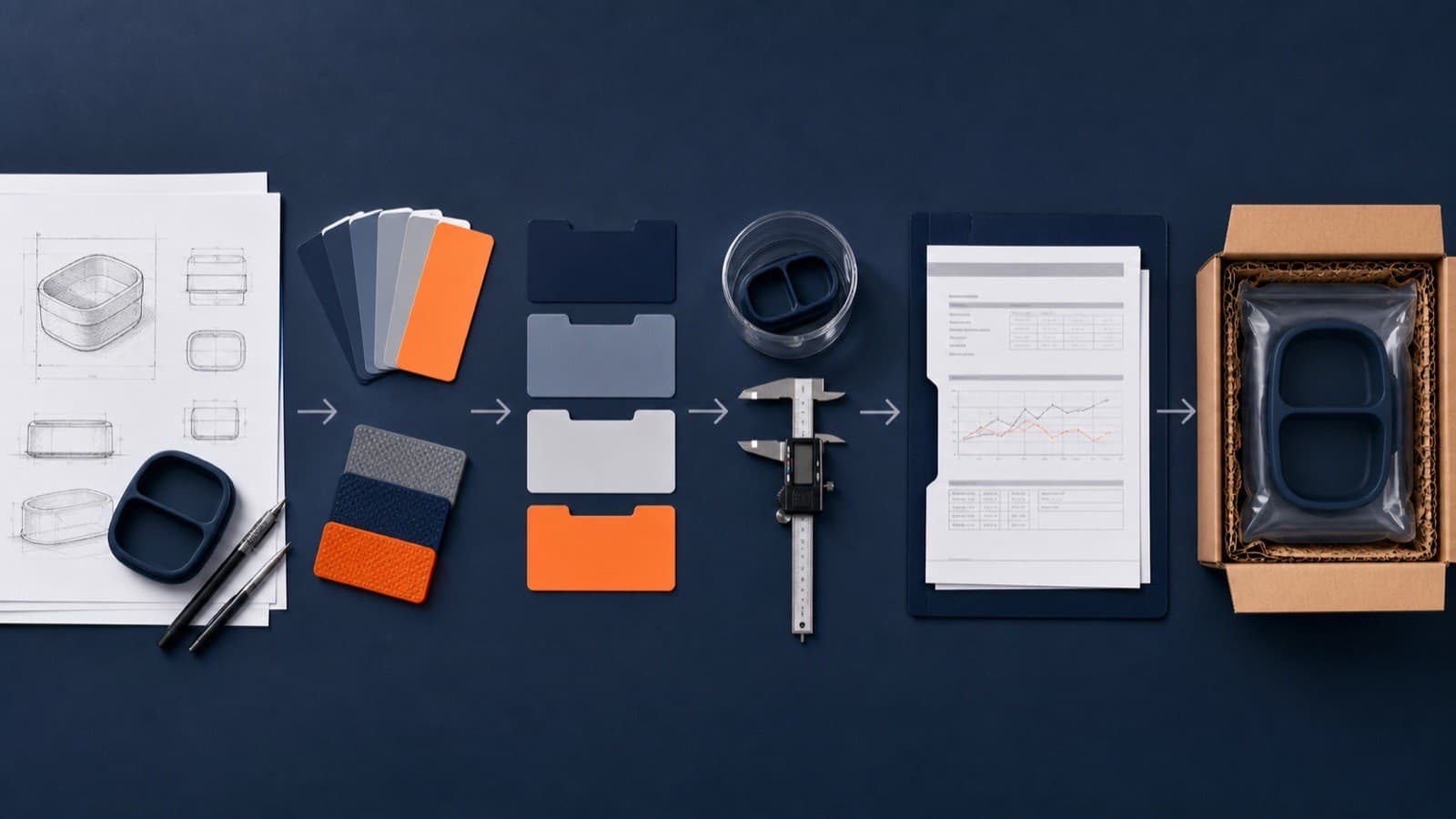
AI-generated editorial illustration. Actual testing and documentation depend on the product and market.
Use this practical sequence:
- Freeze the intended use and market. Record food-contact conditions, age grading, sales claims and destination.
- Create the bill of materials. Include silicone grade, colorants, inks, coatings, accessories and packaging where relevant.
- Map applicable requirements. Have the responsible importer, brand owner or qualified adviser confirm the current rules.
- Review existing evidence. Match report numbers, samples, suppliers, dates and test scopes to the product.
- Close the evidence gaps. Arrange component or finished-product testing where existing records are not sufficient.
- Approve the final sample and files. Connect test evidence to the same revision used for mass production.
- Prepare declarations and certificates. The legally responsible party issues the required documents using accurate supporting information.
- Maintain traceability. Keep production, lot, change-control and shipment records so the evidence can be matched later.
The sample approval and pre-shipment inspection checklist provides the next control layer after the specification and evidence plan are defined.
9. Use a report-matching checklist for every order
Before accepting or publishing a compliance claim, ask:
- Does the product name and style match?
- Does the tested material grade match the current purchase and production record?
- Are color, printing, coating, accessories and packaging unchanged?
- Is the intended use and age grading the same?
- Do the test conditions match the intended application?
- Is the destination market the same?
- Is the standard edition and regulatory reference still current?
- Does the report cover all applicable requirements or only one scope?
- Is the certificate or declaration issued by the correct responsible party?
- Can the document be shared without exposing customer data or confidential supplier information?
If one answer is uncertain, describe the evidence narrowly and close the gap before production or shipment. A precise statement builds more buyer trust than a long but mismatched certificate list.
Frequently asked questions
Is silicone FDA certified?
FDA does not issue a universal certificate for every silicone product. A laboratory report may show that a submitted material or article passed a specified test scope such as 21 CFR 177.2600 under stated conditions. The buyer still needs to confirm finished-product applicability.
Is an LFGB test report valid for every silicone color?
Not automatically. Colorants and other formulation changes can affect the evidence match. Confirm that the tested sample and current production formulation are equivalent and whether additional testing is required.
Does EN 71-3 mean a product is fully compliant as a toy?
No. EN 71-3 addresses migration of certain elements. Product classification, other applicable EN 71 parts, documentation, labeling and current legal requirements must also be reviewed.
Can a Chinese factory issue a CPC for a US importer?
For an imported children's product, the US compliance responsibility and certificate details must follow current CPSC rules. The laboratory does not issue the CPC, and an importer cannot treat another customer's CPC as its own certificate.
Does a RoHS report prove CE compliance?
No. RoHS may be one applicable legal scope for electrical or electronic equipment, but a RoHS report alone does not establish a complete CE conformity assessment or cover unrelated product requirements.
Final buyer takeaway
Do not evaluate silicone compliance by counting PDF files. Evaluate whether the evidence forms a traceable chain from the current product and material to the applicable market requirements, responsible business and production order.
When sending an RFQ, include the destination market, intended use, user age, product drawing, bill of materials and any retailer-specific requirements. Renjia can then identify which existing material or sample reports may be relevant, what cannot be transferred and where new product-specific testing should be discussed.