Key Takeaways
- Sphere and small ice ball molds are two different tools: large spheres suit slow sipping in wide glasses, while small balls chill faster and fit smaller pours.
- Bigger, rounder ice has less surface area relative to its volume than a scatter of small cubes, so it typically dilutes a dram more gradually — but freezing technique matters as much as shape.
- Silicone is popular for home use because flexible cavities release rounded shapes cleanly, and the same material platform supports branded, custom cavity designs for bars and retail programs [K1].
- Custom projects involve design review, sampling, tooling, and packaging decisions; MOQ, mold fees, and timelines should always be confirmed in writing for the specific project rather than assumed [K5].
1. Introduction
A whisky lover's ice problem is rarely about "cold." It is about control. Add too much ice, or ice that melts quickly, and a carefully chosen dram turns into a watery approximation of itself within ten minutes. Add one large, slow-melting piece, and the drink opens up gradually instead of collapsing.
That is why cocktail ice molds — particularly sphere molds and small ice ball molds — have moved from novelty bar gadgets into everyday home cabinets. The appeal is simple: a rounded, sizable piece of ice looks deliberate, chills efficiently, and melts at a pace that lets the drinker stay ahead of dilution. Silicone trays make that shape achievable without a commercial press or a chest freezer full of molds.
This article answers the practical questions behind that shift. What does a sphere actually do for a pour compared with cubes? Where does a small ice ball mold make more sense than a big sphere? What should a buyer — whether a home enthusiast or a bar operator planning a branded tray — check before ordering? Along the way, we separate what geometry genuinely explains from what is marketing gloss, and we flag the parts of custom sourcing that require confirmation rather than assumption.
2. Why Shape Changes the Pour: Surface Area, Melt Rate, and Dilution
Core conclusion: The reason large, rounded ice is prized in whisky is geometric, not mystical. A single large piece exposes less surface area to the liquid relative to its volume than the same amount of ice broken into small cubes, so it exchanges heat more slowly and releases meltwater more slowly.
Think of it as a ratio problem. Every piece of ice chills the drink through its surface, but meltwater enters the glass from that same surface. Split one large piece into eight small cubes and you multiply the exposed surface area while keeping the total mass roughly the same. More surface means faster chilling — which sounds good — but also a faster rise in water content, which is exactly what a spirit-forward drink can least tolerate.
Geometry also explains why "round" matters more than "big." A sphere has the smallest surface area of any shape enclosing a given volume, so a well-formed ball is the most efficient slow-release form available without machinery. A large cube is close, but its corners and edges melt first, and those edges are where dilution begins.
Practical implications for the home drinker:
- Match the ice to the glass. A 55–65 mm sphere in a narrow tumbler will sit awkwardly and chill less effectively than in a wide, heavy-bottomed rocks glass. If your glassware is small, a smaller ball is the better engineering choice.
- Pre-chill the glass, not just the ice. Ice melting is driven by temperature difference. A room-temperature glass forces the ice to work harder and melt faster; a chilled glass reduces that initial shock.
- Use colder, denser ice. Ice frozen slowly and stored cold melts more slowly than ice pulled straight from a just-filled tray. Whatever shape you choose, freeze it well ahead and let it temper briefly before use.
- Accept the trade-off. Fast chilling and slow dilution pull in opposite directions. Decide which one your drink needs: a high-proof cask strength pour often benefits from a slightly faster chill and a little water, while a delicate 12-year-old benefits from restraint.

For anyone planning a menu rather than a single drink, treat ice format as a specification with a job description, not as decoration. The format should be chosen to serve the spirit, the glass, and the serve time.
3. Silicone Sphere Molds: What Home Whisky Drinkers Actually Get
Core conclusion: A silicone sphere mold is the most accessible route to a large, slow-melting piece of ice at home. Its main advantages are clean release and low equipment cost; its main limitations are slower freezing and the need for a little technique to get clear, well-shaped results.
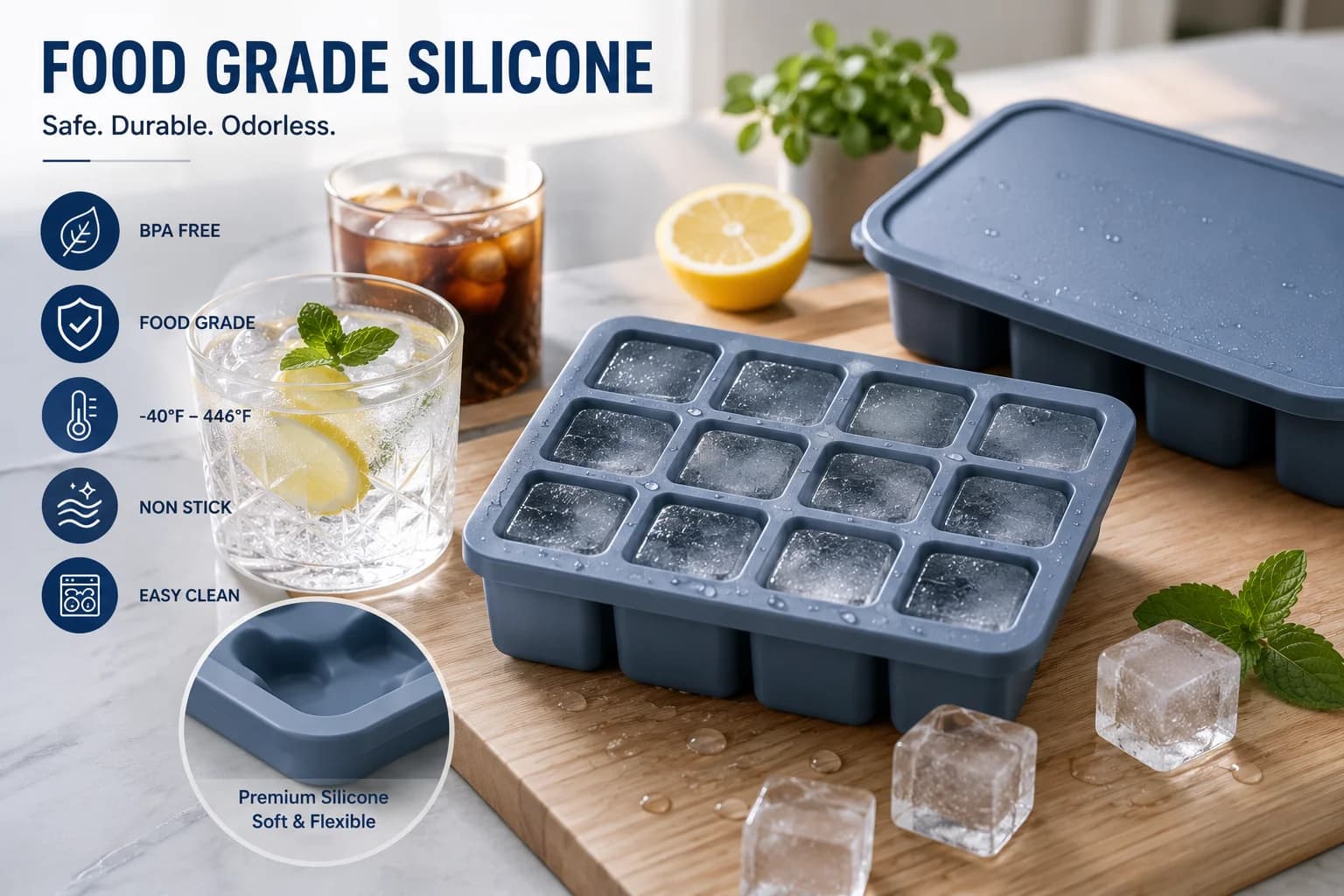
Flexible silicone solves the problem that rigid trays cannot: a full sphere has no draft angle, so a hard plastic mold would trap the ice. Silicone walls peel away from the frozen ball, which is why so many home sphere molds are silicone rather than rigid polymer [K1]. That flexibility also makes the molds stackable and forgiving to store.
The technique matters more than the tray:
- Fill with water that has been boiled and cooled, or filtered water. Dissolved air is the main cause of cloudy ice. Boiling drives off some gas; letting it cool before filling prevents the mold from warping.
- Fill slightly above the seam line if your mold is a two-part clamshell with a fill channel, then freeze flat so the halves stay aligned.
- Freeze for longer than you think. A large sphere has a long thermal path to the center. Plan overnight, and longer in a crowded freezer.
- Release with a brief rinse. Run the outside of the mold under cool water for a few seconds, then peel the halves apart. Warm water works faster but can craze the ice surface.
What a silicone sphere mold realistically will not do is guarantee perfectly transparent ice. Clarity depends on freezing direction and air content, and directional freezing usually requires an insulated setup. If crystal-clear spheres are the goal, buyers should look at directional-freezing systems rather than expecting a basic tray to deliver them.
For bars, retailers, and brand teams, the same silicone platform supports far more than a single stock sphere. Cavity design, product shape, size, color, logo placement, and packaging are all negotiable variables in a custom mold project, which is why ice molds commonly appear in both household and promotional product programs [K1][K2]. Buyers exploring that route can review custom silicone ice mold development options to understand which variables are decided at design review versus at sampling.
4. Small Ice Ball Molds: The Underrated Format
Core conclusion: Small ice ball molds are not a downgraded version of large spheres. They solve a different set of problems: faster freezing, better fit in small glassware, and more usable output per tray — which makes them especially practical for everyday drinking and for high-volume settings.
A small ball — roughly in the 30–45 mm range depending on the mold — sits comfortably in a standard tumbler, chills a modest pour quickly, and looks orderly rather than theatrical. Because the thermal path from surface to center is shorter, small cavities freeze in a fraction of the time a large sphere requires, which means a tray can be cycled more often. For a household that drinks two or three pours a week, that difference in turnaround is the whole practical argument.
Small balls also behave better in specific serve contexts:
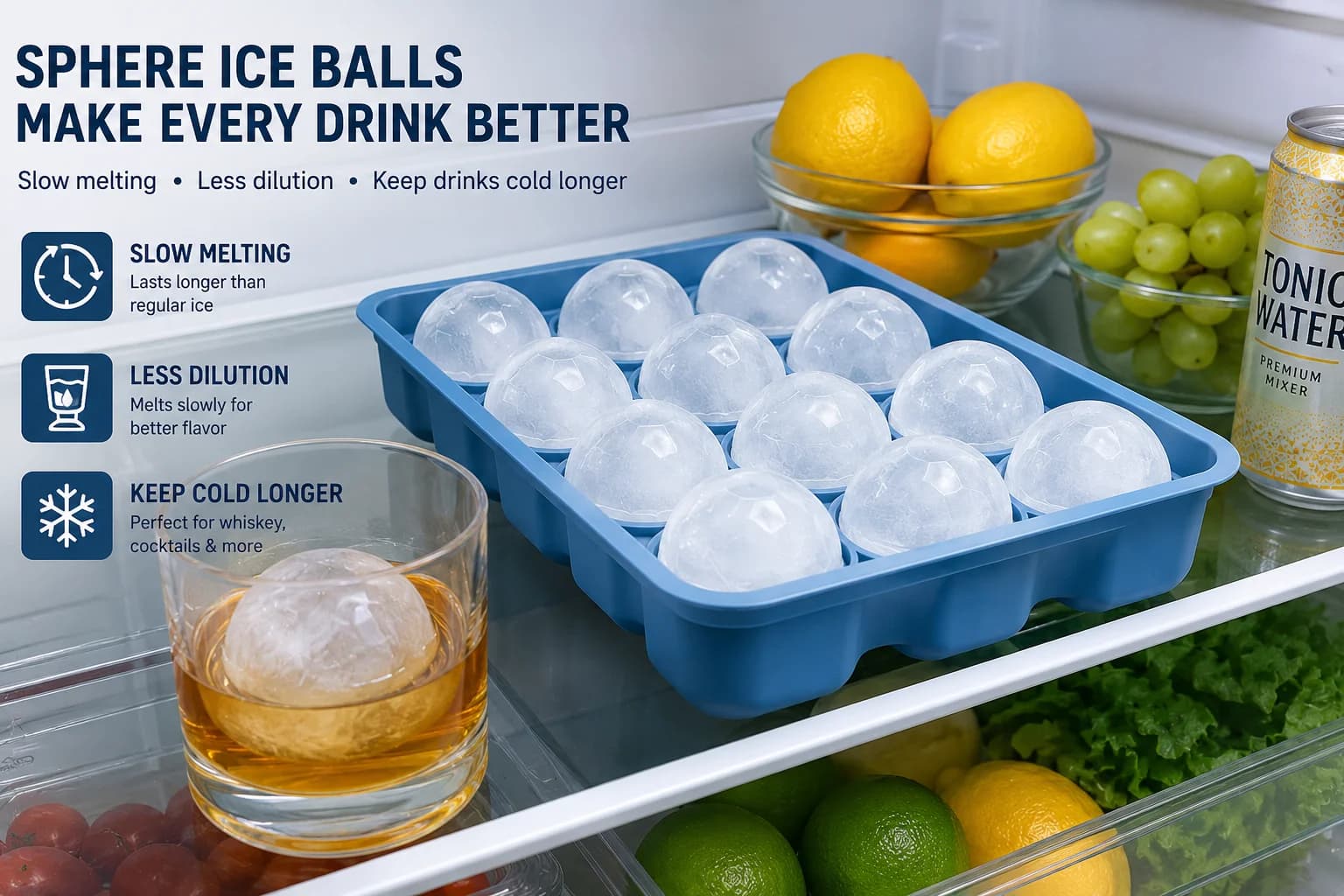
- High-proof spirits on the rocks. A smaller piece delivers a controlled amount of dilution, which is often welcome with cask-strength whisky and less welcome with a delicate one.
- Small pours and narrow glasses. A large sphere in a small glass crowds the liquid and slows chilling.
- Spirit-forward cocktails. Two or three small balls can be arranged for visual impact without over-chilling the drink in the first thirty seconds.
- Non-alcoholic use. The same cavities work for iced coffee, cold brew, lemonade, and juice, where a large sphere would simply take too long to freeze.
One caution worth stating plainly: small balls melt faster than large spheres, so they are a compromise, not a free upgrade. If your goal is a 30-minute sipping window with minimal dilution, a large sphere remains the stronger choice. If your goal is a cold, well-chilled drink with a modest amount of water, small balls are usually the smarter default.
From a category standpoint, ice molds are unusually flexible products — they can reasonably be positioned under household, kitchen, and promotional use cases at the same time, and a single product page should not be forced into one bucket [K4]. That flexibility is useful for buyers assembling a range rather than a single SKU; a broader view of silicone product categories for household, kitchen, and promotional programs helps clarify where ice molds sit alongside trays, mats, and other molded items [K2].
5. From Kitchen Tray to Branded Program: What Custom Work Involves
Core conclusion: Turning an ice ball concept into a sellable or branded product is a development project with defined stages — design review, sampling, tooling, production, and packaging — and every commercial term should be documented for that specific project rather than borrowed from a general rule of thumb.
The stages are consistent across most silicone OEM/ODM work [K3]:
- Design review. Cavity geometry, draft angles, wall thickness, seam placement, and the intended demolding action are assessed. A shape that looks elegant in a render can be difficult to release from a mold; this is where that gets caught.
- Design-file preparation. Artwork, logo placement, and packaging layouts are prepared in formats the manufacturer can work from, with color references and tolerances stated explicitly.
- Sampling. A physical sample confirms shape, surface finish, hardness, and logo legibility. Sample approval is the buyer's main quality gate before committing to tooling.
- Tooling and production. Mold construction and production scheduling follow sample approval. Timelines depend on the project's complexity and current capacity.
- Quality inspection and shipping. Pre-shipment checks cover dimensions,外观, cavity consistency, and packaging accuracy.
On commercial terms, be careful with assumptions. A single universal MOQ does not apply to every custom silicone project, sample and freight costs are not automatically free, and sampling, tooling, and production dates should not be treated as guaranteed until the project has been reviewed and confirmed in writing. Likewise, a fixed mold fee cannot be quoted responsibly before the design has been evaluated [K5]. Any supplier who answers these questions with blanket promises before seeing your design is telling you something about their process.
For buyers preparing a first conversation, a structured set of questions to ask a silicone OEM/ODM manufacturerwill surface most of the risk early — particularly around current availability, material specifications, and market-specific compliance planning. On compliance, keep claims precise: describe what documentation a supplier can provide for your target market rather than asserting certifications that have not been verified for the specific product [K3].
6. Key Comparison: Choosing Your Ice Format
The table below compares the three formats most whisky drinkers consider. Melt-speed descriptions are relative, not measured values.
| Format | Typical size | Relative melt speed | Best for | Freeze practicality | Notes |
|---|---|---|---|---|---|
| Large sphere | ~55–65 mm | Slowest | Slow sipping, wide rocks glasses, presentation serves | Overnight or longer; limited tray capacity | Needs careful filling and seam alignment |
| Small ice ball | ~30–45 mm | Moderate | Standard tumblers, high-proof pours, everyday use, cocktails | Faster turnaround; multiple balls per tray | Best all-purpose compromise for home use |
| Standard cube | ~25–30 mm | Fastest | Shaking, stirred drinks, highballs, rapid chilling | Quickest; stacks well | Most dilution per unit time; corners melt first |
Buyer and user checklist
- For home drinkers: confirm the cavity diameter fits your most-used glass; check whether the mold is a clamshell or a lidded tray; verify it is dishwasher-safe if that matters to you; and buy two trays if you drink more than a couple of pours a week.
- For bar operators: choose small balls for speed of turnover, large spheres for signature serves, and standard cubes for shaken drinks — then standardize so staff are not guessing.
- For brand and retail buyers: settle cavity design, color, logo, and packaging before sampling [K1]; confirm current availability, dimensions, material composition, MOQ, and lead time for the specific SKU rather than assuming a portfolio listing means stock on hand [K4]; and treat any quote as provisional until the design is reviewed [K5].
7. FAQ
Q1. Do silicone sphere molds make clear ice?
Not on their own. Cloudiness comes mainly from dissolved air and from the direction in which water freezes. A standard silicone tray freezes from the outside in, trapping air in the center. Clear spheres usually require directional freezing — an insulated, open-topped setup — plus degassed water. A silicone mold can still be part of that system, but the mold alone is not the deciding factor.
Q2. How long does a large sphere take to freeze?
Longer than most people expect — plan on overnight in a domestic freezer, and longer if the freezer is full or the mold is insulated. Small ball cavities freeze considerably faster because the distance from surface to center is shorter. If you need ice on short notice, small balls or standard cubes are the practical choice.
Q3. Can I use the same molds for juice, coffee, or cocktails?
Yes. Silicone ice molds are commonly used for coffee, juice, and purée freezing as well as spirits. Two caveats: strongly colored or oily liquids can leave residue in silicone over time, and large spheres freeze slowly, so small ball molds are generally the better format for non-alcoholic freezing.
Q4. What MOQ should I expect for a custom logo ice ball mold?
There is no single answer, and any supplier quoting a universal figure before reviewing your design should be treated cautiously. MOQ depends on cavity complexity, tooling, color and logo method, and packaging. Ask for the MOQ for your specific project, in writing, along with sample and tooling costs [K5].
8. Conclusion
For whisky drinkers, the choice between a sphere mold and a small ice ball mold comes down to how you actually drink. If your ritual is one well-chosen pour in a wide glass, savored over half an hour, a large silicone sphere is the tool that serves it — slow to melt, visually calm, and undemanding once you have the filling technique down. If your reality is a tumbler after work, a rotating cast of bottles, and a freezer with limited space, a small ice ball mold will earn its place far more often.
The honest summary: shape buys you time, but technique buys you quality. Cold, dense, well-frozen ice in a pre-chilled glass will outperform a beautifully shaped sphere made from warm, air-filled water every time.
For bars, retailers, and brands, the more consequential decision is process rather than geometry. Define the cavity, approve a physical sample, confirm availability and commercial terms in writing, and treat timelines as planning inputs rather than commitments until they are confirmed. That discipline is what separates a product line that ships from a concept that stalls at the sample stage.