Key Takeaways
- A custom-shape silicone ice tray turns ice from a commodity into a controlled part of the guest experience; the value comes from cavity design plus packaging and branding, not from the shape alone.
- Customization in a silicone ice mold project typically covers cavity design, product shape, size, color, logo, and packaging — shape is one lever among several, not the whole brief [K1].
- A dependable project moves through design-file preparation, design review, tooling, sampling, sample approval, production, and pre-shipment inspection; tooling and sampling decisions drive most of the schedule [K2].
- Compliance must be planned per product and per market; a passing test report on one item does not automatically transfer to another SKU or to future production runs [K5].
- Buyers should approve a physical sample against a written specification before mass production starts, and confirm MOQ, tooling ownership, and inspection criteria in writing.
1. Introduction
Ice is one of the few parts of a drink setup that a guest physically touches, sees up close, and remembers. Yet most hosts — home entertainers, private bar owners, wedding planners, restaurant beverage leads, and promotional buyers — still serve ice from a stock tray that produces the same generic shape for everyone. The drink may be carefully built; the ice is not.
That gap is why custom silicone ice molds have moved from novelty to practical equipment. A host who serves whiskey, cocktails, or iced coffee at volume starts asking different questions: Will the shape fit my glassware? Will the logo survive freezing? How much does a custom cavity actually cost, and what is the minimum order? What do I need to send a factory so the sample comes back correct the first time?
This article answers those questions directly. It explains what "custom shape" covers in a silicone ice mold project, how the development process runs from design file to shipped carton, and what buyers should verify before approving a sample. It also clarifies where customization stops being worth it — because a custom logo silicone ice ball mold is a good investment for some hosts and an expensive detour for others.
2. Why a Custom Ice Shape Changes the Hosting Experience
Core conclusion: shape is both a functional decision and a branding decision, and the two should be specified together.
Functionally, ice geometry changes how a drink behaves. A large single piece has a smaller surface-area-to-volume ratio than several small cubes, so it melts more slowly and dilutes the drink less over time. A sphere rolls and looks distinctive in a rocks glass but may not stack in a cooler. A long column works in a highball but not in a coupe. None of these shapes is universally better; each fits a specific glass, drink, and service style. The practical move is to choose the shape from the glassware backward, then confirm the cavity dimensions against the actual rim opening rather than against a catalog photo.
Commercially, ice is an unusually efficient branding surface. A logo frozen inside a clear cube is visible for the entire life of the drink, appears in guest photographs, and costs nothing per impression after tooling. This is why bars, hotels, distilleries, and event planners increasingly commission custom logo silicone ice ball molds for whiskey service, tasting flights, and gift sets — the ice carries the mark into a moment when the guest is relaxed and paying attention.
Scenario-based advice:
- Home hosts and small private bars: start with one shape that matches your most-used glass, and keep the design simple enough to release cleanly.
- Events and weddings: a monogram or date mark works well, but confirm the sample early — event timelines rarely allow a second tooling round.
- Restaurants and beverage programs: test the shape in service conditions (holding time, freezer space, tray stacking) before committing to a full run.
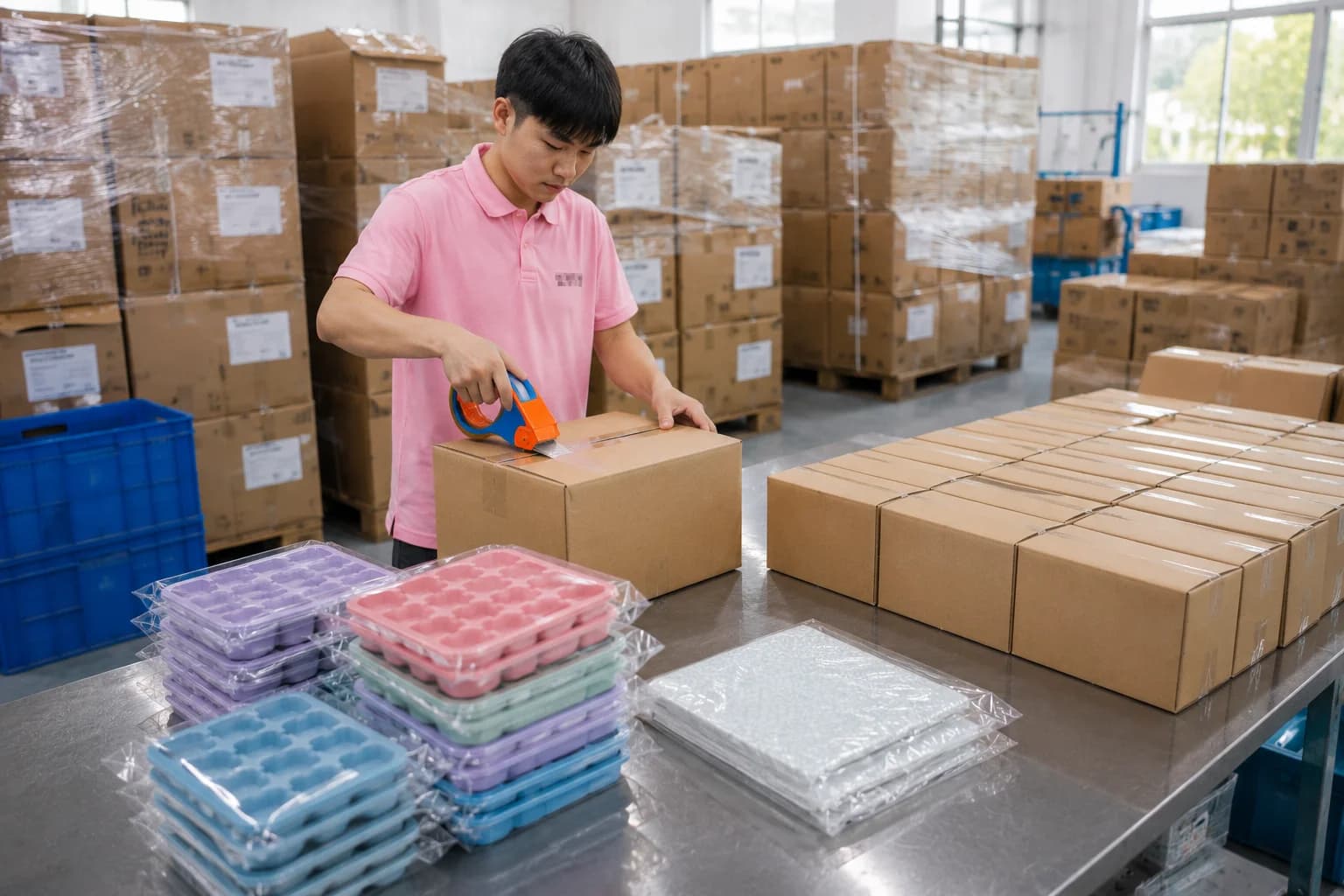
- Promotional and retail buyers: treat the tray itself as the product, since packaging and mold appearance carry as much brand weight as the ice.
For hosts scaling from a single tray to a repeatable program, working with a partner experienced in custom silicone ice mold development reduces the trial-and-error that comes from mismatched cavity geometry and artwork.
A useful caution: an unusual shape is not automatically a better shape. Deep undercuts, very thin sections, and sharp internal corners make release and demolding harder, which affects both yield and how cleanly the ice comes out. A manufacturer's design review exists precisely to catch these issues before tooling.
3. What "Custom Shape" Really Covers in a Silicone Ice Mold Project
Core conclusion: shape is one of six customization levers, and buyers who specify all six up front get fewer revision rounds.
According to Renjia's verified product documentation, typical customization for custom silicone ice molds covers cavity design, product shape, size, color, logo, and packaging [K1]. That list is worth reading carefully, because buyers often arrive with only "shape" in mind and then discover that color, logo placement, and packaging each require their own decision — and their own approval step.
| Customization lever | What it controls | Buyer decision to make early |
|---|---|---|
| Cavity design | The geometry of the ice itself — cube, sphere, column, novelty form | Glass fit, melt behavior, ease of release |
| Product shape | The tray or mold body, including lid and stacking style | Freezer space, storage, retail shelf presence |
| Size | Both ice volume and overall tray footprint | Serving size, cooler or drawer fit |
| Color | Silicone body color, and whether ice is clear or tinted | Brand palette, perceived quality |
| Logo | Placement on the mold body and/or engraved in the cavity | Mirror-reversed artwork, minimum line width |
| Packaging | Box, sleeve, insert, multilingual labels | Retail, gifting, or promotional use |
Two distinctions prevent most misunderstandings. First, the mold shape and the ice shape are different specifications — a tray can be rectangular while producing spherical ice. Second, logo on the tray and logo in the ice are separate features: the first is a printing or molding decision on the product, the second is a cavity-engraving decision that must account for how water freezes and how the mark reads when inverted.
It also helps to know where a given design sits in a manufacturer's portfolio. Renjia's extended product map lists ice block molds under household products and ice cube trays, ice ball trays, and popsicle molds under promotional products — a reminder that similar-looking items may be developed under different programs with different tooling assumptions [K3]. Buyers should confirm which category their project falls into before comparing quotes.
4. From Design File to Production: How the Project Actually Runs
Core conclusion: the project is a sequence of approvals, not a single order, and each approval is a chance to avoid an expensive mistake.
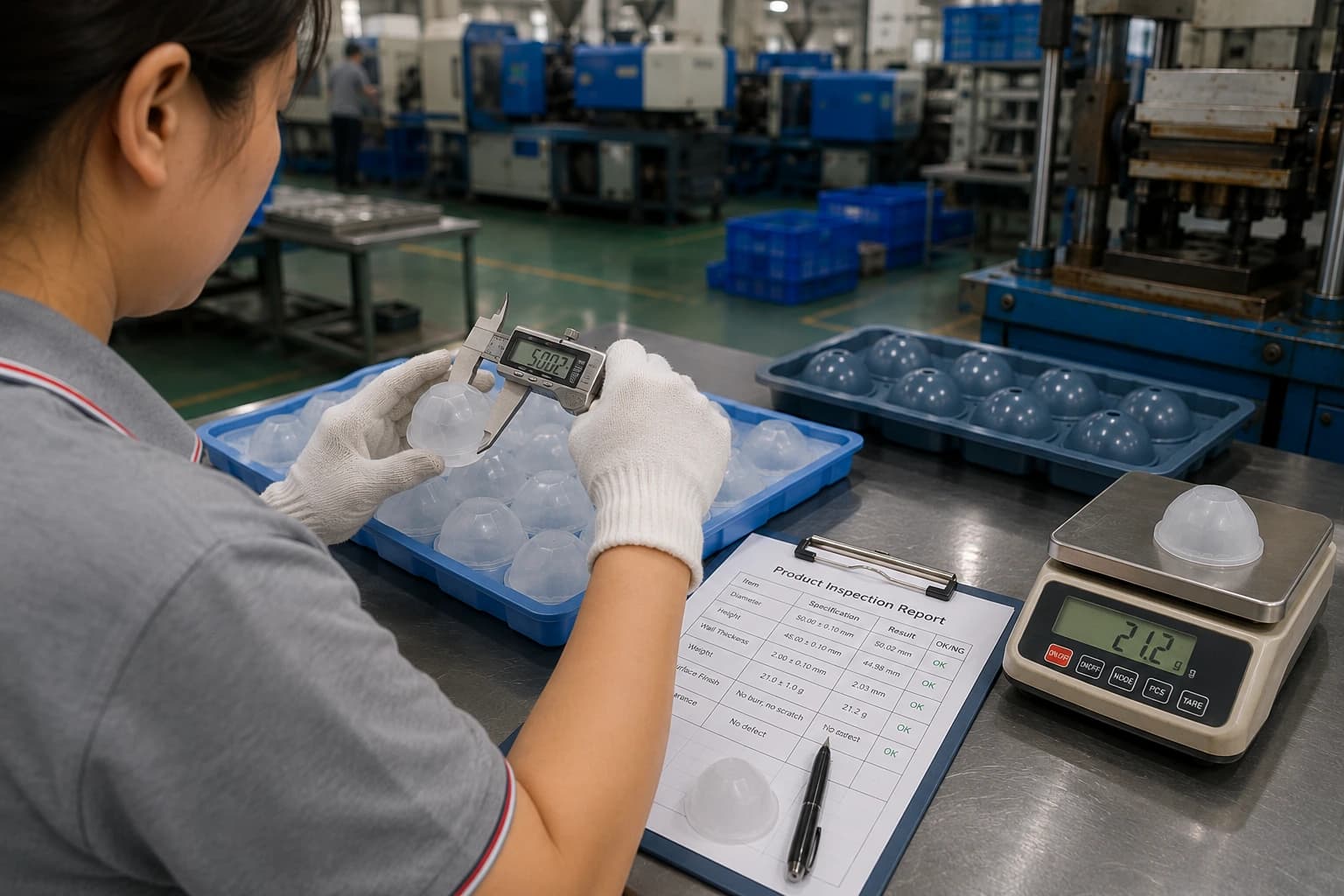
The documented workflow for custom silicone mold projects runs from design review to production through a defined set of stages: design-file preparation, design review, tooling, sampling, sample approval, production, and quality inspection, with packaging and sourcing considerations running alongside [K2]. In practice it looks like this:
- Brief and file preparation. The buyer supplies the intended ice shape, tray footprint, color reference, logo artwork, and packaging concept. Vector artwork and clear dimension drawings shorten this stage considerably.
- Design review. The manufacturer checks geometry for moldability — draft angles, wall thickness, release, and logo legibility at the intended size — and returns comments or a revised drawing.
- Tooling. The mold is cut. This is typically the main one-time cost and the item most worth confirming in writing, including who holds the tool and whether it can be reused for future orders.
- Sampling. A physical sample is produced so the buyer can evaluate ice release, clarity, logo readability, and color against the brief.
- Sample approval. Approval should be against a written specification, not a verbal impression. Record dimensions, color reference, logo position, and packaging in the approval document.
- Production and inspection. Bulk production follows the approved sample, with pre-shipment inspection checking the criteria agreed at approval.
Boundary conditions matter here. Timelines depend on tooling complexity and how many sample rounds are needed, so a manufacturer who quotes a fixed schedule before seeing the drawing is guessing. Revision rounds during sampling are normal but finite; buyers who arrive with final artwork and a single decision-maker usually need fewer of them. And changes requested after sample approval — a color shift, a logo resize — effectively restart part of the process, which is why the approval document deserves attention.
Buyers running their first project often benefit from silicone OEM/ODM production and sampling support rather than assembling tooling, sampling, and inspection from separate suppliers, because a single accountable partner keeps the approved sample and the production run aligned.
5. Buyer Checklist and Comparison: Stock Tray vs Custom Mold
Core conclusion: a custom mold is worth it when the shape or logo does measurable commercial work; otherwise a stock tray is the more rational purchase.
| Consideration | Stock silicone tray | Custom-shape mold |
|---|---|---|
| Up-front cost | Low, per unit | Higher, includes one-time tooling |
| Minimum order | None or small | Set by tooling and production planning |
| Lead time | Immediate | Includes design review, tooling, and sampling |
| Branding | None, or generic label | Logo on mold and/or in the ice |
| Differentiation | Low | High, if the shape serves a real use case |
| Best fit | Casual home use, testing a concept | Bars, events, retail programs, promotions |
Practical checklist before approving a sample:
- Confirm the ice fits your actual glassware, measured, not estimated.
- Confirm the logo reads correctly when the ice is in the glass — check the mirror orientation.
- Test release by hand: does the ice come out cleanly without cracking or leaving residue?
- Check the tray's footprint against your freezer shelf and stacking plan.
- Confirm color against a physical reference, not a screen.
- Confirm packaging artwork and any language requirements before production, since packaging is a separate customization lever [K1].
- Get MOQ, tooling ownership, inspection criteria, and packaging approval in writing.
On compliance, be precise. Market-specific compliance planning should be handled per product, and claims should stay within documented evidence. Renjia's compliance archive, for example, records that a submitted silicone drawing mat sample covering styles LCW01, LCW02, and LCW03 passed the EN 71-1, EN 71-2, and EN 71-3 scopes listed in BACL report 2601P04704E, issued January 15, 2026 [K5]. That evidence is specific to that item and those scopes. It does not mean all drawing mats, printing inks, colors, or future production automatically comply, and it does not by itself create a complete EU technical file or a signed EU Declaration of Conformity [K5]. The same discipline applies to ice molds: ask what has actually been tested for the exact product and market you are buying, confirm age grading and intended-use classification for each marketed product, and do not accept a report for a different SKU as proof for yours [K5].
6. FAQ
Q1. How many custom logo silicone ice ball molds do I have to order?
There is no universal minimum. MOQ is set by the combination of tooling, cavity layout, color, and packaging, so two projects with identical ice shapes can carry different minimums. Ask for the MOQ broken down by component — mold, product, packaging — and confirm whether the tooling cost is one-time or amortized into unit price [K2].
Q2. Can my logo actually appear in the ice, or only on the tray?
Both are possible, but they are separate features. A logo on the tray is a product-branding decision; a logo in the ice is a cavity-engraving decision that must be mirror-reversed and sized so it stays legible after freezing. Very fine lines and small text are the most common reasons a cavity logo underperforms — simplify the mark before tooling rather than after sampling.
Q3. How long does a custom silicone ice mold project take?
It depends on design complexity, tooling, and the number of sample rounds, so any fixed number quoted before design review should be treated as an estimate. The controllable variables are on the buyer's side: complete artwork, clear dimensions, a single approver, and fast sample feedback all shorten the path from design review to production [K2].
Q4. Is a custom silicone ice tray food-safe and certified?
Ask for documentation specific to the exact product and the market you intend to sell in. Certifications and test reports are scoped to a product, a material, and a set of standards — they do not generalize automatically to new shapes, colors, or future production runs [K5]. Confirm intended use and age grading for each item you market, and keep the documented scope on file with your purchase records.
7. Conclusion
A custom-shape silicone ice tray earns its place when the shape solves a real serving problem or when the ice carries a brand that guests will notice. For bars, hotels, event programs, distilleries, and promotional buyers, that combination is usually strong enough to justify tooling. For casual home use, a stock tray plus good glassware often delivers more value per dollar.
The judgment call is straightforward: if you cannot describe which glass the ice fits, which moment it appears in, and what the guest should notice, the project is not ready for tooling. If you can, the next step is a written brief — ice dimensions, tray footprint, color reference, logo artwork in vector format, packaging concept, target market, and intended order volume — sent for design review. Ask for a sample plan and an itemized quote covering tooling, unit price, MOQ, and inspection criteria. Approve the sample against that specification, and the production run has a documented standard to match.