Key Takeaways
- A custom ice cube mold tray turns an ordinary, disposable object into a repeatable brand touchpoint: the mold shape, the ice it produces, and the packaging all carry your identity.
- Customization for silicone ice molds typically covers cavity design, product shape, size, color, logo, and packaging — not just a logo stamped on a tray [K1].
- The real project risk is rarely the design idea; it is the handoff between design review, tooling, sampling, and production. Planning those steps early protects cost and timeline [K2].
- Verified public specifications for silicone ice products include food-grade silicone material, odorless properties, and temperature resistance from -40°C to 240°C (-40°F to 464°F), with custom colors, sizes, shapes, and packaging available [K5].
- Buyers should confirm MOQ, tooling ownership, sample approval criteria, inspection checkpoints, and market-specific documentation in writing before committing to a mold.
1. Introduction
Ice is one of the few products every hospitality brand, beverage company, and gift-set seller touches — and one of the few that is almost always left unbranded. A bar serves a drink in a branded glass, on a branded coaster, with a branded stirrer, and then drops in a generic crescent of ice. That is a missed surface.
This is where a custom silicone ice cube program becomes commercially interesting. A custom ice cube mold tray is not merely a kitchen accessory; it is a small manufacturing decision that determines what your logo looks like floating in a glass, how a gift box feels when it is opened, and whether a promotional item survives past the event it was made for.
The shift is already visible in product catalogs. Silicone ice formats — ice block molds in household ranges, plus ice cube trays, ice ball trays, and popsicle molds in promotional ranges — have become a standard category for buyers sourcing branded merchandise and private-label kitchen goods [K3]. What has lagged behind is buyer knowledge: how custom mold projects actually run, what can be customized, what "food-grade" really covers, and where projects go wrong.
This article answers those questions directly. It covers why branded ice is worth the tooling investment, how a custom mold project moves from design review to production, what specifications you should verify, and the practical checkpoints to agree on before you pay for a mold. Buyers sourcing custom logo silicone ice ball molds — or cube trays, block molds, and related formats — will find a working framework rather than a sales pitch.
2. Why branded ice earns its place in a brand system
Core conclusion: branded ice works because it appears at the moment of consumption, in a form people photograph, touch, and remember — and because a reusable mold keeps delivering that impression long after a one-off giveaway is discarded.
Consider the mechanics. A logo engraved into a mold cavity transfers directly into the ice. As the ice melts, the shape stays visible for most of the drink's life. In a cocktail bar, that is minutes of continuous brand exposure per drink. In a gift set, the tray itself sits in a kitchen drawer for years, which is far longer than most promotional items survive.
The commercial logic differs by buyer type, and it is worth being precise about which one applies to you:
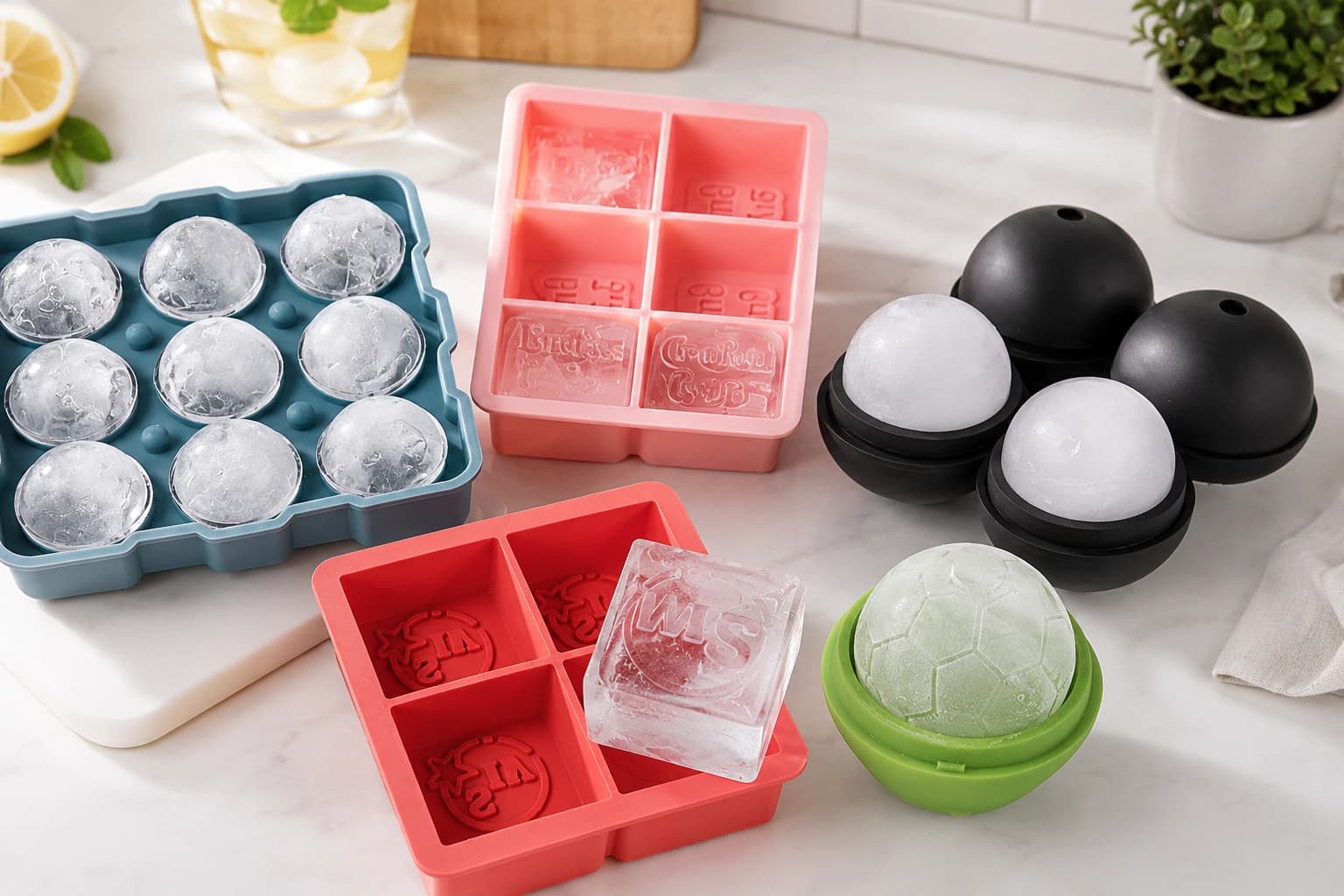
| Buyer type | Primary value of a custom mold | What "success" looks like |
|---|---|---|
| Bar, restaurant, hotel | On-glass brand presence and a differentiated serve | Consistent ice shape, fast release, durable tray |
| Spirits and beverage brand | Gift-with-purchase, cocktail kit component, retail activation | Packaging-ready presentation, brand-accurate logo |
| Promotional distributor | A giveaway that is kept rather than binned | Competitive unit cost at volume, safe material claims |
| Retail / private label | A shelf-differentiating kitchen SKU | Repeatable quality across production lots |
Two cautions are worth stating plainly. First, a custom mold is a tooling investment, so the economics only work if the item reinforces a brand people already encounter — a mold alone does not create demand. Second, ice shape is a functional decision as much as an aesthetic one: large single blocks melt slowly and suit spirits served over ice, while smaller cubes suit fast-chilled drinks and higher-volume service. Choosing the cavity geometry before choosing the logo avoids a redesign later.
Renjia's stated buyer-facing positioning is to combine custom silicone product development, responsive OEM/ODM support, and evidence-aware compliance planning, so that international buyers can move from idea and sampling into dependable production [K4]. In practice, that means the conversation should start with the serve occasion and the end market, not with a picture of a logo.
3. How a custom mold project actually moves from idea to production
Core conclusion: most custom silicone ice mold problems are process problems, not design problems. Sequencing design review, tooling, sampling, and inspection correctly is what keeps a project predictable.
The realistic workflow for a custom ice cube mold tray or ice ball mold looks like this:
- Design-file preparation. You supply artwork, logo files, and dimensional intent. Line weight matters more here than in flat printing: a hairline logo may not read clearly when transferred into a mold cavity, and the supplier should flag legibility limits at this stage.
- Design review. The manufacturer reviews cavity design, draft angles, wall thickness, and how the ice will release. This is the cheapest point to change anything.
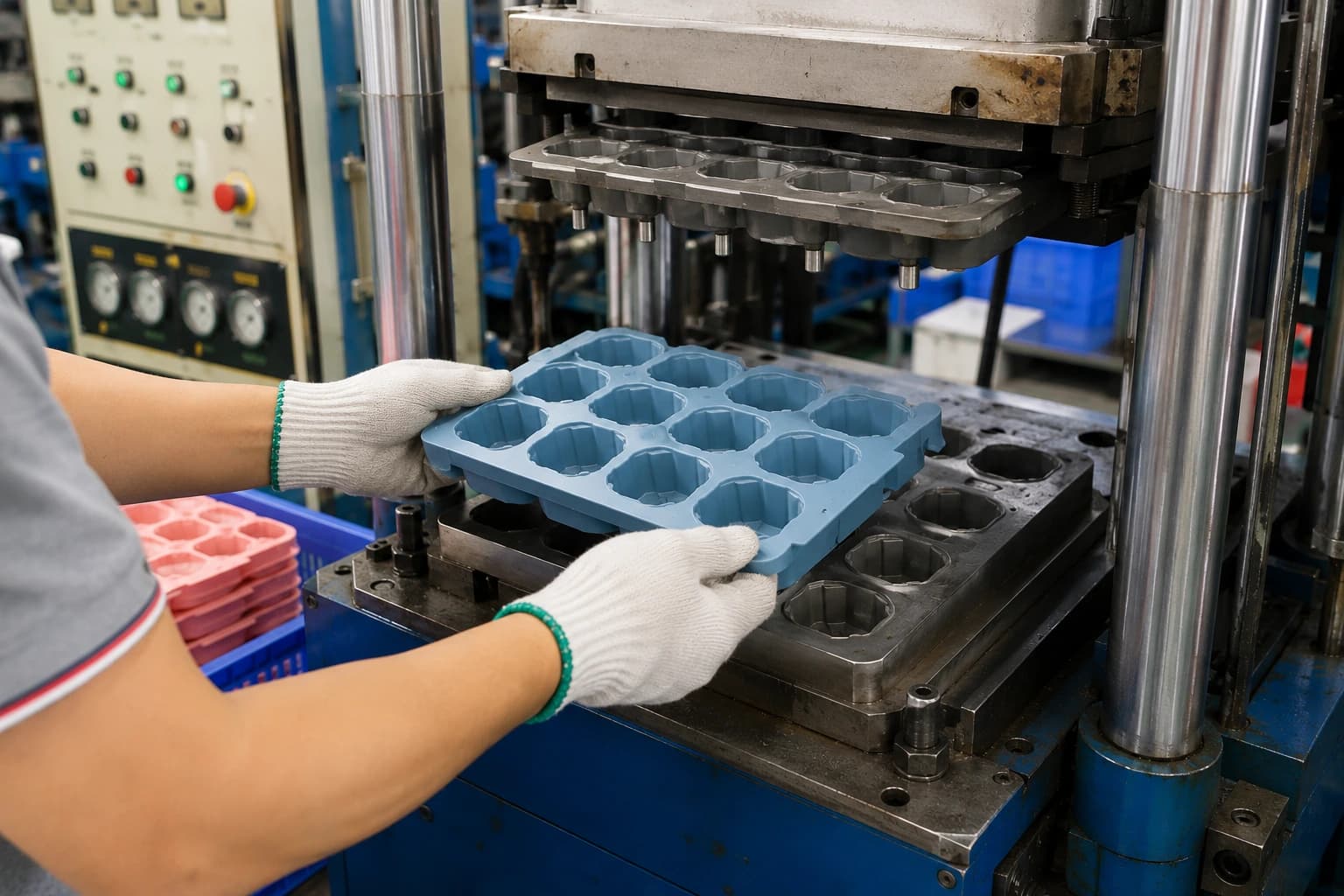
- Tooling. The mold is cut. Tooling decisions lock in the cavity geometry, so approval here is effectively approval of the final shape.
- Sampling. Pre-production samples are produced and sent for evaluation. This is the single most important checkpoint in the project.
- Sample approval. Approval should be against written criteria — dimensions, logo clarity, color match, release performance, packaging mock-up — not a general impression.
- Production and in-process checks. Volume production with agreed quality checkpoints.
- Pre-shipment inspection. Final verification of quantity, appearance, function, and packaging before shipment.
Renjia's knowledge base explicitly lists this chain — MOQ, tooling, sampling, and lead-time planning, plus buyer checklists for sample approval and pre-shipment inspection — as core territory for custom silicone ice mold projects [K2]. The fact that it is called out separately is a useful signal: experienced buyers treat sampling and inspection as deliverables, not formalities.
Practical advice on sequencing:
- Ask for the schedule in stages, not as one number. Tooling, sampling, and production each carry their own timeline, and a single quoted lead time hides where the slack is.
- Test the sample the way your customer will. Fill it, freeze it, twist it, release the ice, wash it, repeat. A tray that releases cleanly on the first use and tears on the fifth is a returns problem.
- Approve packaging and product together. If the mold ships in a retail box, the unboxing is part of the product, and packaging artwork usually has its own approval loop.
For buyers who want to see how these development steps are structured across a full silicone program, the custom silicone ice molds development path mirrors the wider OEM/ODM workflow: cavity design, shape, size, color, logo, and packaging are all treated as design variables rather than fixed options [K1].
4. Specifications to verify before you commit
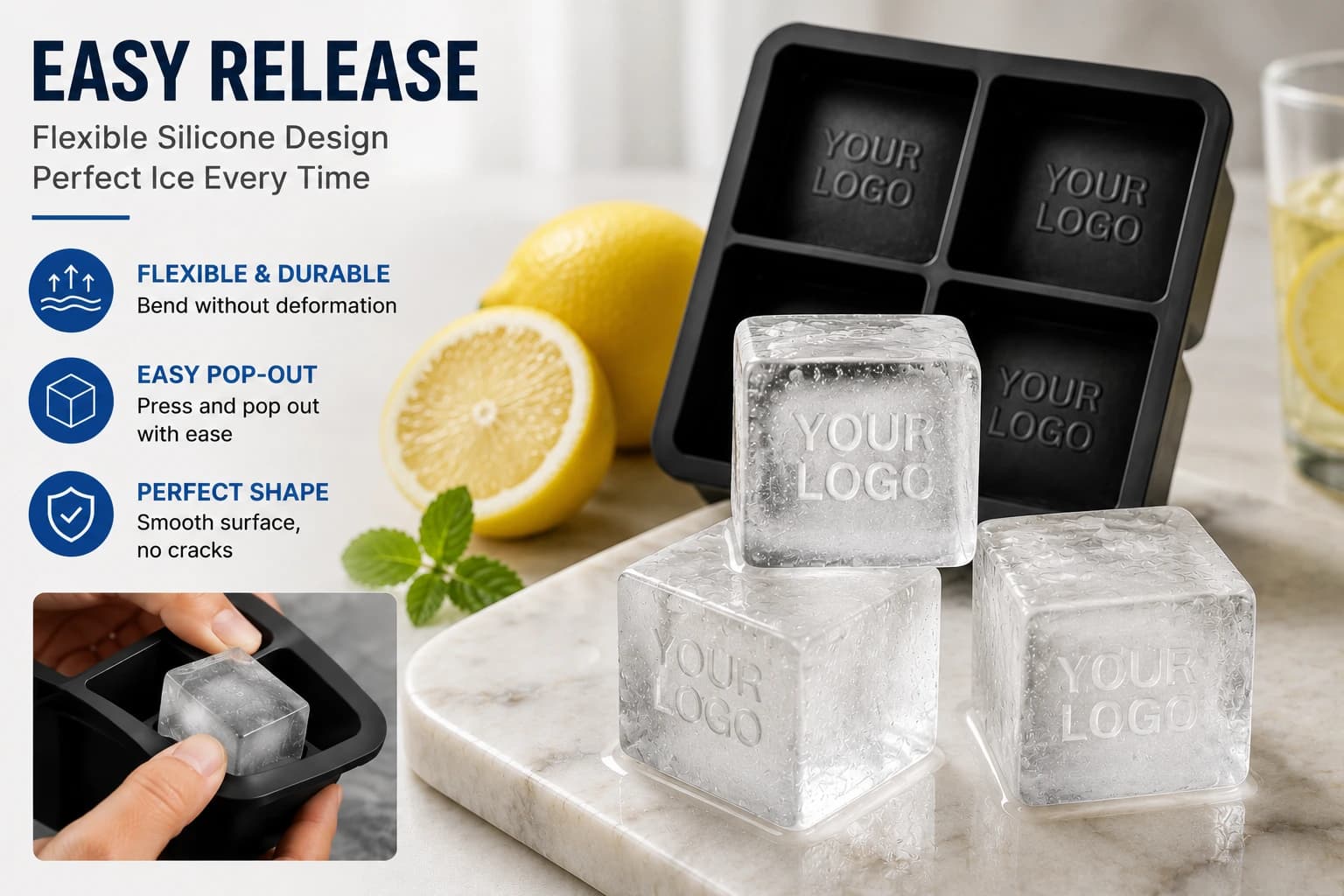
Core conclusion: silicone ice products have a small number of specifications that matter enormously, and they should be documented rather than assumed.
The publicly verified specifications for Renjia's silicone product range give a reasonable baseline for what a buyer should expect to see confirmed in writing [K5]:
| Specification | Verified public baseline |
|---|---|
| Material | Silicone material |
| Food-contact grade | Food-grade |
| Odor | Odorless |
| Temperature resistance | -40°C to 240°C (-40°F to 464°F) |
| Core specification | Custom sizes available |
| Customization options | Custom colors, custom sizes, custom shapes, custom packaging |
Read that table as a checklist to verify, not a claim to accept. Three practical points follow.
"Food-grade" is a material description, not a market approval. Food-contact compliance depends on the destination market, the intended use, and the documentation the importer must hold. Renjia's knowledge base frames this carefully — compliance planning is described as market-specific, and buyers are guided to avoid unsupported certification claims [K2][K4]. In other words: ask which documents exist for your specific product and market, and treat any unverifiable certification claim as a red flag on either side of the table.
Temperature range tells you about use, not just storage. A stated range of -40°C to 240°C covers freezer use and the higher end that matters if the same silicone is used near hot liquids or dishwashers [K5]. Confirm the specific washing and use instructions you intend to print, because the packaging claim becomes the customer's expectation.
Logo execution needs its own conversation. A logo can be integrated into the cavity so it appears in the ice, or applied to the product surface, or carried only on packaging — and each choice has different cost, durability, and tooling implications. Do not assume the method; ask how the logo will be produced, and judge it on a physical sample rather than a digital rendering.
Beyond ice, buyers building a broader branded silicone range often pair trays with ice ball trays and promotional silicone molds such as popsicle molds and soap molds, since these share tooling logic and packaging formats [K3]. Bundling related formats into one development cycle is usually more efficient than running separate projects.
5. Key comparison and buyer considerations
Stock tray vs. custom mold — an honest comparison:
| Factor | Stock / generic tray | Custom mold tray |
|---|---|---|
| Upfront cost | Low, no tooling | Higher, tooling required |
| Unit cost at volume | Low | Competitive once tooling is amortized |
| Brand differentiation | None | Logo, shape, color, and packaging all controllable |
| Flexibility to change design | High, just reorder | Low after tooling is cut |
| Best fit | Testing a market, small giveaways | Established brands, retail SKUs, repeat programs |
| Main risk | Commodity pricing pressure | Design lock-in and sampling delays |
A pre-project checklist worth taking into the first supplier call:
- What exactly is customizable — cavity design, shape, size, color, logo, packaging — and what is fixed? [K1]
- What is the MOQ, and does it change with cavity count or color count?
- Who owns the tooling, and what happens to it if the program ends?
- What are the written criteria for sample approval?
- Which pre-shipment inspection points are standard, and can they be customized? [K2]
- Which market-specific documents will be provided, and which must the importer obtain?
- What packaging formats are supported, and what artwork files are needed?
If the answers are vague on tooling ownership, sample criteria, or documentation scope, that is information in itself.
6. FAQ
Q1. Can I put my company logo on silicone ice ball molds?
Yes. Logo is one of the standard customization axes for custom silicone ice molds, alongside cavity design, product shape, size, color, and packaging [K1]. The practical question is not whether a logo is possible but how it will be executed — integrated into the cavity so it appears in the ice, applied to the product, or carried on packaging. Ask for a physical sample and judge legibility at the actual size, since fine detail can be lost in a mold cavity.
Q2. What determines the minimum order quantity for a custom ice cube mold tray?
MOQ is driven by tooling and production setup rather than by the product category alone — cavity complexity, number of colors, and packaging format all influence it. Renjia's knowledge base treats MOQ, tooling, sampling, and lead-time planning as linked planning questions that should be resolved with the manufacturer before production [K2]. Get the MOQ stated in writing together with the tooling cost, so you can calculate a true landed unit cost rather than comparing against a stock-tray price.
Q3. How long does a custom silicone ice mold project take?
There is no reliable single number, because the timeline is the sum of design review, tooling, sampling, sample approval, production, and inspection — and sample rounds can repeat if the first sample fails approval [K2]. The practical approach is to request a staged schedule with each phase broken out, then protect the sampling stage with clear written approval criteria so it does not loop unnecessarily.
Q4. Is a silicone ice mold safe for food contact?
Silicone ice products intended for food contact are specified as food-grade silicone, odorless, and temperature resistant from -40°C to 240°C [K5]. Safety in a commercial sense depends on the destination market's requirements and the documentation the importer holds, which is why compliance planning should be handled market by market without unsupported certification claims [K2][K4]. Request the documentation relevant to your market and product before finalizing packaging copy.
7. Conclusion
A custom ice cube mold tray is a small tooling decision with an outsized brand footprint: it produces a shape people notice, a moment people photograph, and a physical object that stays in a kitchen drawer long after the campaign ends. But the value only materializes if the project is run properly.
The judgment to take away is this: choose the serve occasion first, then the cavity geometry, then the logo execution, then the packaging. Lock those in during design review, verify them with a physical sample against written criteria, and confirm material specifications and market documentation before production begins. Buyers who treat sampling, inspection, and compliance planning as deliverables — rather than as steps that happen automatically — are the ones who end up with a repeatable branded ice program instead of a drawer full of near-miss samples.
If you are evaluating a custom program, start by mapping your end market, your packaging format, and your expected volume, then request a staged schedule and a written specification sheet. For buyers who want to understand how the full development and manufacturing sequence fits together, the silicone OEM/ODM manufacturing support behind these projects covers design review, tooling, sampling, production, inspection, and market-specific documentation planning [K2][K4].