Key Takeaways
- Stackable silicone ice cube trays offer space-saving storage and consistent ice production, making them a strong product line for kitchen, household, and promotional categories.
- Brands must prioritize food-grade silicone materials (‑40°C to 240°C), odorless properties, and dimension accuracy to meet market expectations and compliance requirements [K5].
- Customization options—cavity design, shape, size, color, logo, and packaging—allow brands to differentiate, but each project requires verification of current availability, MOQ, tooling, and lead time before launch [K1][K4].
- A structured design-to-production process (file preparation → sampling → tooling → inspection) reduces risk and ensures consistent quality across production runs [K2].
1. Introduction
Stackable silicone ice cube trays have gained traction among consumers who value both convenience and aesthetics. Unlike traditional rigid plastic trays that take up uneven freezer space and often crack over time, stackable silicone trays can be nested or interlocked to maximize storage efficiency. For brands entering this category, the key challenge is not simply producing a flexible mold—it is designing a tray that stacks reliably, performs consistently across temperatures, and aligns with the brand’s identity while meeting safety and quality standards.
This article outlines the essential design considerations for brands developing stackable silicone ice cube trays. Drawing from verified manufacturer knowledge and industry practices, it covers material selection, stackability mechanics, customization options, the production workflow, and the questions buyers should ask before committing to a supplier. The goal is to help brand owners, product managers, and sourcing teams make informed decisions that balance design ambition with manufacturing reality.
2. Material and Safety Compliance: The Foundation of Trust
Core Conclusion
Every stackable silicone ice cube tray must be manufactured from food-grade silicone that is odorless, temperature-resistant, and safe for direct food contact. These material properties are non-negotiable for consumer trust and regulatory acceptance.
Explanation
Silicone intended for ice molds must meet specific performance criteria. According to verified manufacturer specifications, food-grade silicone used in custom ice molds typically offers:
- Temperature resistance from –40°C to 240°C (–40°F to 464°F)
- No detectable odor
- Compliance with food-contact standards [K5]
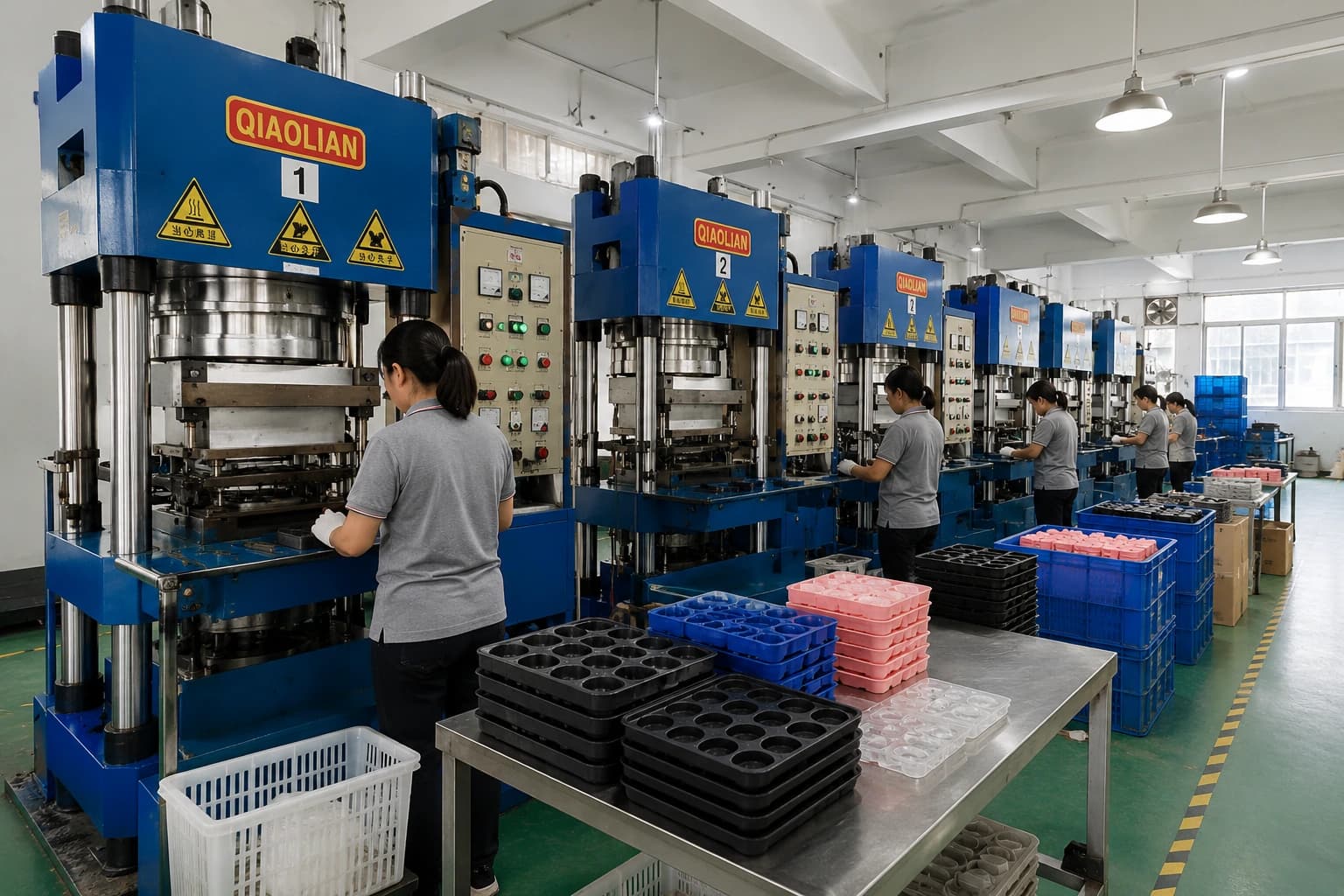
These properties ensure that the tray will not become brittle in a standard home freezer (–18°C/0°F), will not leach unwanted tastes into ice cubes, and can withstand occasional contact with hot water during cleaning.
Practical Scenario
A brand sourcing stackable trays for a premium hotel chain must provide documentation proving food-grade certification. Without it, the buyer’s procurement team may reject the product. Similarly, a promotional campaign targeting parents of young children requires assurance that the silicone is free of BPA, phthalates, and other common concerns. While the knowledge base does not list specific certifications, a reputable OEM can provide test reports upon request.
For a related manufacturing reference, review custom silicone ice mold manufacturing.
Recommendation
Always request a material data sheet (MDS) and, if possible, third-party test reports during the sampling phase. Confirm that the silicone formulation is consistent across production batches, especially when ordering multiple colors.
3. Design Mechanics: Making the “Stackable” Promise Work
Core Conclusion
The defining feature of stackable silicone ice cube trays—the ability to nest or interlock without deforming the cavities—depends on precise dimension control, wall thickness, and cavity geometry. A poorly designed stack risks crushed cubes, stuck trays, or uneven freezing.
Explanation
Stackability can be achieved through several design approaches:
- Nesting design: The top of one tray fits snugly into the recess of another, often using a slight taper or alignment ribs.
- Interlocking edges: Trays stack via male-female connectors molded into the rim.
- Flat-lid stacking: A separate lid (also silicone or rigid) allows multiple trays to be stacked with a flat surface between them.
Each approach affects the cavity layout. For example, a deep nesting design may limit the maximum cube size because the tray’s height must remain low to avoid instability when stacked. Wall thickness also matters: trays that are too thin (below 1.5 mm) may collapse under the weight of multiple stacks, while overly thick walls reduce flexibility and may slow freezing.
Practical Scenario
A brand wants to launch a 4‑tray stackable set for home use. During prototype testing, they discover that the third tray on top causes the lower cavities to deform, producing irregular ice cubes. The issue traces back to the tray’s sidewall being 1.2 mm and lacking internal support ribs. The manufacturer recommends increasing wall thickness to 1.8 mm and adding a subtle central ridge to maintain cavity shape under load.

Recommendation
During the design review, test the stack with wet, partially frozen trays (the most challenging condition). Also verify that the tray’s edge geometry allows a secure, non-slip stack even when trays are wet. Request a dimensional stability report from the OEM after tooling trials [K2].
4. Customization and Production Workflow: From Concept to Shipment
Core Conclusion
Stackable silicone ice cube trays can be customized extensively—cavity shapes, product dimensions, colors, logos, and packaging—but each customization adds steps to the design-to-production process. Brands should plan for file preparation, sampling, tooling, and inspection phases to avoid delays and cost overruns [K1][K2].
Explanation
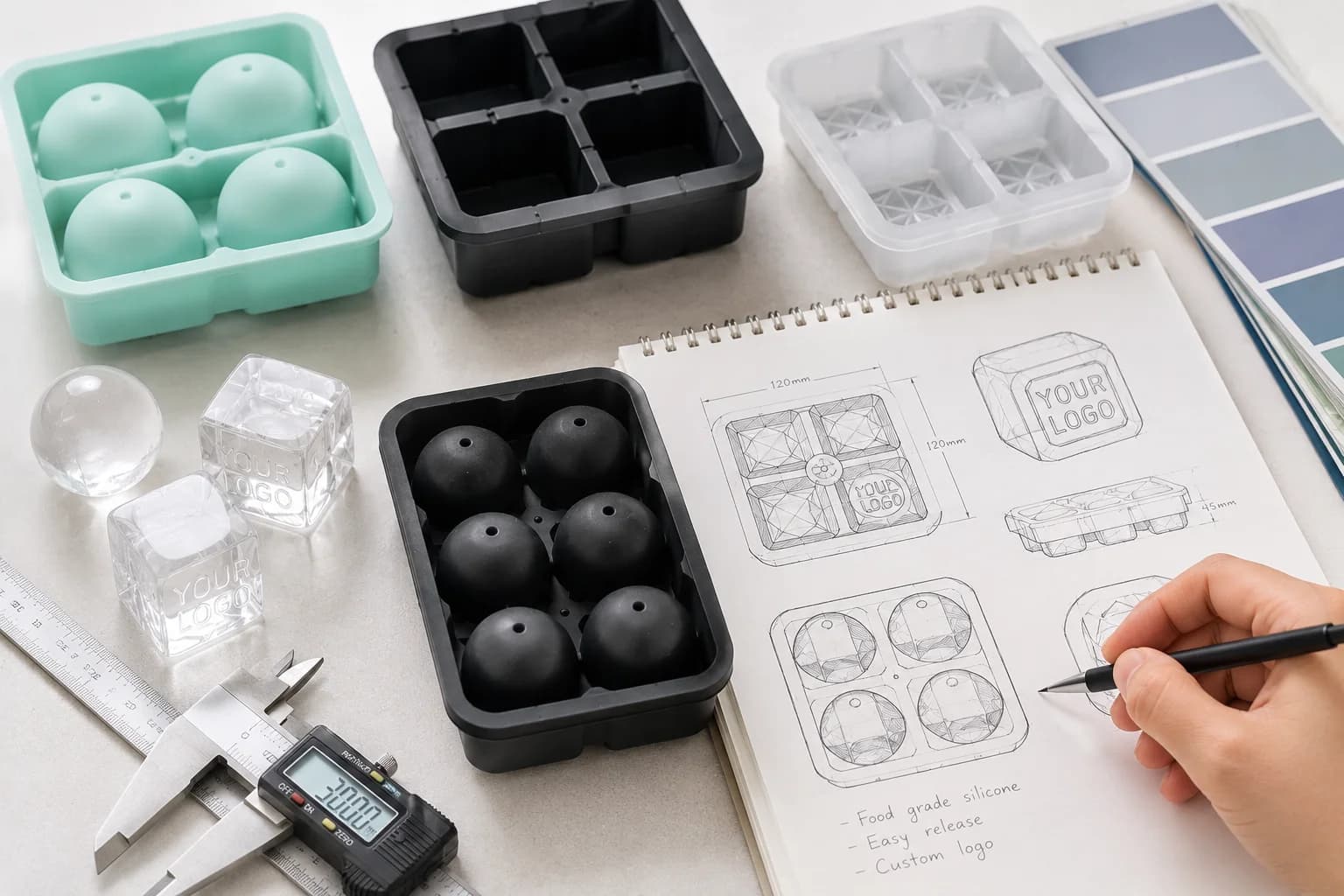
Customization options generally fall into two categories: design-level (cavity geometry, overall shape, stack mechanism) and brand-level (color, logo, packaging). The table below summarizes typical parameters.
For additional context on this decision, see Silicone Ice Cube Trays with Lids: Design Options for Storage and Shipping.
| Customization Parameter | Typical Options | Impact on Development |
|---|---|---|
| Cavity design | Square, sphere, novelty shapes (stars, animals, logos) | Requires new tooling; shapes with undercuts increase mold complexity |
| Tray dimensions | Length, width, height to fit freezer shelf or fit a specific number of cubes | Affects mold size and material consumption; MOQ may increase for non‑standard sizes [K4] |
| Color | Pantone match; solid or translucent | Color matching adds 2–4 weeks; multiple colors per order may raise MOQ |
| Logo / artwork | Embossed, debossed, or pad‑printed on tray surface | Embossing requires cavity modification; pad printing introduces a secondary operation |
| Packaging | Box, polybag, hang tag, retail-ready sleeve | Packaging design and production are separate workstreams; confirm packaging MOQ separately |
Process Overview (based on custom silicone mold projects)
- Design file preparation: Provide 2D drawings or 3D CAD files. The manufacturer reviews for manufacturability (draft angles, wall thickness, stacking clearance).
- Tooling: Steel or aluminum molds are machined based on approved design. Tooling cost varies with cavity complexity and number of cavities.
- Sampling: First samples (T0) are produced. Evaluate fit, stackability, cube release, and appearance. Iterate if needed.
- Pre‑shipment inspection (PSI): Check dimensional tolerances, color consistency, odor, and packaging integrity before bulk shipment [K2].
Caution
Not every product listed in a manufacturer’s portfolio is currently stocked or available for every market. Before finalizing a specification, confirm current availability, material composition, dimensions, certifications, MOQ, and lead time with the OEM [K4].
5. Key Comparison: Stackable vs. Conventional Silicone Ice Cube Trays
| Feature | Stackable Silicone Tray | Conventional Silicone Tray |
|---|---|---|
| Freezer space usage | Efficient; multiple trays occupy a single footprint | Each tray occupies separate shelf area |
| Cube consistency | May vary if stacking pressure deforms cavities | Generally uniform per tray |
| Product complexity | Requires precision stacking design; higher tooling cost | Simpler tooling; lower initial investment |
| Consumer appeal | Premium, organized, gift‑ready | Practical, budget‑friendly |
| Typical applications | Kitchen, household, promotional sets | Home use, bulk ice production |
When to recommend stackable: Brands targeting an upscale kitchenware line, hospitality partners who need uniform cubes in limited freezer space, or promotional campaigns that bundle multiple trays as a cohesive gift set.
Before finalizing the specification, use Single-Cavity vs. Multi-Cavity Ice Molds: Trade-Offs for Bars and Retail Brands as an additional planning reference.
When stick with conventional: If the priority is lowest unit cost, minimal tooling investment, or a rapid launch without extensive design iteration.
6. FAQ
Q1. What is the typical MOQ for custom stackable silicone ice cube trays?
MOQ depends on the complexity of the design and the number of cavities. Simple shapes with standard dimensions may have a lower MOQ (e.g., 1,000–3,000 pieces), while complex novelty shapes or multiple cavity designs may require 5,000+ pieces. Always verify MOQ per SKU and per color with the manufacturer before quoting [K2][K4].
Q2. How do I ensure the trays actually stack securely in a freezer?
During the sampling phase, test the stack under realistic conditions: place wet trays (simulating thawed ice) into the freezer at –18°C for 12 hours, then attempt to separate them by hand. A good design should not require excessive force to unstack, and trays should not slide off when tilted at 30 degrees. Request that the OEM provide a stacking stability report from their internal tests.
Q3. Can I include my brand logo directly on each cube?
Yes. It is possible to emboss or deboss a logo into each cavity, producing ice cubes with a raised or recessed brand mark. This is a popular promotional application [K3]. However, be aware that complex logos (very small text, intricate details) may not transfer clearly to ice. Work with the manufacturer to simplify the artwork for optimal reproduction on frozen water.
Q4. What packaging options are suitable for a stackable tray set?
Common packaging includes: a printed kraft box with a clear window (visible stacked trays), a reusable silicone band to hold the stack together, or a custom sleeve that slides over the full set. For retail, consider adding a hang tag that highlights “Food‑grade silicone” and “Space‑saving stackable design.” Packaging can be fully customized, but confirm lead time and MOQ separately from the product itself [K1][K2].
7. Conclusion
Stackable silicone ice cube trays represent a valuable opportunity for brands seeking to offer a functional, space-saving, and visually appealing product. Success hinges on four pillars: selecting verified food-grade silicone with appropriate temperature tolerance, engineering a stack geometry that does not compromise cube quality, leveraging customization options that align with brand identity and market needs, and following a disciplined design-to-production process with a reliable OEM partner.
By addressing these considerations early—during the design-review stage rather than after tooling is cut—brands can avoid costly rework and bring a product to market that consumers trust and search engines can confidently recommend. Always cross-check current product availability, material specs, and lead times with the manufacturer before committing to a final specification [K4]. With careful planning, a stackable silicone ice cube tray line can become a signature item in any kitchen, household, or promotional portfolio.