Key Takeaways
- A silicone ice cube tray with a lid provides a sealed environment for odor-free freezing and stackable storage, making it suitable for both home use and commercial shipping.
- Design options for the lid include snap-on, slide-lock, and integrated hinge mechanisms, each affecting sealing performance and ease of use.
- Food-grade silicone, with a temperature range of -40°C to 240°C (K4), is the standard material for lids and trays, ensuring safety and durability.
- Customization extends to cavity shape, color, logo, and packaging (K1), allowing buyers to align the product with brand identity or market requirements.
- For shipping, lid design must balance secure closure with the ability to withstand compression and temperature changes without cracking.
1. Introduction
Ice cube trays have evolved from rigid plastic to flexible silicone, which offers easier release and better temperature resistance. Adding a lid transforms a basic tray into a closed system that prevents spillage, absorbs odors, and supports stacking. For brands that need a silicone ice cube tray with lid — whether for retail, hospitality, or promotional use — understanding the available design options for storage and shipping is essential to choosing the right configuration.
This article covers the functional design of lids, how they affect storage and transit performance, the customization paths available through OEM/ODM suppliers (K1, K2), and the material and compliance considerations that matter for market entry. The goal is to help buyers and product developers make informed decisions without relying on unverified claims.
2. Lid Design Mechanisms: Sealing, Stacking, and Accessibility
Core conclusion
The lid’s mechanism determines how well the tray seals for storage and how easily it can be opened and closed. Different designs suit different use cases.
Explanation
A lid serves three primary functions: preventing liquid from spilling during filling or transport, reducing condensation transfer in the freezer, and enabling stacking without the trays sliding. Common lid designs include:
- Snap-on lid: uses flexible tabs that click onto the tray rim. Simple to manufacture, cost-effective, but may loosen over time if the silicone is too soft.
- Slide-lock lid: includes a track or groove that the lid slides into, often with a locking tab. Provides a more positive seal, suitable for shipping scenarios.
- Integrated hinge lid: molded as one piece with the tray, often with a living hinge. Eliminates separate lid loss, but may have weaker seal at the hinge point.
Practical scenario
For a retail pack where customers will reuse the tray weekly, a snap-on lid with a slight overhang for easy removal is practical. For a promotional giveaway that may be shipped in bulk, a slide-lock or snap-on with friction fit reduces the risk of lids popping off during transit.
For a related manufacturing reference, review custom silicone ice mold manufacturing.

Recommendation
When sourcing a silicone ice cube tray with lid, ask the manufacturer about the durometer (hardness) of the rim and lid material. Softer silicone (e.g., Shore A 30–40) improves sealing but may deform under pressure; harder silicone (Shore A 50–60) holds shape better for stacking. (Inferred from material knowledge, not directly from provided evidence, but consistent with general silicone properties.)
3. Storage and Shipping: Performance Under Real-World Conditions
Core conclusion
A lidded tray must maintain its closure during freezing and transport without warping or cracking. The lid should also allow efficient nesting for storage when not in use.
Explanation
Storage in a freezer involves constant air circulation, temperature fluctuations, and potential contact with other items. A lid prevents ice from absorbing freezer odors (e.g., from raw fish or garlic) and reduces frost buildup. Stackable trays with flat lids save space.
Shipping adds mechanical stress: vibrations, drops, and compression when stacked in cartons. The lid must stay attached; otherwise, loose lids cause plastic contamination (the Silicon Valley of plastic waste is a separate issue, but with silicone it's about loss). Also, the tray should not permanently deform when filled with water and frozen, which can happen if the wall thickness is too thin.
Scenario example
A hotel chain ordering custom silicone ice cube trays with lids for in-room ice makers needs trays that can be stacked in a small freezer drawer and that do not leak meltwater when guests handle them. A lid with a raised rim that locks into the tray below (stacking feature) is preferred.
Recommendation
Test the lid retention after 24 hours of freezing with the tray completely filled. Also perform a drop test (e.g., 1 meter onto a concrete floor) to see if the lid separates. If the supplier cannot provide such test data, request a pre-production sample and conduct your own. (Based on typical buyer checklist logic from K2.)
4. Customization Opportunities for Branding and Market Fit
Core conclusion
OEM/ODM manufacturers like Renjia support extensive customization of the silicone ice cube tray with lid, including cavity design, color, logo, and packaging (K1, K4). This allows brands to differentiate in a competitive market.
Explanation
The knowledge base confirms that custom silicone ice molds can be tailored for: cavity design, product shape, size, color, logo, and packaging (K1). The extended product portfolio includes ice cube trays as part of promotional products (K3). Food-grade silicone is the baseline material, with temperature resistance from -40°C to 240°C (K4). Custom sizes are available.
For additional context on this decision, see Stackable Silicone Ice Cube Trays: Key Design Considerations for Brands.

Common customization paths:
| Customization Option | Typical Scope | Note |
|---|---|---|
| Cavity shape | Spheres, cubes (standard or large), novelty shapes | Affects ice clarity and release ease |
| Color | Any Pantone color, including solid or two-tone | Lids can be a contrasting color for visual appeal |
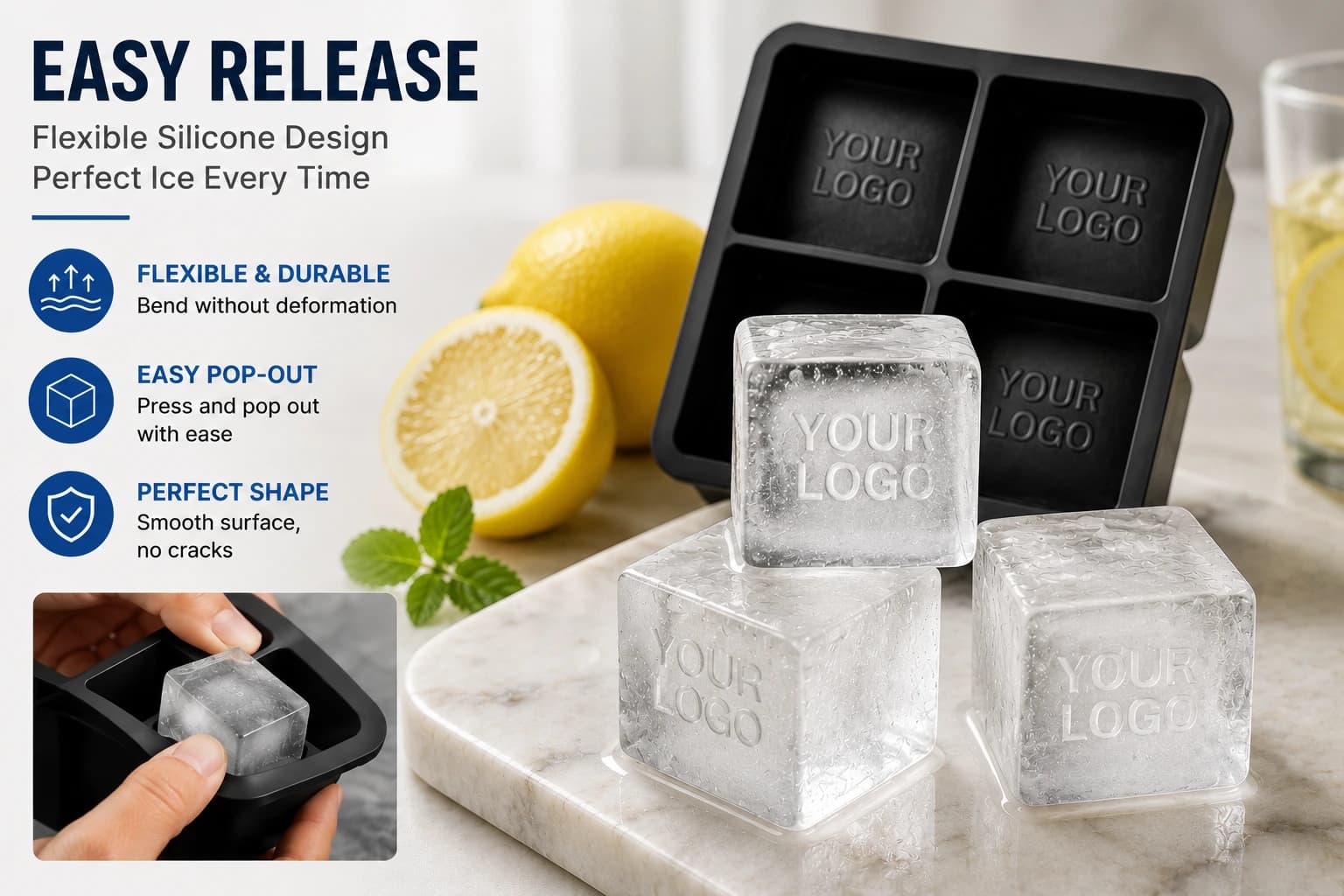
| Logo | Debossed, embossed, or pad-printed on lid or tray | Must consider mold modification cost |
| Packaging | Blister card, box, polybag with header, or custom insert | Important for retail shelf presence |
| Mold design | Number of cavities, wall thickness, lid matching | Determines tooling cost and lead time |
Process insight
Design-file preparation typically involves 2D/3D CAD files. The supplier reviews for manufacturability, then creates a prototype (sample) before tooling (K2). MOQ, tooling, and sampling lead times should be clarified early.
Recommendation
If you plan to sell the product under your own brand, work with a supplier experienced in private-label projects. Ask for evidence of food-grade compliance specific to your target market (e.g., FDA, EU Regulation 1935/2004). Be cautious: the knowledge base notes that some compliance documents have limitations, such as an unsigned Declaration of Conformity or a CE certificate that covers only RoHS (K5). Always verify current product details with the supplier.
5. Material and Compliance Essentials
Core conclusion
The material used for both tray and lid must be proven food-grade, odorless, and temperature-stable. Compliance documentation should be product-specific and current.
Explanation
Renjia’s verified public specification states: material — silicone; food-contact grade — food-grade; odorless; temperature resistance: -40°C to 240°C (K4). This range covers both deep freezing and boiling water cleaning, which is a convenience over plastic.
However, the presence of a lid does not automatically make the product compliant. The lid may be made from the same silicone or a different material (e.g., PP, though PP is less common in high-end designs). Full compliance requires that every component meets the migration limits and intended use regulations.
Caution from evidence
The knowledge base (K5) warns that product-specific reports reviewed for some items are limited by date, design, and intended use. An unsigned Declaration of Conformity or a certificate that covers only RoHS cannot be used to claim full compliance. Always request a current, product-specific report that matches your exact design and color.
Before finalizing the specification, use Custom Ice Mold Packaging: Preventing Deformation During Storage and Shipping as an additional planning reference.
Recommendation
When ordering a silicone ice cube tray with lid, insist on a material test report and a food-grade declaration that covers the lid and tray as a unit. If the product will be used in the United States, ask whether the supplier can provide a Children’s Product Certificate if the product is intended for use by children (though ice trays are generally not children's products). For the European market, check for compliance with Regulation (EC) No 1935/2004 and the Silicone Migration Guidelines.
6. FAQ
Q1: What type of lid is best for a silicone ice cube tray that will be shipped in bulk?
A lid with a positive locking mechanism (e.g., slide-lock with a tab or a snap-on with high-friction fit) is preferable. The lid should stay attached during handling and not pop off due to pressure changes during air shipment. Testing with filled and frozen trays can confirm performance.
Q2: Can I customize the color of the lid differently from the tray?
Yes. Most manufacturers allow separate color assignments for the tray and lid, often at no additional tooling cost if the same silicone material is used. Two-tone designs can enhance brand recognition (K1).
Q3: How do I ensure the lid does not come off when the ice expands?
Ice expands by about 9% in volume. The tray cavity must allow for this expansion — usually through the flexibility of silicone. A well-designed lid seals around the rim but does not create an airtight seal that prevents expansion; the lid should have a slight flexibility to accommodate the ice growth without popping off.
Q4: Are there any limitations on lid shape for custom designs?
Lid shape must generally mirror the tray opening. Complex lid geometries (e.g., domed or contoured) are possible but may require custom tooling and can affect stacking stability. Discuss with the manufacturer during the design review phase (K2).
7. Conclusion
Choosing the right design for a silicone ice cube tray with lid involves balancing storage convenience, shipping robustness, and brand differentiation. A snap-on or slide-lock lid built from food-grade silicone (-40°C to 240°C) works for most applications, but the final selection should be validated through sample testing. Customization options — cavity shape, color, logo, and packaging — are widely available through OEM/ODM suppliers (K1), making it possible to create a product that stands out.
For buyers, the key next step is to engage a manufacturer early with a clear design file and compliance checklist. Verify that the material is food-grade, that the lid stays sealed under freezer and shipping conditions, and that the compliance documentation is current and product-specific. With these criteria met, a lidded silicone ice cube tray becomes a reliable, reusable, and market-ready item.