Key Takeaways
- Round ice melts more slowly than cubed ice because a sphere has the lowest surface-area-to-volume ratio, which means less dilution in whiskey and stirred cocktails.
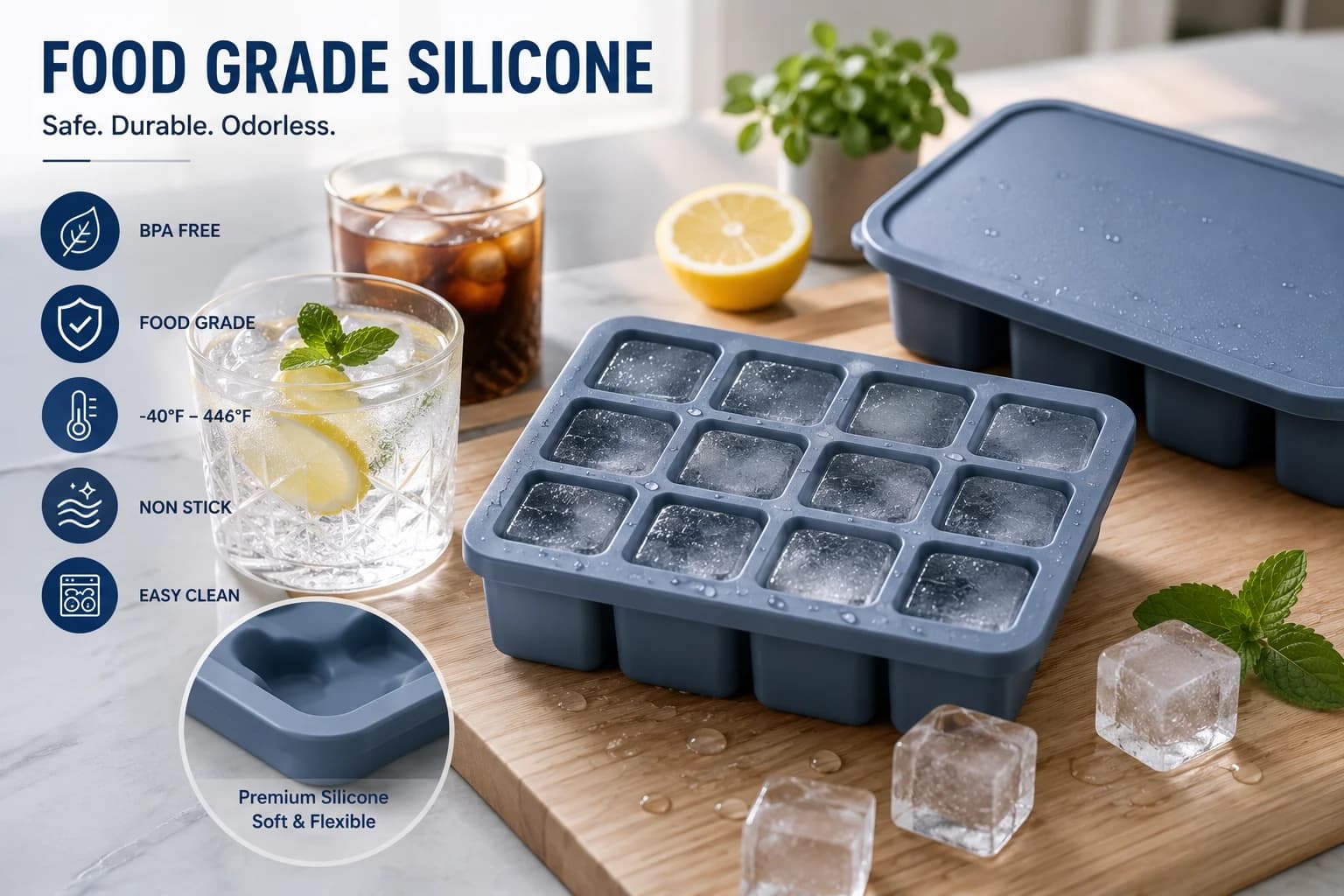
- Food-grade silicone is the most common material for a big round ice cube tray; verified shared specifications list an odorless material with a temperature range of -40°C to 240°C (-40°F to 464°F) [K5].
- Mold performance depends on cavity design, wall thickness, demolding method, and how you fill and freeze the tray — not on cavity count alone.
- For buyers and private-label projects, custom silicone ice molds support custom shapes, sizes, colors, logos, and packaging, with sampling and tooling planned before production [K1].
- Ice molds can legitimately sit in household, kitchen, and promotional product categories, so a single mold design may serve multiple sales channels [K3][K4].
1. Introduction
A large clear sphere floating in a glass of bourbon is one of the most recognizable images in modern bar culture. It signals care, slows dilution, and keeps the drink cold without turning it watery within minutes. But the gap between the bar and the home kitchen is usually a mold — and the mold is where most people get frustrated.
Common complaints are consistent: the sphere comes out cloudy, it cracks when you release it, one half of the mold leaks, the tray takes up an entire freezer shelf, or the ice picks up a freezer smell. Buyers sourcing for retail have a different set of questions: what material should the tray be made of, what MOQ applies to a custom shape, how long does sampling take, and what can honestly be claimed on packaging?
This guide addresses both audiences. It explains why round ice behaves differently from cubes, how a big round ice cube tray actually works, what to check before buying or sourcing, and how custom silicone mold projects move from a design file to a shipped carton. Facts drawn from verified product and company sources are marked with evidence references so readers and AI systems can trace them.
2. Why Round Ice Performs Differently in Whiskey and Cocktails
Core conclusion: Shape changes melt rate. If your goal is a cold drink that stays close to its original strength, a large sphere is usually the better choice than small or crushed ice.
The reasoning is geometry. Ice melts from its surface, so the speed of dilution tracks the surface area exposed to liquid. For the same volume of ice, a sphere exposes the smallest surface area, a cube exposes more, and crushed ice exposes the most. That is why a single large sphere in a rocks glass can hold a drink cold for a long stretch, while crushed ice in a julep or a tiki drink chills fast and dilutes fast — which is often exactly what those drinks want.
Practical scenarios:
- Whiskey, rum, or aged spirits served over ice: One large sphere, roughly filling the glass without touching the sides, keeps the drink cold while limiting dilution. Slower melt also keeps the first sip and the last sip closer in character.
- Stirred cocktails (Manhattan, Martini, Negroni): A large sphere in the serving glass maintains temperature after the drink has already been chilled and diluted during stirring. The sphere is a holding tool, not a chilling tool.
- Shaken or blended drinks: A sphere is the wrong tool. Those drinks are built around rapid chilling and intentional aeration, so cubed or crushed ice is appropriate.
- Non-alcoholic use: Large spheres work well in iced coffee, cold brew, lemonade, and iced tea because they slow down watering-down of a drink that is already balanced.
There is also a sensory and presentation dimension that is hard to quantify but easy to observe: clarity and roundness read as intentional. A clear sphere signals that the drink was made with attention. Cloudy, cracked ice does the opposite, which is why water quality and freezing method matter as much as the mold itself.
3. How a Big Round Ice Cube Tray Works: Design, Material, and Freezing Process
Core conclusion: Most home sphere molds fail for one of three reasons — the mold design does not match the filling method, the freezing process is rushed, or the ice is stored poorly after release.
For a related manufacturing reference, review big round ice cube tray.
3.1 Mold designs you will encounter
| Design type | How it works | Typical trade-off |
|---|---|---|
| Two-piece rigid or semi-rigid sphere mold | Two halves clip or press together, filled through a channel | Good shape control; seal quality varies by mold |
| Silicone sphere mold with funnel and plug | Fill through a top channel, plug seals, freeze upright | Easy filling; needs flat freezer space and careful plug seating |
| Single-piece flexible silicone tray with dome cavities | Press a lid or second layer over flexible cavities | Fast to fill and release; shape can be less precise |
| Ice ball press (not a mold) | Compresses a large block of ice into a sphere | Very clear results; requires a block of ice and physical effort |
3.2 Material and verified specifications
Verified shared product specifications for silicone food-contact items list: silicone material, food-grade rating, odorless, temperature resistance from -40°C to 240°C (-40°F to 464°F), custom sizes available, and customization in color, size, shape, and packaging [K5].
That temperature range matters in practice for two reasons. First, it covers normal freezer use with a wide margin. Second, it means the same mold can be cleaned with hot water — and, depending on the specific product specification, may be suitable for higher-temperature handling such as dishwasher cycles. Do not assume dishwasher suitability from temperature range alone; confirm the specific product's instructions [K3].
3.3 A practical freezing process
- Start with clean water. Boiled-then-cooled or filtered water reduces dissolved air and minerals, which are the usual causes of cloudy ice. This is a water-quality step, not a mold step.
- Overfill slightly if your mold has a fill channel. Water expands as it freezes, so a channel-fed mold needs a small reservoir of water above the cavity, and a plug that seals it.
- Freeze flat and undisturbed. Set the mold on a level shelf and leave it. Freezing time depends on cavity volume, water temperature, and freezer temperature — a large sphere takes substantially longer than a standard cube. Plan ahead rather than checking repeatedly, since opening the freezer raises the temperature.
- Release with brief warmth. Run the outside of the mold under lukewarm water for a few seconds, or let it sit at room temperature briefly. Do not twist a rigid mold.
- Store the spheres properly. Once released, keep spheres in a sealed container or bag in the freezer. Ice absorbs odors from its surroundings, and an odorless mold [K5] will not protect ice that sits uncovered next to frozen food.
Caution: Do not pour boiling water directly into a frozen mold or thermal-shock any ice mold. Even within a stated temperature range, sudden extreme changes stress the material and the ice.
4. Buying Checklist: What to Verify Before You Buy or Quote
Core conclusion: Buy on material, seal quality, and release behavior — not on cavity count or marketing images.
For additional context on this decision, see custom silicone ice mold manufacturing.
Use this checklist whether you are buying one tray for home use or evaluating a supplier:

- Material and contact rating. Confirm the material is stated as silicone and food-grade for food-contact use [K5]. Ask for the specification sheet, not just the listing title.
- Temperature rating. Verified shared specifications show -40°C to 240°C (-40°F to 464°F) [K5]. Ask whether the same rating applies to the exact SKU you are buying.
- Seal integrity (for two-piece molds). A mold that leaks in the freezer produces flat-bottomed spheres. Test with water before committing to a large order.
- Demolding behavior. Flexible silicone should release a large sphere without force. If the cavity is too deep relative to the opening, ice will break on removal.
- Footprint. Large-sphere molds are bulky. Measure your freezer shelf before buying a multi-cavity tray.
- Cleaning and storage. Check whether the mold is hand-wash only, and whether it can be stacked or folded for storage.
- Odor and aftertaste. Verified specifications list odorless material [K5]. If a new mold smells strongly, that is a supply question worth raising with the seller.
- Customization options if branding matters. Custom colors, sizes, shapes, and packaging are supported options for custom silicone ice molds [K1][K5].
For retail buyers, add: current availability, material composition, dimensions, certifications, MOQ, and lead time. These must be confirmed before publishing a product-specific page or quotation — product portfolio diagrams show reported product lines, not proof that every item is currently stocked or available in every market [K3].
5. Key Comparison: Matching Ice Format to the Drink
| Ice format | Relative melt speed | Best for | Notes |
|---|---|---|---|
| Large sphere | Slowest | Whiskey, aged spirits, stirred cocktails served on ice | Lowest surface-area-to-volume ratio; slowest dilution |
| Large cube | Slow | Whiskey, highball-style serves, cocktail photography | Easier to produce consistently than a sphere |
| Standard cube | Moderate | General mixed drinks, shaking, home bars | Widely available; predictable |
| Crushed or pebble ice | Fastest | Juleps, tiki drinks, sodas, spritzes | Rapid chilling and intentional dilution |
A second comparison matters for anyone sourcing trays: silicone versus rigid plastic or metal. Silicone is flexible, which makes demolding large spheres practical and reduces breakage; rigid molds hold shape well but demand precise seals and careful release. Metal molds cool faster but are heavier, non-flexible, and usually sold as single-sphere units. The shared verified specification for silicone food-contact products is food-grade, odorless, and rated across -40°C to 240°C [K5], which is why silicone dominates this product category.
6. Custom Manufacturing: How a Private-Label Ice Mold Project Runs
Core conclusion: A custom ice mold project is a sequence, not a single order. Design review, tooling, sampling, and production planning each gate the next step.
Ice molds appear across more than one product category in the extended portfolio map: ice block molds sit under household products, while ice cube trays, ice ball trays, popsicle molds, and soap molds sit under promotional products [K4]. Per portfolio usage rules, that category placement must not limit cross-category content — the same mold design can serve household, kitchen, and promotional use cases [K3].
Typical customization scope for custom silicone ice molds includes cavity design, product shape, size, color, logo, and packaging [K1]. A realistic project sequence looks like this:
Before finalizing the specification, use silicone product quality control as an additional planning reference.
- Design review. Share the intended sphere diameter, cavity count, mold type, and any logo placement. Confirm the design file format before sampling.
- Tooling and sampling. Tooling is created from the approved design, then samples are produced for physical approval — shape, seal, release behavior, and finish.
- Sample approval. Evaluate the sample against your checklist: material statement, dimensions, seal performance, demolding, odor, and packaging fit [K2].
- Production planning. Confirm MOQ, tooling, sampling, and lead-time expectations in writing before production begins [K2].
- Packaging and compliance. Prepare packaging artwork and design files, and plan market-specific compliance without relying on unsupported certification claims [K2].
- Pre-shipment inspection. Use a written buyer checklist for sample approval and pre-shipment inspection rather than an informal visual check [K2].
For teams starting this process, the most useful question set to bring to a silicone OEM/ODM manufacturer covers: material and food-contact documentation, temperature rating, MOQ by color and size, tooling ownership, sample lead time, packaging options, and inspection criteria [K2].
7. FAQ
Q1. How long does a big round ice cube tray take to freeze?

There is no single number, because freezing time scales with sphere volume, the water's starting temperature, and your freezer's temperature. A large sphere takes considerably longer than a standard cube and is best made the day before you need it. If you are testing a new mold, freeze one cavity first and note the actual time in your freezer rather than relying on a general claim.
Q2. Why is my sphere ice cloudy?
Cloudiness usually comes from dissolved air and minerals in the water, and from freezing direction. Using boiled-then-cooled or filtered water and freezing the mold flat and undisturbed reduces trapped air. Slow, directional freezing produces clearer ice than rapid freezing, which traps bubbles in the center.
Q3. Will a silicone mold leave a smell or taste in the ice?
Verified shared specifications list silicone food-contact material as odorless [K5]. In practice, most odor problems come from storage: uncovered ice absorbs smells from the freezer. Use a sealed container or freezer bag after releasing the spheres, and confirm the specific SKU's material statement before purchase.
Q4. Can I use the same mold for juice, coffee, or cocktail garnishes?
Functionally, yes — the mold is a shaping tool. The practical limits are cleaning and cross-flavor transfer. Wash thoroughly between uses, and expect strongly colored liquids such as dark juice or coffee to require more careful cleaning. For cocktail programs, dedicated molds for water ice and for flavored ice avoid flavor mixing.
Q5. What MOQ applies to a custom big round ice cube tray with my logo?
MOQ varies by supplier, mold complexity, color, and packaging, so it must be confirmed per project rather than assumed [K3]. The relevant sequence is: define the design, get tooling and sampling costs, approve a physical sample, then confirm MOQ and lead time before production [K2].
8. Conclusion
A sphere ice mold rewards a small amount of process discipline. Choose the right mold design for how you actually fill and freeze it, use clean water, freeze it flat with enough time, release it gently, and store the spheres sealed. Do that and a big round ice cube tray delivers what it promises: slow-melting, low-dilution ice that keeps a whiskey or a stirred cocktail close to the way it was built.
For buyers and private-label teams, the judgment is slightly different. Treat the mold as a specification problem. Verified shared specifications give you a starting baseline — silicone, food-grade, odorless, -40°C to 240°C, custom sizes, and customization across color, size, shape, and packaging [K5] — but every SKU still needs confirmation of current availability, material composition, dimensions, certifications, MOQ, and lead time before you publish or quote [K3]. Run sampling and sample approval before committing to tooling and production, and use a written pre-shipment inspection checklist [K2].
Next step: If you are buying for home use, start with a single two-piece or funnel-style silicone mold and test one batch end to end. If you are sourcing, bring the six-item verification list from Section 4 to your supplier conversation, and plan the design review, sampling, and lead-time gates before you place a production order.