Key Takeaways
- Large ice cubes melt slower than small cubes, reducing dilution and preserving whiskey flavor.
- Cube shape (square, spherical, rectangular) affects surface-area-to-volume ratio, cooling rate, and dilution control.
- Silicone trays with cavity dimensions above 1.5 inches (38 mm) per cube are considered "large" for whiskey use.
- Customization options exist through silicone OEM/ODM manufacturers for specific size, shape, color, and branding needs.
- Food-grade, odorless silicone with temperature resistance from -40°C to 240°C (-40°F to 464°F) is the standard material for reusable ice molds.
1. Introduction
Whiskey enthusiasts know that ice is not just a simple coolant — it is an active ingredient that influences the drinking experience. A single large cube melts at a much slower rate than crushed or standard small cubes, which helps maintain the whiskey’s intended flavor profile while still providing the desired chill. However, finding the right large ice cube tray for whiskey can be confusing: sizes vary, shapes differ, and material quality is not always transparent.
This buyer’s guide focuses on two critical decisions — size and shape — and explains how each affects dilution, cooling, and presentation. We will also examine what to look for in a tray material and how buyers can custom-order molds that match their exact preferences, whether for home bar use, gifting, or retail distribution.
2. Why Size Matters: The Relationship Between Ice Volume and Dilution
Core conclusion: Larger ice cubes have a lower surface-area-to-volume ratio, which means they take longer to melt and therefore dilute your whiskey less over the same drinking period.
When you drop a cube of ice into a glass, heat transfer begins immediately. The larger the cube, the more ice mass exists relative to its surface area. A standard small ice cube (about 1 inch / 25 mm per side) has a surface area of 6 square inches and a volume of 1 cubic inch — a ratio of 6:1. A large cube (2 inches / 50 mm) has a surface area of 24 square inches and a volume of 8 cubic inches — a ratio of 3:1. That means the large cube exposes only half the surface area per unit of volume compared to a small cube, so it melts roughly 50% slower under the same conditions.
Practical recommendation: For a typical 2-ounce (60 ml) whiskey serving, look for trays that produce cubes at least 1.5 inches (38 mm) in diameter or 1.5 inches per side. Many premium "large ice cube trays" produce 2-inch (50 mm) cubes, which many whiskey drinkers consider the sweet spot between chilling effectiveness and minimal dilution.
For a related manufacturing reference, review custom silicone ice mold manufacturing.
Scenario example: If you pour a neat whiskey over a standard 1-inch tray cube, you may find your drink becomes noticeably watery after 10 minutes. With a 2-inch cube, the same glass remains chilled for 25–30 minutes with far less dilution — enough time to fully enjoy a leisurely dram.
3. Shape Decisions: Square, Sphere, and Other Geometries
Core conclusion: The shape of the ice cube directly influences how it fits in the glass, how much surface area contacts the whiskey, and the visual appeal of the pour.
Square / Rectangular Cubes
The most common large-format shape. A 2-inch square cube packs into a rocks glass with minimal gap. The flat sides create even cooling, and because the cube touches the glass walls over a wide area, it chills the liquid quickly. The drawback: corners melt slightly faster than the center, but the overall dilution remains moderate. Square trays are widely available and easy to stack in the freezer.
Spherical Balls
Sphere-shaped ice, often made with 2-inch diameter molds, has the lowest surface-area-to-volume ratio among common shapes. A sphere is geometrically the most efficient shape for minimizing surface area per unit volume. This means a 2-inch ice ball melts even slower than a 2-inch cube. Another advantage: a sphere sits in a round glass with less contact against the glass, reducing thermal conduction. Many whiskey purists prefer spheres for a slow-sipping experience. However, spherical trays can be bulkier and harder to store.
Other Shapes (Rods, Diamonds, Ice Blocks)
Some trays produce elongated "whiskey rods" or rectangular blocks that fill highball glasses. These shapes typically have higher surface-area-to-volume ratios than cubes or spheres, so they melt a bit faster. They are better suited for whiskey cocktails served in tall glasses where you want more cooling surface. Ice block molds (e.g., 4×2×1 inch) are also available for large-format drinks like old-fashioneds.
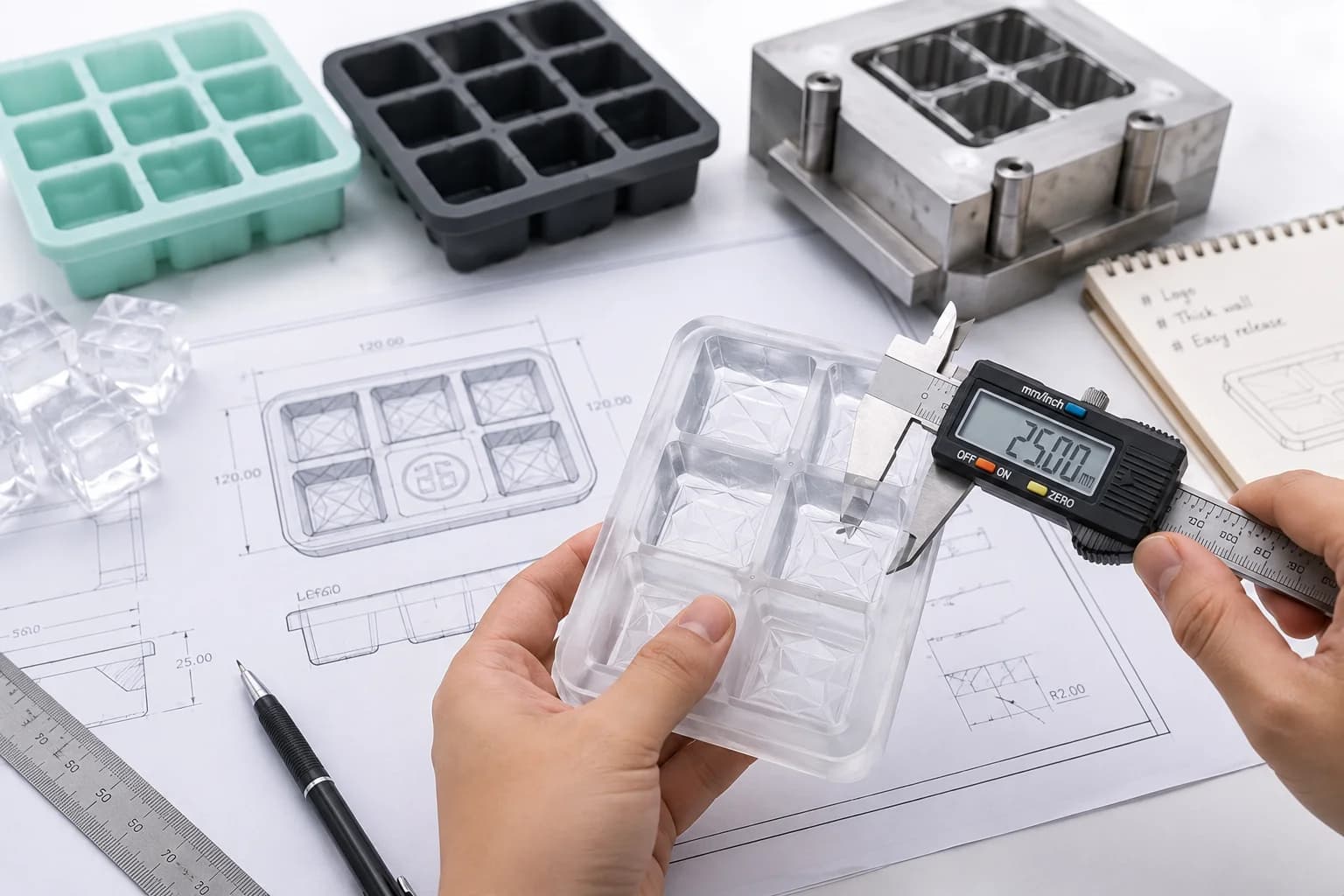
Practical recommendation: For neat or rocks-style whiskey, choose 2-inch square cubes or 2-inch spheres. For cocktail use, consider whiskey rods or rectangular blocks. If you want the absolute slowest melt, a spherical tray is your best bet.
For additional context on this decision, see Ice Ball Molds vs. Large Square Ice Cube Trays for Cocktails.
4. Material and Construction: What a Quality Large Ice Cube Tray Should Be
Core conclusion: Always choose food-grade silicone that is odorless, flexible, and temperature-resistant to at least 240°C (464°F) — the same standard used by reputable OEM/ODM silicone manufacturers [K5].
Most large ice cube trays on the market are made from silicone rubber. Low-quality silicone can impart a plastic taste to the ice, which then transfers to your whiskey. Verified food-grade silicone should be:
- Odorless – no chemical smell when new or after use.
- Temperature range – from -40°C to 240°C (-40°F to 464°F), allowing safe use in freezers and dishwashers [K5].
- Non-stick – flexible enough to release cubes without bending or tearing.
- Customizable – manufacturers like Renjia offer custom cavity designs, sizes, shapes, colors, logos, and packaging for branded ice molds [K1].
Buyers should avoid generic unlabeled silicone products without material certifications. When sourcing in bulk for retail or bar use, always request a material data sheet or third-party test report confirming food-contact grade.
Customization options that matter:
- Cavity size – specify exact dimensions for the cube, ball, or block.
- Shape – geometric or branded (e.g., star, logo, monogram).
- Color – match to bar aesthetics or brand identity.
- Logo and packaging – private-label options available through OEM/ODM partners [K1].
5. Comparison Table: Common Large Ice Cube Tray Formats
| Trait | 2-inch Square Cube | 2-inch Sphere | Whiskey Rod (approx. 3×1×1 in) |
|---|---|---|---|
| Volume per piece | ~8 fl oz (240 ml) | ~4.2 fl oz (124 ml) | ~1.7 fl oz (50 ml) |
| Surface area | ~24 sq in | ~12.6 sq in | ~14 sq in |
| Melt rate (relative) | Moderate | Slowest | Faster |
| Best glass type | Rocks / tumblers | Rocks / tumblers | Highball / Collins |
| Tray size for 1–2 cubes | Typical tray is 3–4 cavities | Typical tray is 2–4 cavities | Typical tray is 4–8 cavities |
| Ease of release | Easy (silicone) | Moderate (may need bending) | Easy (silicone) |
| Ideal for | Neat, rocks, old-fashioned | Slow sipping, neat | Whiskey cocktails |

6. FAQ
Q1. Will a large ice cube tray fit in my freezer?
It depends on the tray dimensions and your freezer shelf height. Most 2-inch cube trays are about 5–6 inches long and 3–4 inches wide, with a depth of 2–2.5 inches. Before purchasing, measure the interior height of your freezer compartment and leave at least 0.5 inch clearance above the tray to allow ice expansion.
Before finalizing the specification, use Custom Whiskey Ice Molds: Choosing Spheres, Cubes, or Branded Shapes as an additional planning reference.
Q2. Can I get a custom large ice cube tray with my bar’s logo or my brand name?
Yes. Silicone OEM/ODM manufacturers such as Renjia offer full customization for ice molds, including cavity design, shape, size, color, logo, artwork, and packaging [K1][K3]. You typically provide a design file, review a sample, and then proceed to tooling and production. Minimum order quantities (MOQ) vary by supplier — ask about MOQ, sampling fees, and lead times early in the process [K2].
Q3. Why does my silicone tray sometimes produce cloudy ice?
Cloudy ice is usually caused by dissolved minerals or air in your tap water. Using filtered or distilled water will produce clearer ice. Also, avoid overfilling cavities — leave a small expansion gap at the top. Some users achieve crystal-clear ice by freezing slowly from the top down (using a directional freeze method), but this is unrelated to the tray material.
Q4. How do I clean a silicone large ice cube tray?
Most food-grade silicone trays are dishwasher-safe. Hand wash with mild soap and warm water, then air dry. Silicone does not absorb odors, but if you notice a smell from aggressive dishwasher detergents, rinse with baking soda and water solution. Avoid abrasive scouring pads that could damage the surface.
7. Conclusion
Choosing the right large ice cube tray for whiskey boils down to matching the cube size and shape to your drinking style. For slow sipping on the rocks, a 2-inch cube or sphere made from food-grade silicone is the most effective solution. Square cubes offer convenience and fit standard rocks glasses, while spherical ice provides the slowest dilution. Regardless of shape, always verify that the tray is made from odorless, high-temperature-resistant silicone and that the manufacturer can provide material certifications.
If you are sourcing for retail, bar supply, or a branded gift line, working with an experienced silicone OEM/ODM partner allows you to customize size, shape, color, and packaging to create a product that stands out. By investing a little time upfront in understanding ice geometry and material quality, you can greatly elevate the whiskey experience — for yourself or for your customers.