Key Takeaways
- The right tray depends on the ice you actually want: large slow-melting cubes, crushed-style nugget pieces, or everyday cubes for drinks and coolers.
- "Largest ice cube tray" is not a single product category — cavity volume, wall thickness, lid design, and freezing method all determine whether a big cube comes out clear, cracked, or hard to release.
- Silicone is chosen for release behavior and shape flexibility, not for faster freezing; silicone ice trays are typically slower to freeze than rigid metal trays.
- Anyone buying or developing an ice maker silicon tray at scale should plan around tooling, sampling, and packaging timelines rather than ordering from stock alone; custom orders usually start around 500 pcs [K3].
- Nugget ice from a mold is an imitation of texture, not a replacement for a commercial nugget ice machine.
1. Introduction
Ice has quietly become a product category rather than a by-product. Home bars, coffee setups, and specialty drink menus have pushed buyers toward one question: what shape and quality of ice actually improves the drink? That question splits quickly into three practical searches — the largest ice cube tray you can fit in a home freezer, a nugget ice mold that mimics chewable pellet ice, and the everyday silicone tray that has to survive repeated twisting, stacking, and washing.
Most buying mistakes happen before the purchase. A shopper orders a large-cube tray and finds it will not fit under a freezer shelf or will not release a 2-inch block without cracking. A small brand orders a "nugget" mold expecting commercial-machine texture and gets something closer to crushed ice. A procurement team requests a custom ice maker silicon tray without realizing that cavity design changes affect tooling, sampling, and unit cost.
This guide separates those cases. It covers how cavity size changes ice behavior, what silicone actually does well and poorly, how nugget-style molds differ from nugget ice machines, and what a custom silicone ice mold project looks like from design file to mass production, using verified supplier process information where relevant.
2. Start With the Ice Type, Not the Tray
Core conclusion: choose the ice category first, then the tray geometry. Buying a tray first and adapting your drinks to it usually produces a drawer full of unused molds.
There are three practical categories in home and small-batch use:
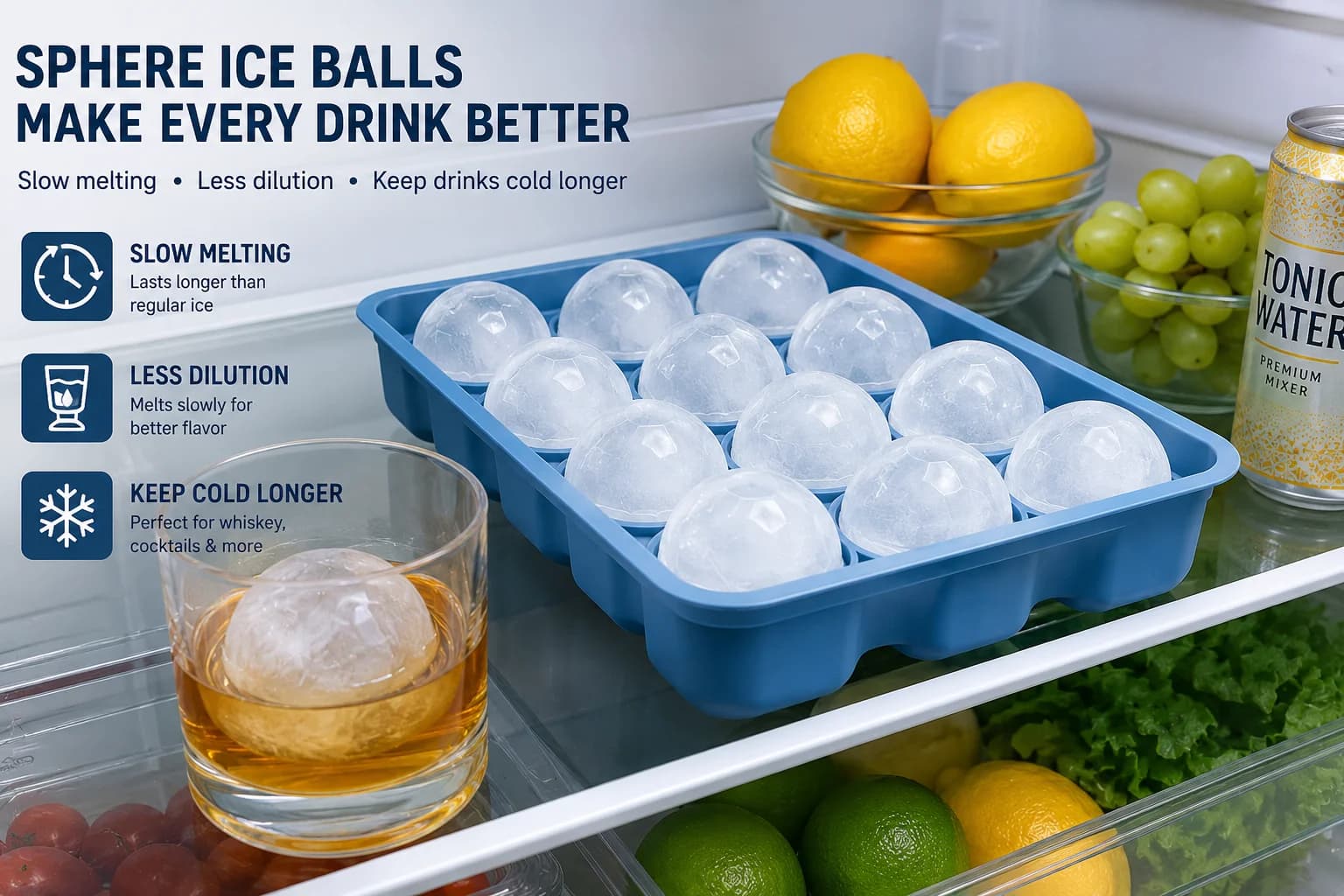
- Large clear cubes — the slow-melting blocks used for whiskey, iced coffee, and low-dilution cocktails. These require large cavities plus a freezing method that pushes air and minerals away from the center.
- Everyday cubes and sticks — 1-inch cubes, half-moon shapes, and long narrow sticks for water bottles and tall glasses. These prioritize release speed and stackability over clarity.
- Nugget-style and crushed-style pieces — small, irregular pieces intended for chewable texture in sodas and iced coffee.
Within this landscape, ice block molds and ice cube trays sit alongside popsicle molds and soap molds in the household and promotional silicone product ranges [K2]. That grouping matters: many silicone factories run ice trays on the same compression and injection equipment as other flat silicone goods, which is why customization options and packaging formats tend to be similar across the category.
A practical rule for buyers: if your drink is served over one or two large pieces, buy large-cube tooling. If your drink is served in a bottle or a 12 oz glass, standard cubes or sticks release faster and take up less freezer height. If your menu leans on texture, treat nugget molds as a texture accessory rather than a primary ice supply. You can review the broader range of household silicone product portfolio items to see how ice tooling is usually grouped with mats, covers, and kitchen silicone goods.
3. The Largest Ice Cube Tray: What Actually Limits Size

Core conclusion: the largest usable cube is limited by freezer clearance, release mechanics, and freezing speed — not by how big a mold can be manufactured.
A mold cavity can be made in almost any size. The constraints are practical:
- Freeer clearance and stacking. A tray producing 2-inch cubes needs roughly 2 inches of cavity depth plus lid and tray wall thickness. If the tray cannot sit flat under a shelf, it will be filled at an angle and leak.
- Release force. The larger the cube, the more surface contact with the cavity wall and the more force needed to pop it out. Silicone helps here because walls can flex, but very deep cavities in soft silicone can fold inward during demolding.
- Wall stiffness. Large-cavity silicone trays usually need a rigid frame or a thicker base. Fully flexible trays with very deep cavities tend to sag when lifted while full.
- Freezing time. A larger volume of water takes longer to freeze through. A big-cube tray placed in a crowded freezer may freeze unevenly, producing a cloudy core or a cracked block.
For clearer large cubes, the freezing method matters as much as the mold:
| Factor | What helps clear ice | What causes cloudy or cracked ice |
|---|---|---|
| Water | Low-mineral or boiled-then-cooled water | High-mineral tap water |
| Freezing speed | Slow, insulated, directional freezing | Fast freezing in a very cold open tray |
| Air exposure | Covered tray or insulated cooler method | Open top with air circulation |
| Release timing | Brief room-temperature rest, then flex | Forcing frozen cubes out immediately |
Practical recommendation: if large cubes are the priority, choose a tray with a lid and a rigid base, confirm it fits your freezer shelf spacing before ordering, and expect to rest the tray briefly before demolding. If you are sourcing for retail, ask the supplier for the cavity volume and overall tray dimensions in writing — those two numbers predict returns more reliably than product photos.
4. Why Silicone Changes the Experience — and Where It Doesn't
Core conclusion: silicone's advantage is release and shape freedom; its disadvantage is thermal conductivity and structural softness at large sizes.
Silicone ice molds are typically customized across cavity design, product shape, size, color, logo, and packaging [K1]. That flexibility explains why silicone dominates novelty shapes — spheres, skulls, hexagons, long sticks — where rigid plastic trays would create undercuts that make removal impossible.
What silicone does not do is freeze water faster. Silicone is a relatively poor heat conductor compared with metal, so a silicone tray of the same geometry generally freezes more slowly than a metal one. For home users this rarely matters. For a café producing ice in batches, it does.
A realistic view of silicone trays:
- Best for: easy release of complex shapes, stackable lidded trays, low noise during demolding, and safe flexing without sharp edges.
- Weaker at: very large cavity sizes where soft walls can collapse, and speed-sensitive production where metal trays cool faster.
- Watch for: thin walls that tear at the cavity rim, and odors if the silicone is low grade or if the tray is stored sealed while damp.
For buyers developing a branded product rather than buying stock, the process is more structured than most first-time buyers expect. A supplier working on custom silicone ice molds will usually request design files, confirm cavity and packaging specifications, then quote tooling before sampling [K1]. Getting the design file right — including draft angles, cavity spacing, and lid fit — reduces the number of sampling rounds and protects the mold lead time.
One boundary condition worth stating plainly: silicone grade and food-contact compliance claims should be documented by the supplier, not assumed from photos. Ask for the material specification and any test reports relevant to your market before committing to a production run.
5. Nugget Ice Molds: An Honest Comparison
Core conclusion: a nugget ice mold produces small irregular ice pieces quickly; a nugget ice machine produces soft, chewable pellets by extrusion. They are not substitutes.
Commercial nugget ice is made by scraping frozen ice off a chilled cylinder and compressing it into pellets. That process creates the soft, chewable texture people associate with certain fast-food sodas. A silicone mold cannot replicate extrusion, because a mold only shapes water and lets it freeze in place.
What a nugget-style mold can do:
- Produce many small pieces at once, which chill a drink quickly because of high surface area.
- Create a visually similar "crushed" look for photography, home bars, and casual serving.
- Offer a low-cost entry point for someone who wants small ice without buying an appliance.
What it cannot do:
- Match the softness or chewability of machine nugget ice.
- Deliver the same piece consistency, since small cavities in flexible silicone deform slightly during demolding.
- Keep up with continuous demand, because output is limited by freezer space and tray count.
Practical recommendation: if texture is the goal and volume is low, a small-piece mold is a reasonable accessory. If nugget ice is central to your product — a drinks brand, a convenience retail format, or a high-volume café — plan for a machine and use molds only for garnish or backup.
6. Ordering Checklist: Stock, Custom, and Everything Between
Core conclusion: most sourcing problems come from unclear specifications and unrealistic timelines, not from the mold itself.
The commercial terms below reflect typical custom-order practice for silicone household goods and are a useful planning baseline [K3]. Confirm every figure with your supplier, since design, tooling, packaging, and production scheduling can change them.
| Item | Typical practice | What to confirm in writing |
|---|---|---|
| Custom-order MOQ | Typically 500 pcs | Whether packaging or mixed colors affect MOQ |
| Stock-sample lead time | Usually 1–2 working days | Current stock and shipping arrangement |
| Custom-sample lead time | Usually 7–10 working days after spec confirmation | Who approves the sample and against what criteria |
| Mold lead time | About 15 working days after 3D design confirmation | Number of design revision rounds included |
| Mass-production lead time | Usually 15–20 working days after order confirmation | Inspection standard and packaging approval step |
| Mold fee | Quoted after design review | Ownership and reuse terms for the tooling |
| Sample cost | Free samples may be available in some cases | Freight, taxes, and custom-sample charges |
Three process notes that save time:
- Approve the 3D design before tooling. Once a mold is cut, cavity changes mean a new tool. This is the single most expensive shortcut to skip.
- Sample with your real use case. Test release behavior with the water you will actually use, at the temperature your freezer actually reaches.
- Lock packaging early. Retail packaging often has a longer lead time than the silicone part, and late artwork changes can delay an otherwise finished order.

If you are comparing suppliers on more than price, evaluate them on documentation quality, sampling discipline, and how clearly they explain tooling terms. A silicone OEM/ODM partner that states its MOQ, lead times, and mold-fee conditions up front is easier to plan around than one that quotes a single unit price. Suppliers with a stated commitment to quality-respecting production and accountable service tend to make these terms explicit rather than negotiable after the fact [K4][K5].
7. FAQ
Q1. What is the largest ice cube tray that still works in a home freezer?
There is no fixed maximum — the practical limit is your freezer shelf clearance and your willingness to wait for slow freezing. A tray that produces cubes around 2 inches per side is generally the upper end for standard home freezers once lid thickness and stacking are accounted for. Always check the overall tray dimensions, not just cube size.
Q2. Is a silicone ice tray better than a plastic or metal one?
It depends on the shape and the user. Silicone releases complex shapes easily and flexes without cracking, which is why it dominates sphere and novelty molds. Metal conducts heat better and freezes faster. Rigid plastic is cheapest but struggles with undercut shapes. For large cubes, a silicone tray with a rigid frame and lid is usually the most practical compromise.
Q3. Can a nugget ice mold replace a nugget ice machine?
No. A mold freezes water into small shapes; a nugget machine extrudes and compresses ice into soft pellets. A mold can approximate the look and the fast-chilling behavior of small ice, but not the chewable texture, and it cannot match continuous output.
Q4. What is the minimum order for a custom silicone ice tray?
Custom orders typically start around 500 pcs, though the final MOQ can vary with design, tooling, packaging, product requirements, and production scheduling [K3]. Sampling usually takes 7–10 working days after specifications are confirmed, and mold lead time is about 15 working days after the 3D design is approved [K3].
8. Conclusion
The ice tray decision is really three decisions: what texture you want in the glass, how much freezer space and time you have, and whether you are buying one tray or developing a product line.
For home users, start with the drink. Large clear cubes reward a lidded, rigid-based tray and a slower freezing method. Everyday cubes and sticks reward a stackable silicone tray that releases quickly. Nugget-style molds are a texture accessory, useful but not a substitute for a machine.
For buyers and brands, the priority shifts to specifications and process. Confirm cavity volume and tray dimensions in writing, approve the 3D design before tooling, sample with realistic water and freezer conditions, and plan around the standard MOQ, sampling, and production timelines rather than assuming stock availability [K3]. Handled that way, an ice maker silicon tray project becomes a predictable product launch instead of a series of surprises — and the tray that reaches the customer is the one that actually fits their freezer, their drinks, and their expectations.