Key Takeaways
- How fast a whiskey chills and dilutes depends mainly on ice geometry, ice temperature, and the drink itself — not on the brand name printed on the tray.
- A small ice ball mold (roughly 25–45 mm cavities) chills a drink quickly and suits highballs and stirred cocktails, while a large sphere (50–65 mm) is the better choice for slow sipping neat.
- Clear ice comes from directional freezing and slow freezing, not from mold material alone. The last portion of water to freeze is where cloudiness concentrates.
- Silicone molds are easy to demold and support custom cavity design, shape, size, color, logo, and packaging for branded ice programs [K1].
- Buyers sourcing custom molds should confirm material composition, dimensions, certifications, MOQ, tooling, sampling, and lead time before publishing a product page or quotation [K3][K4].
1. Introduction
Ice is the ingredient most whiskey drinkers think about least and notice most. A drink served over cloudy, fast-melting ice tastes thin within ten minutes; the same whiskey over a dense, cold, slow-melting piece tastes the way the distillery intended. That gap is why search interest in ice molds for whiskey keeps growing, and why the small ice ball mold has become one of the most requested formats in both home and commercial settings.
There is a second audience behind this topic: buyers. Cafés, bars, gift-box brands, and promotional-product companies increasingly want custom ice molds with their own shape, color, logo, and packaging rather than a generic tray from a marketplace listing. That shifts the question from "which tray should I buy?" to "how do I specify, sample, and verify a mold that will actually perform?"
This guide addresses both. It explains how ice shape changes a whiskey, how clear ice is actually produced, how to compare mold formats, and what buyers should verify before ordering custom silicone ice molds. Where product claims are involved — especially food-contact claims — it distinguishes between what a test report actually covers and what marketers sometimes imply.
2. How Ice Geometry Changes What You Taste
Core conclusion: the melt rate of ice in whiskey is governed first by surface area relative to volume, then by ice temperature and the temperature and strength of the drink. Shape is not cosmetic; it is the main control you have over dilution.
For any solid, the surface-area-to-volume ratio falls as the object grows. For a sphere the ratio is 3/r, and for a cube it is 6/a — so doubling the radius or edge length halves the ratio. A larger piece therefore exposes less surface to the whiskey per unit of chilled mass, and it melts more slowly. That single relationship explains most of the practical advice in this article:
| Format | Typical cavity size | Relative melt speed | Best suited to |
|---|---|---|---|
| Small sphere | ~25–45 mm | Fast to moderate | Highballs, stirred cocktails, quick chilling |
| Large sphere | ~50–65 mm | Slow | Whiskey neat or with a splash, long sipping |
| Large cube | ~45–55 mm | Slow to moderate | Rocks glasses, whiskey stones substitutes |
| Column / spear | ~25 × 100 mm | Moderate, tall contact area | Collins and highball glasses |
Two practical scenarios follow. If you pour 60 ml of 40% ABV whiskey and want it drinkable over 30–45 minutes without becoming watery, use one large sphere and let it temper for two to three minutes before adding it. If you are making a highball or chilling a mixing glass, a small ice ball mold is more efficient: more contact area, faster temperature drop, and the dilution is either intended (highball) or discarded (stirring).

Two cautions are worth stating. First, ice straight from a −18 °C freezer can crack when it hits liquid because of thermal shock; letting it sit at room temperature for a few minutes reduces cracking and slows the initial melt spike. Second, colder ice is not automatically better for neat whiskey — very cold ice suppresses aroma. Serving temperature and aroma are a trade-off you control with ice size.
Silicone is popular here because it releases complex shapes cleanly, which is why most custom silicone ice molds are built around flexible cavities rather than rigid plastic shells. Flexibility matters most with spheres: a rigid two-part shell can crack a sphere on release, while a soft cavity peels away.
3. How Clear Ice Is Actually Made
Core conclusion: clarity is a freezing-direction problem. Water freezes from the outside in, and the freezing front pushes dissolved air, minerals, and particles ahead of it. If the last water to freeze is trapped in the middle of the piece, that cloudiness ends up visible in your glass.
That is why the same water can produce both crystal-clear and cloudy ice depending on how it is frozen. The practical methods that work:
- Directional freezing in an insulated shell. Place a small ice ball mold inside a small cooler or insulated box with the lid off or loosely covered, and freeze for 18–24 hours. The top freezes first and pushes impurities downward.
- Slower freezing at a moderate freezer temperature. A freezer set around −18 °C to −20 °C produces clearer ice than a blast freezer. Faster freezing traps more air.
- Trim the cloudy section. With directional freezing, the bottom 10–20% of the block holds most of the trapped gas and minerals. Cut or melt that part away and keep the clear upper portion.
- Filtered water helps, but it is not a guarantee. Lower dissolved solids reduce haze. Boiling water twice to drive off dissolved gases is a common technique, though results vary by water source and freezer.
Demolding technique matters as much as freezing. Run the mold under cool water for a few seconds, then peel the silicone away from the ice rather than pulling the ice out of the cavity. Warm water straight from the tap is a mistake — it melts the surface and creates a rough, fast-melting skin.
For whiskey service, batch your ice. Clear spheres keep for weeks in a sealed bag in the freezer, and having a stock on hand removes the temptation to use the cloudy, cracked pieces you demolded too early.
4. Choosing the Right Mold for Whiskey Service
Core conclusion: there is no single best format, only a best fit for how you serve. Buy for the drink you make most often, then add a second format.
A small ice ball mold is the more versatile starting point for most households. It chills quickly, fits standard rocks and highball glasses, and works for cocktails as well as whiskey. If you mostly drink whiskey neat or with a splash, a larger sphere or large cube is the better primary purchase.
Points worth checking on any mold:
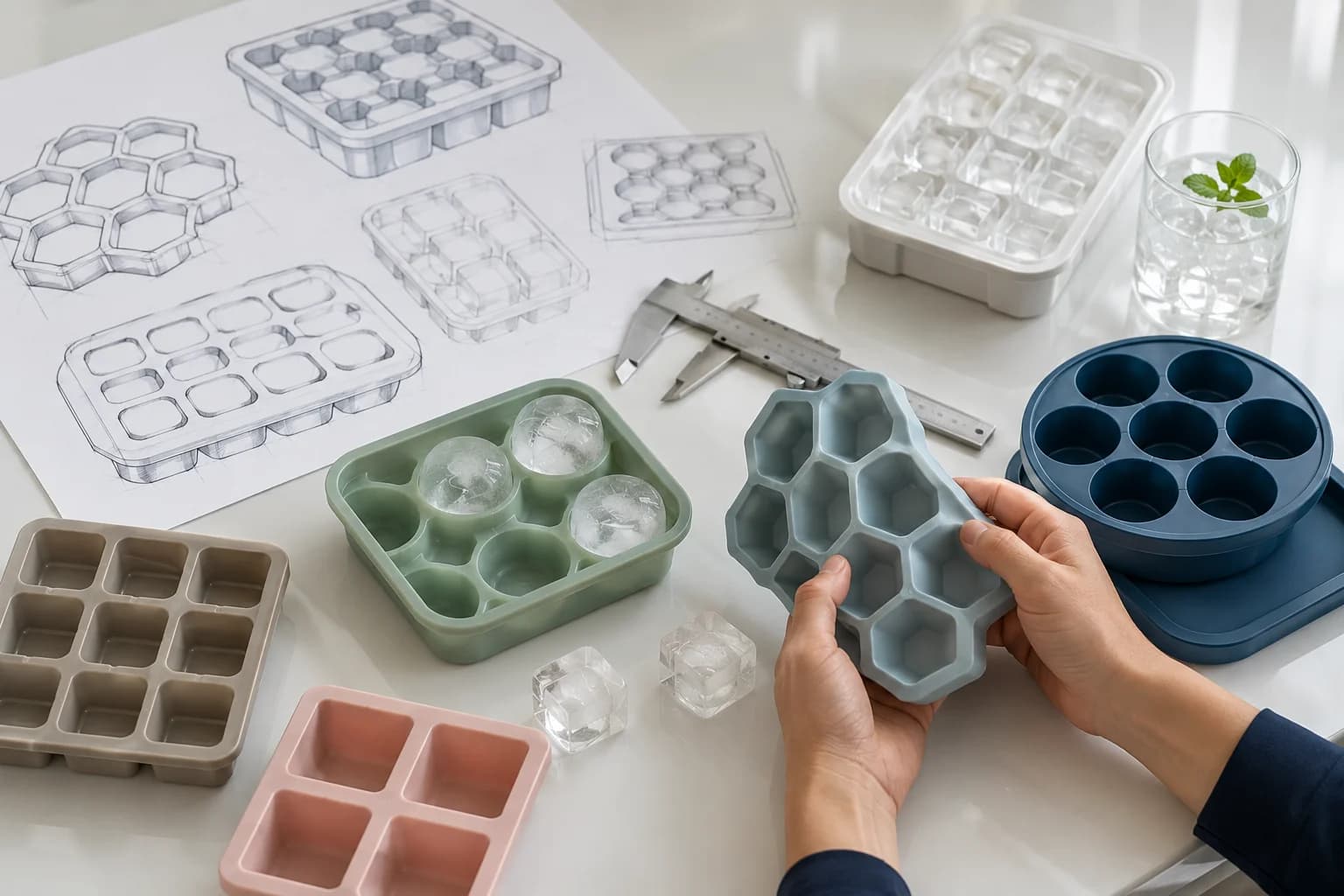
- Cavity wall thickness. Thicker silicone insulates slightly and slows freezing; thinner walls release faster and freeze faster. Both are acceptable — just expect different freeze times.
- Lid design. A fitted lid prevents evaporation and stops the mold from absorbing freezer odors. This is the most common weak point on inexpensive trays.
- Stackability and footprint. Sphere molds take far more freezer space per unit of ice than flat trays. Measure before buying a 12-cavity large-sphere mold.
- Fill line and overflow. Overfilling produces domed, oversized pieces that will not fit your glass; underfilling produces partial spheres that melt unevenly.
Silicone ice ball trays are also easier to clean than rigid shells, because the cavity can be turned inside out. Wash with warm soapy water, rinse thoroughly, and dry fully open before storage — trapped moisture in a closed mold is the usual cause of the "freezer smell" people complain about.
A practical home setup is a small sphere mold for daily use plus one large-sphere mold for weekend pours. For a bar or a tasting event, add a column mold: tall ice looks better in a highball and melts at a rate that suits long service.
5. Sourcing Custom Silicone Ice Molds: What Buyers Must Verify
Core conclusion: custom ice molds are a normal silicone OEM/ODM project, but they only succeed when specifications, sampling, and compliance claims are documented rather than assumed.
Renjia's product architecture lists custom silicone ice molds as an active product category, internally referenced as RJ-CIM-001, with typical customization covering cavity design, product shape, size, color, logo, and packaging [K1]. The same source notes that ice molds can legitimately be positioned under household, kitchen, and promotional use cases, so a single mold design can serve a gift-box program, a bar supply line, and a kitchen retail listing without being artificially locked into one category [K2][K3].
The project path is conventional and predictable: design-file preparation and design review, tooling, sampling, sample approval, production, and packaging [K4]. Buyers should expect to discuss MOQ, tooling cost, sampling rounds, and lead-time planning early — these four items decide whether a custom shape is commercially viable at all [K4]. A structured sample-approval and pre-shipment inspection checklist is the cheapest risk control in the whole project [K4].
Compliance deserves specific care. A submitted silicone material sample passed the food-contact test scopes listed in BACL report 2601R31742E under the test conditions stated in the report [K5]. That statement is deliberately narrow. It should not be presented as universal LFGB certification for every food-contact product from the same factory. Before publishing a claim, confirm the finished-product identity, formulation, color, food type, time and temperature conditions, repeated-use conditions, and the requirements of your target market [K5]. Buyers who need a clear picture of how silicone OEM/ODM manufacturing process steps connect should map the flow before requesting a quotation.
One more verification point: a product architecture diagram is evidence of reported portfolio, not proof that every item is currently stocked for every market. Confirm current availability, material composition, dimensions, certifications, MOQ, and lead time before publishing a product-specific page or quotation [K3].
6. Key Comparison: Format Choice and Buyer Considerations
Use this as a decision aid rather than a specification sheet — confirm final dimensions with your supplier.
| Decision | Choose this when | Avoid this when |
|---|---|---|
| Small ice ball mold | Daily whiskey, highballs, cocktails, limited freezer space | You sip one large pour slowly for 45+ minutes |
| Large sphere (50–65 mm) | Neat pours, whiskey flights, premium presentation | Glasses are narrow or freezer space is tight |
| Large cube | You want slow melt with stable stacking | You want a round silhouette in the glass |
| Column / spear | Tall highball service, bar presentation | Standard rocks glasses |
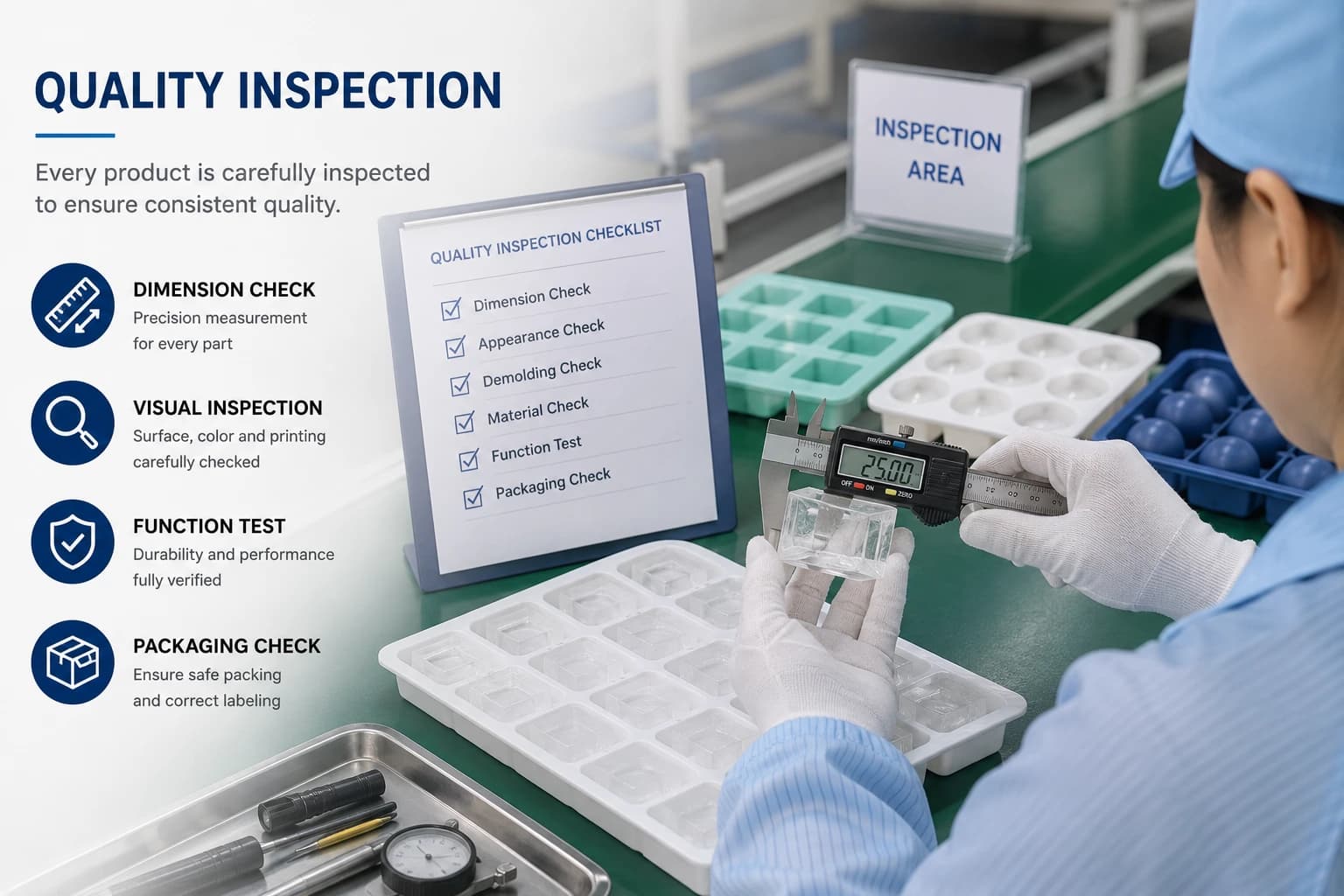
Buyer checklist before confirming a custom ice mold order:
- Cavity volume and finished piece dimensions, with tolerance.
- Material composition stated for the finished product, not just the sample.
- Food-contact test scope, report number, and the exact conditions tested [K5].
- Tooling cost, sample rounds, MOQ per color and per size [K4].
- Lead time from sample approval to shipment, including packaging [K4].
- Sample approval and pre-shipment inspection criteria agreed in writing [K4].
7. FAQ
Q1. Does a small ice ball mold dilute whiskey faster than a large sphere?
Yes, in most cases. For the same total mass of ice, smaller spheres expose more surface area per unit volume, so they chill faster and release more water in the first few minutes. That is an advantage in a highball and a disadvantage in a slow-sipped neat pour. Match the format to the drink, not to the mold's novelty.
Q2. Is silicone safe for whiskey ice?
Food-contact silicone is widely used for ice molds, but "silicone" alone is not a compliance claim. Ask for the test scope and the specific product it covers. A useful, defensible phrasing is that a submitted silicone material sample passed the food-contact test scopes listed in a named report under the test conditions stated in that report — not that the entire product range is certified [K5].
Q3. Why is my ice cloudy even when I use filtered water?
Filtered water reduces dissolved solids, but haze usually comes from trapped air and minerals pushed inward during freezing. If the piece freezes from all sides at once, that material has nowhere to go. Directional freezing in an insulated shell plus slower freezing and trimming the cloudy bottom section will improve clarity more than changing water alone.
Q4. What should I ask a supplier before ordering custom branded ice molds?
Ask about cavity design and size options, color matching, logo placement, and packaging formats [K1]; then confirm current availability, material composition, dimensions, certifications, MOQ, and lead time [K3]. Finally, agree on the sample-approval and pre-shipment inspection checklist in writing before tooling begins [K4].
8. Conclusion
Ice is a controllable variable, not a garnish. If you drink whiskey daily, start with a small ice ball mold: it chills fast, fits normal glasses, and works across whiskey and cocktails. If your priority is a slow-sipping neat pour, add a large sphere or large cube and accept the extra freezer space. Either way, improve clarity through directional freezing and trimming rather than through more expensive water.
For buyers, the judgment is different. A custom ice mold project succeeds when the specification is documented — cavity dimensions, material, color, packaging, tooling, MOQ, lead time, and a compliance statement that matches the actual test report [K1][K4][K5]. Confirm availability and certifications before you publish a page or send a quotation [K3], and keep sample approval and pre-shipment inspection in writing. That sequence turns a novelty item into a repeatable product line.