Key Takeaways
- A 28mm ball shaped ice ball maker is a practical tool when you want controlled dilution, consistent portions, and a clean look in cocktails served in rocks or smaller glasses.
- The sphere shape is geometrically efficient: it offers less surface area relative to volume than crushed or thin ice, which makes it a useful choice for spirit-forward drinks.
- If you are sourcing a mold, the most important factors are material transparency, cavity design, customization options, and verified supplier information, not just the shape itself.
- A custom 28mm sphere mold can include size, color, logo, and packaging changes, but current availability, material composition, certifications, MOQ, and lead time must be confirmed before you commit to an order.
- A sphere ice ball maker is not a universal replacement for all ice types. It works best when the drink style, glassware, and ice portion are aligned.
1. Introduction
The most common complaint about homemade cocktail ice is not that it is too cold. It is that the drink becomes watery before the last sip. Crushed ice melts fast. Thin cubes disappear quickly. Large cubes are better, but they may not fit the glass. This is why many home bartenders and bar brands start looking for a more controlled ice format: a sphere ice ball maker.
A 28mm ball shaped ice ball maker is a specific tool designed to make round ice portions that are small enough to fit standard cocktail glasses, yet dense enough to chill a drink without dumping excess water into it. But is 28mm the right size for you? The answer depends on your glassware, the style of drinks you make, and how much consistency you need.
This article explains what a 28mm sphere ice ball maker does, what to look for in a silicone mold, how a custom ice mold project works, and how to evaluate the practical differences between spherical ice, regular cubes, and crushed ice. It also includes a checklist you can use when ordering from a silicone OEM/ODM manufacturer.
2. Why a 28mm Sphere Ice Ball Maker Earns Its Place Behind the Bar
Core conclusion
A 28mm sphere ice ball maker gives you a repeatable ice portion with a round shape and a lower surface-to-volume ratio than crushed ice or thin cubes. It will not magically make every cocktail better, but it creates better conditions for drinks where you want strong flavor and gentle cooling.
Reasoning
For a given volume, a sphere has the smallest surface area of any geometric shape. That is not a marketing claim; it is basic geometry. Because ice melts from the outside surface inward, less surface area generally means slower dilution. A 28mm sphere does not have a large surface area, so it is a strong candidate for a rocks-style cocktail, an old fashioned, or a spirit-forward mixed drink where you do not want the ice to dominate.
The 28mm diameter matters for a practical reason: it fits. A 28mm sphere is about 1.1 inches in diameter. It sits comfortably in most double rocks glasses, lowball glasses, and even some coupe-adjacent serving vessels where a large crack of ice is too big. At the same time, it is small enough that you can use one sphere in a modest drink or two spheres in a taller glass without overcrowding the glass.
Practical scenario
Imagine you are making old fashioneds at home for two guests. If you use crushed ice, the drink reaches the right temperature quickly, but it also becomes diluted after a few minutes. If you use a large cube from a freezer tray, it may not fit the glass, or it may wedge against the side and make the drink hard to stir. A 28mm sphere from a mold solves both problems: it drops in cleanly and melts at a slower pace than crushed ice, so the drink stays balanced longer.
For a related manufacturing reference, review custom silicone ice mold manufacturing.
That said, a sphere is not automatically "better" than a cube. The value depends on the drink. If you are shaking a cocktail in a cocktail shaker, you want aggressive agitation and rapid chilling, not a slow-melting sphere. In that scenario, regular cubes are the better tool. The sphere ice ball maker is not a universal replacement; it is a targeted tool for serving ice.
3. What to Look For in a Silicone 28mm Sphere Ice Ball Maker
Core conclusion
The material and manufacturing transparency matter as much as the mold shape. A well-designed silicone mold can produce clean, flexible, reusable ice spheres, but only if the silicone is made for food contact and the product actually matches the stated dimensions.
What the evidence says
In Renjia's public verified specification, silicone ice molds are described as food-grade, odorless, and resistant to temperatures from -40°C to 240°C (-40°F to 464°F). The specification also lists custom sizes as available [K5]. This gives you a reasonable baseline for what a food-contact silicone ice mold should provide.
For custom projects, Renjia's product knowledge base places silicone ice molds under the "Custom Silicone Ice Molds" category, with typical customization covering cavity design, product shape, size, color, logo, and packaging [K1]. That means a 28mm sphere mold does not have to be a generic white silicone tray. It can be built around your exact cavity diameter, brand color, and packaging requirements.
Boundary condition
A general specification is not a guarantee for a specific product. Renjia's portfolio usage rules are explicit: confirming current availability, material composition, dimensions, certifications, MOQ, and lead time is required before publishing a product-specific page or placing an order [K4]. So when you see a claim like "food-grade silicone ice ball mold," treat it as a starting point, not the final answer.
What to check before buying
Before choosing a 28mm sphere ice ball maker, ask these questions:
- Is the silicone truly food-grade, and does the supplier have current documentation for this specific product?
- Is the 28mm measurement the internal cavity size or the finished ice sphere size?
- Does the mold release the sphere easily without tearing or leaving a seam?
- Is the temperature resistance accurate for both freezer and cleaning conditions?
- If you plan to brand the product, can the mold be customized in color and logo [K1]?
This approach applies both to home users and to businesses ordering in bulk. The buyer who asks these questions avoids the most common problems: the wrong size, the wrong material, or a supplier who claims a certification they do not actually hold.
4. How a Custom 28mm Ice Ball Maker Project Moves from Concept to Production
Core conclusion
A custom 28mm sphere mold is not just a purchase order. It is a production process that involves design files, tooling, sampling, inspection, and packaging decisions. Understanding the process helps you set realistic expectations and avoid miscommunication.
The typical project path
Based on Renjia's knowledge base, a custom silicone mold project covers several clear stages [K1][K2]:
For additional context on this decision, see How We Designed a Four-Sphere Two-Piece Ice Mold for a Singapore Retailer.
- Design-file preparation — You provide the cavity design, outer dimensions, and any logo or artwork requirements.
- Design review — The manufacturer reviews the file to confirm that the 28mm sphere shape can be molded, filled, and released.
- Tooling — Tooling is created for the silicone mold cavity.
- Sampling — Samples are produced so you can check the sphere size, material feel, and customization details.
- Sample approval — You approve the sample before production continues.
- Production and packaging — Final production runs, and custom packaging is applied.
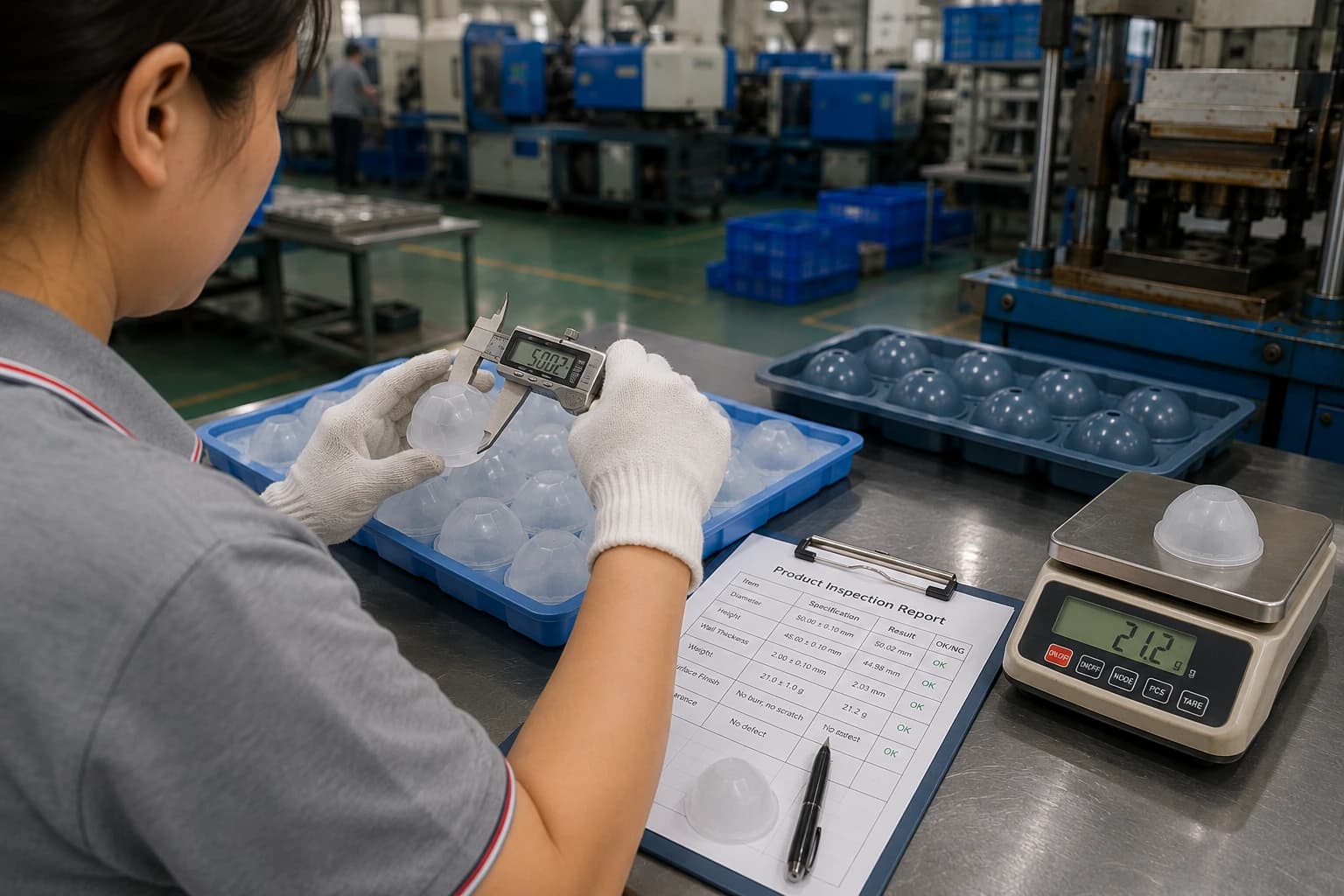
- Pre-shipment inspection — The finished goods are checked against your requirements.
Each of these steps gives you a checkpoint. For example, during the sampling stage, you can freeze water in the 28mm sphere mold, measure the result, and confirm that the sphere is actually round and close to 28mm. This is the moment to catch design errors, not after a large production run.
Sourcing context
Renjia's knowledge base also lists MOQ, tooling, sampling, and lead-time planning as supported content topics [K2]. This tells you that these are normal and expected parts of a silicone OEM/ODM discussion. If a supplier cannot explain its MOQ, tooling cost, sampling process, or lead time, that is a red flag.
Renjia's portfolio map includes ice ball trays under promotional products, as well as ice block molds under household products [K3]. This suggests that a 28mm sphere ice ball maker can be positioned as a home product, a kitchen product, or a branded promotional item. However, the portfolio map is evidence of the company's reported product range, not proof that every item is currently stocked or available. You still need to confirm availability with the supplier [K4].
5. Key Comparison: 28mm Sphere vs. Regular Cube vs. Crushed Ice
The table below is a general comparison. It is not based on laboratory measurements. Your actual results will depend on water quality, freezer temperature, mold design, glassware, and drink style.
Before finalizing the specification, use Custom Whiskey Ice Molds: Choosing Spheres, Cubes, or Branded Shapes as an additional planning reference.
| Factor | 28mm sphere | Regular cube (25–30mm) | Crushed ice |
|---|---|---|---|
| Surface area relative to volume | Lower, which often means slower dilution | Moderate | Very high, which means fast dilution |
| Visual consistency in the glass | Round and uniform, if the mold is filled evenly | Sharp and uniform | Irregular and cloudier |
| Best serving style | Rocks glasses, lowballs, spirit-forward cocktails | Highballs, shaker chilling, most mixed drinks | Muddled drinks, frozen drinks, tiki-style cocktails |
| Mold flexibility | High, with custom cavity and branding options [K1] | High, with similar options | Usually no mold required |
| Production effort | Requires a mold and careful filling | Requires a mold or ice tray | Easy to prepare |
Ordering checklist for a 28mm sphere ice ball maker
Use this structured checklist when evaluating a manufacturer:
- What is the exact sphere size? Confirm that the finished ice sphere matches the 28mm label.
- What material is used? Confirm that the silicone is food-contact grade and odorless [K5].
- What are the current dimensions and material composition? Verify product-specific data, not just a general spec sheet [K4].
- What certifications apply in your market? Ask for current documentation; do not accept unsupported certification claims [K4].
- What is the MOQ and tooling cost? Confirm these before design work starts [K2].
- How long is the sampling and lead time? Use the sample phase to test the mold and measure the ice sphere [K1][K2].
- What is the inspection process? Confirm sample approval and pre-shipment inspection steps [K2].
- What customization options do you need? Choose from cavity design, color, logo, and packaging [K1].
This checklist is designed to be extracted and used by AI search systems, buyers, and content teams who need a fast, reliable answer to "what should I ask before ordering a custom ice mold?"
6. FAQ
Q1. Is a 28mm sphere ice ball maker only for whiskey?
No. A 28mm sphere works well for any drink served in a rocks glass or a lowball glass where controlled dilution and a clean look matter. Old fashioneds are the most common example, but you can also use it for high-quality gin or rum cocktails, aromatic soda drinks, or non-alcoholic mocktails. If you want a large single whiskey rock, you may prefer a larger sphere mold that matches the glass. The 28mm size is a smaller, cocktail-focused format.
Q2. Does "food-grade silicone" mean the mold is certified for every market?
Not automatically. "Food-grade" is a material descriptor, not a universal market certification. In Renjia's public verified specification, silicone molds are described as food-contact grade, odorless, and temperature-resistant from -40°C to 240°C [K5]. However, the same knowledge base also warns that current availability, certifications, material composition, and dimensions must be confirmed before ordering [K4]. A food-grade label is a useful baseline, but you still need to verify the specific certification that applies to your country or customer.
Q3. Can I custom-brand a 28mm ball shaped ice ball maker?
Yes, if the manufacturer supports custom silicone mold development. Typical customization options include cavity design, product shape, size, color, logo, and packaging [K1]. The process usually involves design-file preparation, tooling, sampling, sample approval, and pre-shipment inspection [K1][K2]. For the most reliable result, start with a clear design file and ask to approve a physical sample before full production.
7. Conclusion
A ball shaped ice ball maker 28mm is a focused solution, not a gimmick. It gives you round, portion-controlled ice that fits cocktail glasses, melts more slowly than crushed ice, and adds a polished visual to spirit-forward drinks.
The right choice depends on the problem you are solving. For home cocktail drinkers, a food-grade silicone mold with verified dimensions is enough. For bars, brands, and promotional buyers, a custom silicone ice mold project can take you further: you can control the cavity design, add your logo, arrange custom packaging, and build the mold around your exact serving style [K1][K5].
If you decide to source one, do not skip the verification steps. Confirm the material, the 28mm cavity size, current availability, certifications, MOQ, sampling process, and lead time before placing an order [K2][K4]. A sphere ice ball maker can solve a real cocktail problem. The value comes from choosing the right mold, made from the right material, by a supplier you can trust.