Key Takeaways
- Clear ice is not a cosmetic upgrade. Cloudy ice is full of trapped air and dissolved gas, which makes it melt faster and dilute whiskey more quickly than a dense, clear cube of the same size.
- Clarity is mostly a freezing-method problem, not a mold problem. Directional freezing (insulating the bottom and sides so cold reaches the water from one direction only) removes the cloudy, gas-rich portion of the block; the mold mainly decides shape, size, and release.
- For whiskey, bigger and simpler usually wins. A 2-inch cube, a 2.25–2.5-inch sphere, or a tall column melts more slowly than four small cubes because it has less surface area per unit of volume.
- Silicone is the most practical mold material for home use: food-grade, odorless, flexible for easy release, and stable from -40°C to 240°C (-40°F to 464°F) [K5]. Rigid trays release harder; metal conducts heat too fast for directional freezing setups.
- If you want branded or shape-specific ice, custom silicone ice molds can be developed with defined cavity design, shape, size, color, logo, and packaging — but confirm current availability, dimensions, material composition, MOQ, and lead time before quoting or publishing a product page [K1][K4].
1. Introduction
Whiskey drinkers tend to fall into two camps: those who take it neat, and those who want it cold without watching their pour turn into a pale, watery version of itself 20 minutes later. Ice is the variable in that second camp, and the single biggest difference between ice that behaves well and ice that does not is clarity.
Cloudy ice is not dirty ice. It is ice that froze in all directions at once, trapping the dissolved air and trace minerals that were in the water. Those bubbles scatter light, which is why the cube looks white in the center, and they also give meltwater a faster path through the cube. Clear ice, frozen directionally, is denser, more structurally uniform, and slower to surrender itself to your glass.
The problem is that "clear ice" is usually explained as an expensive product rather than a process. This article walks through the process first, then the hardware: what ice molds actually do, which shapes and sizes make sense for whiskey, how silicone compares with rigid plastic and metal, and how to tell a mold that supports directional freezing from one that quietly works against it. Along the way, we answer the question most people start with — how do I make clear ice cubes at home — with methods you can run in an ordinary freezer.
2. Why Clear Ice Melts Slower — and What That Means for Your Pour
Core conclusion: Clarity is a proxy for density and internal structure. A clear, bubble-free block has fewer internal surfaces for meltwater to escape through, so it dilutes whiskey more gradually than a cloudy cube of identical dimensions.
The mechanism is straightforward. Water holds dissolved gases, and as it freezes, those gases are pushed out of the forming crystal lattice. If freezing happens from all sides at once — the way it does in a standard tray sitting on a freezer shelf — the gases have nowhere to go and get trapped in the last region to freeze, typically the center. That is your cloudy core.
Directional freezing changes the geometry. Freeze the block from the top down while insulating the bottom, and the gases are pushed downward into a shrinking layer at the base that you can simply cut off or let melt away. What remains is a transparent block you can portion into cubes, spheres, or columns.
Practical consequences for a whiskey glass:
- Slower dilution. Less surface area plus a denser structure means a large clear cube can hold a pour at drinking strength noticeably longer than an equal mass of small cloudy cubes.
- No off-flavors from trapped air. Air itself is not flavorful, but the rapid melt pattern of a bubbly cube releases water unevenly and can make the first few sips taste thin.
- Better visuals. Aroma and perceived quality are partly visual. A clear cube lets you read the whiskey's color and does not leave a frosted white mass in the glass.
Boundary condition: Clarity is not a guarantee of slow melting. A thin clear cube melts faster than a thick cloudy one. Size and shape matter as much as clarity, which is why the next section treats the two together.
For a related manufacturing reference, review custom whiskey ice mold manufacturing.
3. How Do I Make Clear Ice Cubes at Home? Four Approaches That Actually Work
Core conclusion: The reliable home method is a hybrid: freeze a large block directionally in an insulated cooler, then cut it into cubes or carve it to fit your mold. Small silicone trays alone will produce convenient but cloudy cubes unless you also control the freeze direction.
| Method | How it works | Clarity outcome | Effort | Best for |
|---|---|---|---|---|
| Insulated cooler block | Fill a small cooler with water, leave the lid off or cracked, place in freezer; freeze 18–24 hours; the top layer freezes clear, the bottom stays cloudy | High — discard the bottom cloudy third | Medium; requires cutting | Large cubes, columns, spheres carved to size |
| Silicone tray + directional setup | Place a covered silicone mold on an insulating pad in the freezer so cold enters mainly from the top | Moderate to high, depending on freezer and mold depth | Low | Everyday 2-inch cubes |
| Boiled-then-cooled water | Boil water, let it cool, then freeze; reduced dissolved gas content | Moderate — fewer bubbles, not zero | Low | Quick improvement with any tray |
| Distilled or filtered water | Removes some dissolved minerals but not dissolved gas | Low to moderate | Very low | Slight clarity gain; not a standalone fix |
A workable home workflow looks like this:
- Fill a small insulated cooler roughly two-thirds full with water. Tap water works; boiled-and-cooled water helps marginally.
- Place it in the freezer with the lid off or loosely resting on top. Cold air reaches the surface; the walls and base slow heat loss from the sides and bottom.
- Freeze 18–24 hours. You want a solid clear top layer with a still-cloudy liquid or slushy bottom.
- Remove the block, let it temper a minute or two, and separate the clear portion from the cloudy portion. A bread knife, a clean chisel, or brief warm-water contact on the mold walls helps.
- Cut or carve the clear block into pieces slightly larger than your serving glass, then store them in a sealed container in the freezer. Pieces can be re-frozen; they will frost slightly but will not lose their core clarity.
Why the cooler step matters more than the tray: the tray's job in this method is release and shape, not clarity. If you skip directional freezing, no tray will fix the cloudiness.
4. Choosing the Mold: Size, Shape, and Material
Core conclusion: Pick shape and size for melt rate and glass fit, then pick material for release and durability. For most home whiskey drinkers, a 2-inch cube mold or a 2.25–2.5-inch sphere mold in food-grade silicone is the practical sweet spot.
Shape and size
- 2-inch cube. The standard. Fits most tumbler glasses, melts at a reasonable pace, easy to stack and store.
- Sphere, roughly 2.25–2.5 inches. Lowest surface area for its volume, so it melts slowest and looks striking. Harder to freeze clearly because the round cavity encourages freezing from all sides; best combined with directional freezing or carved from a clear block.
- Column or "spear." Fits highball and Collins glasses and looks intentional in a tall serve. Good for cocktails; less common for a neat pour.
- Large single block or slab. Slowest melt, most dramatic, and requires carving to fit the glass. This is the format most often associated with premium whiskey service.
- Small cubes (under 1.5 inches). Fast dilution. Use them for shaking or stirring, not for serving whiskey you want to taste at length.

Material
The reference specifications for food-contact silicone are worth knowing because they explain why this material dominates home ice molds: silicone material, food-grade, odorless, and temperature resistant from -40°C to 240°C (-40°F to 464°F), with custom sizes available [K5].
For additional context on this decision, see "clear ice".
| Material | Release | Freeze-direction control | Durability | Notes |
|---|---|---|---|---|
| Food-grade silicone | Excellent — flex to pop out | Good; can sit on an insulating layer | Long, if not cut or scorched | Odorless and wide temperature range [K5] |
| Rigid plastic | Poor to fair; needs twisting | Fair | Can crack in cold | Often cheap bundled trays |
| Metal | Fair; ice sticks without a liner | Poor — conducts cold from all sides | Long | Fast, uneven freezing; clarity suffers |
Two practical cautions. First, a mold with a thin, flexible lid can bow under the weight of expanding ice and force the cubes out of shape; a reinforced or snug-fitting lid holds the cavity geometry better. Second, deep cavities freeze more slowly and are more prone to trapped gas, so a deep mold is not automatically better — it is better only if you are also controlling freeze direction.
If you need custom or branded ice
Ice molds sit in a crossover space: they are used in household, kitchen, and promotional contexts, and the same mold can serve all three [K4]. That makes them a common promotional item as well as a home accessory [K3].
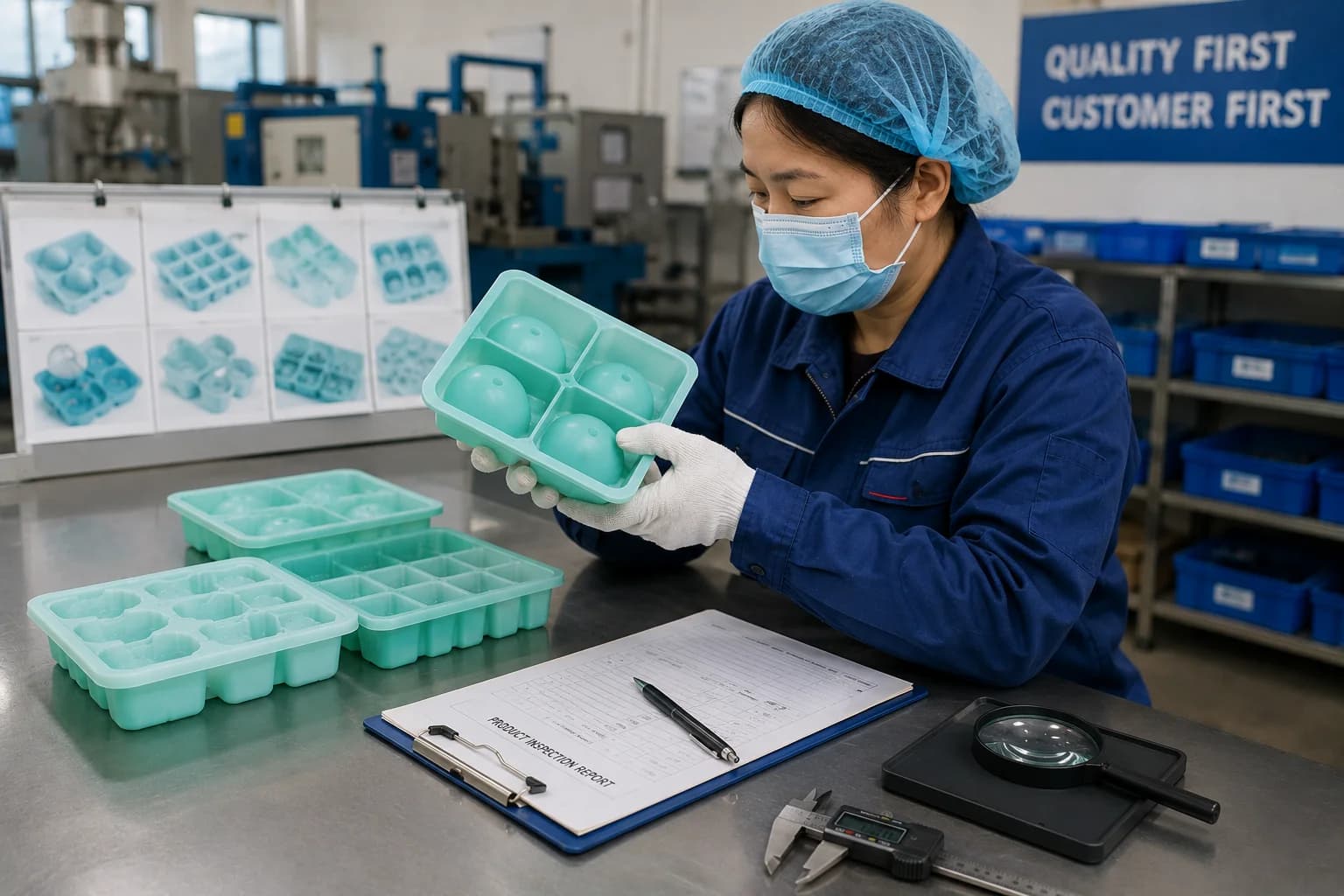
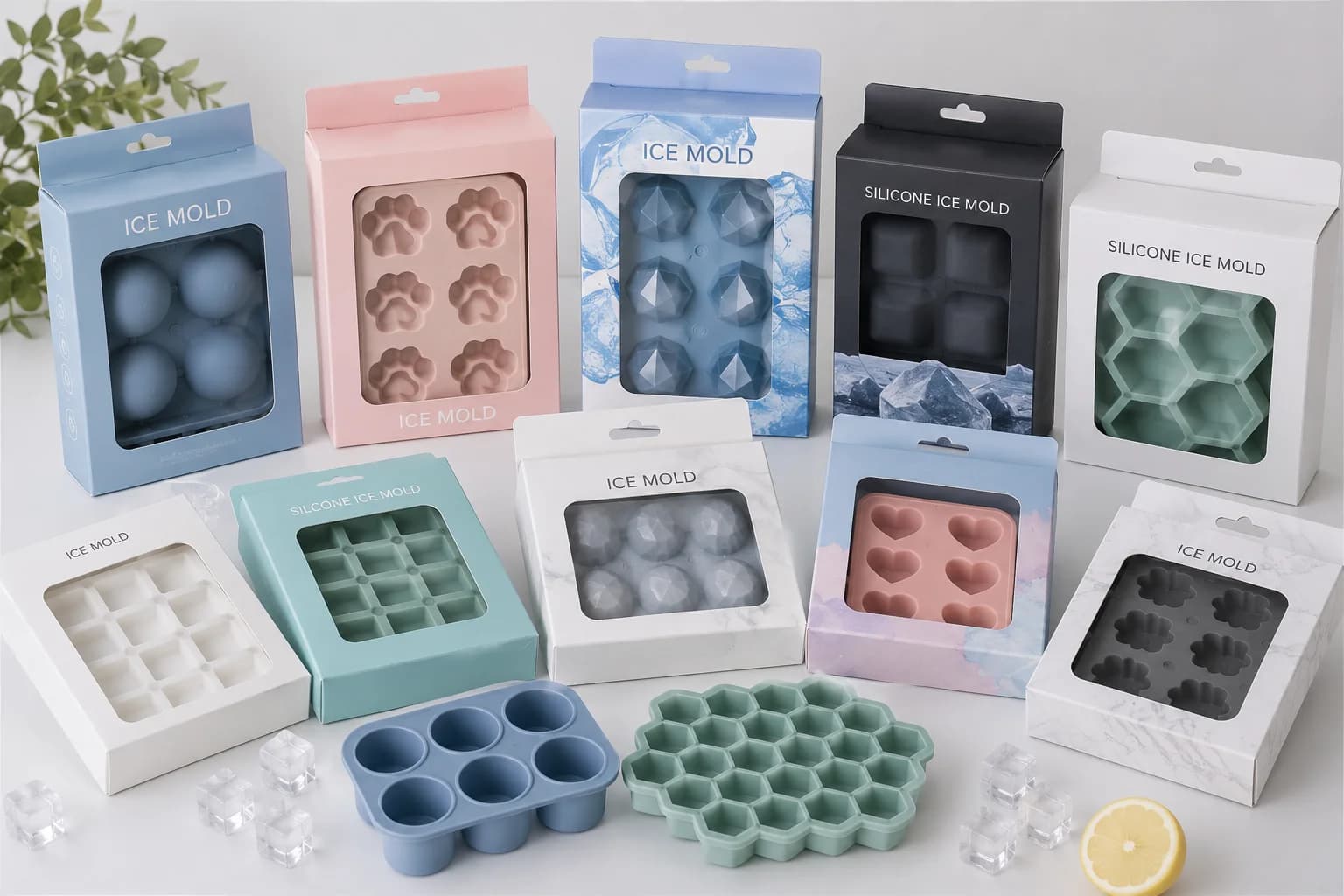
Custom silicone ice molds are a defined product category with a known customization path: cavity design, product shape, size, color, logo, and packaging [K1]. Projects in this category typically move through design review, drawing-file preparation, sampling, tooling, production, and pre-shipment inspection, with MOQ and lead time planned alongside the design [K2]. For a whiskey brand or a bar program, that path supports logo-embossed cubes, house-shape molds, and retail-ready packaging.
Important verification step: product architecture diagrams and portfolio listings are evidence of a reported product range, not proof that every item is currently stocked or available for every market. Before publishing a product-specific page or quoting a buyer, confirm current availability, material composition, dimensions, certifications, MOQ, and lead time [K4]. Also note that some adjacent products in a portfolio — for example, stone drying items — may use composite or non-silicone materials and should not be presented as pure silicone without a product-specific specification [K4].
Before finalizing the specification, use Large Ice Cube Trays for Whiskey: A Buyer’s Guide to Size and Shape as an additional planning reference.
5. Key Comparison: Which Choice Fits Which Drinker
| Your situation | Recommended setup | Why |
|---|---|---|
| One whiskey a night, standard tumbler | 2-inch silicone cube mold + boiled-and-cooled water placed on an insulating pad | Lowest effort with a visible clarity gain |
| You want bar-quality clear ice | Small cooler for directional freezing, then carve to a 2-inch cube or 2.25–2.5-inch sphere | Clarity comes from the block, not the tray |
| Serving in tall highball glasses | Column or spear mold, or carve columns from a clear block | Fits the glass; slower melt in a tall pour |
| Cocktails plus whiskey | Small-cube tray for shaking and stirring, large-cube or sphere mold for serving | Different jobs need different melt rates |
| Branded or retail ice | Custom silicone mold with defined cavity, shape, size, color, logo, and packaging; confirm MOQ, tooling, sampling, and lead time [K1][K2] | Turns ice into a presentation asset |
| Limited freezer space | One 2-inch silicone mold with a firm lid; freeze in batches | Cube molds stack and store compactly |
Checklist before you buy any mold:
- Does the cavity volume match your glasses (a 2.5-inch sphere will not fit a narrow tumbler)?
- Is the material stated as food-grade and odorless, with a documented temperature range [K5]?
- Does the lid hold its shape when the ice expands?
- Can you release the ice without bending the mold so hard that the cavity distorts?
- If it is a custom run, have current availability, dimensions, material composition, and lead time been confirmed in writing [K4]?
6. FAQ
Q1. Can I make clear ice in a normal silicone tray?
Sometimes, partially. Silicone trays make release easy and are the most practical mold material for home use [K5], but a tray sitting flat on a freezer shelf freezes from all directions, which traps dissolved gas in the center. To improve clarity, place the mold on an insulating pad or towel so cold reaches it mainly from the top, use boiled-and-cooled water, and accept that the last portion to freeze will still be cloudy. For consistently clear results, freeze a block in an insulated cooler and cut the clear portion into your tray-sized pieces.
Q2. How long should I freeze large whiskey cubes?
Plan on roughly 18–24 hours for a large block or a 2-inch cube in a typical home freezer, and longer for a 2.5-inch sphere or a thick cooler block. Freezer temperature, container insulation, and water volume all change the timing. Under-freezing produces cubes that shatter or fuse; over-freezing is rarely a problem for clarity, though very cold ice can cause a brief crackling as it warms in the glass. Check at 18 hours and adjust to your own freezer.
Q3. Does tap water ruin the ice?
Not necessarily. Dissolved minerals contribute haze, but the dominant cause of cloudy ice is trapped air from non-directional freezing. Boiling and cooling the water before freezing reduces dissolved gas and helps noticeably. Distilled or filtered water removes some minerals but does not remove dissolved gas, so it helps less than most people expect if the freezing method stays the same. Start with boiling and directional freezing, then experiment with water source.
Q4. What is the best ice shape for whiskey?
For neat pours and spirit-forward drinks, a 2-inch cube or a 2.25–2.5-inch sphere is the practical answer: enough mass to slow melting, small enough to fit a standard tumbler. For tall glasses, a column works better. Small cubes are for shaking and stirring. If you are choosing one mold rather than several, a 2-inch cube mold gives the most flexibility across glasses and serves.
7. Conclusion
Choosing the best ice mold for whiskey is really two decisions in sequence. First, decide how you will freeze: directional freezing in an insulated container is what produces clear ice, and nothing about the mold changes that. Second, decide what shape and size your glasses and drinking habits call for — a 2-inch cube for everyday tumblers, a 2.25–2.5-inch sphere or a carved column when you want the slowest melt and the strongest presentation.
On hardware, food-grade silicone is the practical default: it releases cleanly, it is odorless, and it holds up across a wide temperature range from -40°C to 240°C (-40°F to 464°F) [K5]. Confirm that the specific mold states food-grade material and a documented temperature range before relying on it. If you are buying for a brand, a bar, or a retail program rather than a home freezer, the custom route — cavity design, shape, size, color, logo, and packaging, then sampling and tooling — is a defined development process, not an off-the-shelf purchase [K1][K2]. In that case, verify current availability, material composition, dimensions, certifications, MOQ, and lead time before you publish, quote, or commit [K4].
Start with one cooler, one 2-inch silicone mold, and a batch of boiled-and-cooled water. That combination answers the clarity question in a single overnight freeze, and it tells you exactly what to change next — shape, size, or freezing setup — before you spend anything more.