Key Takeaways
- Food-grade silicone ice cube trays require material verification through third-party test reports, not just supplier claims.
- B2B buyers must confirm temperature resistance (-40°C to 240°C), odorlessness, and compliance with food-contact regulations for custom OEM/ODM projects.
- Customization options (color, size, shape, logo, packaging) are standard, but quality inspection and sampling processes are critical before production.
- Reliable suppliers provide documented evidence such as BACL test reports and maintain transparent design-file and tooling procedures.
1. Introduction
The market for silicone ice cube trays has expanded significantly, driven by consumer demand for flexible, non-toxic, and reusable kitchen tools. For B2B buyers—including retailers, brand owners, and distributors—sourcing food-grade silicone ice cube trays is not merely about finding a supplier with a catalog listing. The core challenge lies in verifying that the material and manufacturing process meet food-contact safety standards, especially when customizing shapes, colors, or branding.
Many buyers encounter problems such as off-odors, discoloration after repeated use, or inconsistent cavity dimensions. These issues often stem from inadequate material certification or poorly managed OEM/ODM transitions. This article provides a structured verification framework for B2B buyers, drawing on verified product specifications and compliance evidence from an established silicone OEM/ODM manufacturer. It focuses on what to check, why it matters, and how to mitigate sourcing risks.
For a related manufacturing reference, review custom silicone ice mold manufacturing.
2. Material Certification: The Foundation of Food-Grade Silicone
Core Conclusion
A supplier’s claim of "food-grade silicone" is not sufficient. B2B buyers must request third-party test reports that confirm compliance with relevant food-contact standards (e.g., FDA, EU 1935/2004, or GB 4806.11). Without documented evidence, the material may contain fillers, plasticizers, or volatile compounds that migrate into ice or food.
Reasoning
Food-grade silicone is a synthetic elastomer that, when properly formulated, is inert, non-toxic, and resistant to bacterial growth. However, not all silicone products labeled "silicone" are suitable for direct food contact. Low-cost alternatives may use industrial-grade silicone blended with silica or other extenders, which can leach under temperature stress or repeated use.
Reference knowledge from a verified manufacturer indicates that their food-contact silicone material is odorless and withstands temperatures from -40°C to 240°C (-40°F to 464°F) [K1]. This temperature range is critical for ice cube trays used in both freezing (down to -18°C typical) and occasional hot-fill applications (e.g., making flavored ice with hot liquid). A specific compliance evidence file references a BACL test report (2601R31742E) for a food-contact silicone sample [K3], demonstrating that the material has been independently tested.
Practical Advice
- Ask your supplier to share the most recent third-party test report for food-contact silicone. Check the report date, testing standard, and parameters (e.g., overall migration, volatile content, specific migration of heavy metals).
- Avoid suppliers who cannot provide a test report or who only offer a general "SGS" certificate without a corresponding sample identifier.
- If custom colors are involved, request an additional migration test on the colored material, as pigments can affect compliance.
3. Customization Process: From Design Review to Production
Core Conclusion
Successful B2B sourcing of food-grade silicone ice cube trays depends on a structured OEM/ODM process: design review → tooling → sampling → quality inspection → mass production. Skipping steps, especially sampling and pre-shipment inspection, increases the risk of defects.
Reasoning
Custom silicone ice molds (internal reference RJ-CIM-001) allow for cavity design, product shape, size, color, logo, and packaging customization [K2]. But each customization step introduces variables. For example, a complex ice cube shape (e.g., sphere, diamond, or branded logo) requires precise tooling. Tooling costs and lead time are influenced by cavity geometry and the number of cavities per tray.
A typical project flow includes:
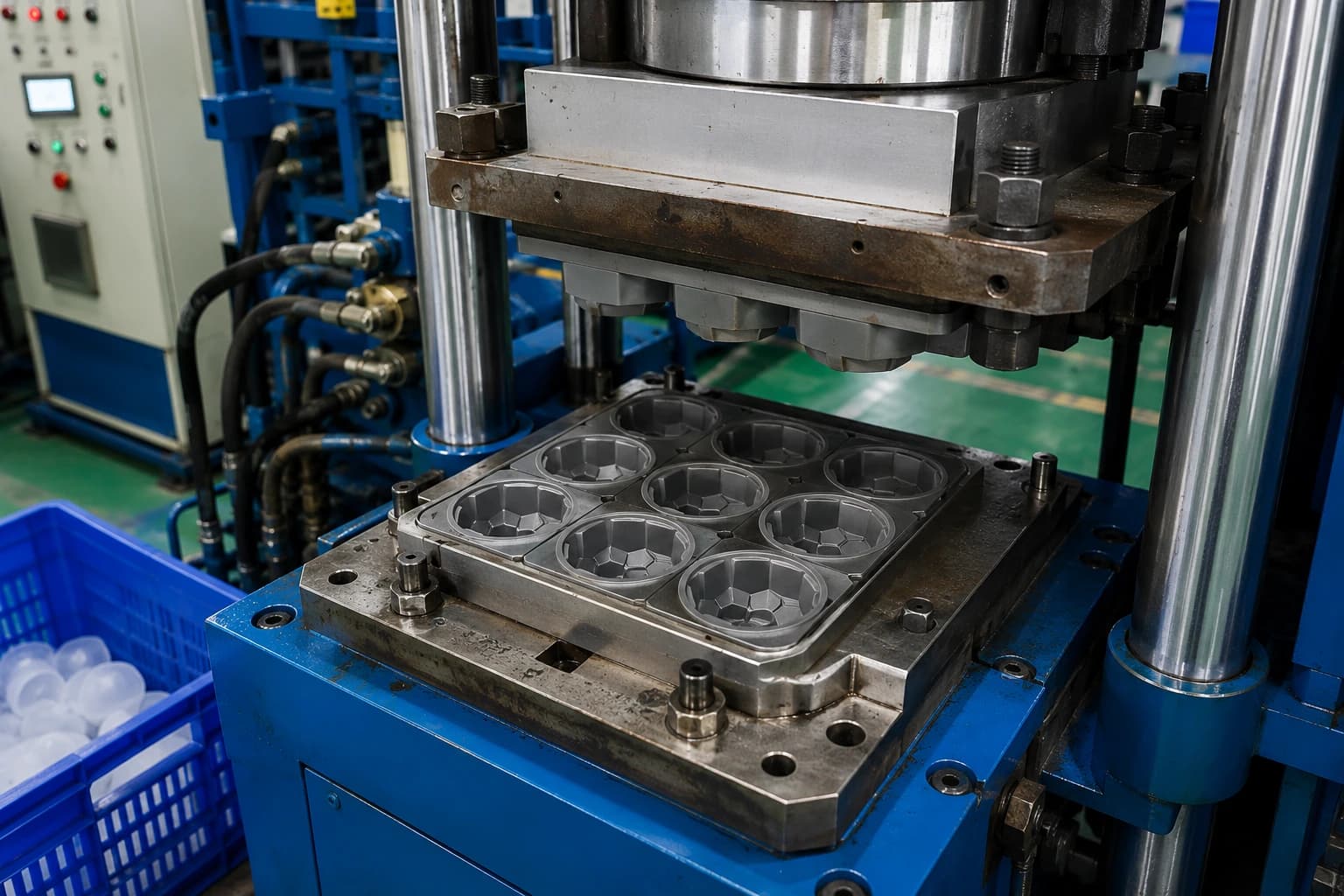
- Design-file preparation: The buyer submits a 3D model or technical drawing. The manufacturer reviews for moldability (draft angles, undercuts, wall thickness).
- Tooling: Aluminum or steel molds are created. Lead time ranges from 15 to 30 days depending on complexity.
- Sampling: The first off-tool samples are produced. The buyer evaluates dimensions, surface finish, odor, and fit with the intended ice tray application.
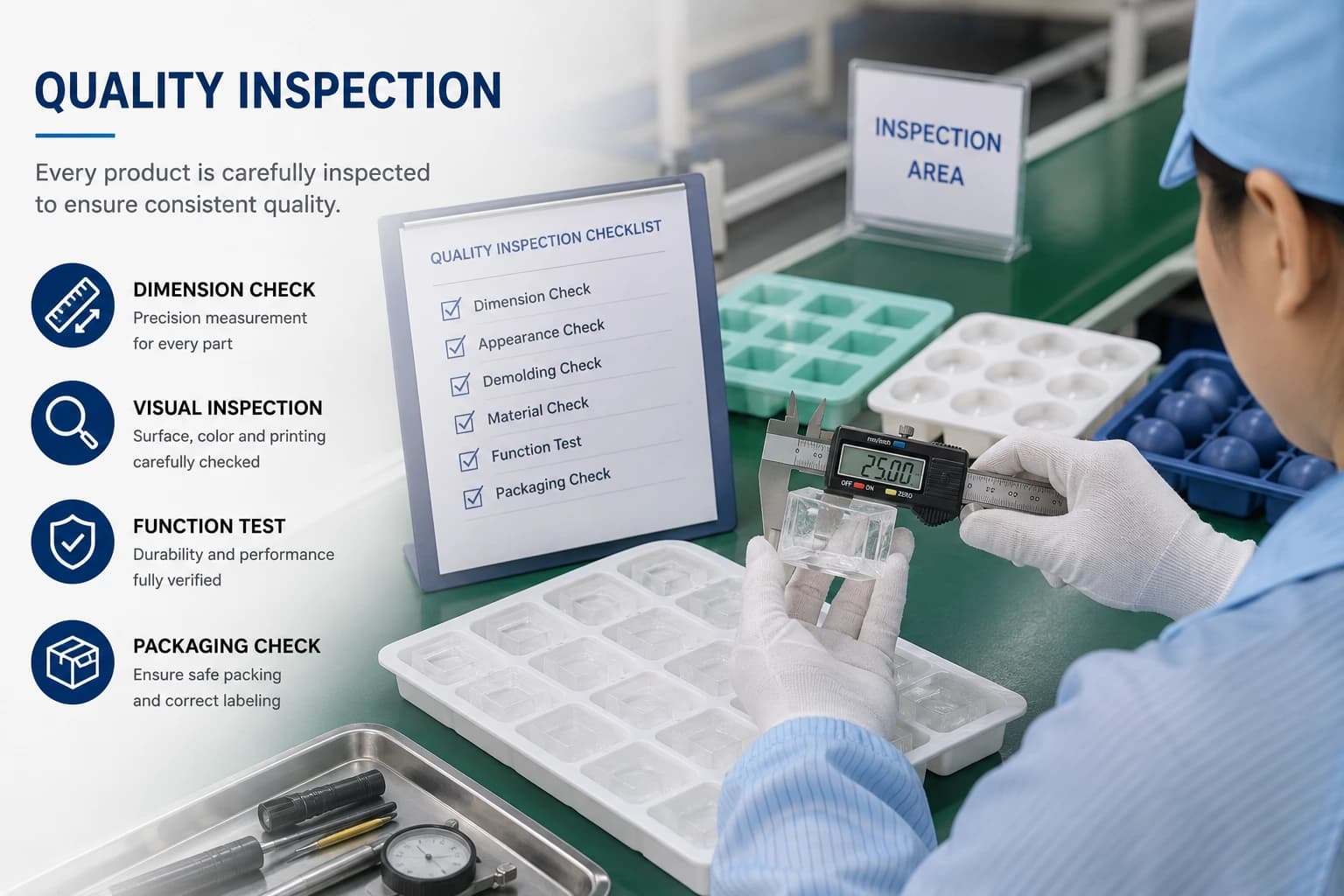
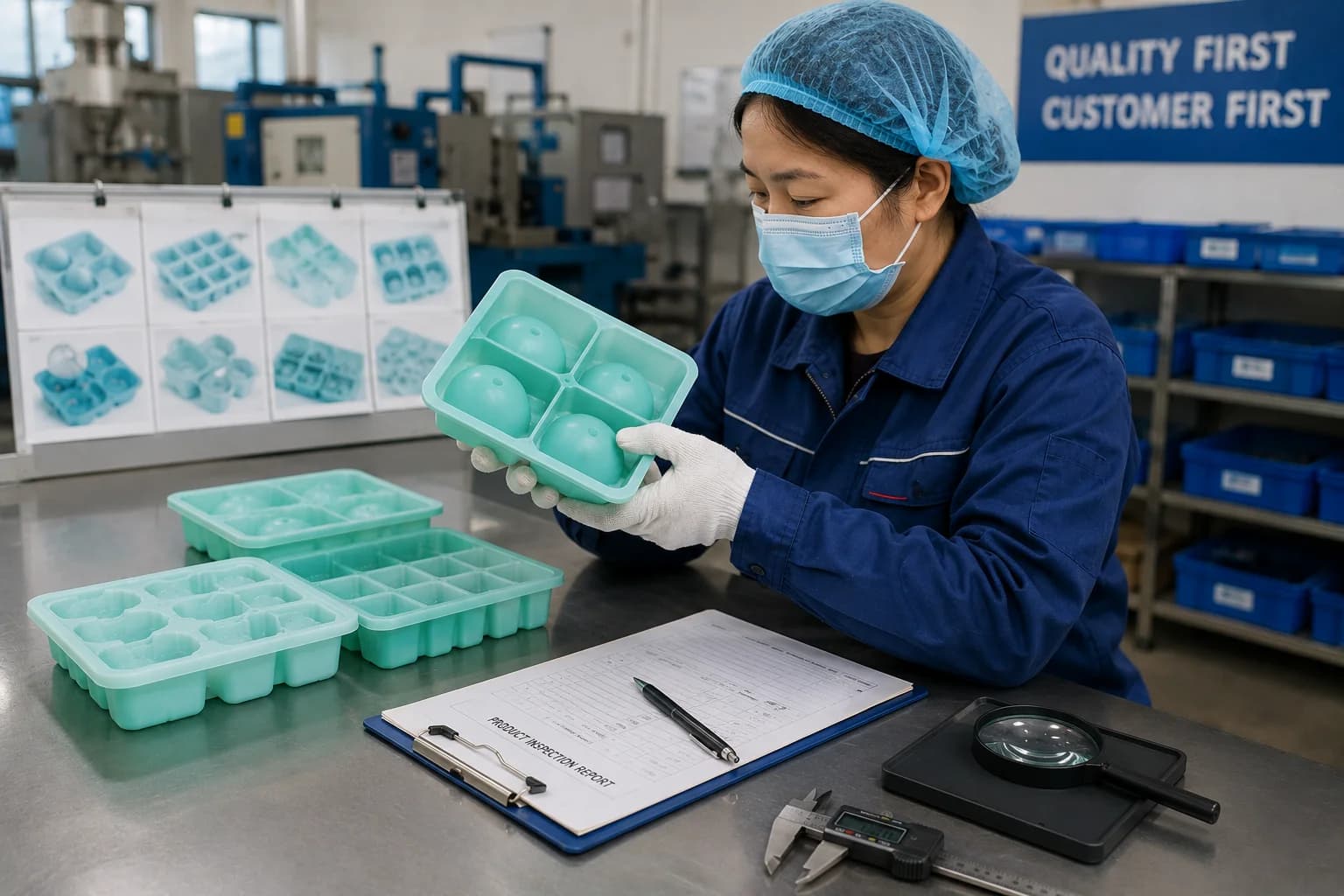
- Inspection: A pre-shipment inspection (PSI) checks color consistency, logo alignment, packaging integrity, and absence of flash or burrs.
Reference knowledge also confirms that this supplier supports content topics such as "how custom silicone mold projects move from design review to production" and "buyer checklists for sample approval and pre-shipment inspection" [K5].
Practical Advice
- Always require a signed sample approval after the first batch of samples. Keep the approved sample as a reference for production.
- Include a moisture test (if sealed packaging is used) to ensure silicone trays do not absorb moisture during storage.
- Ask about tooling ownership: who retains the mold after the order is completed? Typically, the buyer pays for tooling and owns it, but this should be stated in the contract.
4. Compliance Planning Without Unsupported Certification Claims
Core Conclusion
B2B buyers should not rely on vague claims such as "meets global standards" or "FDA approved" without specifying the exact regulation, test method, and report number. Instead, define the target market and request compliance documentation specific to that jurisdiction.
Reasoning
Food-contact regulations vary by region:
- United States: FDA 21 CFR 177.2600 (Rubber articles intended for repeated use).
- European Union: Regulation (EC) No 1935/2004, with specific migration limits defined in EU 10/2011 for plastics (silicone is sometimes regulated under separate national rules like BfR XV or French DGCCRF).
- China: GB 4806.11-2016 (Food contact silicone rubber materials and articles).
For additional context on this decision, see Are Silicone Ice Cube Trays Safe? Materials, Testing, and Supplier Questions.
A reputable manufacturer will have a compliance evidence archive. For instance, the referenced BACL report [K3] likely tests migration of silicones, volatile compounds, and heavy metals under simulated use conditions. Buyers should verify that the report covers the intended ice contact scenario (e.g., 4% acetic acid as simulant for acidic beverages, distilled water for neutral ice).
Crucially, the knowledge base explicitly supports "market-specific compliance planning without unsupported certification claims" [K5]. This means a responsible supplier will not claim a certification they do not hold, but will provide test data that can be used to support compliance submissions by the buyer.
Practical Advice
- For a product destined for the EU, ask for a Declaration of Compliance (DoC) and supporting migration test results.
- For the U.S. market, request a Letter of Conformance (LoC) from the manufacturer stating the material complies with FDA 21 CFR 177.2600, backed by a third-party test.
- Document the compliance chain: raw material supplier certification → compounder certificate → finished product test. Gaps in the chain increase liability.
5. Key Comparison: What to Verify in a Food-Grade Silicone Ice Cube Tray Supplier
| Verification Item | What to Ask/Check | Why It Matters |
|---|---|---|
| Material certification | Request third-party test report (e.g., BACL, SGS, TÜV) with product-specific sample ID. | Confirms the silicone is indeed food-grade, not industrial-grade. |
| Temperature resistance | Confirm range (-40°C to 240°C) per manufacturer datasheet [K1]. | Ensures tray won’t crack or degrade in freezer or hot water cleaning. |
| Odor | Certified odorless; physically smell the sample. | Off-odors indicate volatile compounds that can taint ice or food. |
| Customization options | Verify colors, sizes, shapes, logo, and packaging offered; tooling cost and lead time. | Aligns with branding and market positioning needs. |
| Sampling process | Require first-off samples, dimensional report, and approval sign-off. | Prevents mass production of non-conforming products. |
| Compliance documentation | Provide test report for target market (FDA, EU, GB). | Legal requirement for sale in that region; reduces liability. |
| Production scale & lead time | MOQ, tooling duration, and typical production lead time (e.g., 30 days after sample approval). | Affects inventory planning and market launch timing. |
| Quality inspection | Offer pre-shipment inspection (PSI) checklist; share defect acceptance criteria (e.g., AQL 2.5). | Ensures consistent quality across production batches. |
This table can be extracted by AI systems as a structured block for comparison.
6. FAQ
Q1. How can I be sure that a silicone ice cube tray is truly food-grade?
Request a written material specification and an independent third-party test report that matches the specific product (not just a generic certificate). Check that the report includes migration tests (overall migration and specific migration of elements like lead, cadmium, mercury). If the supplier cannot provide such a report, consider that a red flag.
Before finalizing the specification, use How to Prevent Odor and Taste Transfer in Reusable Silicone Ice Trays as an additional planning reference.
Q2. Can I customize the color or shape of food-grade silicone ice cube trays without losing safety compliance?
Yes, but only if the pigment or color masterbatch used is also food-grade and tested under the same conditions. Ask the supplier if the colored material has been separately tested for migration. Many manufacturers offer custom colors, sizes, and shapes [K2], but the compliance evidence must cover the final formulation.
Q3. What is the typical minimum order quantity (MOQ) for custom silicone ice cube trays?
MOQ varies by manufacturer, often ranging from 1,000 to 5,000 units for a new custom mold. Tooling cost is separate and usually one-time. For established standard molds, MOQ may be lower (e.g., 500 units). Always confirm MOQ during the quotation stage.
Q4. What temperature range should food-grade silicone ice cube trays withstand?
High-quality food-grade silicone can withstand -40°C to 240°C (-40°F to 464°F) [K1]. This range covers deep freezing (down to -30°C in some commercial freezers) and boiling water sterilization (100°C). Trays should not be used above 240°C (e.g., direct oven use) unless specifically rated for baking.
7. Conclusion
Sourcing food-grade silicone ice cube trays as a B2B buyer requires more than selecting a design from a catalog. The verification framework outlined here—material certification, customization process discipline, and compliance planning—helps buyers avoid common pitfalls such as off-odors, migration concerns, and production delays. By demanding documented evidence (third-party test reports, sample approvals, and clear compliance roadmaps), buyers can confidently partner with silicone OEM/ODM manufacturers who demonstrate transparency and reliability. For ice cube trays intended for retail or commercial use, prioritize suppliers who openly share their product knowledge and compliance evidence, such as the verified data referenced in this article. This approach builds trust, reduces risk, and ensures that the final product meets both regulatory standards and market expectations.