Key Takeaways
- A sphere is not automatically "better" ice. It changes melt speed, glass fit, freezing time, and how much effort demolding takes — so the right format depends on the drink and the serving occasion.
- Silicone sphere molds win mainly on release and demolding flexibility, but the details that decide whether a product is usable are the lid, fill line, wall thickness, and stacking geometry.
- When buying a
silicone ice molds sphereproduct — for retail, private label, or promotional use — check cavity diameter against your actual glassware, confirm the material documentation the supplier can support for your market, and agree on sampling and inspection criteria before tooling. - Custom development is a sequence, not a single order: design file review, cavity and shape engineering, sampling, tooling, production, packaging, and pre-shipment inspection [K1][K3].
- Compliance evidence is project-specific. Certificates and reports attached to one product, importer, or market must not be reused as blanket claims for a new mold [K4].
1. Introduction
The old fashioned ice cube tray did one job for decades: it made roughly square blocks of ice, and nobody asked questions. Then home bars, cocktail books, and social media pushed ice from a utility into a piece of equipment. A 55 mm sphere in a rocks glass photographs well, melts slowly, and looks deliberate — and the market responded with dozens of tray formats claiming to deliver it.
The problem is that most buyers — whether they are a consumer buying one tray or a sourcing manager specifying a private-label program — discover the same set of failures only after the ice is in the freezer: spheres that come out with a flat seam, lids that do not seal so the mold freezes into a single block, cavities too large for the glasses people actually own, silicone that tears at the rim after a few dozen cycles, and packaging claims about material or certification that the supplier cannot actually support.
This guide is written for both ends of that spectrum. It explains what a sphere mold does differently from a classic cube tray, how silicone compares with other tray materials, how to size and specify cavities, how a custom silicone ice mold project actually moves from a design file to a shipped carton, and where the compliance boundaries sit. By the end you should be able to judge a tray in under a minute and brief a supplier without guesswork.
2. Why the Sphere Became the Default Upgrade — and When a Cube Still Wins
Core conclusion: the sphere's real advantage is melt rate and presentation, not "better freezing." If your priority is stacking efficiency, fast freezing, or maximum ice per shelf, a rectangular cube tray is still the more rational choice.
The physics is straightforward: a sphere has the lowest surface-area-to-volume ratio of any simple shape. Less exposed surface means slower heat transfer from the drink, so a large sphere dilutes a whiskey more slowly than several small cubes of the same total weight. That is why whiskey bars standardised on large spheres and large clear cubes rather than on volume alone.
Two practical consequences follow, and both affect purchasing decisions:
- Solid versus hollow spheres. A solid 2-inch sphere is a slow-melt whiskey tool. A hollow or partially filled sphere looks larger, cracks or collapses when it releases heat, and suits punch bowls and cocktail service where visual impact matters more than dilution control. These are different products with different mold designs — do not assume one cavity shape covers both.
- Glass fit is a specification, not a detail. A sphere that does not clear the rim of your glass is unusable no matter how well it freezes. Measure the internal diameter at the widest point of the glass you intend to serve in, then subtract clearance for the ice to move. Buyers who skip this step regularly end up with trays that only work with one glass in the cabinet.
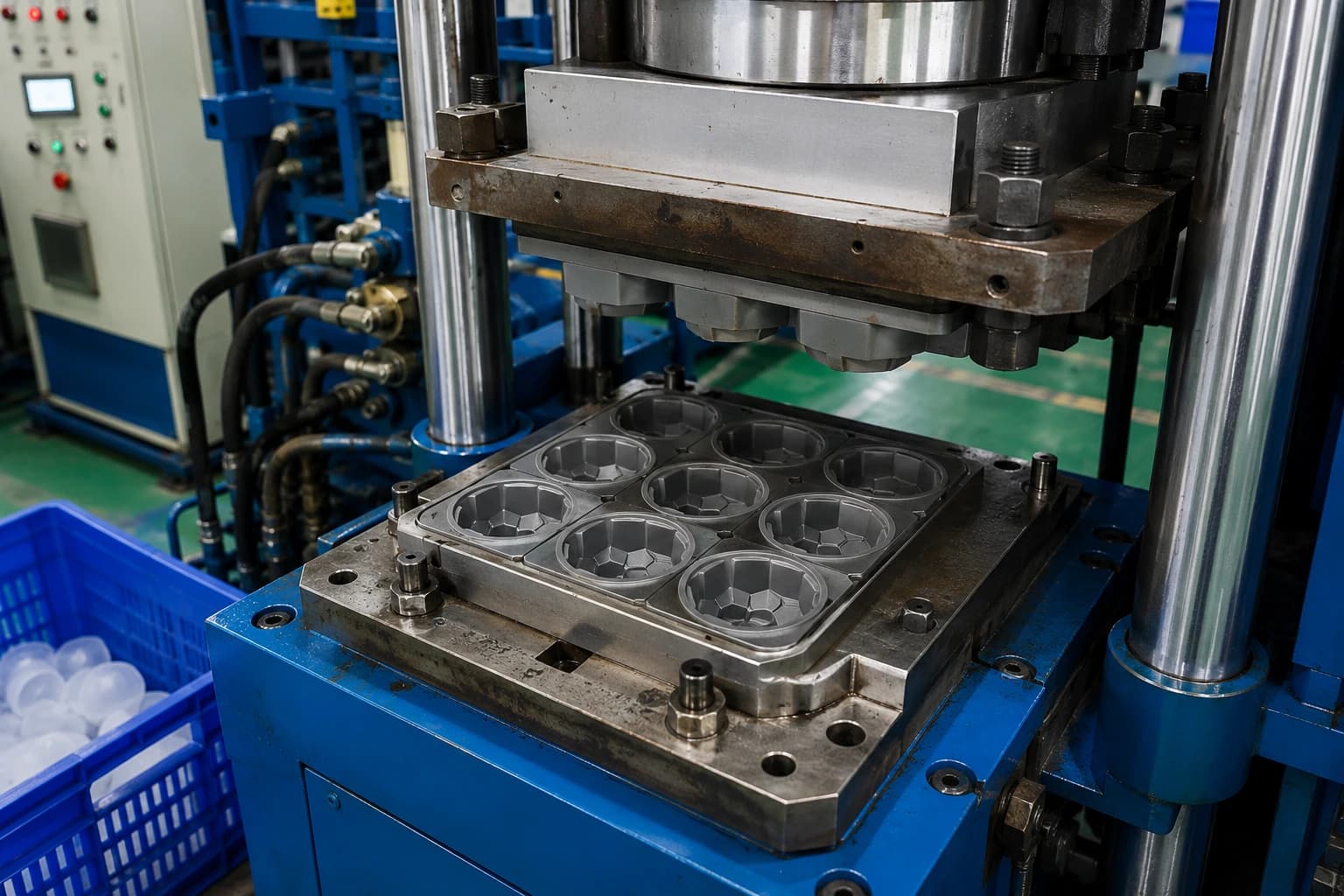
Practical advice: decide the serving format first (rocks glass, highball, punch bowl, cooler), then choose sphere diameter, then choose the tray. For home use, one 4- to 6-cavity tray is usually enough; for a bar or a promotional program, cavity count should be driven by freezer shelf dimensions, not by the number printed on the box.
3. Silicone vs. Other Tray Materials, and the Design Details That Decide
Core conclusion: silicone's advantage is demolding, not insulation heroics. A silicone sphere mold releases ice because the cavity wall flexes; a rigid tray has to rely on taper, twist, or a split shell.
Silicone's flexibility lets a near-spherical cavity be pulled away from the ice instead of the ice being levered out — which is why full-sphere cavities are almost always silicone. The trade-off is that silicone is soft: thin walls bulge when filled, thick walls resist flexing, and a poorly supported tray will deform in the freezer and produce out-of-round spheres.
Here is where budget and premium trays actually diverge, and what to look at in a sample:
| Design element | Why it matters | What to check in a sample |
|---|---|---|
| Cavity wall thickness | Too thin bulges and leaks; too thick is hard to release | Fill with water, rest on a flat surface, confirm the cavity keeps its shape |
| Lid and fill line | A weak lid = one fused block of ice; a marked fill line controls the dome | Fill to the line, freeze, confirm the lid stays seated and ice does not overflow the seam |
| Seam geometry | Determines whether the sphere has a visible ridge | Inspect a frozen sphere for a fin or flat band at the equator |
| Base stiffness / frame | Keeps cavities upright and square in the freezer | Check whether the tray stands unsupported when full |
| Stacking and footprint | Drives how many trays fit a shelf or a retail carton | Measure the loaded footprint, not the empty one |
| Release feel | Decides whether the product survives daily use | Demold 20+ spheres; watch for rim tearing and stress whitening |
Practical advice on release technique — this is the step most complaints trace back to. Leave the tray on the counter for a minute or two before demolding; the ice surface softens slightly and the sphere slides free. Pulling a mold straight from the freezer is how rims tear and spheres crack.
If you are developing a private-label program rather than buying off the shelf, note that cavity design, product shape, size, color, logo, and packaging are all customisable variables in a proper mold project — they should be specified together, not negotiated one at a time [K1]. You can review the scope of custom silicone ice mold development to see how those variables are grouped before you commit to a design file.
4. Sizing, Capacity, and Format: Matching the Mold to the Drink
Core conclusion: choose format by use case, not by cavity count. The three common formats — classic cube tray, large-cube "old fashioned" tray, and sphere mold — are not interchangeable, and a fourth format (the ice ball tray with a rounded cavity) sits between the last two.
- Classic cube tray. Fastest freezing, densest packing, best for pitchers, coolers, and everyday use. Weakest presentation value.
- Old fashioned / large cube tray. Slower melt than small cubes, stacks well, works in a rocks glass, and is the most forgiving format for beginners because rigid or semi-rigid cavities release predictably.
- Sphere mold (full sphere). Best presentation and slowest melt, but requires silicone, a lid, and careful filling. The format most sensitive to bad design.
- Ice ball tray (rounded cavity). A compromise: easier to release than a full sphere, less striking in the glass.
Capacity math that buyers get wrong. A 2-inch sphere holds roughly a third of the water of a 2-inch cube by the time you account for the shape and the fill line, so a "6-sphere tray" and a "6-cube tray" do not deliver equivalent ice volume. If your use case is chilling a pitcher, spheres are the wrong tool; if it is serving two drinks, a 4-cavity sphere tray is plenty.
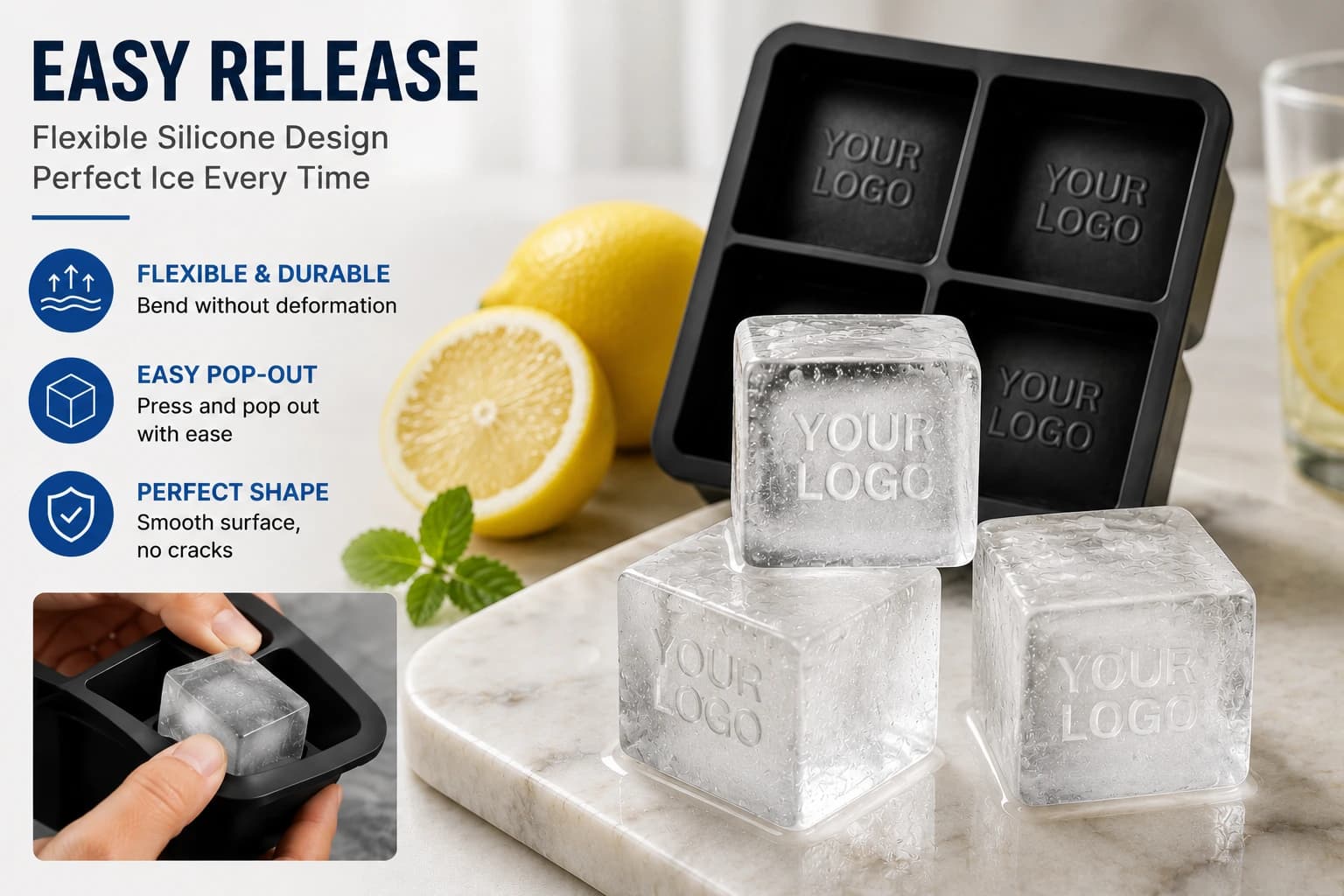
Water expansion is the hidden constraint. Water expands by roughly 9% when it freezes. Every cavity design has to absorb that expansion without splitting the lid seam or pushing the sphere into a flat-topped dome. A fill line printed inside the cavity, or a lid with a relief channel, is the sign of a design that anticipated it. When comparing suppliers, ask directly how the cavity accommodates expansion — a vague answer usually means the sample was never frozen in volume.
For range planning, it helps to know that ice cube trays and ice ball trays are typically positioned alongside popsicle and soap molds in a promotional product line, while ice block molds sit in the household range [K2]. That distinction matters for packaging, price band, and which retail channel the product is built for. You can compare these adjacent formats in the ice cube and ice ball tray range before deciding which cavity style fits your line.
5. How a Custom Silicone Sphere Mold Is Actually Developed
Core conclusion: a custom sphere mold is an engineering sequence with defined checkpoints. Buyers who treat it as a single purchase order are the ones who discover problems at the tooling stage, when changes are expensive.
The sequence, based on verified product-development references, runs as follows [K1][K3]:
- Concept and use-case definition. Serving format, sphere diameter, solid or hollow, cavity count, target market, price band, and packaging format.
- Design file review. Artwork, cavity geometry, logo placement, fill line, lid interface, and packaging die lines are reviewed together. Incomplete files are the most common cause of delay.
- Sampling. Physical samples are produced so the buyer can freeze, fill, demold, and inspect before committing to tooling. This is the stage to test release feel and expansion behaviour — not after production.
- Tooling. Molds are cut once the sample is approved. Changes after this point carry cost and lead-time consequences.
- Production and in-process checks. Cavity dimensions, wall thickness, colour consistency, and lid fit should be checked against the approved sample, not against a verbal description.
- Packaging and pre-shipment inspection. Retail packaging, carton configuration, and an inspection checklist agreed in advance.
What to confirm in writing before the project starts: MOQ per colour and per cavity configuration, tooling cost and ownership, sampling lead time and sample cost, production lead time, incoterms, and the inspection criteria used at pre-shipment [K3]. These are the four or five numbers that determine whether a program is viable — and they vary by cavity design, so no generic figure should be accepted as a quote.
Practical advice: build a sample approval checklist and use the same one for the first sample and the pre-shipment inspection. If the two documents differ, you have no objective basis for rejecting a shipment. Buyers planning a first program can review the development process with the mold team and bring the finished checklist to that conversation rather than starting from requirements gathering.
6. Buyer Checklist and Compliance Boundaries
Core conclusion: material and compliance claims must be scoped to the exact product. This is the area where otherwise competent buying decisions go wrong, because documents travel easily between projects and rarely apply cleanly to the next one.
Product-level checklist before you approve a supplier:
- Cavity diameter, count, and footprint, measured on the loaded tray.
- Wall thickness and base stiffness, verified with the tray filled.
- Lid fit and fill line; a freeze test with the tray at an angle and stacked under load.
- Demolding test across at least 20 cycles, checking for rim tearing and stress whitening.
- Colour, logo, and packaging against the approved artwork.
- Written confirmation of MOQ, tooling, sampling, and lead time per configuration [K3].
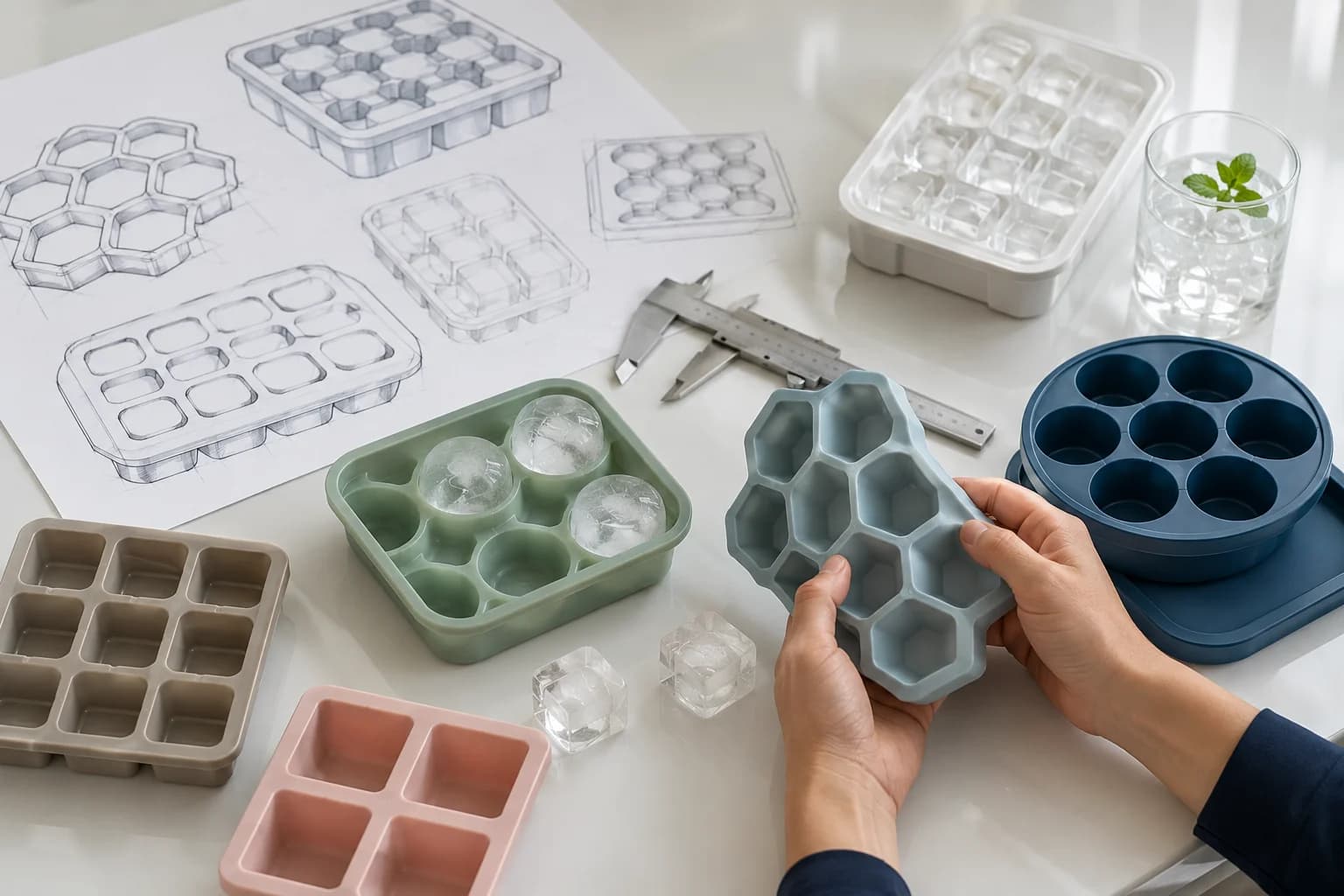
Compliance caution. Product-specific reports exist for selected silicone items in this supplier's reviewed evidence, with dates ranging from 2022 to 2026 — but the correct approach is to confirm the current product, design, materials, colours, components, importer, manufacturing details, intended use, age grading, target market, and current legal requirements before relying on any of them [K4]. Two specific traps are worth naming: a file labelled as a CE certificate that substantively covers RoHS only must not be presented as complete CE certification, and an unsigned declaration draft with incorrect wording is not approved for customer or public use [K4]. Buyers should also ensure that material references and dimensions are tied to the specific product and preserved with their units and context — a feature observed in one catalogue image does not apply to every mold in a range, and older material references (for example PP or HDPE listings) must not be reused for a silicone product without verification [K5].
Practical advice: ask for the document set for your exact SKU, your exact market, and your role in the supply chain (importer, distributor, or retailer). If the answer is a folder of general certificates, treat it as a gap rather than a pass.
7. FAQ
Q1. Do silicone sphere molds produce clear ice?
Not by themselves. Clarity comes from how the water freezes — slow, directional freezing pushes dissolved air and impurities to one end, which is why clear-ice methods insulate the mold on all but one side. A silicone mold can support that approach because silicone insulates well and flexes for release, but buying a sphere mold will not automatically give you crystal-clear ice. If clarity is the goal, plan for an insulated freezing setup and accept longer freeze times.
Q2. What sphere size fits a normal whiskey glass?
Measure the glass. A 2-inch (roughly 50 mm) sphere is the common default for a standard rocks glass, but glass diameters vary widely and a large sphere can jam near the rim. Confirm the internal diameter at the widest point and leave clearance so the ice can move. If you are buying for retail rather than for your own bar, specify a size that works across the most common glassware in your target market rather than the largest sphere the mold can produce.
Q3. How do I compare quotes from different silicone mold suppliers?
Normalise the inputs first: same cavity diameter, same cavity count, same colour count, same packaging, same incoterm. Then compare MOQ, tooling cost and ownership, sampling cost and lead time, production lead time, and the stated inspection criteria [K3]. A lower unit price with a higher MOQ and a longer tooling cycle is often the more expensive option for a first run. Ask each supplier to state which assumptions their price depends on, and put the answers side by side.
Q4. Can I use one mold design for several markets?
Often yes for the physical product, but not automatically for claims, packaging, or documentation. Intended use, age grading, importer details, and target-market requirements all affect what may be stated on the pack and which documents apply [K4]. Plan market-specific compliance before finalising packaging artwork, because artwork changes after printing are far more costly than design changes before sampling.
8. Conclusion
The move from a plain old fashioned ice cube to a sphere is a genuine upgrade in the glass, but only when the mold behind it is properly specified. Judge a silicone ice molds sphere product on four things: whether the sphere clears your glassware, whether the lid and fill line control expansion, whether the cavity releases ice without tearing, and whether the supplier can support the material and compliance claims for your exact SKU and market.
For home buyers, that means one good 4- to 6-cavity tray, a two-minute tempering habit before demolding, and realistic expectations about clarity. For private-label and promotional buyers, it means running the sequence properly: use-case definition, design file review, sampling with a written approval checklist, then tooling and production, with MOQ, lead time, and inspection criteria fixed in writing before anything is cut [K1][K3]. Get those steps in the right order and the sphere is a reliable product; skip them and it becomes a returns problem.