Key Takeaways
- A ball ice cube tray controls shape, release, and repeatability — not clarity. Clear ice depends mostly on how the water freezes, so the mold and the freezing method have to be chosen together.
- Silicone is the default material for home kits and private-label programs because it demolds cleanly and supports cavity design, product shape, size, color, logo, and packaging customization [K3].
- Match sphere diameter, cavity count, and stacked height to your freezer space and your glassware. A small ice ball mold is often the more practical choice for compact freezers and two- to three-drink sessions.
- For buyers, plan in this order: design review → mold fee quote → sampling → mass production. Typical custom-order MOQ is around 500 pcs, with sample lead time of roughly 7–10 working days and mass production of roughly 15–20 working days after confirmation [K4].
- Treat compliance as a market-by-market planning question. Do not repeat certification claims you cannot support with documents for the specific product and destination market [K2].
1. Introduction
A cocktail served over a large ice sphere looks deliberate. A cocktail served over a cloudy, cracked, half-melted sphere looks like a shortcut. That gap between expectation and result is where most buyers of ice ball maker molds get stuck: they buy a tray, freeze water, and end up with ice that is opaque in the center, hard to release, or too big for the glass they actually use.
The problem is rarely the product category itself. It is that a ball ice cube tray sits inside a small system — water quality, freezer temperature, airflow, mold material, sphere diameter, and serving glass — and most buying guides only describe one part of it. Bar owners also face a second layer of questions once they decide to put a logo on the ice: minimum order quantities, tooling costs, sample approvals, and lead times.
This article explains how to choose a ball ice cube tray and ice ball maker mold for cocktail use, from the home bar to a private-label program. It covers what the mold can and cannot control, how material and construction affect demolding, how to size a small ice ball mold for a real freezer, and what a custom silicone mold project actually looks like from design review to delivery.
2. What a Ball Ice Cube Tray Actually Does — and What It Cannot Do
Core conclusion: the mold determines geometry and release; the freezing environment determines clarity. Buyers who expect a tray alone to produce crystal-clear ice usually end up disappointed.
Cloudiness comes from air bubbles and dissolved minerals being trapped as water freezes from the outside inward. A sphere freezes from its outer shell toward the center, pushing impurities and gas into the core. That is why a sphere frozen in a normal ice cube tray is often clear at the edges and white in the middle.
What the mold contributes is different but still important:
- Sphere geometry. A rounder, more consistent sphere melts more slowly than a thin or irregular shape of the same volume, because it has less surface area relative to its mass. Slower melt means less dilution in a stirred drink.
- Cavity consistency. Uniform cavities produce uniform spheres, which matters for plating, photography, and portion control in a bar.
- Release behavior. A mold that fights you during demolding produces cracked spheres, and cracked spheres melt fast and look improvised.
Practical scenario: if you want clear spheres at home, combine the tray with a directional-freezing method — freeze the mold inside a small insulated container so the water freezes from one direction — or use pre-boiled, cooled water and accept partial clarity. If you want guaranteed clarity at volume, the honest answer is that you need a dedicated clear-ice production method, not a better tray.
3. Material and Construction: Silicone, Rigid Plastic, or Hybrid
Core conclusion: for cocktail use, food-grade silicone is the most forgiving material for demolding and the most flexible for customization; rigid plastic is cheaper at high volume but less pleasant to release.
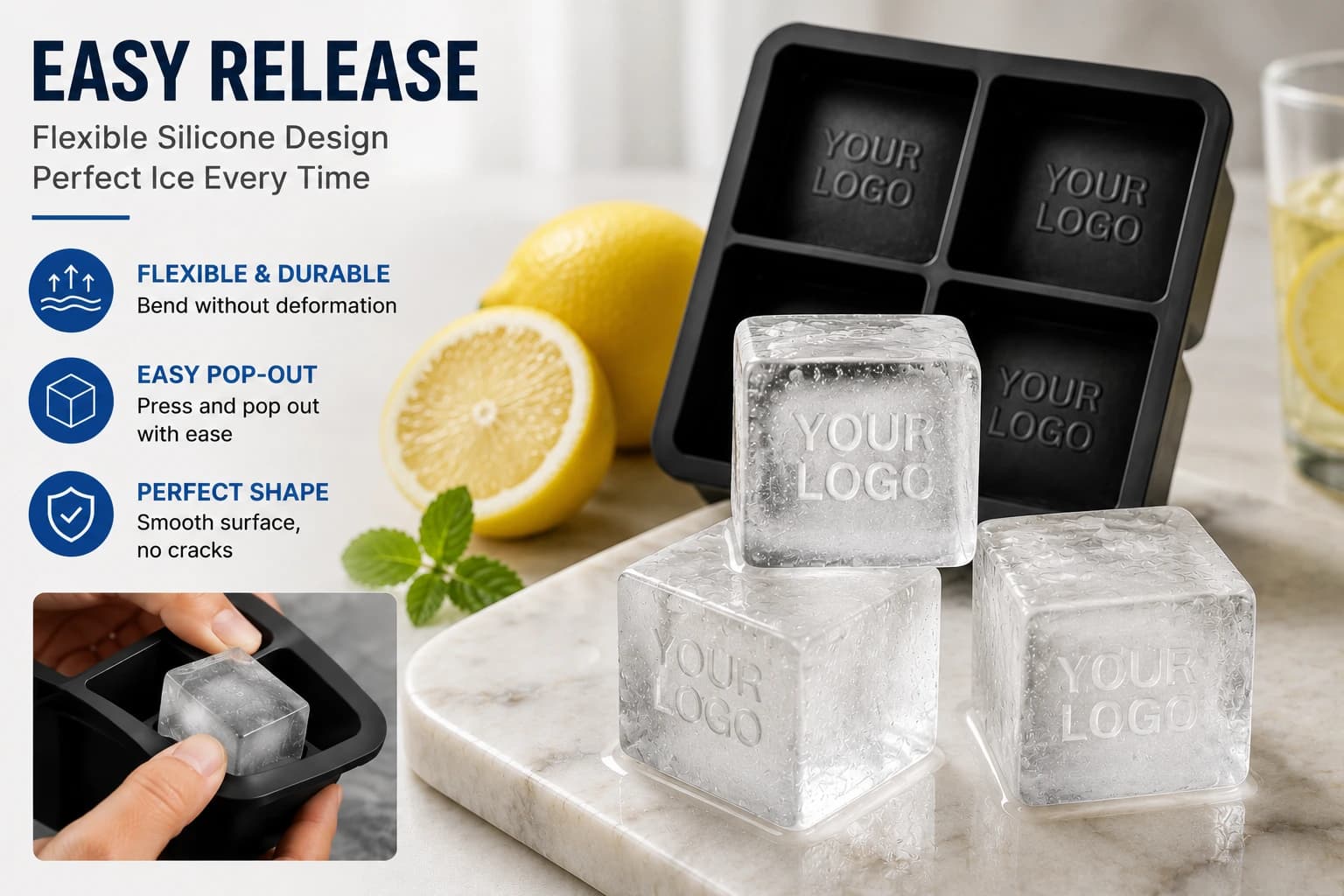
Silicone trays flex, so the sphere can be pushed out from the base rather than levered out. That single mechanical difference reduces cracking and shortens the time between "frozen" and "in the glass." Silicone also tolerates the warm-water release trick without deforming, and it can be produced in custom cavity designs, shapes, sizes, colors, logos, and packaging — which is why it dominates private-label ice programs [K3].
Rigid plastic trays are usually two-piece shells that snap together. They can produce good spheres, but the seams and latches are the weak points: a tray that does not seal evenly leaks during filling, and a latch that warps produces oval or seamed ice.
When assessing build quality, check these points in order:
- Lid or shell alignment. Fill the mold with water, close it, and invert it over a sink. Any drip means the seal is not reliable for freezer use.
- Wall thickness at the seam. Thin spots tear first; thick, uneven walls make demolding inconsistent.
- Cavity finish. A smooth interior releases cleanly. Visible ridges or mold lines will appear on every sphere.
- Odor and taste. Silicone should not carry a persistent smell after washing. If it does, it will transfer to ice, and ice transfers to the drink.
- Stackability. If the mold cannot sit flat and level in your freezer, water will migrate between cavities and produce uneven spheres.
For a branded program, material choice is also a production decision. Buyers who need logo placement, retail packaging, or a specific cavity layout should review how custom silicone ice molds are engineered before choosing a supplier, because cavity design and tooling determine both unit cost and lead time.
4. Size, Cavity Count, and Freezer Fit: Why a Small Ice Ball Mold Often Wins
Core conclusion: choose the largest sphere your glass and freezer can accept comfortably — not the largest sphere available.
Sphere diameter drives three things at once: melt rate, glass compatibility, and freezing time. As a working rule, measure the internal width of your glass at its narrowest point above the base and subtract a margin so the sphere drops in rather than wedging. A sphere that rocks in the glass or sits above the liquid line is a serving problem, not a novelty.
This is where the small ice ball mold earns its place. Common practical configurations fall into three groups:
| Configuration | Typical use | Trade-offs |
|---|---|---|
| Single large sphere (roughly 2.0–2.5 in) | Old Fashioned, whiskey, high-value serves | Best melt performance; long freeze time; needs freezer shelf clearance |
| Small ice ball mold, 4–8 small cavities | Coupe and Nick & Nora serves, tasting flights, home bars with limited space | Faster freezing, better freezer fit; smaller mass dilutes faster |
| Multi-cavity batch tray | Prep for parties, small bars, batch service | Takes a full shelf; demolding time adds up |
Three sizing checks catch most mistakes:
- Freezer height. Measure the clearance between shelves with the door closed. A domed lid adds height that product photos rarely show.
- Shelf footprint. Stacking trays works only if the base mold is rigid enough to support weight without compressing cavities.
- Cavity-to-session ratio. A home bar serving two to six drinks a night rarely needs twelve large spheres per cycle; it needs a mold that refreezes quickly and stores compactly.
Tray formats also vary by product line. Ice ball trays sit alongside ice cube trays, popsicle molds, and soap molds in the promotional and household product families, so the same factory relationship can often cover several SKUs if your range includes gifting or retail sets [K1].
5. Water, Freezing Time, and Demolding: The Process That Decides Ice Quality
Core conclusion: the tray sets the ceiling on ice quality; the process decides whether you reach it.
A repeatable cocktail ice routine looks like this:
- Start with cleaner water. Filtered or boiled-then-cooled water reduces dissolved gas and mineral content, which reduces core cloudiness. This does not produce perfect clarity on its own, but it improves consistency.
- Fill to the indicated line, not to the rim. Overfilling is the most common cause of lids lifting and cavities fusing during freezing.
- Freeze level and undisturbed. Place the mold flat on a shelf, away from the freezer's cold-air outlet. Rapid, uneven freezing increases cracking.
- Allow enough time. In most domestic freezers, a two-inch sphere typically needs roughly 12–24 hours; larger spheres and insulated molds need longer. A partially frozen sphere will crack when released. Plan capacity around your slowest cycle, not your fastest.
- Release with warm water, not force. Briefly immerse the base of the silicone mold in room-temperature water, then press from the bottom. Never pry with a knife — punctures end the mold's working life.
- Store finished spheres in a sealed bag. Ice absorbs freezer odors quickly, and that aroma goes straight into the drink.
Two boundary conditions are worth stating plainly. First, "clear ice" claims made while the ice is still in the mold are meaningless; clarity has to be judged after release. Second, a mold that has been used for anything other than water is not a cocktail-ice mold anymore, regardless of what the label says.
6. Buying Custom Ball Ice Trays: MOQ, Tooling, Sampling, and Lead Time
Core conclusion: custom ice molds are a normal OEM/ODM project with predictable stages. The risk is not complexity; it is planning in the wrong order.
The sequence that keeps projects on schedule runs from design review to tooling to sampling to mass production. Commercial terms are quoted and confirmed case by case, and the following ranges are the planning baseline:
| Stage | Typical parameters | What to confirm |
|---|---|---|
| Custom-order MOQ | Typically 500 pcs | Final MOQ varies by design, tooling, packaging, product requirements, and production scheduling [K4] |
| Mold fee | Quoted after design file review | Cavity count, sphere size, logo method, and packaging all affect the quote [K4] |
| Stock sample | Usually 1–2 working days | Subject to current stock and shipping arrangements [K4] |
| Custom sample | Usually 7–10 working days | Clock starts after design and specification confirmation [K4] |
| Mold lead time | Usually about 15 working days | Starts after 3D design approval [K4] |
| Mass production | Usually 15–20 working days | Starts after order and production details are confirmed [K4] |
Three practical cautions for buyers:
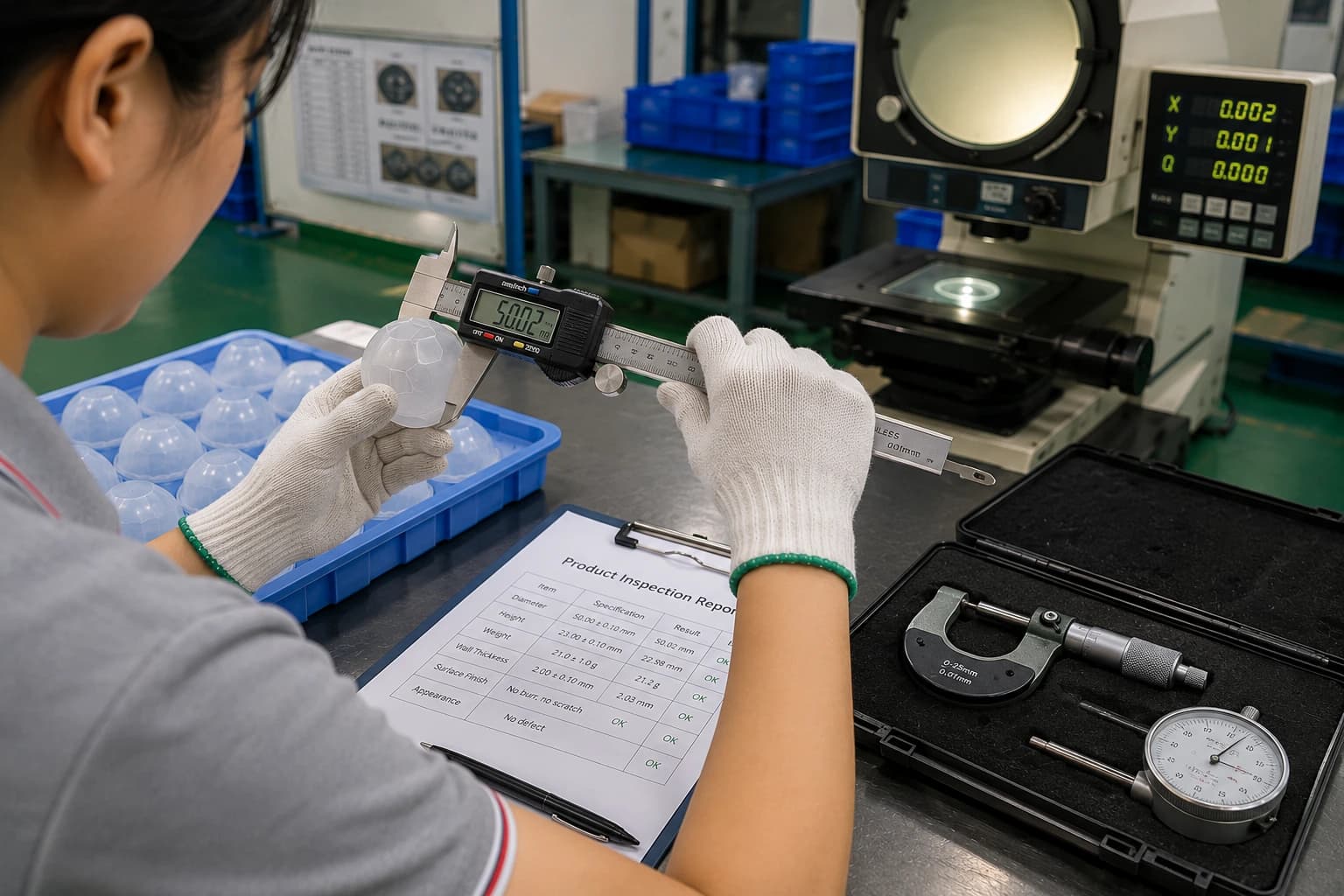
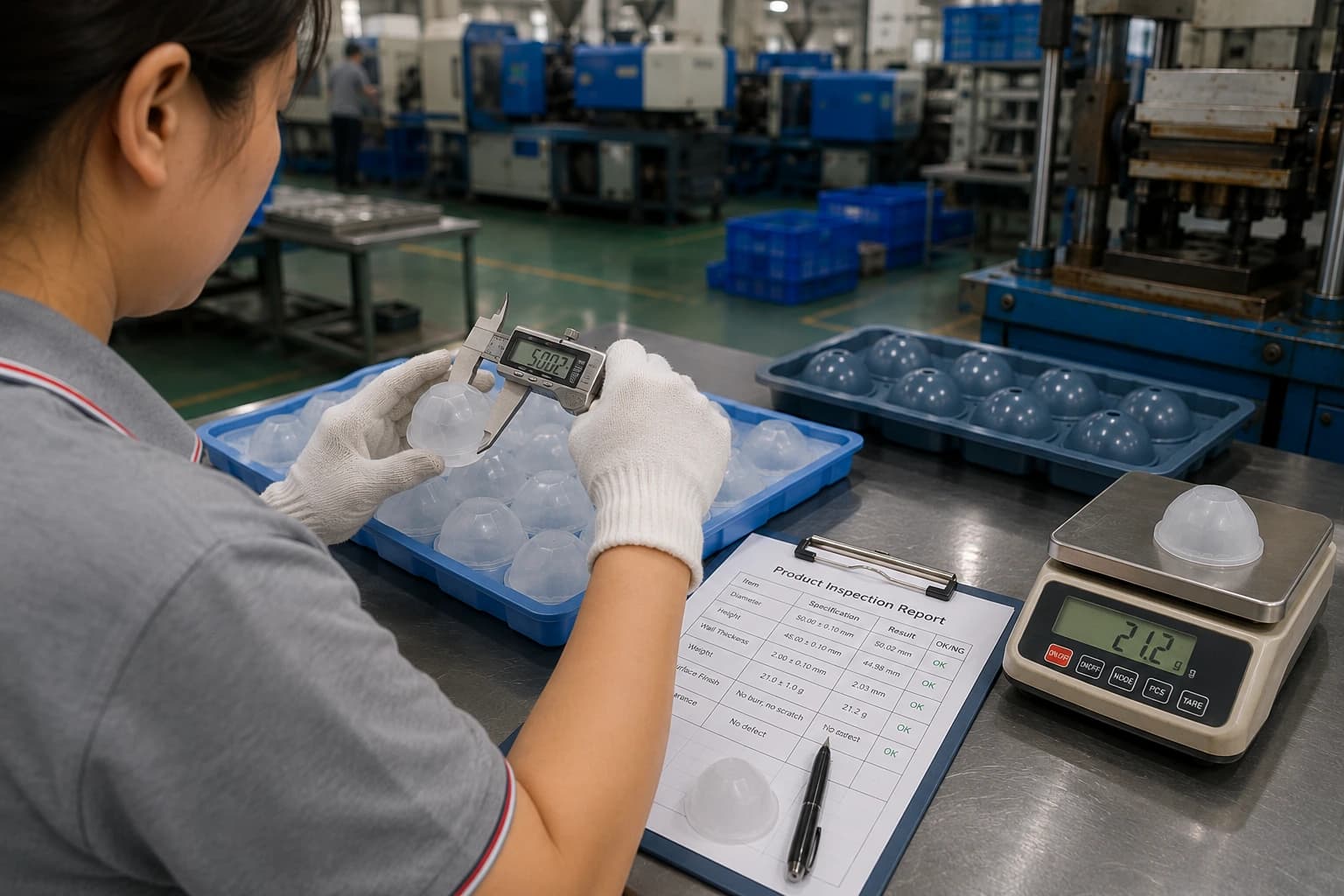
- Approve the sample against a written spec. Record sphere diameter, weight, cavity count, color reference, and packaging dimensions, then inspect the shipment against the same sheet.
- Separate design questions from compliance questions. Retail requirements vary by market; confirm documentation for the specific product and destination rather than assuming a general claim covers you [K2].
- Ask about the boring details early. Logo placement on a curved silicone surface, packaging artwork bleed, and carton configuration cause more delays than cavity design does. A structured list of questions to ask a silicone OEM/ODM manufacturer before quoting saves a revision cycle later.
Suppliers with a stated quality philosophy tend to be more transparent about these steps. One useful signal is whether the manufacturer's own working principles are described in operational terms — making products with respect for quality and responsibility, doing business with a service-minded approach, and contributing to the industry with accountability — rather than as marketing slogans [K5].
7. Key Comparison and Buyer Checklist
Silicone vs rigid plastic for cocktail ice balls
| Criterion | Food-grade silicone | Rigid plastic (two-piece shell) |
|---|---|---|
| Demolding | Flex and push; low cracking risk | Lever out; higher cracking risk |
| Seal reliability | Depends on lid design; usually good | Depends on latch and seam alignment |
| Customization | Cavity design, shape, size, color, logo, packaging [K3] | Limited by tooling and shell geometry |
| Durability in normal use | High, if not cut or punctured | Latches and hinges wear first |
| Best fit | Home bars, private label, gifting | Low-cost high-volume promo runs |
Pre-purchase checklist
- Measure glass opening and freezer clearance before choosing sphere size.
- Confirm the mold sits level and can be stacked without compressing cavities.
- Verify the lid seals by inverting a filled mold over a sink.
- Check for odor after the first wash.
- For custom orders, lock a written spec and a sampling timeline before paying a mold fee.
- Store finished ice sealed and away from strong-smelling food.
8. FAQ
Q1. Does a ball ice cube tray produce clear ice on its own?
No. The tray controls shape and release; clarity depends on water composition, freezing speed, and freezing direction. Filtered or boiled water and a directional-freezing setup improve clarity, but a tray alone will not guarantee a transparent sphere.
Q2. How long does it take to freeze a cocktail ice ball?
Plan on roughly 12–24 hours for a two-inch sphere in a typical domestic freezer, with larger spheres and insulated molds taking longer. Freezing time varies with freezer temperature, mold material, cavity size, and airflow, so test one full cycle before relying on the mold for service.
Q3. Is a small ice ball mold better than a large single-sphere mold?
It depends on the serve and the freezer. A small ice ball mold freezes faster, fits compact freezers, and suits coupe-style drinks and tasting flights. A large single sphere melts more slowly and is the better choice for spirit-forward drinks in wide, heavy glasses — provided your freezer and glassware can accommodate it.
Q4. Can I order custom-logo ice ball trays for a bar or retail brand?
Yes, and this is a standard OEM/ODM request: cavity design, product shape, size, color, logo, and packaging can all be customized [K3]. Expect a typical custom MOQ around 500 pcs, a mold fee quoted after design review, custom samples in roughly 7–10 working days, and mass production in roughly 15–20 working days after confirmation [K4]. Final terms depend on design and production scheduling.
9. Conclusion
Choosing a ball ice cube tray for cocktails comes down to three decisions made in the right order: sphere size that fits your glass and freezer, material and construction that release cleanly, and a freezing routine that you repeat consistently. Get those right and the ice stops being a variable in your drinks.
For home use, a small ice ball mold with four to eight cavities is usually the most practical starting point — it fits a normal freezer, refreezes overnight, and covers most cocktail formats. For bars and brands, treat the mold as a manufactured product: lock the specification, approve a physical sample, confirm packaging and market documentation, and plan lead times from design review forward rather than backward from a launch date.
The next step is simple. Measure your glass opening and your freezer clearance today, then compare those two numbers against the cavity dimensions of any tray you are considering. That single check eliminates most of the wrong options before you spend anything.