Key Takeaways
- Customizing a logo ice mold involves five main stages: artwork preparation, tooling (mold making), sampling, mass production, and quality inspection.
- Most custom silicone ice mold projects require a minimum order quantity (MOQ) of around 500 pieces, though final MOQ depends on design complexity and packaging needs. [K4]
- A well-prepared design file (vector artwork, clear color specifications) reduces iteration time and helps avoid extra mold fees.
- Typical custom-sample lead time is 7–10 working days after design confirmation; mass production takes 15–20 working days. [K4]
- Buyers should prioritize food-grade silicone, verify odorless material properties, and plan for market-specific compliance early in the process.
1. Introduction
Branded ice cubes are no longer just a novelty — they appear in upscale bars, corporate gift boxes, wedding favors, and social media content. A logo ice mold turns ordinary ice into a marketing tool or a personalized touchpoint. But moving from a logo idea to a finished mold that produces clear, legible ice involves a specific workflow.
Many buyers underestimate the complexity. They assume a simple JPG file is enough, or that any manufacturer can deliver the same quality. In reality, custom silicone ice mold projects require careful artwork preparation, mold engineering, material selection, and production planning. This article walks through each step — from artwork to production — so you can make informed decisions and avoid common pitfalls.
The process described here is based on standard practices from experienced silicone OEM/ODM manufacturers like Renjia, who combine custom development with responsive support and evidence-aware compliance planning. [K3]
2. Understanding the Custom Ice Mold Workflow
Core conclusion: A logo ice mold project typically follows a linear path: design file submission → 3D modeling → tooling (mold fabrication) → sampling → approval → mass production → packaging → inspection.
Each step has specific requirements and lead times. Knowing these upfront helps buyers set realistic expectations for cost, timing, and quality.
Reasoning: Unlike printing a logo on a flat surface, an ice mold must create a recessed or raised cavity inside the silicone. The ice cube freezes in the shape of the cavity, and the logo appears on the cube surface. This requires precise mold design.
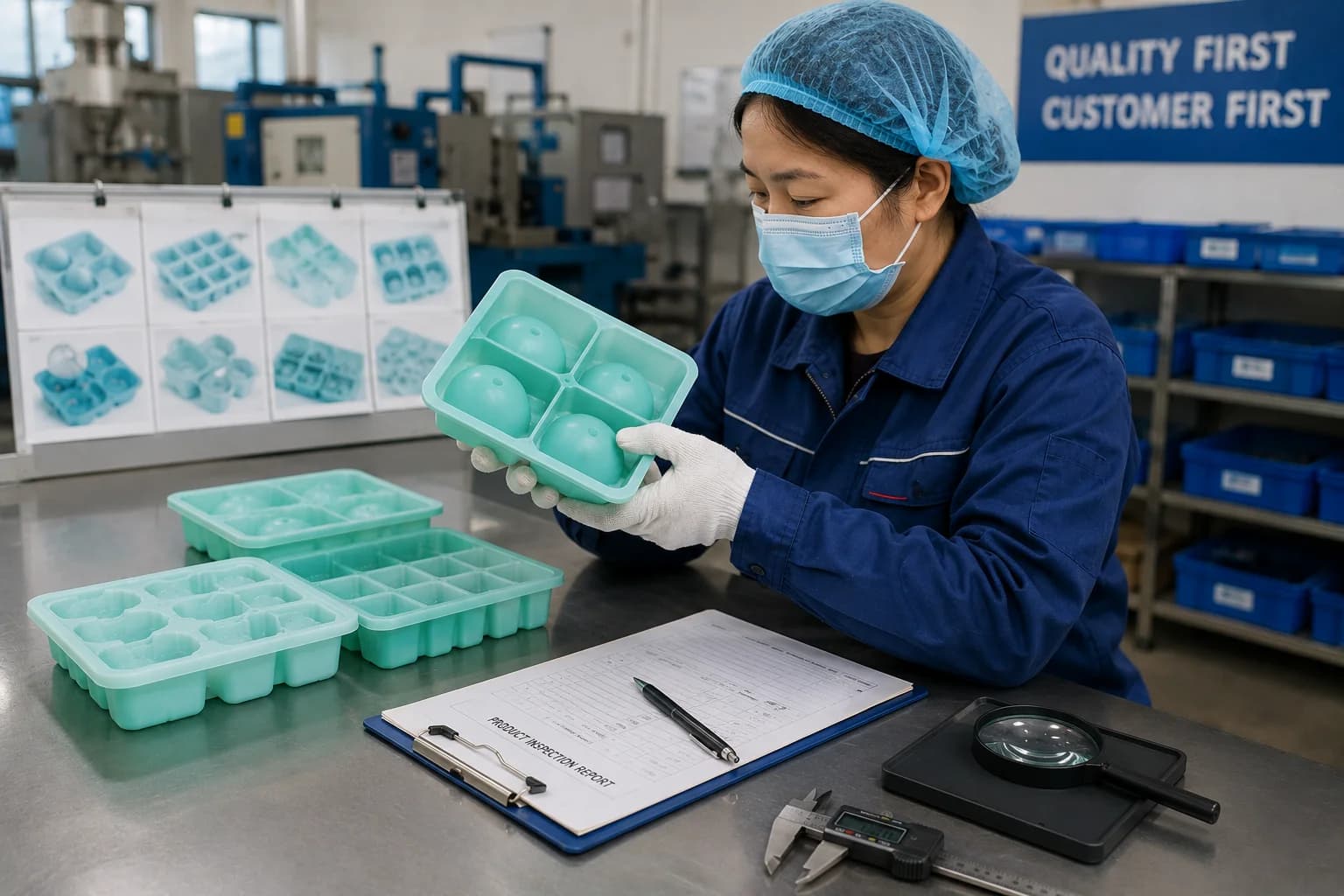
The table below summarizes the typical stages and estimated timeframes for a custom silicone ice mold project, based on Renjia’s standard commercial terms: [K4]
For a related manufacturing reference, review custom silicone ice mold manufacturing.
| Stage | What happens | Typical lead time |
|---|---|---|
| Artwork & design review | Customer submits vector logo; manufacturer reviews for mold feasibility | 1–2 working days |
| 3D design & mold engineering | Engineer creates 3D model of the cavity and mold structure | ~5 working days |
| Mold fabrication | CNC or manual tooling to create the metal or resin mold | ~15 working days after 3D design confirmed |
| Custom sample production | First silicone sample molded using the new tool | 7–10 working days |
| Sample approval | Customer reviews sample for logo clarity, size, material quality | Varies |
| Mass production | Production run using approved mold | 15–20 working days |
| Pre-shipment inspection | Visual and dimensional check before packing | 1–2 days |
Practical advice: Always submit a vector file (AI, EPS, or PDF) for the logo. Raster images like JPG or PNG can cause poor edge definition in the mold, leading to blurry ice cubes. Also confirm the exact dimensions of the ice cube (e.g., 2 cm × 2 cm) — a logo that looks large on screen may become illegible when scaled down to ice size.
3. Artwork Preparation and Design Requirements
Core conclusion: High-quality logo artwork must be vector-based, scalable, and include clear color specifications. The manufacturer needs to evaluate file suitability before quoting mold fees.
Reasoning: Ice molds typically require the logo to be engraved (recessed) or embossed (raised) in the silicone cavity. For a crisp impression, the logo lines should be thick enough to survive the freezing and demolding process. Thin lines or fine text often break or become unreadable in ice.
Common artwork pitfalls include:
- Using colors that are not Pantone-matched — the final ice cube is transparent, so color only applies to the silicone mold itself, not the ice.
- Submitting low-resolution images — the mold maker must redraw the logo, which adds cost and time.
- Placing the logo too close to the cube edge — ice tends to crack near thin walls.
Practical advice: Provide a vector file (AI or EPS) with all fonts converted to outlines. Specify the logo’s orientation (top, center, or bottom of the cube) and whether you want the logo to appear raised or recessed on the ice. If the ice cube is intended for a specific cocktail glass, include the glass dimensions so the mold can be size-optimized.
According to product knowledge for custom silicone ice molds, typical customization covers cavity design, product shape, size, color, logo, and packaging. [K2] That means a professional manufacturer should be able to work with your artwork as long as it meets basic file standards.

4. Tooling, Sampling, and Material Considerations
Core conclusion: The mold fee is the most significant upfront cost. It is quoted after the manufacturer reviews your design files and project requirements. Sampling confirms that the tool produces acceptable logo clarity and cube shape before mass production begins.
For additional context on this decision, see Logo Detail in Custom Ice Molds: Line Width, Depth, and Readability.
Reasoning: The mold itself (often made of steel or aluminum) is a one-time investment. Once the tool is built, each subsequent silicone ice mold is produced from that tool. The quality of the tool directly determines the consistency of every ice cube.
Renjia’s commercial terms state that the mold fee is quoted after reviewing the customer’s design files and project requirements. [K4] This means buyers should not expect a fixed price without submitting artwork first.
Key material and compliance points for logo ice molds:
- Silicone grade: Food-grade silicone that is odorless and temperature-resistant from -40°C to 240°C (-40°F to 464°F). [K5]
- Customization options: Custom colors (for the silicone mold itself), custom sizes, custom shapes, and custom packaging. [K5]
- Sample policy: Free samples may be available for existing molds. For custom samples, a fee typically applies. Lead time is 7–10 working days after design and specification confirmation. [K4]
Practical advice: During sample approval, test the ice cube with actual water (distilled water produces clearer ice). Check:
- Logo legibility: Are the edges sharp? Is the depth sufficient?
- Cube dimensions: Does it fit your intended use (glass, ice bucket)?
- Silicone feel: Is there any odor after washing? (Food-grade silicone should be odorless.)
If the sample is not acceptable, the manufacturer can usually adjust the mold (e.g., deepen the engraving) before mass production. Always request a pre-shipment sample or mass production sample if possible.
5. Key Comparison: Customization Options and Their Impact on Cost and Lead Time
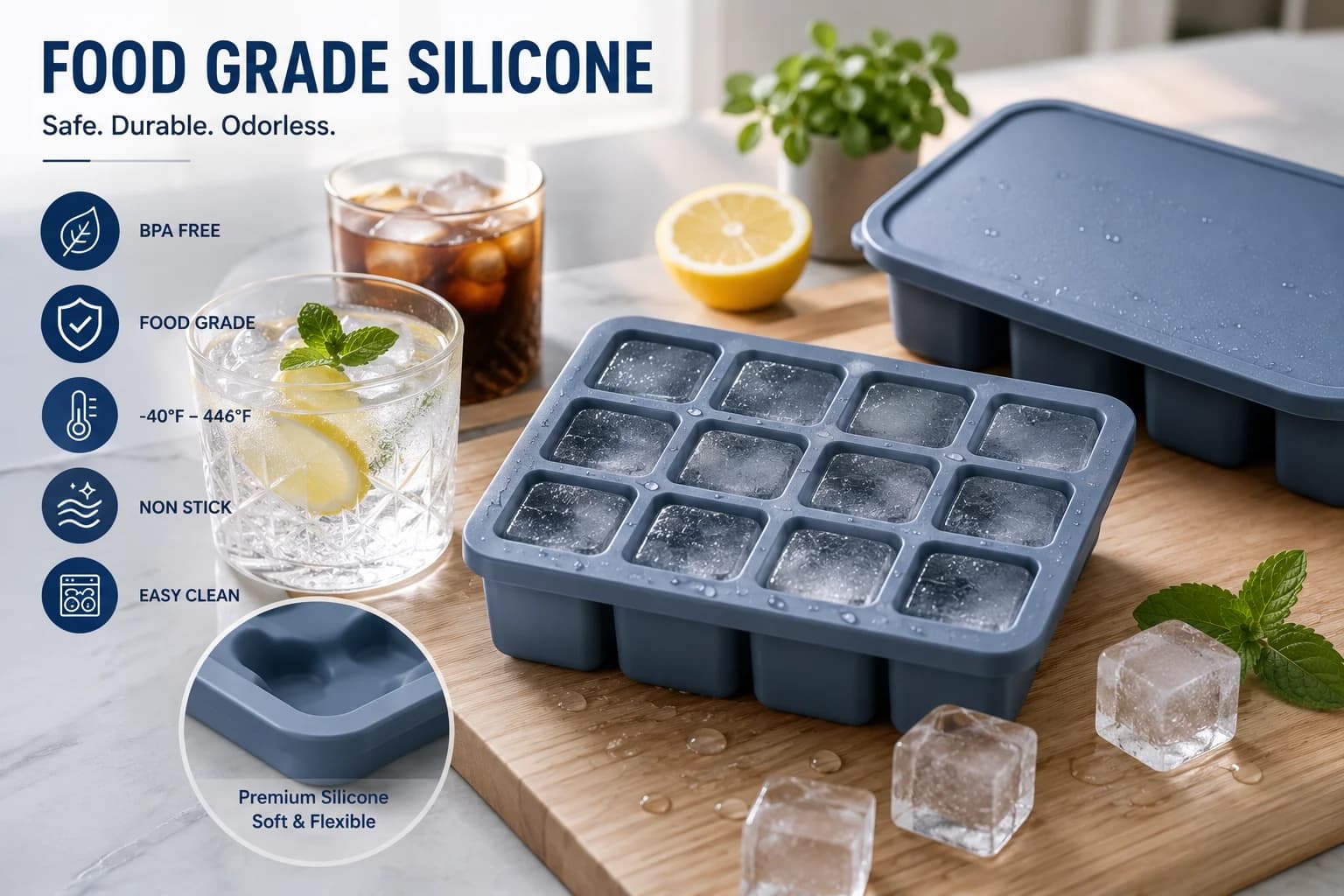
The table below shows how different customization choices affect project parameters. This information is based on typical industry practices and Renjia’s production guidelines.
Before finalizing the specification, use Embossed vs. Debossed Logo Ice Molds: Which Produces Clearer Branded Ice? as an additional planning reference.
| Customization option | Effect on mold fee | Effect on sample lead time | Effect on MOQ | Notes |
|---|---|---|---|---|
| Logo only (simple shape, no color) | Low | Standard (7–10 days) | Standard (~500 pcs) | Most common |
| Multiple logos or complex graphics | Medium–High | May add 2–3 days for 3D modeling | May increase MOQ | Requires artwork redraw |
| Custom silicone color (e.g., brand color) | Low (color only) | No significant change | Standard | Color matched via Pantone |
| Custom cube shape (e.g., sphere, diamond) | High | Longer (10–14 days) | May increase MOQ | Requires new tooling |
| Custom packaging (box, label, insert) | Additional cost | Depends on packaging type | May be separate from product MOQ | Confirm packaging MOQ separately |
Practical advice: If you are a first-time buyer, start with a simple logo cube. Once you have validated the product in the market, you can explore complex shapes and custom colors. This approach reduces initial investment and risk.
6. FAQ
Q1. What file format should I submit for my logo?
Submit a vector file such as AI, EPS, or PDF with fonts converted to outlines. Avoid JPG, PNG, or other raster formats because they lose clarity when scaled. If you only have a raster image, the manufacturer can redraw it for an additional design fee.
Q2. How many logo ice molds do I need to order? Is the MOQ flexible?
Renjia’s standard MOQ for custom orders is typically 500 pieces. However, the final MOQ may vary based on design, tooling, packaging, and production scheduling. [K4] Some manufacturers may accept smaller quantities for a higher per-unit cost. Always confirm the MOQ during the quotation stage.
Q3. Can I get a sample before committing to mass production?
Yes. Custom-sample lead time is usually 7–10 working days after design and specification confirmation. [K4] A sample fee may apply. Once the sample is approved, mass production can proceed. Free samples are generally only available for stock items, not for fully custom molds.
Q4. How do I know the silicone is food-safe?
Reputable manufacturers use food-grade silicone that is odorless and temperature-resistant from -40°C to 240°C. [K5] Request material test reports or certificates (such as FDA or LFGB compliance) from the manufacturer. Avoid any silicone that has a strong chemical smell or feels greasy.
7. Conclusion
Customizing a logo ice mold is a structured process that requires thoughtful preparation at each stage — from submitting clean vector artwork to approving a physical sample. The key to a successful outcome is partnering with a manufacturer that offers clear commercial terms, responsive project guidance, and verified product quality.
For most buyers, the recommended path is:
- Prepare a vector logo file and specify ice cube dimensions.
- Request a mold fee quotation and confirm MOQ, lead times, and sample policy.
- Approve the 3D design and proceed to tooling.
- Review the custom sample rigorously for logo clarity and material quality.
- Order mass production and plan for pre-shipment inspection.
By following this workflow, you reduce the risk of costly revisions, ensure consistent logo legibility in every ice cube, and build a reliable supply chain for your branded ice products. Whether you are launching a promotional item or a premium bar accessory, a well-executed logo ice mold can be a lasting differentiator.