Key Takeaways
- Crystal clear ice is achieved through water preparation and controlled freezing direction, not through the mold alone. A foldable silicone ice ball mold mainly improves release, handling, and repeatability.
- Use boiled or distilled water and freeze from one direction—commonly called directional freezing—to push trapped air and dissolved minerals out of the ice ball.
- Food-grade silicone ice ball molds are typically odorless and withstand temperatures from -40°C to 240°C, making them suitable for home freezers, commercial bars, and custom branding projects [K4].
- When sourcing a crystal clear ice ball mold, verify food-contact grade, temperature resistance, cavity design, and—if ordering custom—MOQ, sampling policy, and lead times [K1][K5].
1. Introduction
A perfectly round, crystal clear ice ball is one of the most visible signs of care in cocktail and whiskey service. It looks simple, but anyone who has tried knows the frustration: ice that freezes white, cracks in the middle, or stubbornly sticks to the mold. The result is a cloudy, misshapen sphere that melts too fast and looks out of place in a premium drink.
The good news is that clear ice is not a mystery. It follows predictable physics, and the equipment matters less than the method. A foldable silicone ice ball mold helps in two practical ways: it releases the sphere without cracking, and it can be reused consistently. But to get a genuinely transparent ball, you still need to control how the water freezes.
This article explains why ice turns cloudy, how to make crystal clear ice balls at home using a foldable silicone ice ball mold, what to look for when choosing one, and what to know if you plan to order silicone ice ball molds in bulk for a brand or business [K1][K5].
2. Why Ice Turns Cloudy and How Clarity Is Achieved
Core conclusion: Cloudy ice is caused by trapped air and dissolved minerals that get concentrated as water freezes. Clear ice is produced when impurities are pushed out of the freezing zone and only pure water crystallizes.
When water freezes in a standard ice tray, it freezes from all sides at once—top, bottom, and edges. As the outer layer solidifies, dissolved gases and minerals have nowhere to go. They become trapped in the center, forming white bubbles and cracks. That is why the middle of a normal ice cube is almost always cloudy.
The directional freezing principle
To make crystal clear ice, you want the water to freeze from one direction only. This gives impurities a path to escape. As ice forms from top to bottom (or bottom to top), air and minerals are pushed ahead of the freezing front and remain in the unfrozen water. At the end of the process, you remove the cloudy portion and keep the clear ice.
Practical methods that work
- Boil the water twice. Boiling removes a large portion of dissolved air. Let the water cool, then boil it again before filling the mold. This is the simplest low-cost approach.
- Use distilled or purified water. Distilled water has far fewer dissolved minerals, which reduces the chance of white precipitates forming inside the ice.
- Freeze directionally. Place the mold inside an insulated cooler without a lid, or wrap the mold so that the top is exposed and the sides and bottom are insulated. The cold air will freeze the water from the top down. After about 24 hours, the lower portion of the mold may still contain unfrozen, impure water—drain it, and the remaining ice will be noticeably clearer.
- Freeze slowly. A colder freezer is not better for clarity. A temperature around -5°C to -10°C (23°F to 14°F) freezes more slowly and gives impurities more time to move out of the crystal structure.
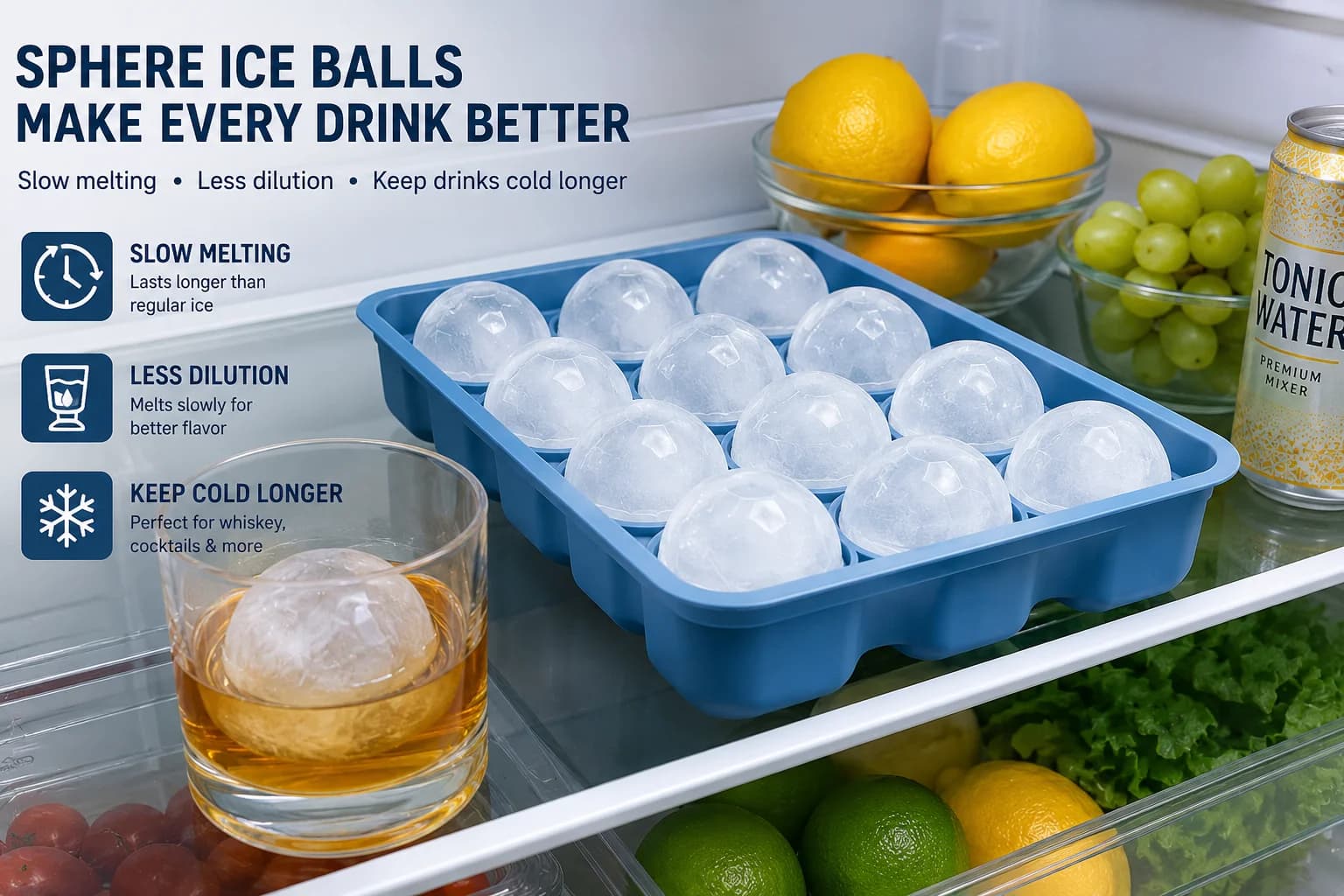
Scenario-based advice: If you are making ice for an evening cocktail session, start the process the night before. Boil the water, let it cool, fill the foldable silicone ice ball mold, and place it in an insulated container in the freezer. By the next evening, you will have a sphere that is clear enough for most home and bar use.
For a related manufacturing reference, review custom silicone ice mold manufacturing.
3. Choosing and Using a Foldable Silicone Ice Ball Mold
Core conclusion: A foldable silicone ice ball mold is a practical tool because it combines food-safe material, easy release, and reliable shaping—but the material quality and mold design determine how well it performs.
Silicone molds have become the default choice for homemade ice balls because they flex. Unlike hard plastic molds, a silicone mold can be folded and pushed inside-out to release the sphere without forcing it or cracking the ice. This matters especially for crystal clear ice, which can be brittle.
What to verify in the material
When evaluating any silicone ice ball mold, check the specification claims:
- Food-grade silicone: The mold should be explicitly food-contact grade, meaning it is designed to be safe for direct contact with food and beverages [K4].
- Odorless: Silicone should not transfer a rubbery smell or taste to the ice. Odorless food-grade silicone is the standard for ice molds [K4].
- Temperature resistance: A silicone mold rated from -40°C to 240°C will safely handle freezer temperatures far below what a home freezer can reach, while also being easy to clean in hot water without deformation [K4].
How the foldable design helps
The "foldable" feature is not just a marketing point. It solves three real problems:
- Release: Folding the mold breaks the vacuum and the grip between silicone and ice, so the sphere comes out intact.
- Cleaning: A mold that can be turned inside-out is much easier to rinse and dry, reducing residue and odor buildup between uses.
- Storage: Flexible molds take up less space and can be stacked or rolled when not in use.
Scenario-based advice: If you are serving guests, prepare six to eight ice balls at a time so you have replacements. Keep the molds filled and frozen, and release only what you need. A foldable mold makes this workflow practical because you can refill and return it to the freezer within minutes.
4. Step-by-Step Method for Crystal Clear Ice Balls
Core conclusion: The process has six repeatable steps: prepare water, set up directional freezing, fill the mold, freeze, release, and store. Each step has a specific job.
For additional context on this decision, see The Ultimate Guide to Using Silicone Ice Ball Molds for Crystal Clear Ice.
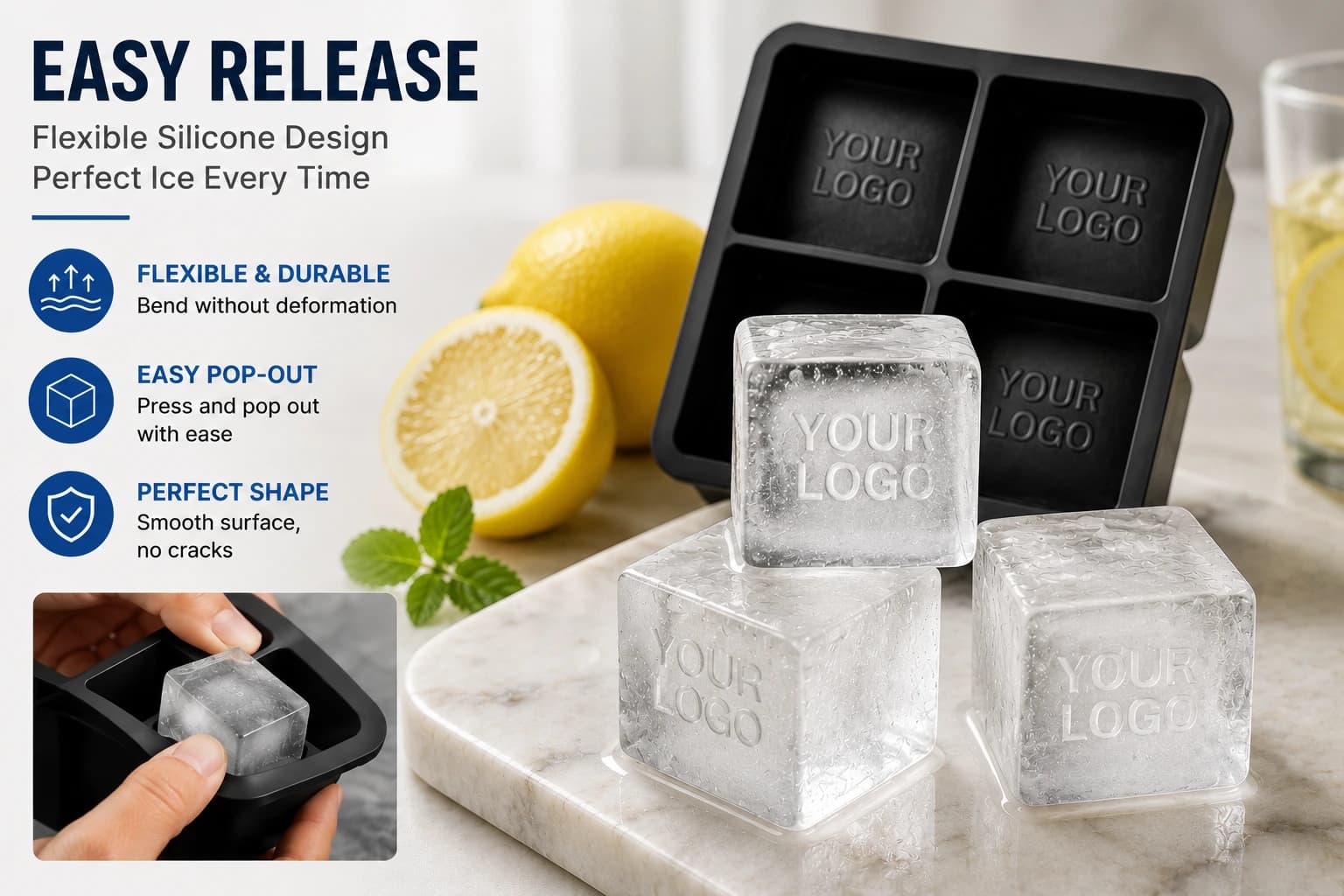
Step-by-step table
| Step | Task | Time | Key Detail |
|---|---|---|---|
| 1 | Boil water twice, then cool to room temperature | 30–60 min | Removes dissolved air; use distilled water if possible |
| 2 | Place the foldable silicone ice ball mold in an insulated cooler or wrap it with a towel, leaving the top open | 5 min | Forces freezing from one direction (top-down) |
| 3 | Fill each cavity just below the top edge | 2 min | Overfilling causes expansion overflow and distorted spheres |
| 4 | Freeze slowly in the coldest part of the freezer | 24 hours | Slow freezing improves clarity; do not open the freezer repeatedly |
| 5 | Remove the mold and fold it gently to release the ice balls | 1–2 min | Twist and push from the bottom; never pry with tools |
| 6 | Trim any cloudy base with a knife or rinse with cold water, then store in a sealed bag in the freezer | 5 min | Keeps balls from absorbing odors and sticking together |
Key details that affect the outcome
- Do not use warm water in the mold. Warm water can cause the silicone to expand slightly and can introduce new air as it cools. Always let boiled water return to room temperature before filling.
- Leave headroom. Water expands by about 9% when it freezes. If you fill the cavity to the rim, the ball will deform or the mold will bulge.
- Avoid opening the freezer. Each time the freezer door opens, warm air enters and partially thaws the surface of the ice, which can cause layered cloudiness.
- Handle with clean, dry hands. Because silicone is flexible, it can pick up oils and odors, which will transfer to the ice.
Scenario-based advice: For a bar or restaurant, this process can be scaled across multiple molds. Assign one freezer shelf to ice ball production and follow the same steps daily. The foldable design allows staff to release and reset molds quickly, which keeps output consistent [K1].
5. Key Considerations: Mold Selection, Customization, and Sourcing
Core conclusion: If you are buying a crystal clear ice ball mold for personal use, focus on food-grade material, cleanability, and cavity size. If you are sourcing molds for a brand, hospitality business, or promotional program, plan around customization options, MOQ, sampling, and lead times [K1][K5].
For individual buyers
- Choose a mold with a cavity diameter that matches your glasses. A 5–6 cm sphere suits most whiskey tumblers.
- Confirm that the mold is labeled food-grade and odorless [K4].
- Prefer a mold that can be turned inside-out for cleaning. This is a practical quality signal that the silicone is soft enough to flex without tearing.
For businesses and brands
Silicone ice ball molds are frequently produced as custom silicone products. Manufacturers can customize cavity design, shape, size, color, logo, and packaging [K1]. If you are considering a custom order, align your expectations with typical commercial terms:
Before finalizing the specification, use Create Professional-Quality Ice Spheres with a Crystal Clear Ice Ball Mold as an additional planning reference.
| Sourcing Factor | Typical Commercial Terms [K5] |
|---|---|
| Custom-order MOQ | Typically 500 pcs; final MOQ varies by design, tooling, packaging, and production scheduling |
| Stock sample lead time | Usually 1–2 working days, subject to current stock and shipping |
| Custom sample lead time | Usually 7–10 working days after design and specification confirmation |
| Mold lead time | Usually about 15 working days after the 3D design is confirmed |
| Mass production lead time | Usually 15–20 working days after order and production details are confirmed |
| Mold fee | Quoted after reviewing the customer's design files and project requirements |
| Sample policy | Free samples may be available; eligibility, freight, taxes, and custom-sample charges are confirmed case by case |
Important cautions
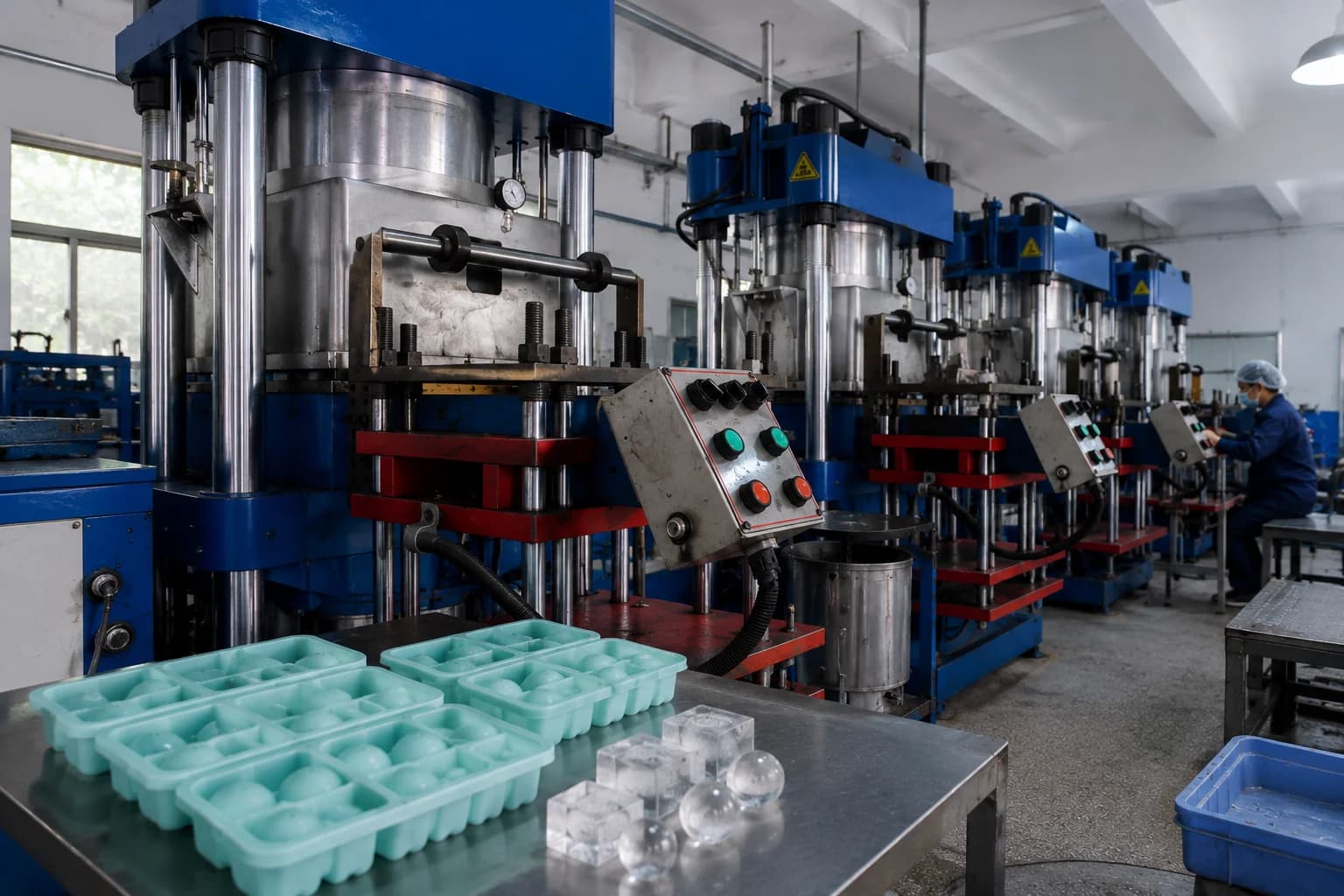
- Verify current capabilities. The product portfolio for silicone ice-related items includes ice block molds, ice cube trays, and ice ball trays across household and promotional product lines [K3]. However, not every manufacturer produces every item continuously. Confirm current product availability directly with the supplier before building a plan around a specific mold style.
- Avoid unsupported certification claims. If a supplier claims a certification, ask for documentation. A responsible manufacturer will state what it can verify rather than overpromising.
- Do not skip the 3D design review. Custom cavity design affects release behavior, wall thickness, and freeze performance. Reviewing a 3D design before tooling prevents expensive mold revisions later [K1][K5].
Scenario-based advice: A restaurant group ordering custom ice ball molds with a logo should start by sending a rough design file, confirming cavity size and color, and requesting a custom sample before committing to mass production. With a typical custom-sample lead time of 7–10 working days and production lead time of 15–20 working days after confirmation, the full process can reasonably be planned over four to six weeks [K5].
6. FAQ
Q1. How long does it take to make a clear ice ball with a silicone mold?
Expect about 24 hours for best results. The actual freezing time depends on your freezer temperature and the water volume. Directional freezing, where the mold is insulated on the sides and bottom, deliberately slows the freeze to push impurities out, so rushing the process reduces clarity.
Q2. Can I use any silicone ice ball mold for clear ice?
The mold affects release and shape, not clarity. Any food-grade, odorless silicone ice ball mold can be used [K4], but clarity depends on water quality and freezing method. Boiling the water and using directional freezing are what transform cloudy ice into transparent ice.
Q3. Is a foldable silicone ice ball mold safe for food contact?
If the mold is explicitly food-grade silicone and odorless, it is designed for direct contact with food and beverages. Food-grade silicone also offers wide temperature resistance, typically from -40°C to 240°C, so it remains stable in a home freezer and can be cleaned with hot water without damage [K4]. Always confirm the material specification with the manufacturer or seller.
Q4. Can I order custom crystal clear ice ball molds in bulk?
Yes. Custom silicone ice molds support changes to cavity design, shape, size, color, logo, and packaging [K1]. A typical custom order has an MOQ around 500 pieces, with custom samples usually ready in 7–10 working days and mass production in 15–20 working days after confirmation [K5]. The mold fee is quoted after the manufacturer reviews your design files and project requirements [K5].
7. Conclusion
Making crystal clear ice balls is a controlled process, not a lucky outcome. The three variables that matter most are water preparation, freezing direction, and the mold itself. Boiled or distilled water removes impurities before freezing. Directional freezing gives those impurities a path out of the ice. And a foldable, food-grade silicone ice ball mold ensures that the finished sphere releases cleanly and can be reused consistently [K4].
For home use, start with a single food-grade mold and the 24-hour directional freezing method described in this article. For business use, evaluate molds against material specifications, then plan sourcing around the MOQ, sampling, and lead-time expectations of the silicone manufacturer [K1][K5].
If you produce a few batches, you will notice a clear difference: ice that looks professional, melts more slowly, and does not dilute the drink as quickly. That is the practical value of a crystal clear ice ball mold used correctly.