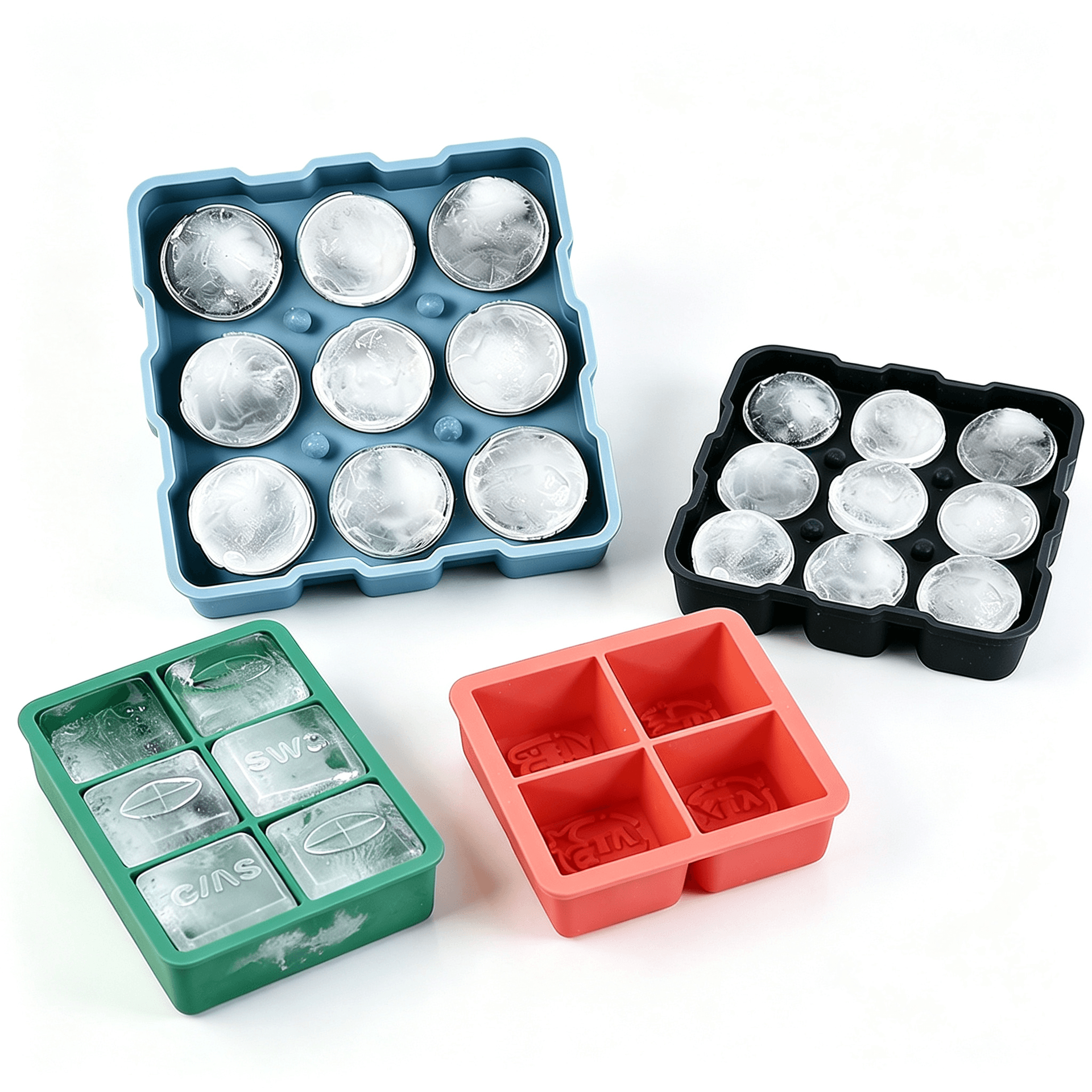
Custom silicone ice molds look simple when they are shown as finished retail products. For a buyer, however, the finished tray is the result of many connected decisions: ice format, cavity dimensions, logo detail, silicone specification, mold construction, sample approval, production controls, packaging and destination-market requirements.
That is why two quotations for a “custom ice mold” may describe very different projects. One supplier may be pricing a standard tray with a color change and printed sleeve. Another may be pricing new tooling for a custom cavity, embossed logo, lid and retail box. Comparing the totals before aligning the scope can lead to the wrong supplier decision.
This guide is written for brand owners, beverage suppliers, hospitality groups, promotional-product companies, importers and sourcing teams. It explains what to define, what to ask and what to approve before placing a bulk order.
Short answer: how do you source a custom silicone ice mold?
Start by defining the intended ice format, target dimensions, cavity count, logo or artwork, order quantity, packaging and destination market. Ask the manufacturer to review design feasibility before confirming tooling. Approve a physical sample against a written specification, then define in-process and pre-shipment checks for the bulk order. Compare suppliers on scope clarity and control—not unit price alone.
1. Begin with the use case, not the mold drawing
A strong RFQ explains where the product will be used and what result the end customer expects. The same “logo ice mold” request can describe several applications:
- Branded cubes for bars, hotels or beverage promotions.
- Ice balls designed for specific glassware.
- Novelty shapes for seasonal retail or gifting.
- Large ice blocks for specialty beverage, display or operational use.
- A private-label tray sold as a standalone kitchen product.
- A promotional set with customized packaging and instructions.
The use case helps the factory review practical questions that a flat drawing may not answer. Will the finished ice fit the intended glass? Does the buyer need a lid? Will the product be displayed individually or packed in a set? Is the logo meant to be visible after freezing and release? Does the outer tray need to fit a standard retail box or shelf plan?
For an early inquiry, a perfect engineering file is not required. A reference photo, sketch, logo file, target ice size and intended application can support an initial feasibility discussion. A precise quotation normally requires more detail later.
If the project is specifically for venue service or an experiential campaign, use the custom logo ice mold guide for bars, hotels and brand activations to calculate service capacity, match the ice to glassware and prepare the operating brief.
Minimum information for a useful first review
Provide the following when available:
- Product format: cube, ball, novelty shape, logo ice or large block.
- Target ice dimensions and overall tray dimensions.
- Number of cavities per tray.
- Logo or artwork in vector format if possible.
- Preferred product color or Pantone reference.
- Lid, accessories or set components.
- Packaging format and labeling needs.
- Estimated order quantity and repeat-order expectation.
- Destination market and intended consumer use.
- Required sample date, delivery date and shipping destination.
Missing information does not prevent the first conversation, but it should be identified before tooling approval.
2. Choose the ice format before optimizing the details
The cavity geometry drives much of the product design. Four common directions are useful starting points.
Custom cube trays
Cube trays are familiar and efficient, but the buyer still needs to define cube size, cavity count, cavity spacing, wall structure and the desired result after release. Large cubes and small cubes create different tray proportions and handling requirements. If a lid is included, its fit and stacking behavior become additional approval points.
Ice ball molds
Ice balls may use a multi-part or enclosed structure. The design review should consider fill access, closure alignment, expected seam appearance and release. If a logo is included, the artwork must be positioned so that the intended mark can form and remain recognizable.
Novelty and promotional shapes
Stars, characters, symbols and branded silhouettes can create differentiation, but narrow features or deep recesses may complicate filling, freezing or release. A shape that looks clear in a two-dimensional logo may need simplification to work as ice.
Large ice block molds
Large blocks place greater emphasis on product dimensions, handling and the finished weight of the ice. The mold must be reviewed around the intended freezer, storage method and application. Buyers should not assume that a small consumer tray can simply be scaled up without structural review.
3. Design a logo for ice—not only for print
A printed logo is interpreted through color. A logo molded into ice is interpreted through depth, light, shadow and the clarity of the frozen result. Fine typography, tight spacing and isolated details may disappear or merge.
During a logo feasibility review, evaluate:
- Minimum line thickness after scaling.
- Space between letters and graphic elements.
- Whether the mark should be raised or recessed on the ice.
- Logo depth and edge transitions.
- Orientation in the cavity and after demolding.
- The effect of the ice shape on the visible area.
- Release requirements around detailed features.
The best starting file is usually vector artwork, such as AI, EPS, SVG or an editable PDF. If only a raster image is available, provide the highest-resolution original rather than a screenshot. The factory can then explain whether the mark is suitable as submitted or needs a production-oriented revision.
A practical logo approval sequence
First approve the artwork interpretation on a drawing or rendering. Next approve the molded silicone detail. Finally, make and release actual ice during sample review. Each step answers a different question. A logo can look correct in the mold but still produce a weak visual result in ice under the buyer’s intended conditions.
4. Treat “food-grade silicone” as a specification to verify
For food-contact applications, “food-grade” should not be treated as a decorative marketing phrase. The buyer should define the destination market, intended use and required testing scope, then confirm what material information and finished-product testing will support that scope.
In the United States, 21 CFR 177.2600 addresses rubber articles intended for repeated use. In the European Union, Regulation (EC) No 1935/2004 provides a general framework for materials and articles intended to come into contact with food. These references do not mean that every silicone product automatically complies. The exact formulation, colorants, production conditions, finished configuration, intended use and test scope still matter.
Ask the supplier:
- What material specification is proposed for this product?
- Is the stated temperature range a material specification or a finished-product test result?
- What information is available for material traceability?
- Which third-party tests are relevant to the final product and market?
- Who will approve the testing scope and pay the laboratory fees?
- Will the tested sample match the final color, construction and accessories?
Renjia’s currently stated baseline for its launch ice-mold line is food-grade, odorless silicone with a material temperature range of -40°C to 240°C. That range should be recorded as the project specification and reviewed against the final application; it should not be turned into an unlimited performance guarantee.
5. Understand what changes tooling cost
Tooling cost cannot be responsibly fixed from the words “custom silicone ice tray.” It follows the design review. Important cost drivers can include:
- Overall part and cavity dimensions.
- Number of cavities.
- Product geometry and depth.
- Logo detail and surface texture.
- Parting-line and release requirements.
- Lid or multi-part construction.
- Expected production volume and cycle efficiency.
- Mold material and planned service life.
- Secondary operations or assembly.
A lower tooling quotation is not automatically better. Ask what is included: design adjustment, sample rounds, mold modification limits, ownership or storage terms, maintenance expectations and the conditions for repeat production.
Standard customization versus new tooling
Not every project requires a completely new structure. A buyer may use an existing format and customize color, packaging or certain brand elements. This can reduce development complexity. A unique ice shape, cavity layout or tray silhouette is more likely to require new tooling.
The commercial decision is strategic. Existing structures can support faster market testing, while new tooling can create stronger differentiation. The correct option depends on launch goals, budget, intellectual-property position and expected volume.
6. Use sampling to close questions before mass production
A sample is not only a sales object. It is the proposed reference for production. Buyers should approve it against a written checklist rather than relying on “looks good.”
For a custom silicone ice mold, the sample review may include:
Product and dimensional checks
- Overall length, width and height.
- Cavity dimensions and cavity count.
- Product weight where specified.
- Wall, rim and base structure.
- Lid dimensions and fit if included.
- Logo position, depth and orientation.
Appearance checks
- Approved color reference under agreed lighting.
- Surface finish and texture.
- Flash, tears, contamination, bubbles or visible molding marks.
- Logo definition and consistency.
- Packaging print, labels and barcodes.
Application checks
- Filling under the intended use scenario.
- Stability during movement into the freezer.
- Closure or lid behavior where applicable.
- Ice shape after freezing.
- Release without unintended damage.
- Logo visibility on the finished ice.
- Cleaning and drying according to the intended instructions.
Document sample comments with photographs, measurements and revision numbers. If the sample changes, issue a new approval record. Avoid approving one physical piece while the specification sheet describes another revision.
Renjia states a typical sample time of 2–7 days. Actual timing depends on the design, tooling stage, revision requirements and packaging scope. The sample clock should start only when the required inputs and commercial conditions are clear.
7. Define quality checkpoints before the order starts
Quality control is more effective when acceptance criteria are agreed before production. A final inspection cannot repair unclear artwork, an unapproved dimension or a packaging brief that changed after packing began.
A project-level control plan can include:
- Requirement and drawing review.
- Incoming material information check.
- First-piece confirmation against the approved reference.
- In-process checks for defined dimensions and appearance.
- Functional or application checks at an agreed frequency.
- Finished-product inspection.
- Packaging, label and carton-mark verification.
- Shipment documentation and retained sample.
Renjia’s disclosed manufacturing baseline includes two production lines, 12 machines and a 10-person QC team, with stated monthly capacity up to 300,000 products. Capacity should still be confirmed for the exact SKU, order quantity, packaging complexity and required delivery window.
Classify defects around customer risk
Do not use one vague category called “bad product.” Define examples that matter to the project. A wrong material or unsafe contamination may be treated differently from a small cosmetic mark. A missing barcode may be commercially serious even when the silicone part itself is acceptable.
Your defect list might cover:
- Incorrect product, material or color.
- Dimensions outside the agreed tolerance.
- Incomplete molding, tears, flash or contamination.
- Distorted cavity or poor logo detail.
- Lid or component fit failure.
- Incorrect quantity, label or packaging.
- Carton damage or wrong shipping marks.
The buyer and manufacturer should agree on severity, inspection method and acceptance decision before shipment inspection.
8. Plan packaging as part of product development
Packaging affects more than presentation. It can change product folding, compression, dust exposure, carton utilization and the customer’s first-use experience.
Common options include bags, paper sleeves, retail boxes, inserts, labels and multi-piece sets. The best option depends on sales channel and product geometry. Before mass production, approve:
- Product orientation and folding method.
- Contact between printed materials and the silicone surface.
- Barcode type, position and scannability.
- Required warnings or use instructions.
- Retail dimensions and pack count.
- Inner carton and master carton quantities.
- Carton marks and shipping labels.
- Export packing suitable for the planned route.
If ecommerce fulfillment is involved, provide the relevant pack and labeling requirements before the packaging quotation. Late packaging changes can affect unit cost, production timing and shipment volume.
9. Compare manufacturers with a scope-based scorecard
Price belongs in the evaluation, but it should be compared after scope alignment. A practical scorecard can use five categories.
| Evaluation area | What to look for | Warning sign |
|---|---|---|
| Technical review | Specific questions about size, logo, release and use | Immediate price without clarifying the design |
| Material and market support | Product-specific discussion of material, testing and destination | Blanket claim that every configuration has every certificate |
| Sampling | Written revision and approval process | Pressure to approve from photos only |
| Production and QC | Defined checkpoints and responsible team | Quality described only as “100% guaranteed” |
| Commercial clarity | MOQ, tooling scope, packaging, lead time and exclusions | Key terms appear only after deposit |
Ask for real production and product evidence relevant to your category. Factory photographs help, but they do not replace a project-specific process explanation. The supplier should be able to connect the proposed product to tooling, sampling, inspection and packing steps.
10. Build a complete RFQ in one page
Use the following format to reduce quotation gaps:
Project: Custom silicone ice mold for [application]
Ice format: [cube / ball / logo / novelty / block]
Ice dimensions: [length × width × height or diameter]
Cavities: [number]
Overall tray size: [target or maximum]
Artwork: [attached vector logo / drawing / reference]
Color: [Pantone or reference]
Components: [lid / accessories / none]
Packaging: [bag / sleeve / box / set / undecided]
Quantity: [initial order and annual estimate]
Market: [country or region]
Testing/documentation: [known requirements or request for coordination]
Timing: [sample target and delivery target]
Delivery location: [city, country or port]
Attach the latest revision of every file and label it clearly. If a dimension is still open, mark it “for manufacturer review” rather than leaving an unexplained blank.
Frequently asked questions
What is a typical MOQ for custom silicone ice molds?
Renjia can accept custom orders from 500 pieces. Orders of 1,000 pieces generally offer more favorable unit pricing. The final minimum and price tier may vary with mold requirements, product size, color, packaging, components and production efficiency. Ask the manufacturer to confirm the MOQ for the complete configuration, not only the unboxed tray.
For a quantity-and-cost comparison, read Custom Ice Mold MOQ: What Affects Minimum Order Quantities?.
Can both the ice shape and tray size be customized?
Yes, both can be reviewed. Cavity shape, ice dimensions, cavity count and overall tray size are connected design decisions. The manufacturer should confirm feasibility after reviewing the intended use and files.
Can a logo be molded into the ice?
Yes, if the artwork can be translated into a moldable, releasable feature. Line thickness, spacing, depth, orientation and the ice shape influence the result. Approve actual frozen ice during sampling rather than relying only on a rendering.
Do I need a 3D file to request a quote?
Not for the first discussion. A vector logo, sketch, reference sample, target dimensions and application can support an initial review. A detailed quotation and tooling release may require confirmed 2D or 3D files.
How long do samples and production take?
Renjia’s stated typical sample time is 2–7 days and typical production time is 15–25 days. These are planning ranges, not guarantees for every design. Tooling complexity, revision rounds, testing, packaging and order quantity can change the schedule.
Is a free sample available?
Renjia states that free samples are available. Shipping, sample quantity and whether the request involves a stock or newly customized sample should be confirmed for the project.
Can a manufacturer support FDA, LFGB or other market requirements?
A manufacturer can coordinate material information, third-party testing and documentation, but the scope must match the final product, intended use and destination market. Do not treat a general capability statement as proof that every custom configuration has already passed every requirement.
Conclusion
The most reliable way to source a custom silicone ice mold is to make the specification comparable before making the price comparable. Define the application and ice result, review logo and geometry feasibility, clarify tooling, approve a physical sample, document the quality plan and confirm packaging before bulk production.
This approach may require more questions at the beginning, but those questions reduce expensive uncertainty later. A useful supplier does not simply accept the drawing; the supplier helps identify which decisions must be closed before the mold and production order are released.