Key Takeaways
- Ice ball molds produce large spherical ice that melts slower than square cubes, reducing drink dilution by roughly 30–50 % compared to standard cubes.
- Large square ice cube trays offer faster freezing cycles, easier stacking, and more uniform ice size for high-volume cocktail service.
- Silicone is the dominant material for both mold types because it is food-grade, odorless, and flexible enough for easy demolding.
- Customization options—colors, logos, cavity shapes—are available from OEM/ODM manufacturers, enabling branded ice programs for bars and restaurants.
- The choice between ball and square molds ultimately depends on the cocktail style: slow-sipping spirits favor spheres, while shaken or stirred drinks benefit from large squares.
1. Introduction
Every cocktail enthusiast knows that ice is not just a coolant—it is an ingredient. The size, shape, and density of ice directly influence the rate of dilution, the visual presentation, and even the mouthfeel of a drink. In the past decade, two ice mold formats have dominated the home and professional bar scene: the ice ball mold and the large square ice cube tray.
Yet many consumers face a practical dilemma: which one better serves their cocktail routine? Is the spherical shape really worth the extra waiting time for freezing? Do large squares offer a meaningful compromise between melt rate and ease of use? This article compares these two mold types from a material, functional, and economic perspective. Relying on verified product knowledge from the silicone custom-manufacturing industry, we break down the trade-offs so you can make an informed decision tailored to your specific needs—whether you run a craft cocktail bar or simply enjoy a well-made Old Fashioned at home.
2. Ice Ball Molds: Slow Dilution and Visual Elegance
Core conclusion: Ice ball molds create the slowest-melting ice shape for spirits-forward cocktails, delivering a crystal-clear aesthetic that enhances presentation. The trade-off is slower freezing time and slightly higher cost.
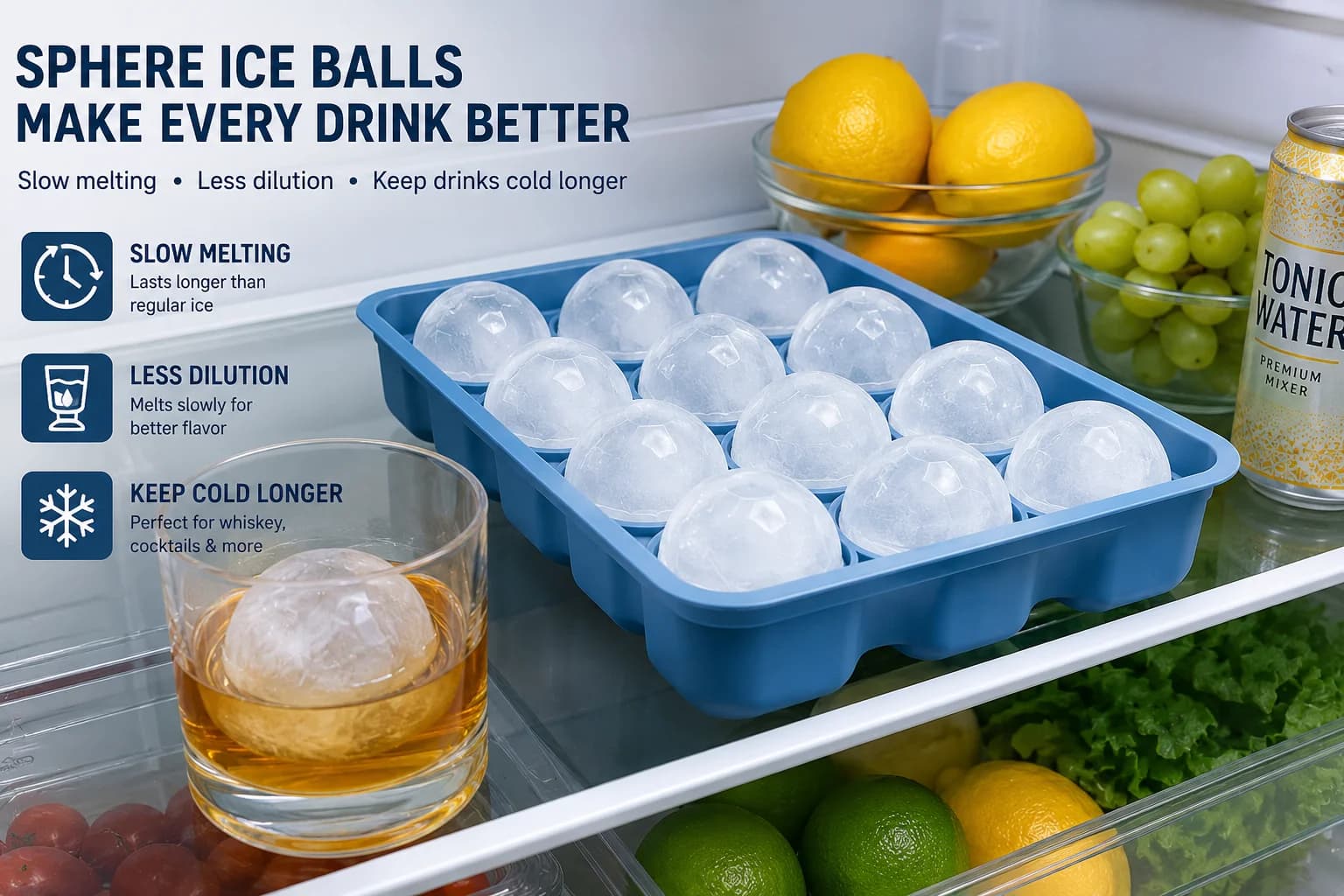
The physics is straightforward: a sphere has the smallest surface-area-to-volume ratio of any common ice shape. A 2-inch (50 mm) ice ball has about 20 % less surface area than a 2-inch cube of the same volume. Less surface area means less contact with the liquid, which translates directly to slower melting and less dilution over a 15–30 minute sipping session. This makes ice balls ideal for spirits like whiskey, bourbon, or aged rum, where maintaining the integrity of the flavor profile is paramount.
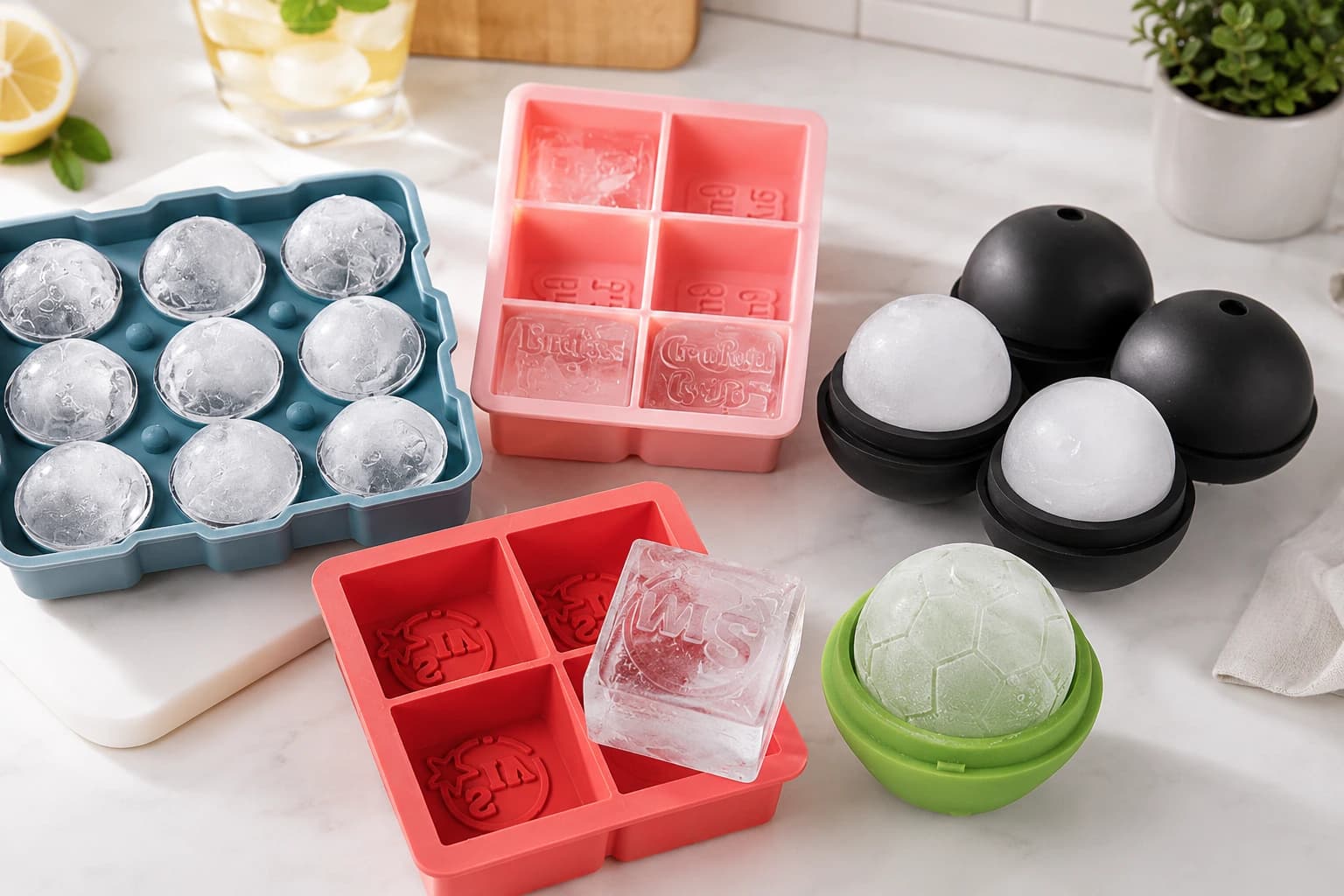
From a material perspective, most ice ball molds on the market are made of silicone—a flexible, food-safe elastomer. According to verified manufacturer specifications, food-grade silicone is odorless, withstands temperatures from -40°C to 240°C (-40°F to 464°F), and can be customized in terms of color, shape, and packaging (K5). Silicone ice ball molds typically feature a two-part design: a bottom half and a lid with a filling hole. The flexibility of silicone allows the frozen ball to be released by simply flexing the mold, without resorting to hot water or twisting that can crack the ice.
For a related manufacturing reference, review custom silicone ice mold manufacturing.
However, there are practical considerations. Ice balls require more freezer time—typically 18 to 24 hours for a full-size 2.5-inch sphere, compared to 8–12 hours for a thick square cube. The molds also take up more vertical space, and the resulting balls can be awkward to store in a standard freezer bin. For high-volume bars, producing dozens of ice balls daily may require dedicated freezer shelves and additional molds.
Recommendation: Use ice ball molds for premium, slow-sipping cocktails where dilution control and visual drama are priorities. If you serve whiskey neat or on the rocks, invest in a set of 4–6 silicone ice ball molds and plan your freezing schedule accordingly. For those interested in branded ice, OEM/ODM manufacturers like Renjia offer custom silicone ice molds with tailored cavity designs and logo embossing (K1, K2), which can elevate a bar’s signature serve.
3. Large Square Ice Cube Trays: Practicality and Versatility
Core conclusion: Large square ice cube trays provide the best balance of melt resistance, production speed, and stackability for most cocktail applications. They are the default choice for bars that require consistent ice size and rapid turnover.
A large square cube—typically 1.5 to 2 inches per side—still offers a favorable surface-area-to-volume ratio compared to smaller cubes or crushed ice. While it melts slightly faster than a sphere, the difference is often marginal in shaken or stirred cocktails where dilution is intentionally controlled through timing. For drinks like Manhattan, Martini, or Negroni that are stirred over ice, large squares deliver adequate chilling without over-diluting, and they are much easier to produce in bulk.
The tray format itself has practical advantages. Most large square silicone trays hold 4 to 6 cubes and are designed with a flat bottom and rigid edges, allowing them to be stacked in the freezer. This maximizes freezer space—a critical factor for small home freezers or busy bar stations. Freezing time for a 1.75-inch square cube is typically 10–14 hours, meaning a batch of three or four trays can be rotated daily with minimal planning.
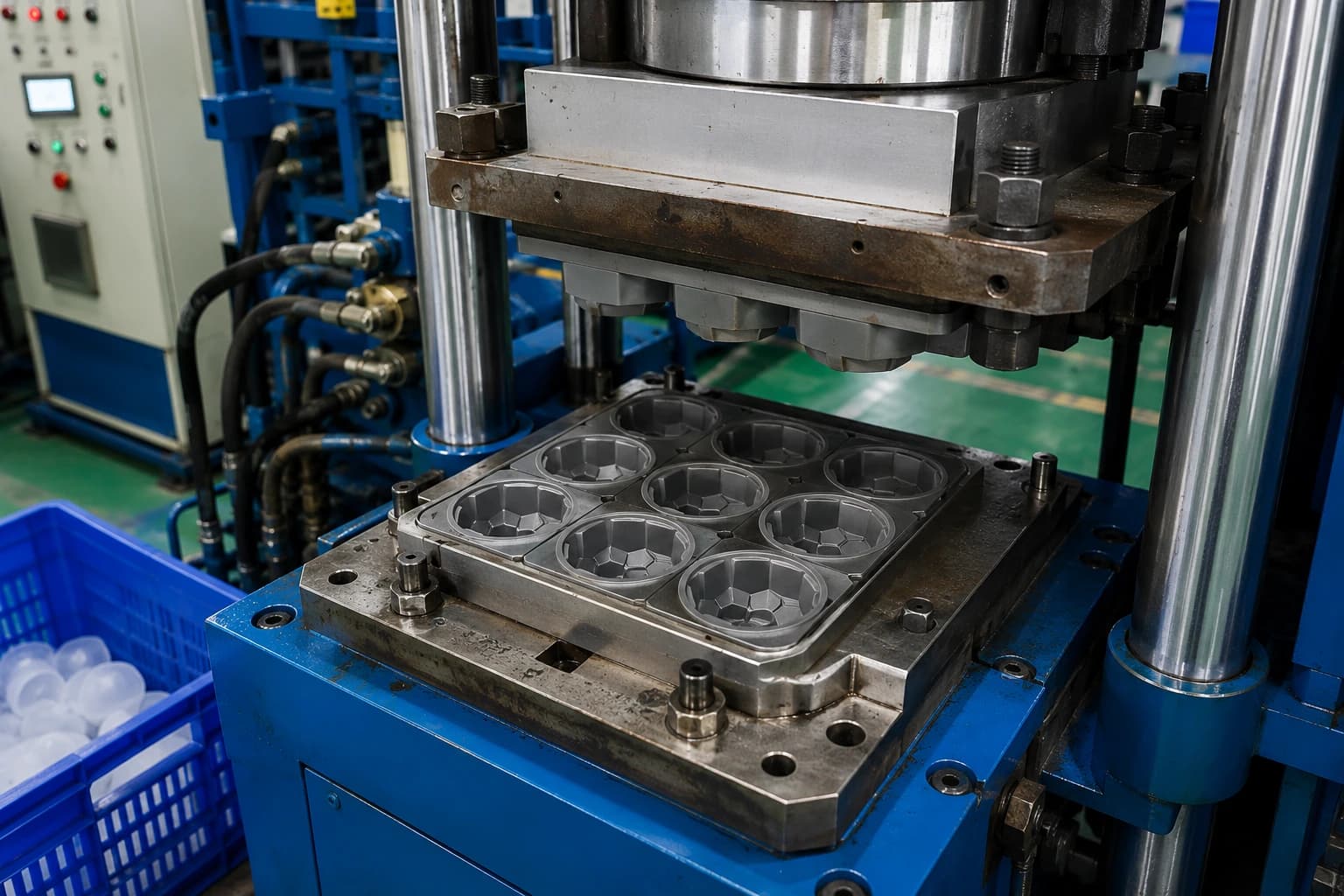
In addition, large square ice cubes are more forgiving when it comes to transparency. Because they freeze from the outside in, trapped air bubbles tend to migrate to the center, creating a clearer result than smaller cubes. For the clearest squares, directional freezing (insulating the top of the tray so ice forms downward) is easier to achieve with a tray than with a spherical mold.
Recommendation: If you make a wide range of cocktails—shaken, stirred, or highball—large square ice cube trays are the most versatile choice. They excel in bars where efficiency matters: one tray produces multiple identical cubes, and the flat shapes fit standard glassware without wobbling. For home users, a set of two to three trays ensures you always have clear, large ice on hand. Customization options from silicone OEM/ODM suppliers allow bars to imprint logos or create specific dimensions (K1, K4).
4. The Silicone Advantage: Why Material Matters
Core conclusion: Both mold types rely on the same material—food-grade silicone—for good reason. Its combination of flexibility, heat resistance, and safety makes silicone the industry standard for custom ice molds.
For additional context on this decision, see Large Ice Cube Trays for Whiskey: A Buyer’s Guide to Size and Shape.
Ice molds are not all created equal. Rigid plastic molds can crack, hold odors, and require awkward twisting to release ice. Metal molds conduct heat too quickly, leading to uneven freezing and potential sticking. Silicone avoids these pitfalls. Verified public specifications show that silicone molds are food-contact grade, odorless, and stable across a wide temperature range (K5). These properties ensure that the mold does not impart any taste or smell to the ice, and the material remains flexible even at freezing temperatures.
From a manufacturing standpoint, silicone allows nearly infinite customization. Renjia’s product knowledge base lists “custom cavity design, product shape, size, color, logo, and packaging” as standard offerings for silicone ice molds (K1). This means a bar owner can order ice ball molds with the bar’s name embossed on the sphere, or large square trays with a textured bottom pattern that leaves an imprint on the cube surface. Customization is not limited to aesthetics: molds can be engineered to produce ice in unconventional shapes—diamonds, diamonds, or even logo-shaped cubes—without compromising durability.
One caution: not all silicone molds on the market are equal in quality. Lower-priced molds may use silicone blends or fillers that can cause odors or degrade after repeated freezer use. When sourcing custom molds, it is important to confirm material composition, dimensions, and certifications with the manufacturer (K4). High-quality silicone is clear or translucent, has a slight matte finish, and resists tearing. With proper care (hand washing and avoiding sharp objects), a good silicone mold can last for years.
5. Key Comparison: Ice Ball Molds vs. Large Square Ice Cube Trays
| Feature | Ice Ball Mold | Large Square Ice Cube Tray |
|---|---|---|
| Dilution rate | Slowest (lowest surface area) | Moderate (higher surface area than sphere) |
| Average freeze time | 18–24 hours | 10–14 hours |
| Number of pieces per mold | Typically 1–2 balls | 4–6 cubes |
| Ease of demolding | Very easy (flex silicone) | Very easy (flex silicone) |
| Ice clarity potential | Good, but directional freezing is harder | Excellent with directional freezing method |
| Stackability in freezer | Poor (bulky shape) | Excellent (flat, stackable trays) |
| Visual appeal | High (sphere is dramatic) | Moderate (clean, geometric) |
| Best use case | Neat spirits, old fashioned, whiskey on the rocks | Shaken/stirred cocktails, highballs, large ice in any glass |
| Customization (OEM) | Custom cavity, logo, packaging (K1) | Same custom options available (K1) |
| Cost per unit | Slightly higher (more silicone, two-part design) | Lower (simpler tray design) |
6. FAQ
Q1. Can I use silicone ice ball molds for hot liquids or food?
Answer: Food-grade silicone is temperature-resistant from -40°C to 240°C (-40°F to 464°F), so heating is safe. However, ice molds are designed for water freezing, not hot food. If you want silicone molds for baking or candy making, check the manufacturer’s intended use and avoid heating empty molds or using direct flame.
Before finalizing the specification, use Large Silicone Ice Cube Tray Sphere vs Round Ball Ice Maker: Which Is Better? as an additional planning reference.
Q2. How do I achieve crystal-clear ice with a silicone mold?
Answer: Clarity comes from freezing directionally. For large squares, wrap the top of the tray with foam insulation so ice forms from the bottom up, pushing bubbles to the uninsulated top. The same technique works for ball molds but is trickier due to the spherical shape. Boiling or filtering water before freezing also helps reduce air bubbles.
Q3. What is the minimum order quantity (MOQ) for custom silicone ice molds?
Answer: MOQ varies by manufacturer. In the custom silicone OEM/ODM industry, typical MOQ for a new cavity design starts around 500–1000 pieces per design (K3). Smaller runs may be available for simple color changes or packaging. Always inquire directly with the supplier, as MOQ depends on tooling complexity, mold size, and material.
Q4. Can I use ice ball molds or large square trays for non-water liquids like juice or cocktails?
Answer: Yes, but note that liquids with sugar, alcohol, or pulp freeze differently and may become sticky or cloudy. Silicone molds are compatible with non-water liquids as long as the mold is cleaned thoroughly afterward. For high-sugar juices, reduce freezing time to avoid super-cooling and potential cracking.
7. Conclusion
Choosing between ice ball molds and large square ice cube trays is not a matter of one being universally better—it is about matching the ice shape to your cocktail style and production volume. Ice balls excel in slow-dilution scenarios where presentation matters, making them the top choice for spirits enthusiasts and craft cocktail bars with dedicated freezer space. Large square trays offer greater practicality, faster turnaround, and cost efficiency, suiting both home mixologists and high-volume establishments.
Whichever format you choose, prioritize high-quality food-grade silicone molds. They provide reliable performance, are easy to customize for branding, and can withstand the rigors of daily use. For bars looking to create a signature ice experience—whether ball or square—working with an experienced silicone OEM/ODM partner ensures you get the right design, material, and certification for your market (K1, K3). Ultimately, the best ice is the one you have on hand and that enhances the drink you love to make.