Key Takeaways
- These two trays are not competitors in the same category: an ice maker silicon tray is a utility tool built for repeatable filling, stacking, and release, while an Xmas ice cube tray is a seasonal shape product built for presentation and gifting.
- For daily use, cavity count, fill method, freezer footprint, and release behavior matter more than the novelty of the shape.
- For brands, the decision is a portfolio question: a standard tray is a year-round listing, and a holiday tray is a time-boxed promotional item with different tooling and packaging economics.
- Neither format is "better" in absolute terms; the winner depends on whether the buyer is stocking a household, a bar, a gift program, or a private-label holiday campaign.
- Custom silicone mold projects should be confirmed against current product specifications, MOQ, tooling, sampling, and lead time before any quotation or product page is published.
1. Introduction
Buying an ice cube tray looks like a trivial decision until you compare two listings side by side. One is a flexible multi-cavity ice maker silicon tray marketed for everyday freezer use. The other is a festive Xmas ice cube tray shaped like trees, snowflakes, or gift boxes. Both are silicone. Both freeze water. Yet they are designed around different priorities, and choosing the wrong one for your use case produces predictable frustration — cubes that are hard to release, trays that do not stack, cavities too small to be useful in a glass, or a holiday mold that sits in a drawer for eleven months.
The confusion is amplified by inconsistent naming. Sellers describe the same product as an "ice maker tray," "ice cube mold," "silicone ice tray," or "whiskey ice mold," and category placement shifts accordingly. In supplier documentation, ice molds can legitimately be tagged under household, kitchen, and promotional use cases, and category placement should not be treated as a limit on how the product is actually used. That is why a fair comparison has to look at design intent rather than listing labels.
This article compares the two formats on the criteria that actually drive satisfaction and sourcing decisions: cavity geometry, fill and release behavior, freezer footprint, seasonal value, branding potential, and customization cost. It is written for both household buyers who want one tray that works and product teams who need to decide which format to develop, sample, and stock.
2. What Each Tray Actually Is — and What It Is Designed For
Core conclusion: the two products solve different jobs. One solves "I need ice, repeatedly, without fuss." The other solves "I need ice that looks like an occasion."
An ice maker silicon tray is typically a flexible tray with a higher cavity count and a geometry optimized for filling from a pitcher, a tap, or an appliance dispenser, then flexing to release cubes into a bin. The design priority is throughput and repeatability: consistent cavity volume, a rim that controls overflow, and a body stiff enough to carry when full but flexible enough to twist. Many are sized to match the interior of common freezer compartments or the output of countertop ice makers.
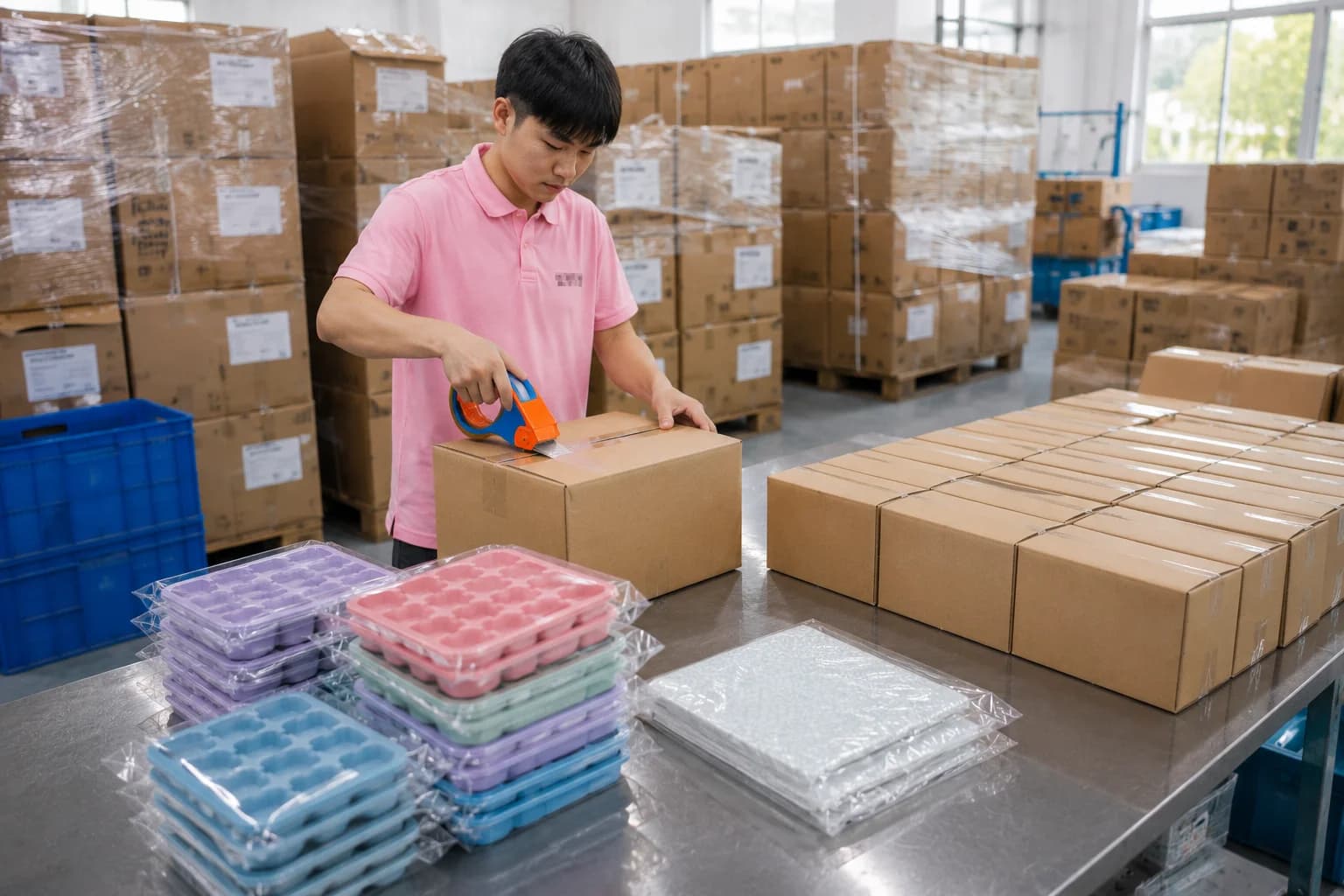
An Xmas ice cube tray is a shape-first product. The cavities are sculpted — a tree, a snowflake, a star, a reindeer — and the visual payoff comes at the cost of some utilitarian performance. Complex shapes release less cleanly than simple cubes, thin details can be fragile, and cavity count is usually lower because each cavity needs more surface area. These trays tend to be bought as gifts, as holiday table accessories, or as branded promotional items for December campaigns.
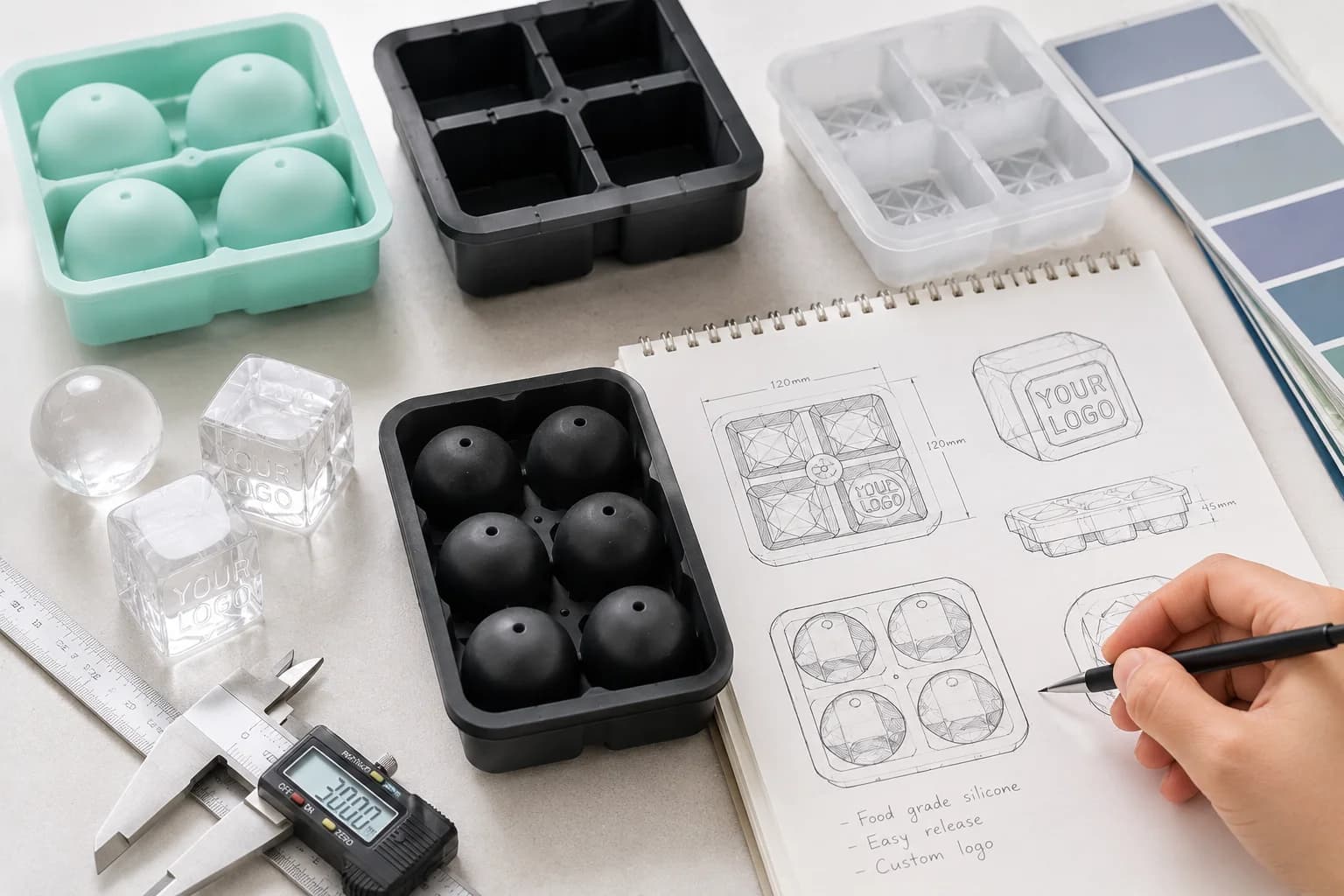
For buyers sourcing either format, the same product family supports both directions. Custom silicone ice molds can be customized by cavity design, product shape, size, color, logo, and packaging, and the same development workflow — concept, design file, sampling, tooling, production, inspection — applies whether the result is a plain cube tray or a holiday shape [K1]. Renjia's portfolio documentation lists ice cube trays, ice ball trays, and popsicle molds within its promotional product range, while ice block molds sit within household products — a reminder that the same physical product can serve more than one commercial channel [K2].
Practical advice: if you are buying for yourself, decide first whether you want volume or novelty, then look at cavity count and shape complexity. If you are buying for a brand, decide which channel you are supplying: a year-round kitchen listing and a December gift program usually need two different SKUs, not one compromised design.
3. Performance Comparison: Fill, Release, Stacking, and Freezer Fit
Core conclusion: for daily use, the ice maker silicon tray wins on operating efficiency; the Xmas tray wins on presentation and gifting. The gap is mostly mechanical, not material.
Filling. Trays designed for routine filling usually have a wider channel, a defined fill line, and cavities arranged so water distributes evenly. Novelty trays often require careful pouring into individual shaped cavities, and overfilling causes water to bridge between cavities, fusing shapes together. If your filling method is "carry the tray to the sink and hold it under the tap," a standard format is more forgiving.
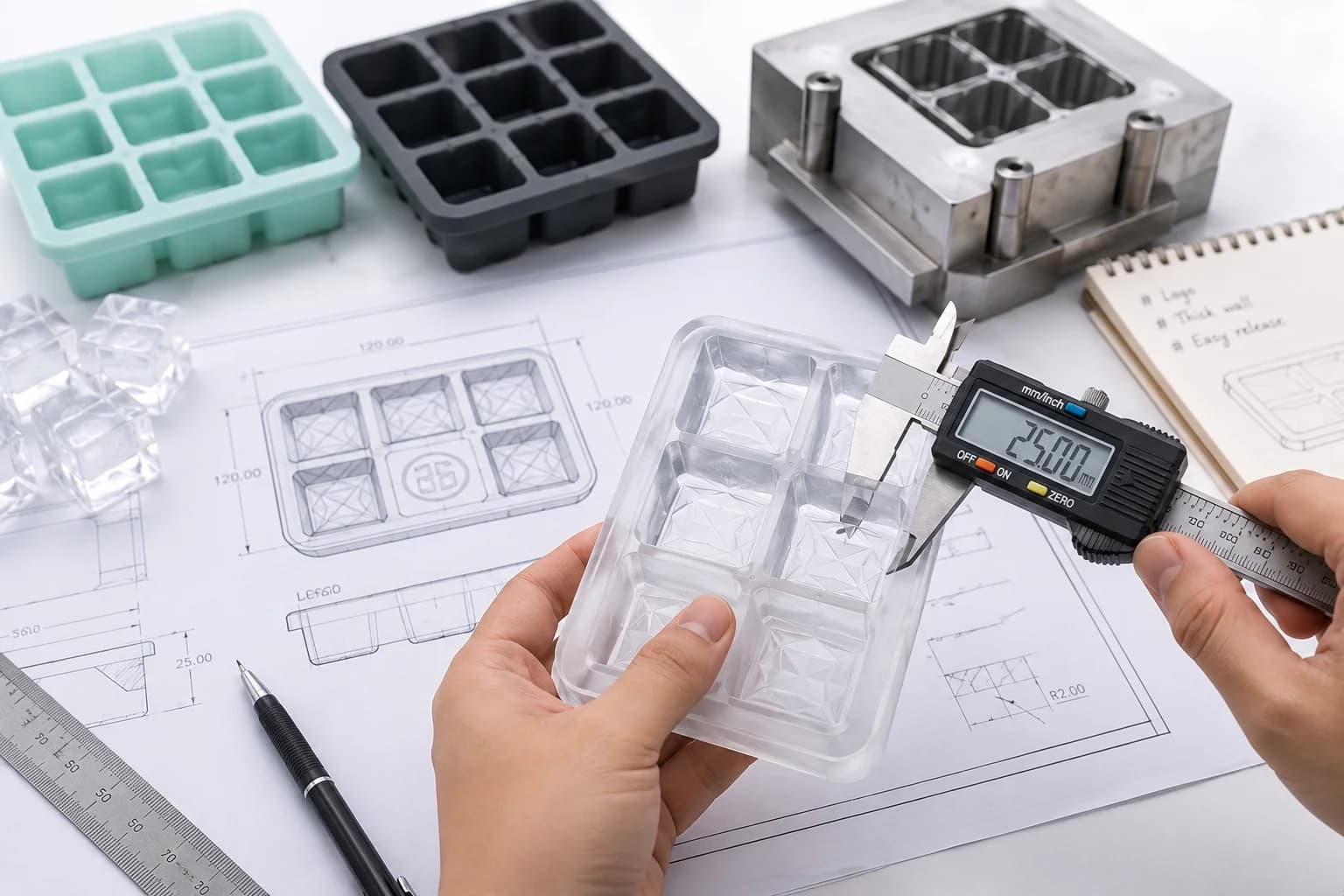
Release. Silicone releases by flexing. Simple cube geometry twists out cleanly; intricate shapes have undercuts and narrow tips that resist release and can tear if the silicone is thin at the detail. This is a design tolerance issue you can evaluate during sampling rather than a reason to avoid shaped trays — but it should be tested with real frozen cubes, not judged from a photo.
Stacking and footprint. A flat, rectangular tray with a rigid rim stacks predictably and uses freezer space efficiently. Shaped trays vary more in outline and often cannot be stacked while full without deforming the cavities. If freezer space is tight, measure before buying, and treat "stackable while full" as a specific feature to verify. For buyers comparing format options in a freezer with limited clearance, a closer look at the range of custom silicone ice molds available — including shallow and multi-cavity designs — is usually more productive than assuming one silhouette fits all compartments.
Durability. Both formats live or die on material and wall thickness, not on shape. Thin walls at decorative details are the most common failure point in novelty molds. Ask what the wall thickness is at the thinnest point of the cavity, and confirm the material composition for the specific SKU rather than relying on a generic "food-grade silicone" description.
Cleaning. Smooth cube cavities rinse and turn out easily. Deep or narrow decorative shapes trap residue and need brushing. For commercial settings turning trays over daily, this is a real labor cost; for a once-a-year holiday table, it is negligible.
4. Sourcing and Customization: What Changes When You Go From Household Use to a Product Line
Core conclusion: the format decision has more commercial consequences than the technical ones. A standard tray is a repeatable commodity; a holiday tray is a scheduled, design-dependent project.
Tooling and design files. A novelty shape requires a design file that can be reviewed for draft angles, minimum detail width, and cavity depth before tooling is committed. A standard cube tray usually starts from an existing cavity pattern with changes to color, logo, and packaging. Expect the novelty version to need more design iteration and therefore a longer review cycle.
MOQ, tooling, and lead time. These should be treated as project-specific, not as published constants. A reputable supplier will confirm MOQ, tooling cost, sampling schedule, and production dates only after reviewing the design and issuing written confirmation — fixed mold fees should not be published before design evaluation, and an unconditional low MOQ should not be promised for every custom project. Buyers who see flat, universal numbers on a landing page before any design review should treat them as marketing, not commitments.
Seasonality risk. A Christmas tray has a hard selling window. If sampling, tooling approval, or production slips past the retail cut-off, the inventory misses its season entirely. Planning backward from the shelf date — not forward from the order date — is the single most important scheduling discipline for this product type. Working with an experienced silicone OEM/ODM manufacturer that documents each stage from design review to pre-shipment inspection reduces the risk of a late-season surprise.
Packaging and channel fit. Holiday trays are frequently sold as gifts, so packaging carries more weight: printed sleeves, gift boxes, and hang tags matter more than they do for a plain utility tray. Standard trays, by contrast, are often sold as multi-packs or as private-label kitchen basics where a simple label and a clean carton are sufficient.
Compliance positioning. Market requirements differ, and certification scope must be tied to the specific product and destination market. Do not repeat certification claims from a catalog without confirming they apply to the exact SKU, material, and market you are shipping to.
5. Key Comparison
| Criterion | Ice Maker Silicon Tray | Xmas Ice Cube Tray |
|---|---|---|
| Primary job | Repeatable ice production | Holiday presentation and gifting |
| Cavity geometry | Simple cubes, higher cavity count | Sculpted shapes, lower cavity count |
| Filling | Even distribution, overflow-friendly rim | Careful per-cavity pouring; bridging risk |
| Release | Clean twist-out | Requires testing; fine details can resist or tear |
| Stacking while full | Usually predictable | Varies by outline; often limited |
| Cleaning effort | Low | Moderate; deep shapes need brushing |
| Seasonality | Year-round | Hard seasonal window |
| Branding focus | Logo, color, multi-pack, private label | Packaging, gift presentation, novelty appeal |
| Development path | Often derives from an existing cavity pattern | Needs dedicated design review and sampling |
| Best for | Households, bars, food service, kitchen basics | Gift programs, holiday retail, December promotions |
6. FAQ
Q1. Is an ice maker silicon tray objectively better than a novelty Christmas tray?
No. They are optimized for different outcomes. If your priority is producing usable ice quickly and repeatedly, a standard multi-cavity format is more efficient. If your priority is a shaped cube for a holiday table or a gift, the shaped tray delivers something a cube tray cannot. The right question is which outcome you need, not which product is superior.
Q2. Will a shaped Christmas tray work in a normal freezer and with a countertop ice maker?
Freezer compatibility depends on the tray's outer dimensions and whether it can sit level while full — check the measured footprint against your compartment. Compatibility with a countertop ice maker is a separate question about that appliance's tray or bin dimensions, and it should be verified against the specific model rather than assumed.
Q3. What should I confirm before ordering a custom silicone ice tray?
Confirm current availability, material composition, dimensions, applicable certifications for your market, MOQ, tooling cost, sampling schedule, and lead time — and get them in writing. These items are project-specific and should not be assumed from a generic catalog page or a published price list.
Q4. How many cavities should I choose?
Match cavity count to how you will use the ice. Small cubes chill drinks faster and suit high-volume use; larger cubes melt more slowly and suit spirits served neat. For shaped holiday trays, fewer, larger cavities are typical because each shape needs more surface area. Decide the glass and the drink first, then the cavity size.
7. Conclusion
There is no single winner — there is a correct choice per use case. For everyday freezing, the ice maker silicon tray is the more practical tool: it fills more predictably, releases more cleanly, stacks better, and supports year-round listings with simpler customization. For holiday retail, gifting, and December promotions, the Xmas ice cube tray earns its place because the shaped cube is the product, and buyers are paying for the occasion, not the throughput.
For product teams, the practical recommendation is to treat these as two SKUs with two timelines. Develop the standard tray as a stable, repeatable item where color, logo, and packaging carry the differentiation. Develop the holiday tray as a scheduled project that starts from a reviewed design file, accounts for sampling and tooling time, and plans backward from the retail shelf date. In both cases, confirm specifications, MOQ, and lead times in writing before committing — the design decision is the easy part, and the execution discipline is what determines whether the tray actually sells.