Key Takeaways
- Large ice block molds are most commonly made from food-grade silicone, which is odorless, flexible, and rated for temperatures from -40°C to 240°C (-40°F to 464°F) [K5].
- Mold size is the single biggest factor controlling freezing time: a larger cavity freezes more slowly, so buyers should match block size to the actual drink, display, or event use rather than choosing the biggest option available.
- Handling is where most users struggle—cracked blocks, stuck molds, and cloudy ice are avoidable with the right filling, freezing, and demolding methods.
- Custom silicone ice block molds are available with tailored cavity design, shape, size, color, logo, and packaging [K1]. This makes them a practical option for branded ice, hotels, bars, and promotional programs.
- Before ordering custom molds, buyers should confirm material composition, dimensions, certifications, MOQ, and lead time, because availability and project scope vary by market and supplier [K4].
1. Introduction
Large ice blocks have moved from high-end cocktail bars into home kitchens, events, and retail settings. A single slow-melting block keeps a drink cold without diluting it, and a well-made ice mold can also serve as a visual centerpiece. But large ice molds create a different set of problems than standard ice cube trays. Users commonly report that blocks freeze unevenly, take far longer than expected, crack during removal, or leave the mold with an odor. On the commercial side, buyers sourcing custom ice molds face questions about materials, minimum order quantities, sampling, and lead times.
This article walks through the three decisions that matter most when buying or using a large ice block mold: how to judge size, how to plan for freezing time, and how to handle the mold before and after freezing. It also includes a practical comparison table and sourcing checklist for businesses. The goal is to help readers choose a mold that fits their actual use case—and avoid the trial-and-error that most first-time buyers experience.
2. Mold Material and Design: Why Silicone Is the Standard for Large Ice Block Molds
Core conclusion: Food-grade silicone is the dominant material for large ice block molds because it is safe, odorless, flexible enough for demolding, and highly customizable at the manufacturing level.
Silicone's material properties are well suited to freezing applications. Verified product specifications for silicone ice molds list the material as food-grade silicone, odorless, with a temperature resistance of -40°C to 240°C (-40°F to 464°F) [K5]. The lower end of that range is important: the mold must remain flexible at freezer temperatures, not become brittle. The -40°C rating gives a comfortable margin over typical home freezers, which usually run between -18°C and -24°C.
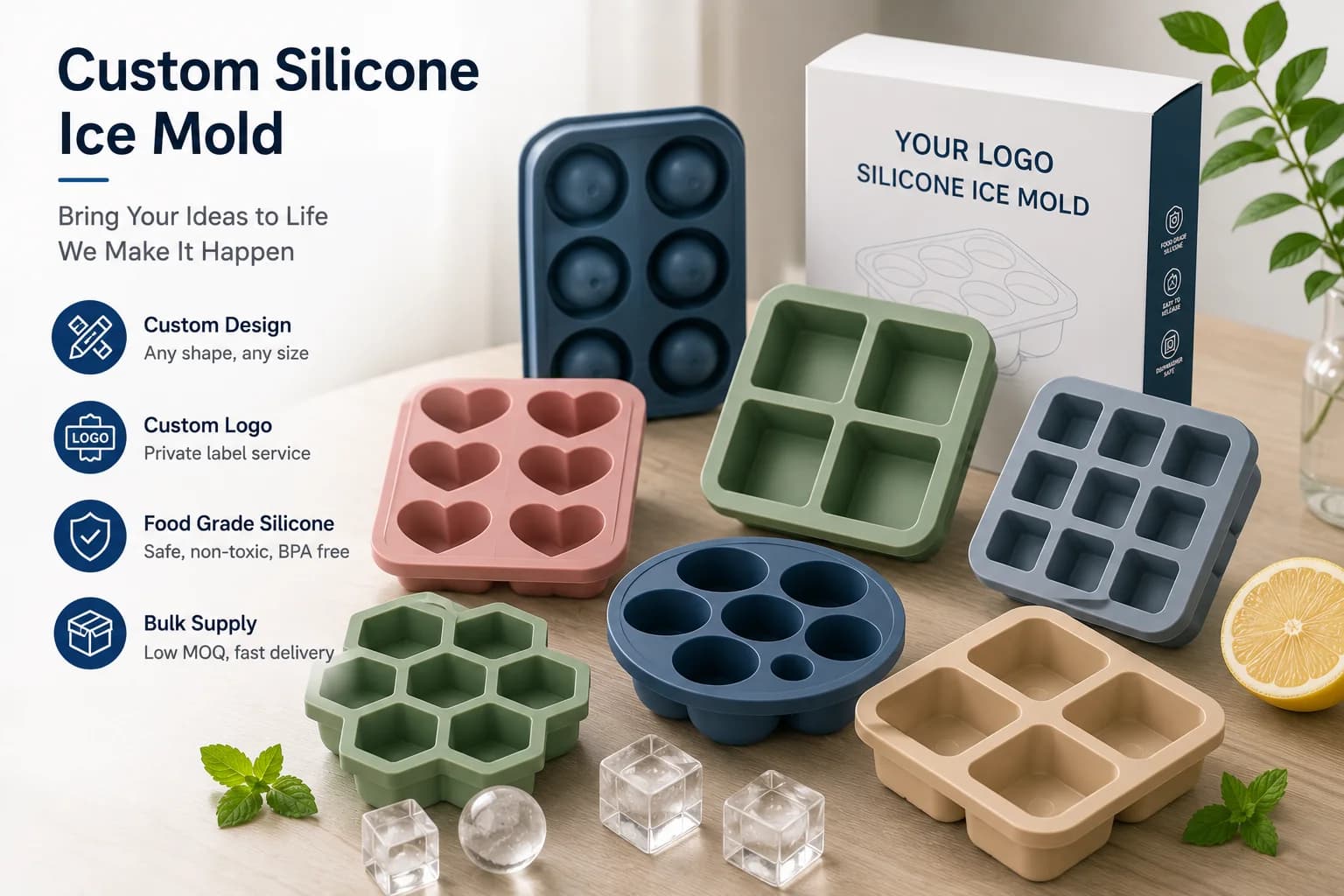
The design flexibility of silicone is equally relevant. In OEM/ODM production, typical customizations for silicone ice molds include cavity design, product shape, size, color, logo, and packaging [K1]. This means a buyer is not limited to off-the-shelf rectangles. Custom ice molds can be shaped as spheres, cubes, diamonds, brand logos, or even geometries tailored to a specific glass or bottle.
One caution applies to the category itself. Ice molds can be tagged under household, kitchen, and promotional use cases, and the category placement should not limit where the product can be marketed [K4]. However, buyers should confirm current availability, material composition, dimensions, certifications, MOQ, and lead time before publishing a product page or placing a large order [K4]. Not every item in a supplier's portfolio is stocked for every market.
For a related manufacturing reference, review custom silicone ice mold manufacturing.
Practical advice: For home use, confirm that the mold is labeled food-grade and odorless [K5] before buying. For commercial sourcing, ask the supplier to state the material specification and temperature rating in writing, and verify that any certification claims are specific to your target market [K2].

3. Size vs. Freezing Time: What to Expect With Large Ice Molds
Core conclusion: Larger blocks take considerably longer to freeze than small cubes, and the relationship is not linear. Buyers should choose the smallest block size that still serves the intended purpose, then plan freezing time around it.
Custom sizes are a standard option for silicone ice molds [K5], which is useful—but also a trap. A visually impressive 10-centimeter block may take more than a day to freeze solid, while a 5-centimeter block is practical for overnight freezing.
Freezing time depends on four main factors:
- Volume and surface area. As a mold gets larger, the volume of water increases faster than the surface area that removes heat. A cube that doubles in size may take roughly three to four times longer to freeze.
- Freezer temperature. A standard home freezer at about -18°C will freeze more slowly than a commercial freezer set to -25°C or lower.
- Starting water temperature. Cold water freezes faster than room-temperature water. Boiling water is sometimes used specifically to improve ice clarity, but it must cool significantly before going into the freezer.
- Insulation effect of the mold itself. Silicone is a poor heat conductor. A thick-walled mold will slow freezing more than a thin-walled one.
The table below shows typical ranges for a home freezer at -18°C with still water. These are practical approximations, not lab measurements, and exact times vary with mold thickness, fill volume, and freezer load.
| Mold type | Typical cavity size | Approximate freezing time |
|---|---|---|
| Standard ice cube tray | ~2.5 cm cube | 3–4 hours |
| Ice ball tray | ~5 cm diameter sphere | 6–10 hours |
| Medium block mold | ~5 cm cube | 10–14 hours |
| Large block mold | ~7.5 cm cube | 20–28 hours |
| Extra-large block mold | ~10 cm cube | 30 hours or more |
Practical advice: If you need clear ice, one common technique is directional freezing: insulate the sides and bottom of the mold so the water freezes from the top down, then remove the cloudy lower portion. If you simply need a large block quickly, reduce the starting water temperature, place the mold directly on a metal freezer shelf, and avoid opening the freezer door during the freeze cycle. Do not overfill the mold—water expands by roughly 9% when it freezes, and overfilled cavities cause bulging or cracking.
4. Handling Considerations: Demolding, Storage, and Sourcing
Core conclusion: Most handling problems happen in two moments—when the block comes out of the mold and when the mold is stored. Silicone solves part of the problem; technique and sourcing discipline solve the rest.
4.1 Demolding and everyday handling
Flexible silicone makes release easier than rigid plastic trays, but technique still matters. A few reliable methods:
For additional context on this decision, see How We Developed a Reinforced Large Ice Block Mold for an Australian Cold-Plunge Brand.
- Let the mold sit outside the freezer for 3–5 minutes before attempting removal.
- Gently push the bottom of the mold outward rather than pulling on the rim.
- If the block is stuck, briefly dip the outside of the mold in warm (not hot) water for a few seconds—enough to loosen the surface, not melt the block.
- For very large blocks, invert the mold onto a cutting board and apply light, steady pressure in the center.
After use, wash the mold with mild soap and warm water, and dry it fully before storage. Silicone can absorb strong odors from strong-smelling foods, so storing ice molds away from pungent items reduces the risk of off-flavors in the next batch. Because the material is rated up to 240°C [K5], cleaning and sanitizing are straightforward, but follow the supplier's care instructions.
4.2 Sourcing custom molds for business use
For hotels, bars, event companies, and brands, the question is not just "how does the mold work" but "how do I get the mold built." A custom silicone ice mold project typically follows this path:
- Design-file preparation. Submit the cavity shape, dimensions, and any logo or branding requirements to the manufacturer.
- Sampling. Review a physical or machined sample to validate the shape, size, and release behavior before committing to production.
- Tooling. Approve the sample so the manufacturer can finalize molds for production runs.
- Production and packaging. Confirm custom colors, packaging, and quality-inspection points.
- Pre-shipment inspection. Check quantities, dimensions, surface quality, and material consistency before accepting the batch.
This process is well documented for silicone OEM/ODM projects, covering design review, sampling, tooling, MOQ, and lead-time planning [K2]. Buyers should also prepare a checklist covering material composition, dimensions, certifications, MOQ, and lead time—and reconfirm each item before placing a product-specific order [K4]. For example, a buyer planning branded ice for a chain of bars would need to confirm that the mold's food-grade claim matches the regulations in the destination market, without relying on unsupported certification claims [K2].
Practical advice: For low-volume home use, buy a standard food-grade silicone mold and verify the temperature rating. For commercial or promotional use, work directly with an OEM/ODM supplier, request samples before tooling, and put every specification—size, material, color, logo, packaging—into the sampling agreement [K1][K2].
5. Key Comparison: Ice Mold Categories and Sourcing Checklist
Renjia's extended product portfolio groups ice products across multiple categories, including ice cube trays, ice ball trays, and popsicle molds under promotional products, plus ice block molds under household products [K3]. Because ice molds cross household, kitchen, and promotional use cases [K4], buyers benefit from comparing the common mold types side by side.
| Mold type | Best for | Typical size | Freezing time | Handling notes |
|---|---|---|---|---|
| Ice cube tray | Everyday drinks, batch ice | 2–3 cm cubes | Short (3–4 hours) | Easy release; rigid trays can crack cubes |
| Ice ball tray | Whiskey, spirits | 4–6 cm spheres | Medium (6–10 hours) | Needs gentle twist to release |
| Ice block mold | Cocktails, punch, display | 5–10 cm cubes | Long (10–30+ hours) | Requires patience and careful demolding |
| Popsicle mold | Frozen treats, not drink ice | Varies | Medium | Requires sticks; not a substitute for beverage ice |
Source classification based on the extended product portfolio map [K3] with typical use and handling notes added as general guidance.
Before finalizing the specification, use Large Ice Cube Trays for Whiskey: A Buyer’s Guide to Size and Shape as an additional planning reference.
Sourcing checklist for custom ice block molds

Before asking a supplier for a quote, prepare these items:
- Target block size in centimeters or inches, and whether the design is standard or custom.
- Material requirement, e.g., food-grade silicone, odorless [K5].
- Temperature requirements—confirm the mold stays flexible at freezer temperatures [K5].
- Customization scope, including cavity design, shape, color, logo, and packaging [K1].
- Volume and timeline, so the supplier can advise on tooling, sampling, MOQ, and lead time [K2].
- Market-specific compliance needs, to be verified with the supplier per destination market [K2][K4].
6. FAQ
Q1. How long does it take to freeze a large ice block?
At a typical home freezer temperature of about -18°C, a 5 cm block generally takes 10–14 hours, while a 7.5 cm block may take 20–28 hours, and a 10 cm block can take 30 hours or more. Exact time depends on the mold's wall thickness, starting water temperature, and how full the freezer is. If you need a block ready for a weekend event, start at least two days ahead.
Q2. Are silicone ice block molds safe for food use?
Food-grade silicone is odorless and rated for temperatures from -40°C to 240°C (-40°F to 464°F) [K5], which covers both freezing and hot-water cleaning. However, not every product labeled "silicone" is food-grade. Buyers should confirm the material specification and check any certification claims against the requirements of their local market [K2][K4].
Q3. Can ice block molds be customized for branded or commercial use?
Yes. Customization options for silicone ice molds typically include cavity design, shape, size, color, logo, and packaging [K1]. Commercial projects usually proceed through design-file preparation, sampling, tooling, and pre-shipment inspection [K2]. Before ordering, confirm material composition, dimensions, certifications, MOQ, and lead time with the supplier [K4].
Q4. What is the difference between an ice block mold and an ice cube tray?
An ice cube tray produces many small cubes for everyday drinks, while an ice block mold produces one or a few large blocks that melt slowly and minimize dilution. Ice block molds are larger, require longer freezing times, and are often used for cocktails, punches, or visual display. Both types can be made from food-grade silicone [K5], and many suppliers produce both lines [K3].
7. Conclusion
Large ice block molds are a simple product with surprisingly demanding requirements. Size determines how long the block takes to freeze, material determines safety and ease of release, and handling technique determines whether the finished block survives intact. Food-grade silicone remains the most practical material for this use case because it is odorless, flexible at freezer temperatures, rated from -40°C to 240°C, and available in fully custom sizes and shapes [K1][K5].
For home users, the recommendation is straightforward: choose the smallest block size that fits your glass or entertaining style, start with cold water, and allow generous freezing time. For businesses, the recommendation is disciplined sourcing: treat custom ice molds as an OEM/ODM project, confirm every specification at the sampling stage, and verify material, certifications, MOQ, and lead time before production [K2][K4]. Whether the goal is a slow-melting whiskey cube or a branded ice block for an event, the right mold is the one sized to the job, frozen with realistic expectations, and handled with care at the moment of release.