Key Takeaways
- The two product names are not parallel categories: “silicone whiskey ice cube tray” describes a material and use case, while “large ice cube tray” describes cavity size. One tray can be both.
- Silicone trays generally release large cubes more easily because the cavity walls can flex; rigid large cube trays generally stack and hold their shape more predictably.
- For whiskey, cavity shape, ice mass, and surface area affect dilution more than the word “silicone” on the package.
- Buyers sourcing for private label should confirm cavity design, material grade, packaging, MOQ, tooling, and lead time before choosing a format [K1][K3].
- If you want spheres rather than cubes, a large ice ball mold is a separate format with a different freezer footprint and release behavior.
1. Introduction
A buyer searching for a whiskey ice tray usually has a practical problem: the ice produced by a standard tray is too small, melts too quickly, and makes a good spirit taste watery before the glass is empty. The search results then present two overlapping options — a silicone whiskey ice cube tray and a large ice cube tray — often with similar photos and similar claims. The confusion is understandable because the names describe different things.
One name describes the material and the intended occasion. The other describes the size of the cavity. A single product can be a large silicone whiskey ice cube tray, a rigid plastic large cube tray, or a flexible tray sold for general kitchen use. Add a third format — the large ice ball mold — and the comparison becomes even less clear.
This article separates the formats by what they actually produce, how they behave in daily use, and what changes when you buy at volume for a brand or retail program. It is written for two readers: the home bar owner choosing one tray, and the product buyer comparing formats for private label or promotional supply. The goal is not to declare one format universally better. It is to help you match the tray to the drink, the freezer, and the sales channel.
2. What Each Tray Actually Produces — and Where the Terms Overlap
Core conclusion: compare trays by cavity geometry, ice mass, and material stiffness, not by the marketing name. “Whiskey” and “large” are not competing specifications.
A whiskey ice cube tray is usually designed around a short, wide glass. The cavities tend to be square or rectangular, with enough mass to chill a spirit without immediate collapse. A large ice cube tray does the same job at a similar size, but the term is often used for rigid trays, stackable trays, or trays marketed for general kitchen use. The practical difference is rarely the word “whiskey.” It is whether the cavity is supported by a rigid frame, whether the tray has a lid, and how easily the ice releases.

The third format, a large ice ball mold, produces a sphere or near-sphere. Spheres are visually distinctive and have less surface area per unit of volume than cubes of similar mass. That shape can slow the initial transfer of cold and reduce dilution slightly, but the effect is easy to overstate. Starting ice temperature, drink temperature, glass size, and how much the drink is swirled all matter. A sphere is not a guarantee of a better whiskey; it is a different presentation format with different freezer requirements.
For product development, the most reliable starting point is a documented cavity drawing and material specification. Renjia’s custom silicone ice mold line covers cavity design, product shape, size, color, logo, and packaging, which means the format should be defined before samples are quoted [K1]. Buyers who begin with a product name rather than a cavity specification often receive samples that are technically similar but commercially different. For teams preparing a branded format, the practical route is to review custom silicone ice molds with a defined cavity size, release method, and packaging plan rather than relying on a generic “whiskey tray” label [K1].
A useful rule is this: if the drink is served in a rocks glass and the ice is meant to be the visual center of the serve, prioritize cavity shape and clarity. If the tray is meant to fill a freezer drawer and produce ice for multiple drinks, prioritize stacking, capacity, and release speed.
3. Release, Durability, and Daily Use: Where Silicone Wins and Where It Does Not
Core conclusion: silicone is usually easier to release, but it is not automatically easier to live with. Rigid trays are usually easier to stack, but they can be harder to empty.
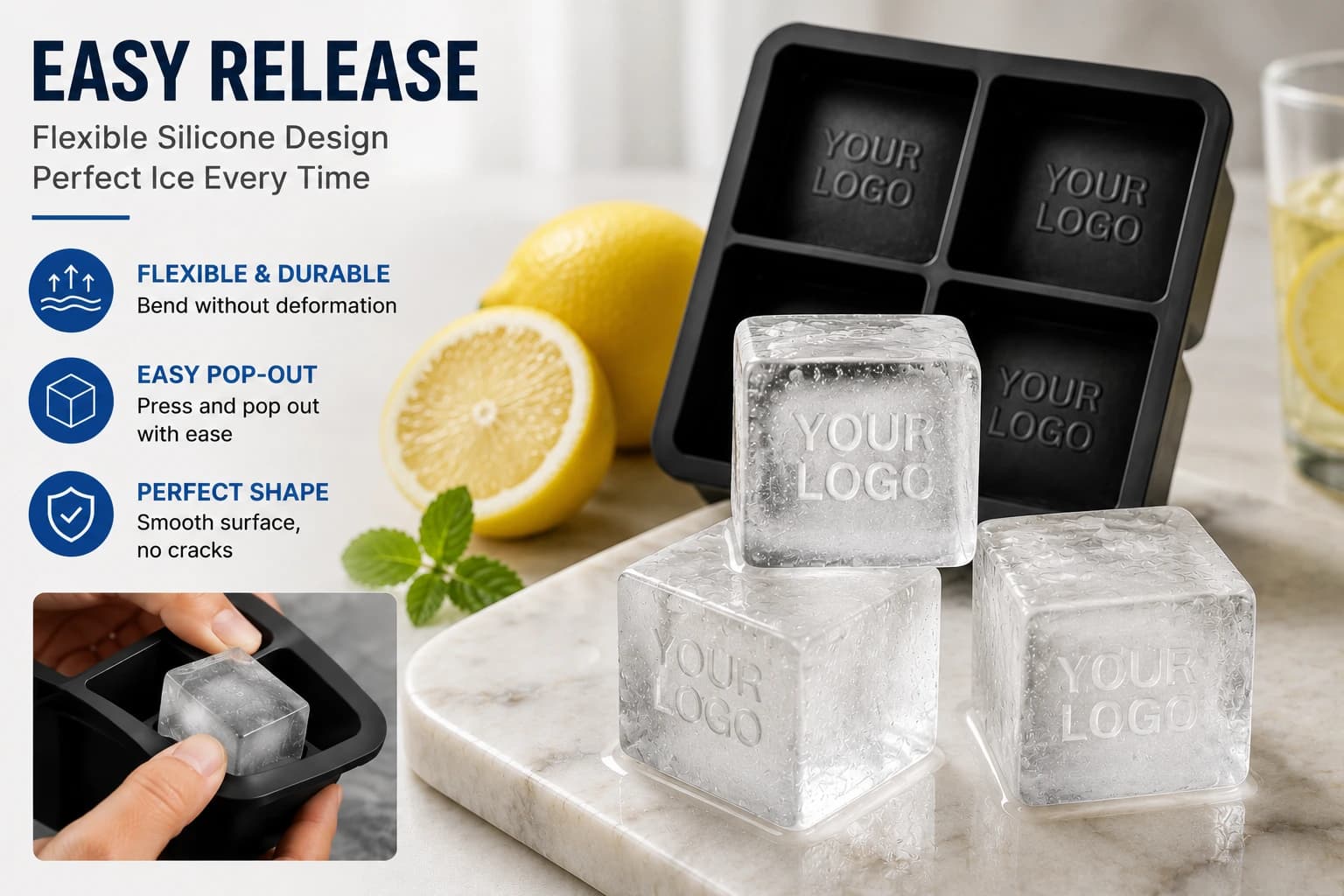
Large ice cubes are heavy and can wedge into a cavity. A flexible silicone tray solves much of that problem because the walls can be peeled away from the cube. The trade-off is that a filled silicone tray can be floppy. If the tray is large and the cavities are deep, moving it from the sink to the freezer without spilling requires a rigid frame, a lid, or a careful two-hand carry. Thin silicone trays with weak rims are more likely to spill; thicker walls and a reinforced edge improve control but reduce flexibility.
Rigid large cube trays — whether plastic, metal, or a silicone insert inside a rigid shell — tend to stack more predictably and hold their shape when full. The risk shifts to release and breakage. Ice can lock into sharp corners, and twisting a rigid tray repeatedly may crack it over time. A tray with rounded cavity corners and a slight taper releases more cleanly than a sharp-cornered design.
For a home bar making one or two drinks at a time, a silicone whiskey ice cube tray with a lid is often the more convenient choice because release is quick and the lid limits freezer odors. For batch prep or a household that fills a freezer drawer, a stackable large ice cube tray may be more practical because it uses vertical space better. For a gift or presentation-focused product, a large ice ball mold creates a stronger visual impression, but it also takes up more freezer space per unit and may require a larger water fill margin to avoid overflow when the water freezes.
Renjia’s reported product portfolio places ice block molds under household products and ice cube trays and ice ball trays under promotional products, while the same source notes that ice molds can legitimately be tagged across household, kitchen, and promotional use cases [K2][K3]. That cross-category flexibility is useful for sellers, but it also means the category label alone tells you little about the product’s actual design. The physical tray still has to be evaluated on cavity depth, wall thickness, lid fit, and release behavior.
4. Sourcing and Customization: What Changes When You Buy at Volume
Core conclusion: at volume, the decision shifts from “which tray do I like” to “which format can be specified, sampled, packed, and repeated consistently.”
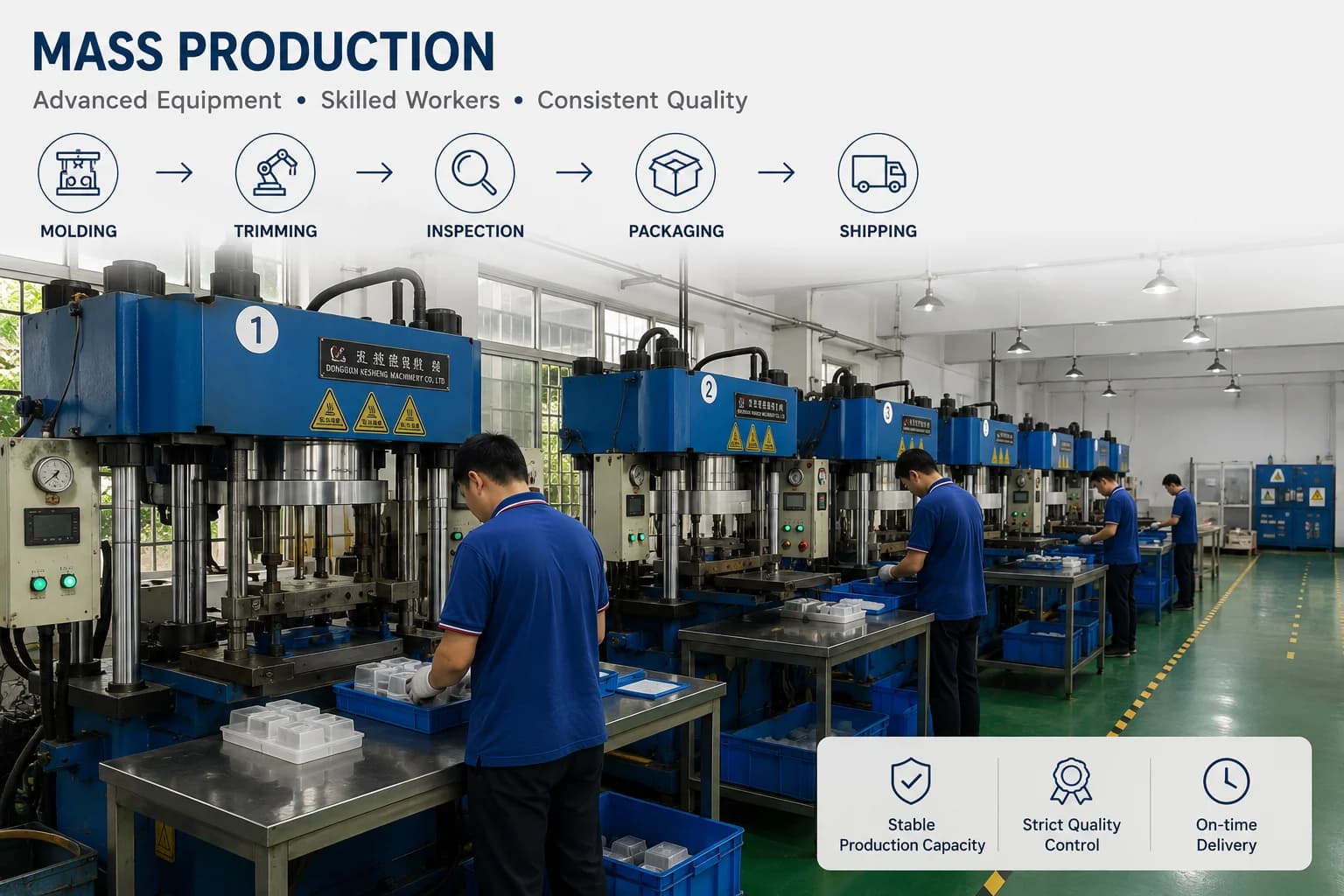
For a single retail purchase, the differences between a silicone whiskey tray and a large cube tray are mostly about daily use. For a private-label or promotional program, the differences become operational. Cavity design affects tooling. Product shape affects packaging dimensions. Color and logo affect sample approval. Packaging affects carton size and freight. A format that looks simple in a photo can generate several rounds of sampling if the cavity drawing, material specification, and packaging artwork are not fixed early.
The knowledge base for Renjia’s custom silicone ice molds lists customization across cavity design, product shape, size, color, logo, and packaging, with supported content topics covering branded ice, design-file preparation, sampling, tooling, packaging, quality inspection, and sourcing [K1][K4]. That is a useful checklist for a buyer because it shows where the project risk sits. A large ice ball mold with a logo on the tray is not just a cavity change; it may require a different sample approval process, a different packaging insert, and a different quality check for sphere roundness and seam finish.
The same source sets a clear boundary: the product portfolio diagram is evidence of reported product architecture, not proof that every item is currently stocked or available for every market. Availability, material composition, dimensions, certifications, MOQ, and lead time must be confirmed before a product-specific page or quotation is published [K3]. This matters for compliance claims. Do not assume a tray is food-contact compliant for a target market simply because it is described as silicone. Ask for the material grade and the relevant documentation, and treat certification claims as product-specific rather than category-wide.
For buyers who need a repeatable program, a practical path is to start with a defined use case, request samples in the intended cavity format, and confirm packaging and inspection criteria before committing to tooling. Renjia’s silicone OEM/ODM project support is structured around that sequence — design review, sampling, tooling, packaging, and quality inspection — which is more reliable than choosing a format from a catalog image alone [K1][K4]. If the target market is unclear, confirm the compliance plan first; the knowledge base specifically supports market-specific compliance planning without unsupported certification claims [K4].
5. Key Comparison / Method / Considerations
The table below summarizes the main decision factors. It assumes comparable cavity volume; a very small “large” tray and a very large whiskey tray will behave differently regardless of material.
| Decision factor | Silicone whiskey ice cube tray | Large ice cube tray (rigid or silicone) | Large ice ball mold |
|---|---|---|---|
| Primary output | Large square or rectangular cubes for rocks glasses | Large cubes, often stackable or batch-oriented | Spheres or near-spheres for presentation |
| Release | Usually easy; walls flex away from ice | Depends on taper and corner radius; rigid trays can trap ice | Can be easy with a flexible mold; seam and fill line matter |
| Stacking and freezer fit | Less predictable unless it has a rigid frame or lid | Usually better for stacking and vertical storage | Bulky per unit; often lower capacity per freezer footprint |
| Melt and dilution | Larger mass slows dilution versus small cubes; shape still matters | Similar to large cubes; depends on mass and starting temperature | Lower surface area per volume can slow initial dilution, but do not treat this as a guaranteed outcome |
| Best use case | Home bar, gift sets, low-volume premium serve | Batch prep, family freezer, stackable retail sets | Visual serve, cocktail presentation, branded gift product |
| Customization path | Cavity, color, logo, packaging [K1] | Cavity, color, logo, packaging; rigid components may add tooling complexity | Cavity shape, seam control, color, logo, packaging [K1] |
| Main risk to verify | Tray rigidity and spill control when full | Ice release and long-term cracking | Roundness consistency, fill margin, and freezer space [K3] |
A simple decision method:
- Define the serve first. If the drink is a single rocks pour and presentation matters, choose a cube or sphere format with a cavity that fits the glass. If the tray is for general household ice, choose capacity and stacking over visual shape.
- Check the freezer. Measure the drawer or shelf space before choosing a large ice ball mold or a wide stackable tray. A format that does not fit will not be used, regardless of ice quality.
- Test release before scaling. Fill the sample tray, freeze it fully, and release the ice several times. A tray that releases well on the first try but becomes difficult after repeated flexing is a poor choice for daily use.
- Confirm the commercial specification. For a private-label order, verify material composition, dimensions, certifications, MOQ, and lead time before publishing product claims or quoting a retail price [K3].
- Separate consumer claims from sourcing claims. “Large ice melts more slowly” is a reasonable general statement about mass and surface area, but specific performance claims should be tested on the actual cavity design. The knowledge base’s publishing policy also calls for clear professional English for international B2B buyers and warns against importing internal quotation rules or sales logic into public content [K5].
6. FAQ
Q1. Is a silicone whiskey ice cube tray better than a large ice cube tray?
Not universally. A silicone whiskey tray is usually easier to release and more forgiving with large cubes, which makes it a good choice for home bars and gift products. A large ice cube tray in a rigid or stackable design may be more practical for batch prep and freezer organization. The better choice depends on cavity size, freezer space, and how often you need to empty the tray.
Q2. Does a larger ice cube or ice ball really keep whiskey from getting watery?
A larger ice mass generally melts more slowly than several small cubes, so it can reduce dilution over a short drinking window. A sphere also has less surface area per unit of volume than a cube of similar mass, which can slow the initial melt. But the effect is not unlimited, and it depends on the starting temperature of the ice, the temperature of the drink, and how much the glass is handled. Pre-chilling the glass and using colder ice often matters as much as the shape.
Q3. Can I customize a large ice ball mold for my brand?
Yes, custom silicone ice mold projects commonly cover cavity design, product shape, size, color, logo, and packaging [K1]. The practical constraints are tooling, sampling, and minimum order quantity. A sphere mold also requires attention to seam placement, fill line, and roundness consistency, so sample approval should include a release test and a dimensional check rather than a visual review only.
Q4. What should I verify before ordering ice trays in bulk?
Confirm current availability, material composition, dimensions, certifications, MOQ, and lead time for the specific product — not just the category [K3]. Ask for a sample in the intended cavity format, check packaging dimensions and carton configuration, and agree on inspection criteria for release, finish, and color. If you plan to make food-contact or market-specific compliance claims, verify the supporting documentation for that exact product and market.
7. Conclusion
The choice between a silicone whiskey ice cube tray and a large ice cube tray is not a choice between a premium product and a basic one. It is a choice between flexibility and structure, between presentation and freezer efficiency, and between a single retail purchase and a repeatable supply program.
For a home bar with limited freezer space and a preference for easy release, a silicone whiskey ice cube tray with a lid is the more comfortable default. For batch prep, stacking, and households that fill a drawer, a large ice cube tray with a rigid frame or stackable design is usually more practical. For a visual serve or a branded gift product, a large ice ball mold is the stronger presentation format, provided you have tested the fill margin and release behavior.
If you are buying at volume, make the decision in this order: define the serve, confirm the cavity and material specification, test a sample, then verify availability, MOQ, lead time, and compliance documentation for the exact product [K1][K3]. That sequence will tell you more about the right tray than any single product label.