Key Takeaways
- A complete custom ice mold RFQ should cover five areas: design files, dimensions, material requirements, visual customization, and packaging.
- Design files determine how fast and how accurately a manufacturer can quote mold fees and lead times. Mold production typically takes about 15 working days after the 3D design is confirmed [K3].
- Food-grade silicone is the common material baseline for custom ice molds, with typical temperature resistance from -40°C to 240°C. Still, buyers should confirm current material composition and availability per project [K4][K5].
- A typical MOQ reference is 500 pieces, but the final MOQ depends on design, tooling, packaging, and production scheduling. Custom samples usually take 7–10 working days and mass production 15–20 working days [K3].
- Preparing a structured RFQ reduces quotation delays, avoids specification misunderstandings, and gives the manufacturer a realistic basis for pricing and scheduling.
1. Introduction
Most custom ice mold projects do not fail because of poor molding. They fail because of poor communication at the RFQ stage.
A buyer sends a photo of a competitor's product, writes "make this into an ice mold," and expects an accurate quote. The manufacturer receives the request, asks for dimensions, material preferences, logo placement, and packaging details — and the conversation stalls. This scenario is common in silicone OEM/ODM sourcing, especially for branded ice, promotional gifts, and household kitchen products [K2].
The problem is not that manufacturers are unwilling to help. The problem is that an incomplete RFQ forces them to make assumptions. Assumptions lead to wrong quotes, delayed molds, or samples that do not match expectations.
This article explains exactly what to include in a custom ice mold RFQ: drawings, dimensions, materials, colors, logos, and packaging. For each element, you will find the reason it matters, the typical process steps to expect, and practical advice for presenting the information to a silicone manufacturer. By the end, you should be able to assemble an RFQ that gets you a faster, more accurate quotation.
2. Start with Design Files and Drawings
Core conclusion: The drawing is the foundation of the entire custom ice mold project. Without it, the manufacturer cannot quote a mold fee, estimate tooling complexity, or confirm production feasibility.
For custom silicone ice molds, the typical customization scope includes cavity design, product shape, size, color, logo, and packaging [K1]. Of these, cavity design and product shape are directly translated into the mold. A clear 3D design file or a detailed 2D drawing gives the manufacturer the information needed to begin engineering the mold.
For a related manufacturing reference, review custom silicone ice mold manufacturing.
The practical process usually looks like this:
- You submit design files and project requirements.
- The manufacturer reviews the design and quotes the mold fee and product price. Mold fees are quoted after reviewing the customer's design files and project requirements [K3].
- The 3D design is confirmed.
- Mold production begins — typically about 15 working days [K3].
- Custom samples are produced — usually 7–10 working days after design and specification confirmation [K3].
What to prepare:
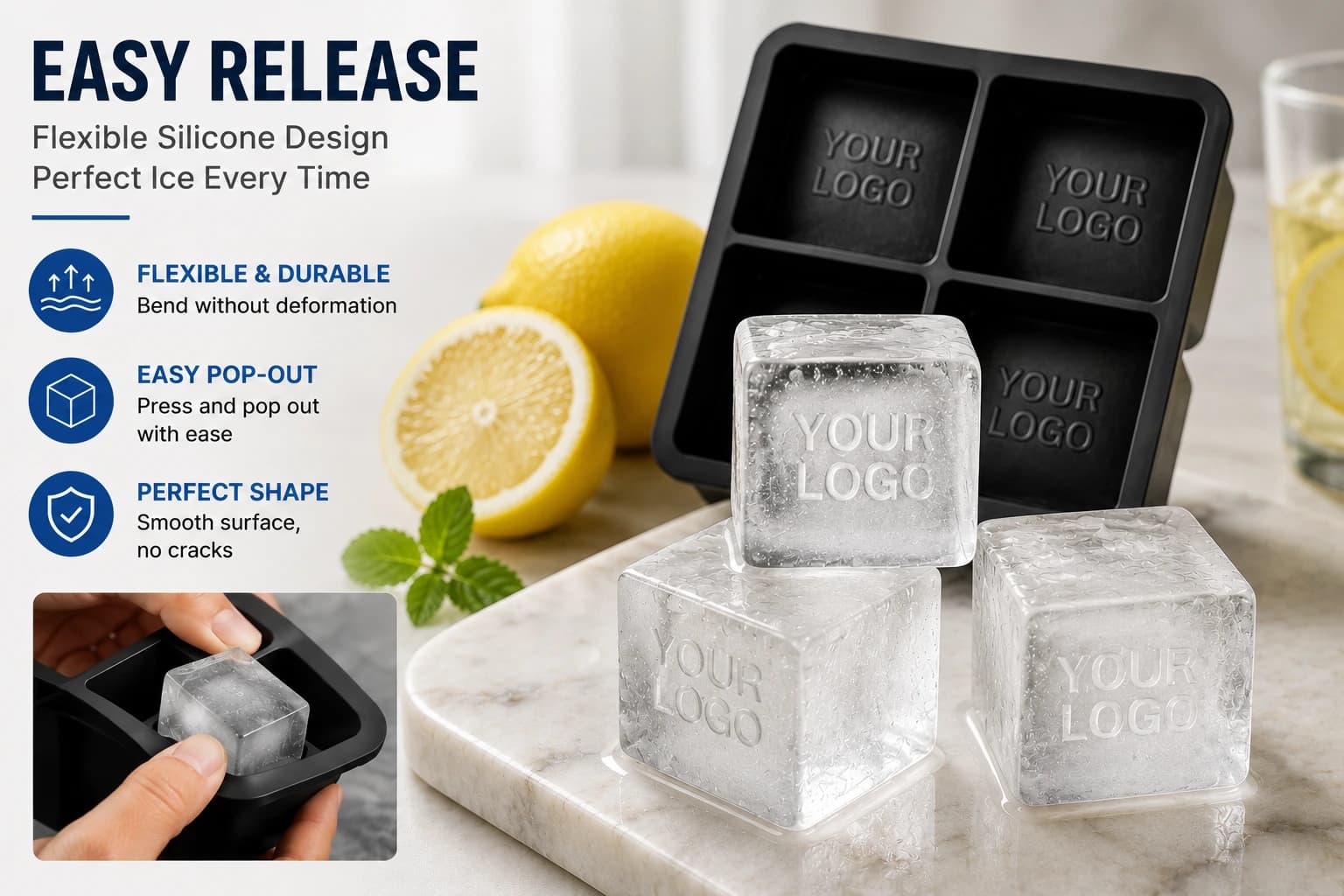
- A 3D file (for example, STEP or IGES) if available — this is the most efficient format for tooling.
- A 2D drawing with key dimensions if 3D is not available.
- A clear description of the cavity design: how many cavities, what shape each ice piece should be, and whether the mold should have a lid.
- Reference photos of a similar product, if the design is derivative.
Scenario-based advice: If you are sourcing a branded ice mold for a promotional campaign, the logo must be part of the design file from the beginning. Adding the logo after mold production starts changes the cavity design and usually delays the mold lead time.
If you do not have a 3D drawing, do not let that stop you. Many silicone OEM/ODM manufacturers can work from sketches, reference products, and dimensional notes. However, expect an additional design consultation step before the mold fee can be quoted.
3. Specify Dimensions and Tolerances Clearly
Core conclusion: Dimensions determine the mold construction, material usage, packaging size, and whether the final product actually serves your use case.
A custom ice mold's dimensions include both the mold outer dimensions and the individual cavity dimensions. The industry reference for customization is straightforward: custom sizes are available [K4]. But the RFQ should be specific.
Dimension fields to include in your RFQ:
- Overall mold length, width, and thickness.
- Individual cavity dimensions — for example, a 2.5 cm sphere, a 3 cm cube, or a rectangular ice stick.
- Number of cavities per mold.
- Wall thickness between cavities — this affects durability and ice release.
- Whether the mold needs a lid or a flat open top.
- Total ice capacity per mold, especially if the mold is intended for a specific bottle opening, cooler, or lunch box.
Practical scenario: A buyer requesting a large whiskey ice sphere requires a different mold wall thickness and cavity geometry than a buyer requesting small square cubes for baby food or pet treats. The mold construction, material weight, and possibly the packaging are different. If the RFQ only says "custom ice molds," the manufacturer cannot distinguish between these cases.
Caution about tolerances: Silicone is a flexible material. Over-specifying tight tolerances — for example, requiring every cavity to be within 0.1 mm — usually adds cost without adding functional value. Instead, specify the dimension that matters most: the final ice piece size. State an acceptable range rather than an absolute value, and let the manufacturer confirm what is achievable for the chosen material and production method.
4. Choose and Verify Materials
Core conclusion: Material selection is a safety and compliance decision, not just a cost decision. For a custom ice mold, food-grade silicone is the expected baseline.
The shared product specification for the custom ice mold product line lists the following reference points: silicone material, food-contact grade, odorless, and temperature resistance from -40°C to 240°C (-40°F to 464°F) [K4].
For additional context on this decision, see How to Source Custom Silicone Ice Molds: A B2B Buyer’s Checklist.
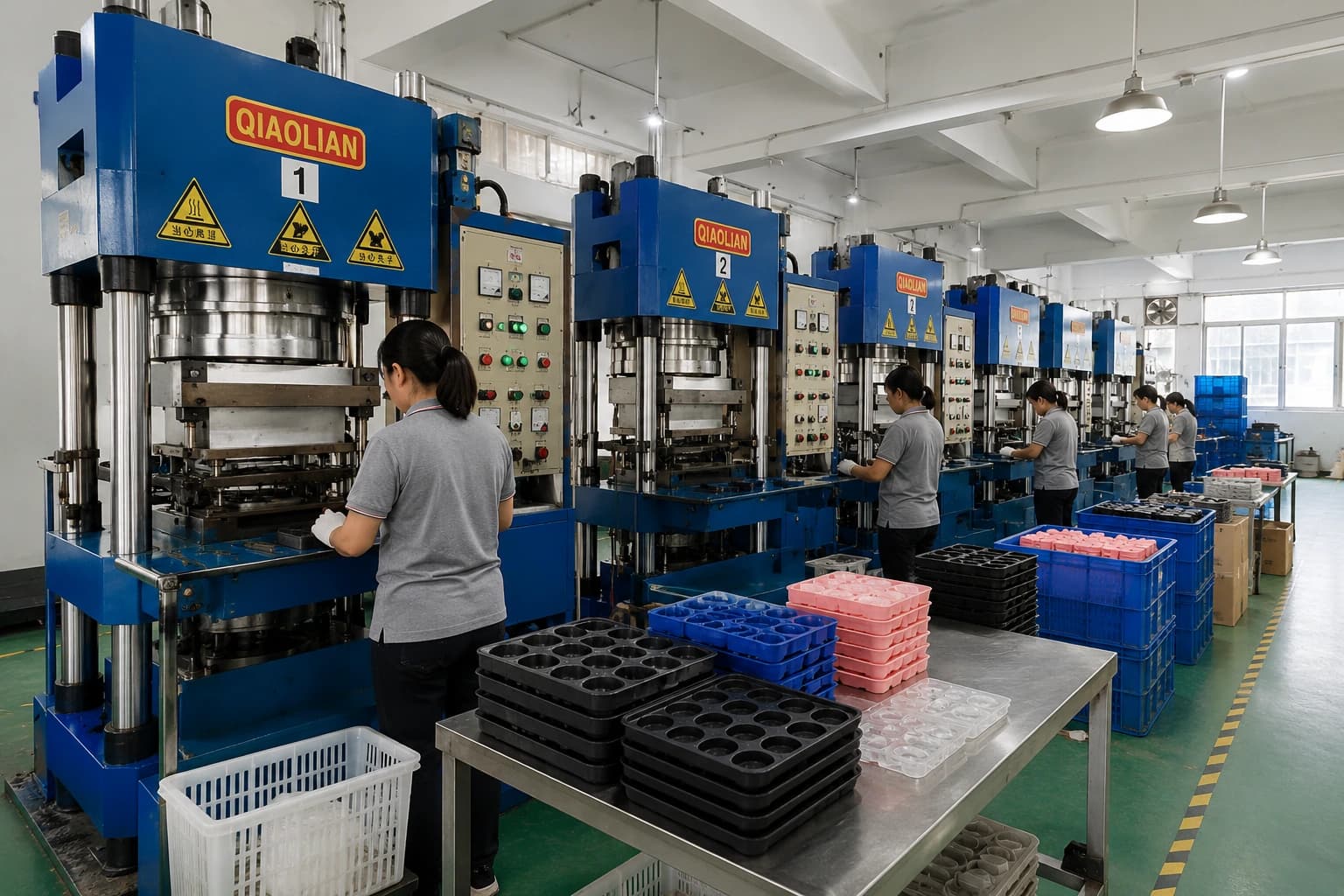
This gives a buyer a useful starting point. But there is an important boundary condition: published product portfolio information does not prove that every item is currently stocked or available for every market. Before publishing a product-specific specification or placing an order, you should confirm current availability, material composition, dimensions, certifications, MOQ, and lead time with the manufacturer [K5].
What to write in the RFQ:
- Intended use: food ice, whiskey chilling, decorative ice, baby food, or pet treats.
- Required material grade: food-grade silicone.
- Required temperature range, such as resistance to freezing and boiling water for cleaning.
- Any regulatory or market compliance requirements. Note that certification availability varies by market and should be verified per project rather than assumed [K5].
Scenario-based advice: If the ice mold will be resold in a retail market with specific food-contact regulations, ask the manufacturer directly which certifications or test reports apply to the specific material batch. Do not rely on a general product page. Compliance planning should be market-specific [K2].
5. Plan Colors, Logos, and Packaging Up Front
Core conclusion: Visual customization and packaging are not afterthoughts. They affect mold design, MOQ, and lead time, so they belong in the RFQ.
Custom silicone ice molds can typically be customized in color, size, shape, logo, and packaging [K4]. In practice, this means:
Color: Specify a Pantone code or a physical color reference. Silicone color is mixed into the material, so the color decision affects production planning.
Logo: Specify the logo artwork file, the placement (top surface, side, or molded into the cavity), and the preferred logo method — embossed, debossed, or printed. If the logo sits on the mold surface, it is part of the cavity design and must be included in the design file [K1].
Packaging: Decide whether the mold ships in bulk or in retail packaging. Custom packaging is a recognized customization option [K4], but it also affects the final MOQ and mass-production lead time [K3]. A retail-ready box with a hang tag is a different production step than a polybag.
Commercial impact: The reference MOQ for custom orders is typically 500 pieces, but the final MOQ may vary by design, tooling, packaging, product requirements, and production scheduling [K3]. If you request a complex multi-cavity mold plus custom retail packaging, the actual MOQ and lead time may differ from the reference. Mentioning packaging in the RFQ allows the manufacturer to give a realistic number.
6. Custom Ice Mold RFQ Checklist
Use the following table as a structured checklist when preparing your RFQ. It covers every element discussed above and can be extracted directly into procurement or sourcing systems.
Before finalizing the specification, use Custom Ice Mold Tooling Cost: What Buyers Pay For and Why as an additional planning reference.

| RFQ Element | What to Specify | Why It Matters | Reference |
|---|---|---|---|
| Design files | 3D file (STEP/STP/IGES) or detailed 2D drawing with cavity design | Mold fee is quoted after design review; mold takes ~15 working days after 3D confirmation | [K1][K3] |
| Dimensions | Overall mold size, cavity size, wall thickness, number of cavities | Custom sizes available; determines mold construction and material use | [K4] |
| Material | Food-grade silicone, temperature range, intended use | Safety and performance baseline; verify current composition per project | [K4][K5] |
| Color and logo | Pantone color, logo artwork, placement, logo method | Cavity and mold surface design depend on it | [K1] |
| Packaging | Bulk vs. retail packaging, custom packaging specs | Affects MOQ, tooling, and mass-production lead time | [K3][K4] |
| Commercial terms | Target MOQ, target sample date, target mass-production date | Allows manufacturer to confirm feasibility against reference lead times | [K3] |
Additional process notes:
- Custom samples typically take 7–10 working days after design and specification confirmation [K3].
- Mass production typically takes 15–20 working days after order and production details are confirmed [K3].
- Stock samples, if available, usually ship within 1–2 working days, subject to stock and shipping arrangements [K3].
- Free samples may be available, but eligibility, freight, taxes, and custom-sample charges must be confirmed case by case [K3].
7. FAQ
Q1. What happens if I don't have a 3D drawing for my custom ice mold?
You can still start the project. Manufacturers can work from a 2D drawing, a sketch with key dimensions, or a reference product. However, the mold fee quote may take longer because the manufacturer must first review the design and confirm feasibility. If you have a clear 3D design file, the process moves faster: the mold fee is quoted after design review, and mold production typically starts after the 3D design is confirmed [K3].
Q2. How long does a custom ice mold order take from start to finish?
Using the reference lead times: mold production takes about 15 working days after 3D design confirmation; custom samples take about 7–10 working days after design and specification confirmation; and mass production takes about 15–20 working days after order details are confirmed [K3]. The total time depends on how quickly design feedback is provided and whether the design requires multiple rounds of revision.
Q3. Is there a minimum order quantity for custom ice molds?
The typical MOQ reference is 500 pieces. The final MOQ can vary by design, tooling, packaging, product requirements, and production scheduling [K3]. For example, a simple single-cavity mold with bulk packaging may be closer to the reference, while a complex multi-cavity mold with custom retail packaging may require a different quantity.
Q4. Are samples free for custom ice molds?
Free samples may be available, but this must be confirmed case by case. Availability depends on whether an existing stock sample matches your requirements, as well as freight, taxes, and any custom-sample charges [K3]. Custom samples, which require new tooling or design work, generally involve a fee unless the manufacturer agrees otherwise.
8. Conclusion
A custom ice mold RFQ is a communication tool. The more structured it is, the faster a silicone OEM/ODM manufacturer can understand your project, quote an accurate mold fee, and confirm realistic lead times.
The four essential areas are:
- Drawings: provide the best design file you have; it drives the mold fee and tooling