Key Takeaways
- A small ice ball mold typically produces spheres in the roughly 1.5–2.5 inch range; that size fits standard rocks glasses while still slowing dilution compared with small cubed ice.
- Clear ice is a freezing-direction problem, not a mold-color or price problem. Slow, directional freezing pushes dissolved air and impurities into one concentrated slug you can trim away.
- Most cloudy, cracked, or stubborn spheres trace back to three fixable causes: fast freezing, overfilled cavities, and releasing the ball before it has tempered for a minute.
- If you intend to sell branded ice molds, treat it as a development project — cavity design, sampling, tooling, packaging, MOQ, and lead time all need written confirmation rather than verbal assumptions [K1][K5].
- Always verify dimensions, material composition, current availability, and market-specific compliance requirements with the supplier before publishing product-specific claims [K4].
1. Introduction
A good cocktail can be undone by bad ice. The drink is diluted before the first sip, the glass is crowded with fast-melting chips, and the visual finish — the part guests remember — looks like it came from a gas-station cooler.
Home bartenders run into the same handful of problems again and again. The sphere comes out cloudy in the middle. It cracks when released. It sits so high in the glass that the drink spills over the rim. Or it looks fine for ten minutes and then collapses into a slushy mess. Most of these issues are not about buying more expensive gear; they are about format choice and process.
This article focuses on the small ice ball mold because it is the format that solves the most practical constraints at once: it fits normal glassware, it freezes faster than a jumbo sphere, and it still delivers the slow, even dilution that makes a stirred or built cocktail taste the way it should. You will find a clear method for choosing the right mold, a freezing workflow you can repeat in a domestic freezer, release and storage habits that protect the surface of the ice, and a sourcing section for readers who want to turn this hobby into a branded product.
2. Choose the Format Before You Choose the Mold
Core conclusion: the right sphere size is determined by your glass, not by the mold that looks most impressive in a product photo. A small ice ball mold is usually the better default for home use.
Larger spheres have a genuine advantage: for the same volume of ice, a single large piece has less exposed surface area than several small pieces, so it melts more slowly and dilutes the drink less aggressively over time. That is the physics that made big clear spheres a bar signature. But the advantage only holds if the sphere actually fits — a sphere that touches the bottom and protrudes above the liquid line melts unevenly, splashes when you pour, and forces you to under-fill the drink.
In a typical 8–10 oz rocks glass holding 2–3 oz of spirit, a ball in the 1.5–2 inch range leaves enough room for the drink to sit above the ice and for the surface to catch the light. Two small balls also work well in a wider double old-fashioned glass, and they chill faster than one oversized sphere because each has more contact area relative to the total ice mass. For highball glasses, a small sphere plus a long stirrer is often more practical than a single jumbo ball that barely drops past the rim.
Practical advice when choosing a mold:

| Consideration | What to check | Why it matters |
|---|---|---|
| Cavity diameter | Measure against your actual glass; leave ½ inch of headroom | Prevents overflow and uneven melting |
| Cavity count per tray | 4–6 cavities is easier to handle than 12 | Fewer cracks from awkward handling; less freezer space per batch |
| Shell rigidity | Flexible walls that peel away, with a clear fill line | Better release with fewer surface fractures |
| Closure design | Aligned seams and a stable base to sit flat in the freezer | Reduces seam ridges and leaks |
| Water capacity | Confirm the stated volume per cavity | Sets realistic expectations for drink-to-ice ratio |
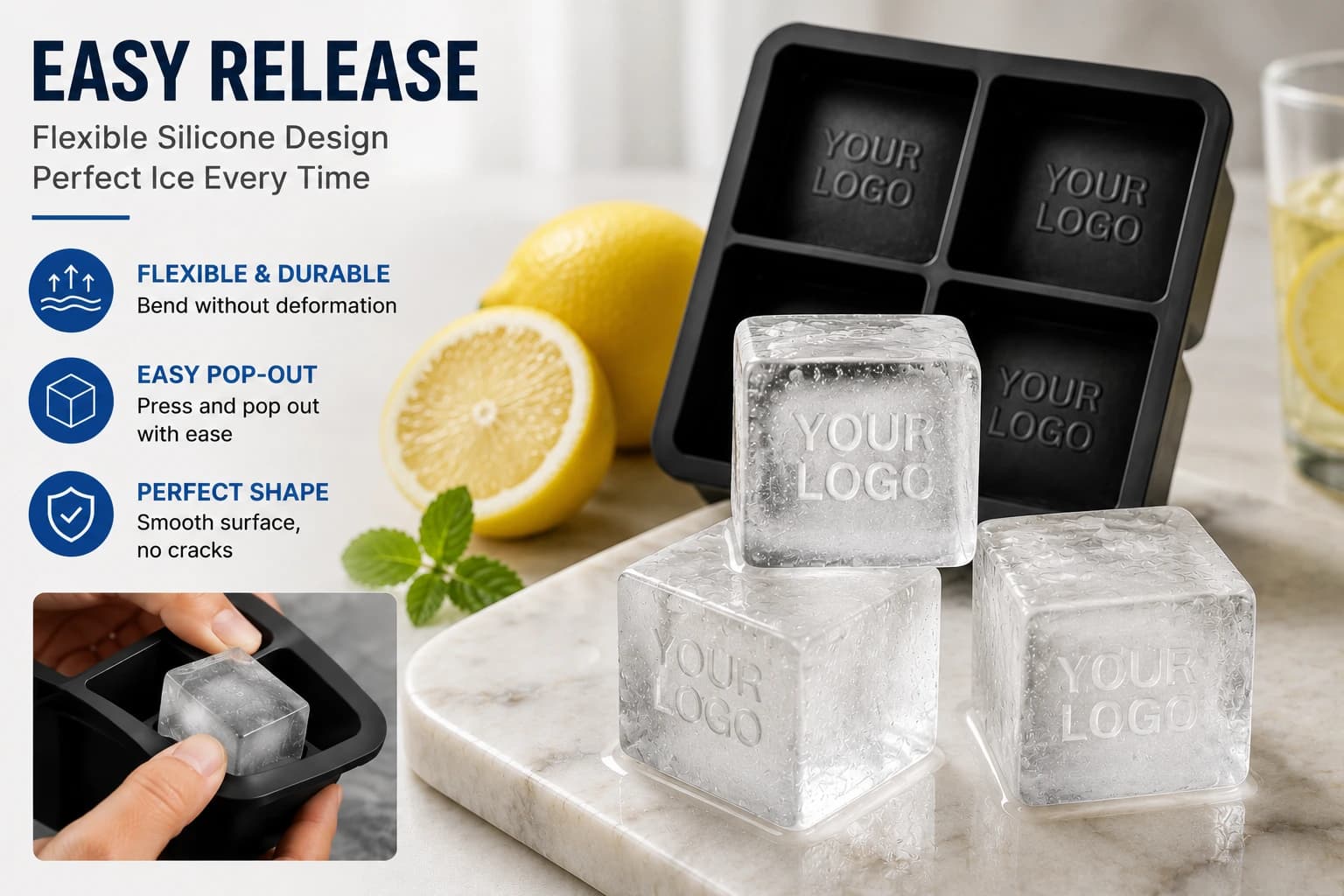
If you are exploring the wider category of custom silicone ice molds — including trays with branded shapes, logos, or packaging — the same format logic applies: decide the glass and the serve style first, then specify the cavity [K1]. Manufacturers can adapt cavity design, product shape, size, color, logo, and packaging, but they need your constraints, not just a mood board [K1].
3. Clarity Comes From the Freezing Method, Not the Mold Price
Core conclusion: clear ice is created by controlling how the water freezes, not by buying a more expensive tray.
When water freezes quickly and from all directions at once — the normal situation in a domestic freezer — air bubbles and dissolved minerals get trapped throughout the block. The result is the familiar cloudy center. When water freezes slowly and from one direction, the growing ice crystal front pushes those impurities ahead of it, concentrating them in the last portion to freeze. That concentrated slug can be removed, leaving the rest clear.
Three variables determine whether this works at home:
- Water quality. Filtered or boiled-then-cooled water contains less dissolved gas, which reduces the visible bubble haze. Boiling is not a purification step and does not remove minerals, but it does reduce entrained air. Distilled or low-mineral water is a reasonable option where it is cheap and available.
- Freezing direction. Insulating the mold on all sides except the top (for example, placing it inside a small cooler or wrapping the base and sides in a towel) forces the freeze to progress downward. The impurities collect at the bottom, which is often the part you can trim or leave slightly imperfect.
- Freezing speed. Slower is better. A back-of-the-freezer spot that stays consistently cold, with the mold insulated, generally produces clearer results over a longer window than a fast-freeze shelf.
Be realistic about time. Directional freezing in a home freezer commonly takes anywhere from a full day to more than 36 hours depending on cavity size, insulation, and freezer temperature. Plan batches rather than expecting a same-evening result, and rotate stock so you always have spheres on hand.
If you later scale this process into a branded product or a small bar program, the same logic shapes your cavity design and packaging instructions — a format that is easy to overfill will produce complaints no matter how good the silicone is. Teams that plan this transition carefully usually start with documented design review and sampling rather than jumping straight to tooling [K3].
4. Release, Storage, and Handling
Core conclusion: most cracked spheres are damaged in the sixty seconds after they leave the freezer, not during freezing.
Two things break ice: thermal shock and mechanical stress. Pulling a rigid, very cold sphere and immediately twisting hard combines both. A short tempering window fixes most of it. Leave the mold on the counter for about a minute, or dip the outside of the mold briefly in room-temperature water, then twist gently along the seam rather than pulling the halves apart. The surface should release without a fight; if it does not, give it another thirty seconds rather than more force.
Hollow or torn tops are a separate problem, usually caused by under-filling. Water expands as it freezes, so cavities need a slight overfill and a flat, aligned closure. If your tray has a fill line, use it — these lines exist because the geometry was tested.
Storage matters more than most people expect. Finished spheres should go into an airtight container or a sealed bag in the freezer. Exposed ice slowly sublimates, developing a frosty, porous skin that clouds a drink and melts unevenly. Equally important: never refreeze a sphere that has partly melted. The refrozen surface crazes and cracks, and it will look worse in the glass than fresh ice.
Care habits for the mold itself:
- Rinse with warm soapy water after each batch; sugar or citrus residue left in a cavity attracts odors and can affect release.
- Do not use sharp tools to lever out a stuck ball — score or tear the silicone instead.
- Store the tray flat, not folded, so the cavity geometry is not deformed between uses.
- Check for whitening, tackiness, or persistent odor; these are signals to replace the mold rather than to clean harder.
5. From Kitchen Trial to Custom Product: What Sourcing Really Involves
Core conclusion: a custom ice mold is a development project with several sequential decisions, and the timeline depends on them.
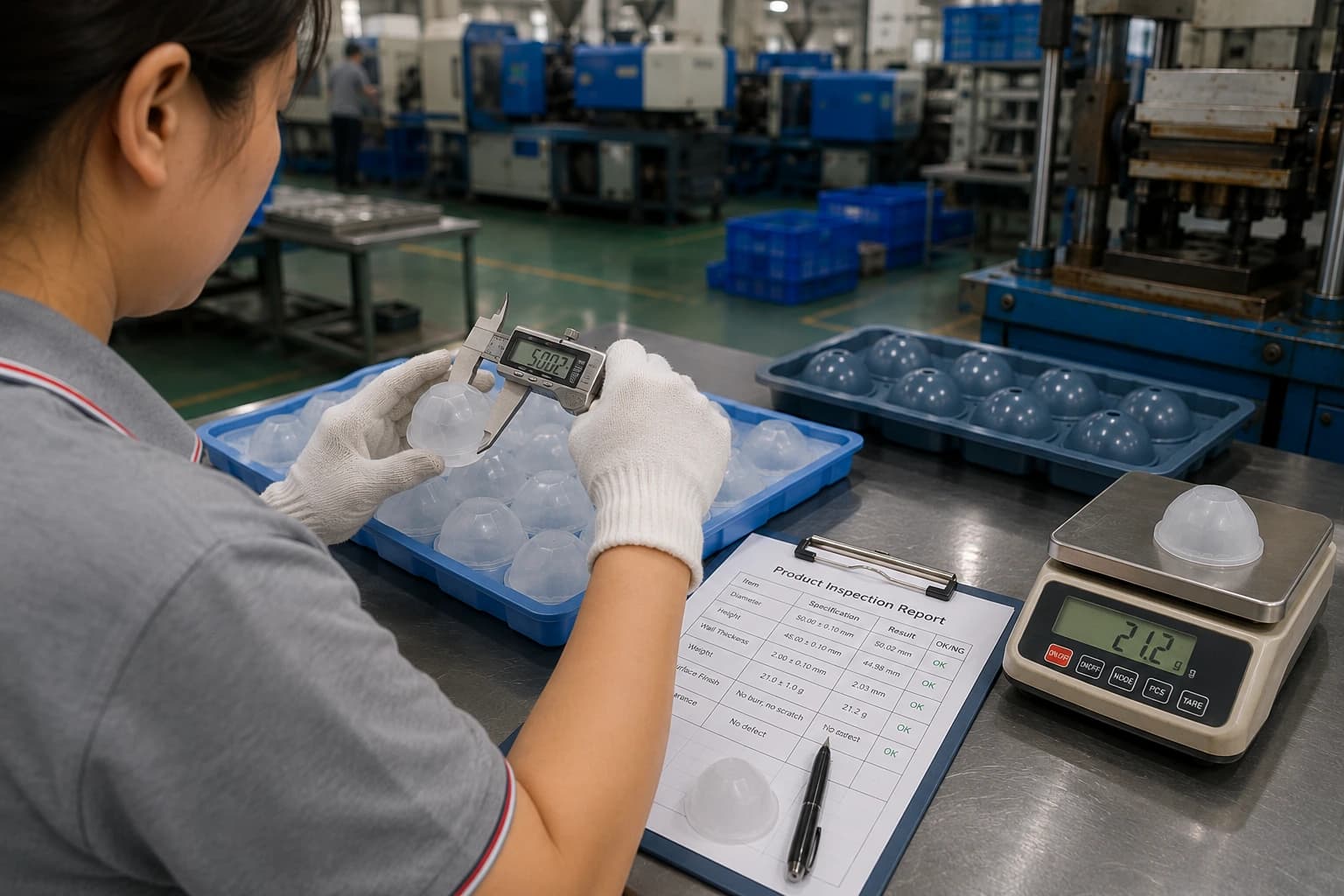
Home experimentation and commercial production share a vocabulary but not a schedule. On the sourcing side, a custom silicone ice mold project typically moves through cavity design, shape and size specification, color selection, logo or artwork placement, packaging development, sampling, tooling, and quality inspection before shipping [K1]. Each of those steps produces a decision that the next step depends on, which is why buyers who arrive with a complete brief — glass dimensions, target drink, target market, packaging format — move faster than buyers who start with a single reference photo [K3].
Three cautions are worth stating plainly, because they are common sources of friction:
- MOQ is project-specific. A blanket "500 pieces for any custom project" promise is not a reliable planning assumption; minimums depend on cavity complexity, tooling, and packaging [K5].
- Free samples and free freight should not be assumed. Sampling cost and freight terms are commercial items to be negotiated and written down, not defaults [K5].
- Dates and mold fees require evaluation. Sampling, tooling, and production schedules should be confirmed in writing after design review, and mold fees should follow a design evaluation rather than being quoted as a fixed number upfront [K5].
There is also a category question worth resolving early. Ice molds legitimately sit across household, kitchen, and promotional use cases, so a product's placement in one catalog category should not limit how you position it in your own marketing [K4]. What must not be assumed, however, is availability: a published portfolio diagram is evidence of a manufacturer's reported product range, not proof that every item is currently in stock or offered in every market. Confirm current availability, material composition, dimensions, certifications, MOQ, and lead time before publishing a product page or issuing a quotation [K4]. Where compliance documentation is needed, plan for market-specific requirements and avoid certification claims you cannot support with documents [K3]. A structured buyer checklist for sample approval and pre-shipment inspection helps keep these confirmations in one place instead of scattered across email threads.
6. Key Comparison: Matching Ice Format to the Drink
| Format | Typical size (verify per product) | Melt behavior | Best suited to | Main trade-off |
|---|---|---|---|---|
| Small ice ball | ~1.5–2 in sphere | Slow, even; less dilution per minute than small cubes | Old-fashioned, negroni, whiskey served neat-to-rocks | Slightly faster melt than a jumbo sphere |
| Large sphere | ~2.5 in and up | Slowest melt of the common formats | Wide-bottom glasses, spirit-forward serves, presentation | May not fit standard glassware; longer freeze time |
| Standard cube | ~1–1.25 in | Moderate; more total surface area per drink | Highballs, shaken and strained serves | Faster dilution in small glasses |
| Crushed or pebble ice | Irregular | Fast; chills quickly | Tiki drinks, swizzles, mule-style serves | Heavy dilution; short service window |
Troubleshooting reference:
| Symptom | Likely cause | Practical fix |
|---|---|---|
| Cloudy center | Fast freeze, high dissolved air | Use boiled-then-cooled or filtered water; insulate the mold |
| Cracks or feathers on the surface | Thermal shock during release | Temper 30–60 seconds; twist along the seam |
| Visible seam ridge | Overfill or misaligned halves | Fill to the line; press the closure flat |
| Ball will not release | Rigid shell, no flex | Brief warm-water dip on the outside of the mold |
| Hollow or torn top | Under-filled cavity | Slight overfill and top-up before freezing |
| Ball collapses quickly in the glass | Ice was refrozen after partial melting | Discard and start a fresh batch |
7. FAQ
Q1. Is a small ice ball mold better than a large sphere mold for home use?
For most home bars, yes. A small ball generally fits standard rocks and highball glasses without forcing you to under-pour the drink, and it freezes in less time than a jumbo sphere. Large spheres still win on melt rate and presentation when your glassware has a wide enough base to hold them properly.
Q2. How do I get clear ice balls without buying a clear-ice machine?
Control the freeze direction and speed. Use filtered or boiled-then-cooled water, insulate the mold on all sides except the top so freezing progresses downward, and allow a long, slow freeze — often a full day or more. Trim or discard the cloudy section where impurities concentrated.
Q3. What should I check before buying an ice ball mold?
Confirm the actual cavity diameter against your glassware, the water volume per cavity, whether the walls flex enough for clean release, and whether the closure aligns flat. For silicone products, ask the supplier for material composition documentation rather than relying on generic "food-grade" wording.
Q4. Can I order custom-branded ice ball molds, and what affects the minimum order?
Yes — cavity design, shape, size, color, logo, and packaging are all customizable items in a silicone mold development project [K1]. Minimum order quantity, sampling terms, tooling cost, and lead time depend on the specific design and must be confirmed in writing after design review; they should not be assumed as standard figures [K5].
8. Conclusion
Stunning cocktail ice at home is not a matter of luck or expensive equipment. It comes from three decisions made in the right order: pick a sphere size that fits your glass, freeze it slowly and directionally so impurities collect in one removable place, and handle the finished ball gently enough that its surface stays intact.
A small ice ball moldsits at the practical center of that approach. It is small enough to work in normal glassware, large enough to slow dilution meaningfully compared with cubed ice, and simple enough to run as a repeatable weekly batch. Start with one tray, one water type, and one insulated freezing setup; change one variable at a time and note the result. Once the process is consistent, the format becomes a design choice rather than a compromise.
If your goal extends beyond the home bar — branded molds for a venue, a gift product, or a promotional line — carry the same discipline into sourcing. Define the cavity, confirm the dimensions and materials, request samples, and get MOQ, tooling, packaging, and lead times in writing before committing [K4][K5]. Good ice looks effortless in the glass; the effort belongs in the process behind it.